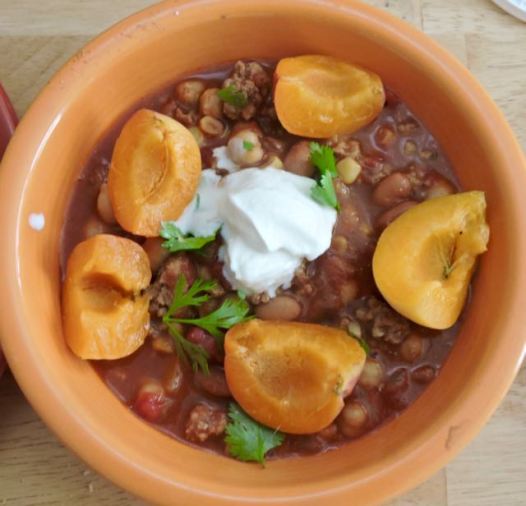
Jean:
Cooking without Recipes?
Soups and stews are right up my alley because they are perfect for recipe-less cooking. That’s not to say I don’t get inspiration from recipes, but I rarely stop there. If we have some vegetables, herbs, or even fruits from the garden that I think would work, they are going in–like into the apricot chili you see above. If the recipe calls for something I don’t have or don’t like, it can stay out or get substituted with something from my pantry. In this way, every soup I make is different and I am in a pickle if someone asks me to recreate their favorite.
I should note that I realize that cooking without a recipe doesn’t work for everyone. My sister, for example, has done things like making pumpkin pie without sugar because she didn’t have any sugar. That was not my favorite, although I do use less sugar in baked goods these days than most recipes call for. The last time I visited my sister, she sent my nephew to pick me up at the airport. As we drove to her house, he assured me (I was hungry, as usual) that she had made beef stew for lunch. Sounded great.
As I settled down with my bowl of steaming “stew” a little later, I was chagrined to discover it looked and tasted like hot water with a little shoe leather floating in it. Prison stew. More gulag than goulash. No flavor to the broth, no savory vegetables, herbs, or starches. The meat was impossible to chew. I guess I deserved it because the last time I served her one of my soups, she asked how to make soup in general, and I was short with her. I said that if she had wanted to make good soups, she would already be doing it. It sounds terrible of me, but in the past she had begged many of my recipes, changed them in less tasty ways, and passed them off on people as my recipes. Revenge is a dish best served hot perhaps, like prison stew, and ultimately she served me what she thought I deserved for not teaching her. I just remember my mother trying to give her cooking lessons. She said my sister’s cooking would improve for a little while after a lesson, but would soon slide back to what it had been before. Perhaps if I had written the tips below years ago, her results might have been better…
Not Recipes, but a Few Tips
Anyway, I hope you get the point, dear reader. I believe anyone can make great soups if they really care to keep trying to develop flavors and textures appropriately. That can happen fairly quickly with some types of soups, but can take some time and care with others. There are some ingredients I always keep on hand in my pantry to help me get started on a soup or a stew, or even just sauce. One is boxes of broth, whatever type you like–beef, chicken, vegetable, low salt, free range. Buy the best you can get. Stocks have more depth of flavor than broth because the meaty elements are cooked with savory vegetables and herbs to make stock, while broth is just water that the main ingredient has been cooked in. Of course if you have time to make your own stock, the flavor will be even richer. I love to take turkey bones after Thanksgiving or use the bones of a rotisserie chicken to make stock at home.
Sometimes you can find packaged specialty broths like pork or seafood, but you can make a lovely one with roasted pork bones or shrimp shells. I am likely to use both if I have something to make stock with, but also a packaged broth to add. I like to cover all my bases. In some cases I might even add a can of prepared or condensed soup to add a flavor or texture that would be time-consuming to develop, such as a can of cream of tomato, mushroom, or roasted garlic soup. Of course fresh mushrooms and freshly roasted garlic would be best; I’m just saying I’m not that much of a purist.
Getting the Flavor in
I’ll get flavor in there any way I can, given what I can get my hands on and what I have time to do under the circumstances. Roasting almost any of your ingredients, including the vegetables, can add that extra layer of flavor.
Depending on the type of soup, there may be a variety of savory vegetables that are either part of the stock and strained out, pureed after cooking to make a thicker base, or added later for a little more texture and visual appeal. These typically might include onions, leeks, celery, carrots, corn, potatoes, and/or tomatoes. You might want to make a soup that features one vegetable and color, such as a pea, broccoli, or asparagus soup. A soup might be spicy or it might be creamy. I get hungry just thinking about them all.
Soups by the Season
Of course, you can respond to the seasons in terms of the temperature and style of your soups as well as the ingredients. I always think of soups in the winter, when it’s the easiest thing to rewarm and dish up after coming in from the cold. Or perhaps you started one in your crockpot early in the day and find it waiting and ready at the end of the day. when you’re too tired to fix anything else. A hearty bowl of soup is often enough for our supper.
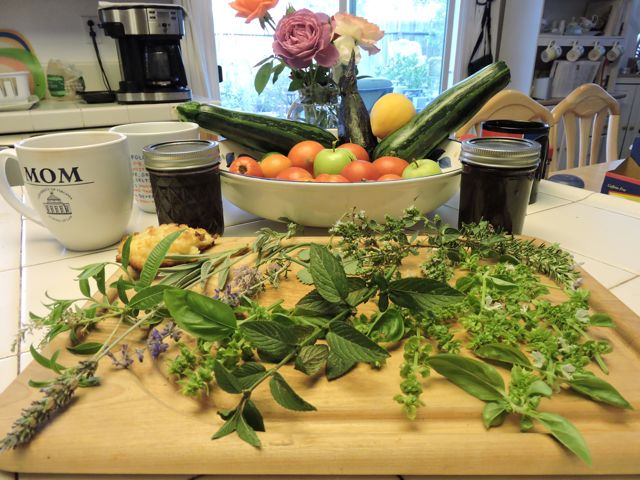
Herbs and veggies fresh from the garden are great additions of flavor to soups.
In the summer, though, soups can be just as inviting, as a way to use some of the freshest produce from your garden or the market. We love cold soups as well as hot ones. A favorite summer soup is watermelon gazpacho, perhaps with the addition of cucumber and fresh mint. Since this is a fresh, uncooked soup, it would even work in the Paleo diet:
A Favorite Summer Soup: Watermelon Gazpacho
For five servings, blend in large blender:
- 3 c. cubed, seeded watermelon
- 1/2 to 1 whole cucumber, chopped (seeded if necessary)
- 1 or 2 peeled, seeded tomatoes
- 1 red bell pepper, chopped
- 2 T. minced shallot or red onion
- 1/2 to one jalapeno pepper if desired for heat
- 2 T. red wine vinegar
- 2 T. olive oil
- 1 T. chopped herbs–dill, basil, parsley, and/or mint
- salt and pepper to taste
As always, taste everything and adjust the proportions accordingly. Use only the best-tasting ingredients you can. I made the mistake in one batch of chopping in a cucumber without tasting it. It was quite bitter and ruined the whole batch. Taste first, last, and all throughout! You could try adjusting the sweet/sour taste balance, depending on how sweet the ingredients are, with a little lemon juice and/or honey if something seems a little “off” or flat. I recommend leaving the fibrous matter in the soup after blending, but you can also strain that out, leaving only a very flavorful, colorful but clear liquid.
A “Soup-erbowl” Party?
One of my favorite ways to entertain is with a “soup party.” I have done this with particular success as an informal holiday party or something later in the winter like a “Soup-erbowl” party. You need several crockpots and Dutch ovens to keep the soups warm without burning them. Then think of an assortment of soups so that one or more of them will appeal to everyone in the group and you don’t have too much overlap. You have to have a vegetarian option, which might be a minestrone without any bacon, pancetta, or sausage. That could also be your Italian and tomato-based choice. Or, you could do a creamed cauliflower, broccoli, or corn soup as vegetarian options.
To contrast with that, you could have a very meaty soup like a chili, white or red (discussed further below). This would be your Mexican or Southwest flavor profile. If that’s not your favorite, try Greek chicken-orzo or lamb stew, or perhaps a West African peanut stew. Use whatever you know about the tastes, dietary restrictions, travel history, and so on of your guests to come up with a variety of pleasing options.
Even the simplest soups can be incredibly satisfying and savory, like the creamy cauliflower soup pictured below. Some recipes don’t use a lot of cream, if you want to avoid the fat. Most recipes derive a lot of flavor from the addition of other typical soup veggies like carrots and celery, plus herbs, such as these recipes: http://www.foodnetwork.com/videos/rees-creamy-cauliflower-soup-0204577
Here’s the lower fat version. Even if you think you don’t like cauliflower, it’s creamy and delicious: http://www.myrecipes.com/recipe/creamy-cauliflower-soup

And for dessert…
Here is a dessert tower I put together to top off one of my soups-and-stews parties. I always want to give lots of choices, and none of these were hard to make: mocha cupcakes, lemon bars topped with lemon curd, apricot pistachio bars, key lime tarts, and mini-blueberry cheesecakes.

Chilis and Stews
Even more than soups, we love stews, which are total one-pot meals, not just appetizers or lunch portions. We consider chili a type of stew, and it is probably our favorite type. I don’t really have a recipe, because I make so many different ones, depending on what meat, beans, or vegetables I have on hand. I particularly love a white chili, made with ground turkey, chicken broth, white or pink beans, and green tomatillo salsa. Chris loves these–but he also loves red chilis, such as the one pictured below, since he loves tomatoes.
The chili below was not made with ground beef but with some small steak bits that were on sale, cut for “stir fry.” They were initially quite tough, but softened nicely under the prolonged cooking I gave the chili while working on the flavors, plus leaving it overnight and serving it the next day.
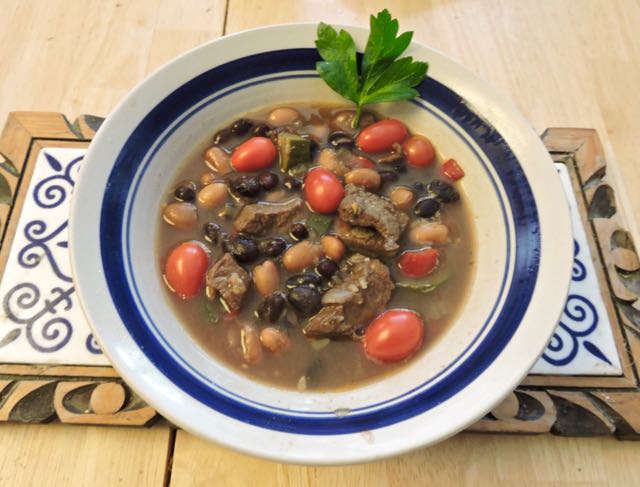
Spice it up…but how much?
The real issue with chilis is how much spice to use, and I sometimes overdo it and have to put in more beans and broth to try to bring the heat down. I have seen recipes or made up my own that use several different forms of chili peppers–fresh, canned, smoked, powdered and dried. The combination of flavors is unbeatable, but when we get a burn in the back of the mouth that just won’t die, I wish I knew which of them I should have left out. The answer is to take your time, putting in one of these at a time and tasting the results. Give it a while, to make sure you are getting the full effect, before trying to add another. Chili peppers like the red hot Thai minis below need to be added carefully. Chris finely chopped just one of these for the whole crockpot of the chili shown above, and it was enough, when mixed into the broth with the other spices I used.

Still want deeper flavor?
Another way to deepen the flavor of chili is to add some deeper flavors to the broth, like some leftover brewed coffee, some dark chocolate, or dark beer. Chris thought my last chili tasted slightly bitter when I added coffee…but by the next day it had mellowed just perfectly!
So whether you like to start with recipes or prefer to make up your own, don’t be afraid to experiment with good ingredients as you go along.
 From Sacramento to Potomac: Tales of Two Valleys
Pingback: December 2020: Coda to a Year of Reinvention | A Sacramento Valley Kitchen Garden