Who doesn’t love tomatoes?
Chris:
Tomatoes are my favorite food, so growing them when I started my garden was an obvious choice. Almost every gardener I know grows tomatoes, and when gardeners meet it’s like a ritual to ask, “How are your tomatoes this year?” It’s part of the ritual to answer something like, “Well, it was so cool early in the season, I thought the Brandywines would never take off, but I can’t stop ’em now. But the Cherokee Purples were a disappointment. Lots of foliage, but not much fruit!” And the other person responds, “I’ve had good luck with the Juliets, but the real surprise has been the Celebrities this year. We can’t give them all away, there are so many. But don’t get me started on the San Marzanos. Not much to show, and they’re usually so reliable.”
So Many Varieties–What to Try This Year?
Because so many gardeners grow tomatoes, the number of varieties in the nurseries, or even in the garden sections of home stores, is wonderful. When you have a small garden like mine–maybe eight plants a year–you could go for several years just trying out varieties that are new to you. I’ve had as many as five different types in a given year, with no more than two of any type, and every year there are at least two or three new types for me. I’ll always have a couple that I think I can rely on from previous years, just in case the newbies don’t pan out. As much as I like to experiment, I always want to be able to take comfort in something that I’m pretty sure will produce.
Besides balancing the new with the tried and true, I also like to balance the larger varieties with the little cherry and grape tomato varieties. I’ve found the grape and cherry tomatoes to be overall more reliable and prolific. They start ripening early, in May, and they often keep producing into late September, with minimal watering and feeding. On the other hand, there’s nothing to match the pleasure in watching a bigger variety grow day by day from a tiny green beebee to a round ripe red beauty plump for slicing into a sandwich.

Celebrity tomatoes, July 2017
The Season
In our climate, the ground is usually warm enough to start planting spring and summer vegetables in early or mid April, when the temps rise to the high 70s-low 80s. That includes tomatoes in all varieties. I’ve never had a tomato plant fail to thrive because of planting too early. I almost always plant from store-bought seedlings, when the plants are at least six inches high and leafing our nicely.
I plant them in various places in the back garden, and I like to experiment with different spots–which vary in the amount of sunlight they receive, because of the surrounding trees. I always plant at least two, and sometimes more, in the two raised beds I have, and I always use the beds for the larger varieties. That’s just a choice, not a necessity. This year, 2017, I planted just two medium-size plants, both Celebrities, in one of the beds, as I used the other bed for three pepper plants (see P Is for Peppers). I planted an Ace tomato in a new spot for me, a quite shady spot almost under the peach tree, just to see what would happen. I planted the fourth medium-sized variety, an unnamed plant that I’d gotten at a plant fair, in another new spot, a very sunny patch between two rose bushes–again, just to see what would happen.
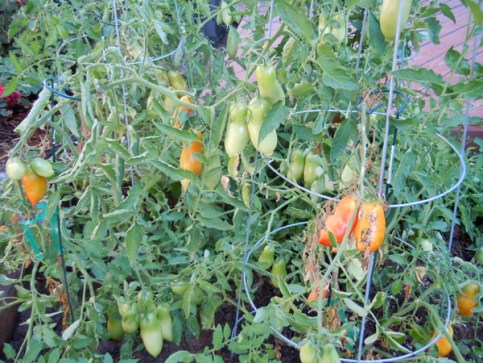
An early crop–Roma tomatoes ripening in 2011
A Special Spot. The other two plants, two grape tomatoes, I planted in what has turned out to be the best patch in the garden, a ten-square-feet area next to one of the raised beds. What makes this patch so special is that I rotate the tomatoes here with arugula in the winter. The arugula grows thick and tall in this spot for five months, then I pull it out after it flowers in late March-early April–and in go the tomatoes. In the two years that I have been growing arugula in that patch in the winter, the tomatoes the next season have been the most productive plants and the longest lasting. In early October this year, I was still harvesting from our two grape tomato plants as many as four dozen in a day. (See more about these plants in U Is for Untended.)
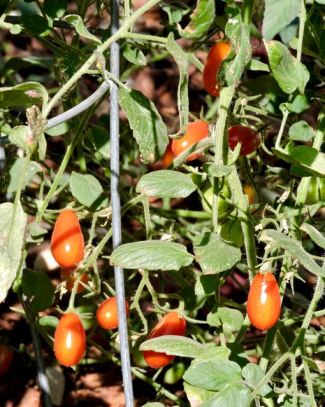
A cluster of grape tomatoes, Sept. 2017
This is a real win-win, because not only does the arugula make the soil rich, but it is tasty and hearty throughout the winter months in our salads (see G Is for Greens).

Arugula, Jan. 2017, growing in the same patch where I plant tomatoes in April
Watering and Soil
When I first planted the raised beds about six years ago, I layered bark mulch, compost, and top soil. Every spring, I replenish some of each. In addition, when I dig the little hole for each seedling, I put in a little Miracle Gro garden soil as a starter, plus some compost and some organic tomato food. During the long growing season, from April to early October, I’ll add some tomato food every two-to-three weeks, no more than a handful at each feeding.
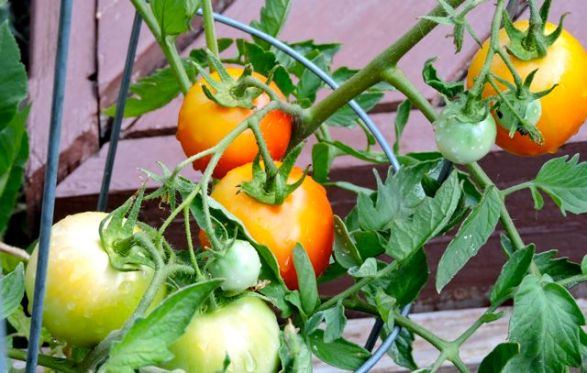
Unknown variety, from plant fair, early June 2017–a pleasant surprise
For the tomato plants outside the raised beds, I rely on the arugula (see above) to prep the soil for the grape and cherry tomatoes, but put in a bit of Miracle Gro garden soil and tomato food when I plant them, as well as some compost from the compost bin. I also feed these some of the organic food every few weeks during the growing season, a handful per plant.
For the tomato plants elsewhere in the garden, the soil is richly organic from leaf mulch, and I add compost from the bin, a bit of Miracle Gro garden soil (a few handfuls), and a handful of tomato food at planting, then a handful of food every few weeks.
Watering of tomatoes happens every other day, by hand, even during the hottest part of the summer. I water from the garden hose, about fifteen seconds per plant. This is not a lot, and, in fact, each year since I’ve started gardening, my watering has declined some each year.
Overall, I feed and water just enough to keep the plants green and supple, but I tend not to get a thick profusion of leaves, and I’m sure this spartan treatment keeps down the number of fruit on the larger varieties. But there are always enough of the larger tomatoes to meet our usual needs, and the amazingly prolific grape and cherry tomato plants give us enough fruit for five months of daily snacking and the occasional sauce for pastas and stews.
Tomatoes in the Kitchen

Sauce of grape tomatoes, green peppers, goat cheese, and herbs
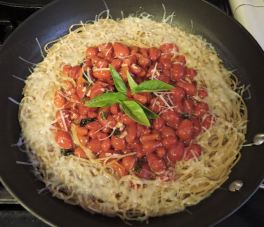
The same sauce on angel hair pasta with garnish of basil and parmesan
No big surprises here. Just good eating. Tomatoes are versatile–whether as the basis for a hearty soup or sauce, as in the photos just above, or chopped into a salad, or sliced for sandwiches or for little bruschettas. We’ve cooked them down into enough marinara sauce for several jars to refrigerate or freeze, or we’ve blanched them to get the skins off, so Jean can puree them into the base for a variety of gazpachos.
Jean’s most recent tomato creation is her Spanish rice, pictured below. Sparked with just one of our tiny Thai peppers and paired with a Chilean sauvignon blanc, it shows off our sweet tomatoes at their best.


Bowls of grape tomatoes, like the one pictured below, keep amazingly well, two weeks or so, out on a counter, so I can snack on them as I pass by, or either of us can grab a handful to toss into scrambled eggs or chop in half for grilled cheese sandwiches. In mid to late summer, the harvest of these little guys is sometimes so good that I’ll bring in a dozen or two dozen a day to replenish the bowl.
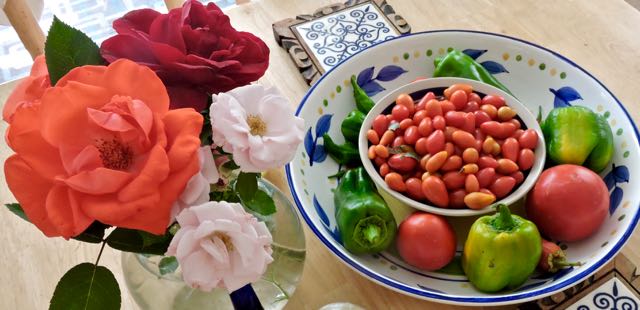
Still life with roses, tomatoes, green peppers, and shishitos, Oct. 2017
So overall...
It’s six years and counting since I started growing tomatoes, and I’m learning every day, because every day I keep an eye on them and give them a few minutes of care. They really don’t require much, and they give back so much more than they need from me. The snails don’t attack them, nor do the birds–who like to perch on the cages I use to keep the vines from stretching everywhere. The tomatoes taste great, and they are so versatile in the kitchen. So what’s not to love? And there are still so many new varieties for me to try.

 From Sacramento to Potomac: Tales of Two Valleys