Chris:
Sometimes I overestimate how necessary I am to the garden.
For two weeks in the early fall, much of our garden was not watered, while we were away visiting relatives. The weather was still hot during the days, with high temps in the upper 70s to mid 80s, and little rain was in the forecast. Indeed, there was only just over a tenth of an inch during the entire period, all of which fell on one day. This is not unusual in our region in early fall, but it was rare for me not to be around to water..
I didn’t worry about the roughly 50% of our plants on the timed drip system; I knew they’d get regular water. But half of our plants are hand-watered, including all of the veggies and all of the herbs in pots, plus some of our roses and all of the potted flowers. Here’s what I imagined would happen during those two–untended–weeks.
The hardest hit would be :
- the grape tomatoes, already near the end of their productivity for the season, would brown out and shrivel
- the same sad result with the pepper plants in the raised beds
- the same with the potted pepper plants
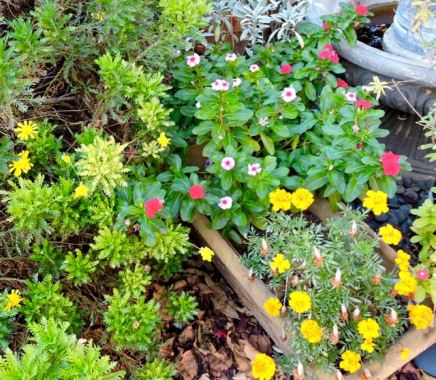
- the vinca and marigolds, both summer annuals, would at best become dull and drooping, with no more blooms
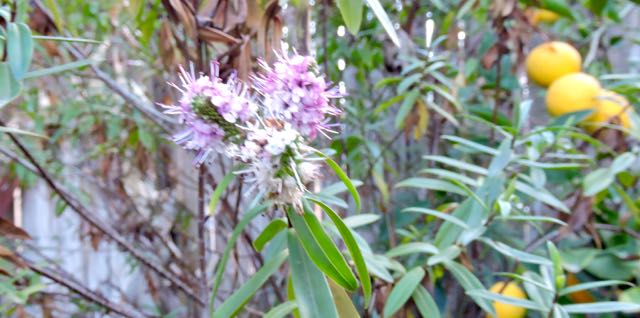
- the hebe bush, always water-needy, would brown out and lose leaves
- the more delicate herbs–parsley, thyme, marjoram, basil–would be droopy dull, if not browned out.
More able to withstand the conditions would be :
- all the perennial potted herbs, hearty year upon year–the sages, the Greek oregano, the chives, the lemon verbena, the lavender, the rosemary–would hang in there, maybe just a little the worse for the lack of water
- the rugged roses not on the drip would still be healthy, but not in bloom
- the sturdy perennial coreopsis, lupine, and mint, almost without a drop all summer–no problem!
- the strawberries, perennial, would be hanging in there, but not fruiting
- the potted perennials such as the geranium, the dwarf pomegranate, the dianthus, and the hibiscus, would be OK, going into their winter dormancy a bit early.
So when we returned, here’s what I saw…
and…
and…
and…
Oh yes, and even…
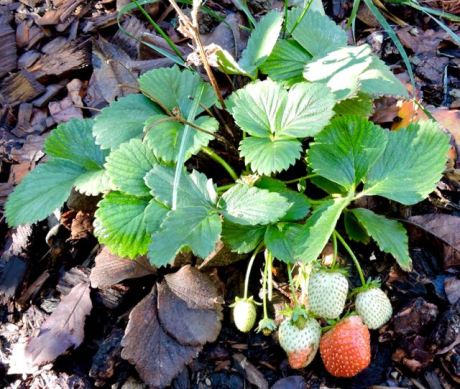
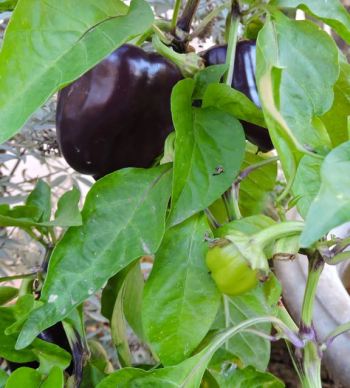
What a pleasant surprise! None of the plants suffered the extremes that I had envisioned–and most of them had not skipped a beat, thank you. I can’t say what shocked me the most. Was it the vinca and marigolds still popping brilliant color and plump greenness? Was it the pepper plants–purples, shishitos, greens, and Thai hots–still putting forth new fruit in some profusion and looking not at all stressed?


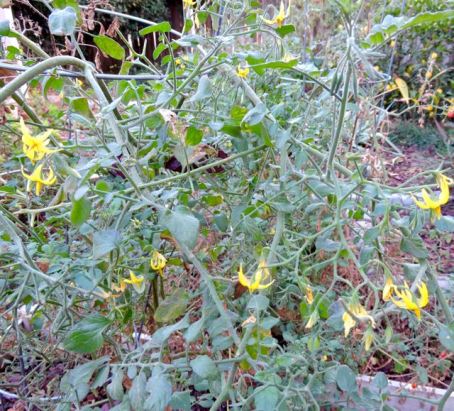
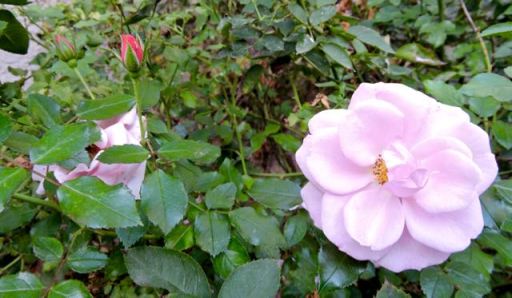
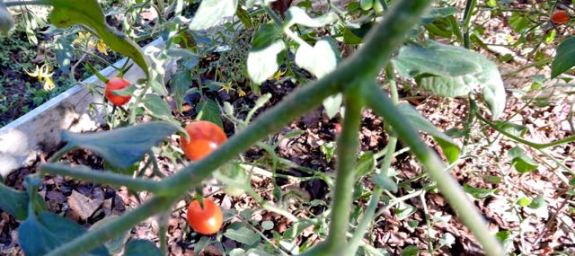
Was it the grape tomatoes, still with red, ripe little gems and a cascade of new yellow flowers? It surely was not the pink and salmon roses, which always defy heat, or cold, or low water–how could I have doubted you? But it might have been the hebe (shown at the top of this entry), which rarely blooms, and here you were in your fuzzy pink splendor. Well, sure, it might have been the strawberries, which were putting forth fruit to provide treats for us and for the birds.
So how to explain the resilience?
I have three possible explanations:
- The one day of a tenth-of-an-inch of rain was just enough to give the hand-watered plants the boost they needed in the hot weather.
- Because of regular watering during the summer, the soil had enough residual moisture to keep the plants healthy.
- The plants are just more resilient than I gave them credit for being.
Whatever the reason or combination of reasons, I’ll feel comfortable next year not worrying if we need to be gone for an extended period in the early fall. I guess my garden overall does a pretty good job of taking care of itself this time of year. But I do like to help out, OK guys?
November Postscript
Now that we are in the middle of fall and almost to Thanksgiving, the spring and summer plants continue to hold their own. The series of photos above were NOT taken when we returned at the end of October–they were taken just a few days ago, in mid November. In prior years, the tomatoes, peppers, and other veggies had given out in early October. So had the annual flowers. But as you can see, this year they continue to bloom and produce.
Most amazing is the one grape tomato pictured above with its yellow blossoms. This one plant has spread over more than seven months to wind its way through three tomato cages. It has produced hundreds of red oval fruit (as shown in T Is for Tomatoes). I have never had so glorious a tomato plant as this one.
Moreover, the five pepper plants have stayed green and fruitful until today, when I pulled them out to make way–finally–for the winter veggies. But, guess what, two of the plants are still going, and I want to see how long they’ll keep producing new fruit.
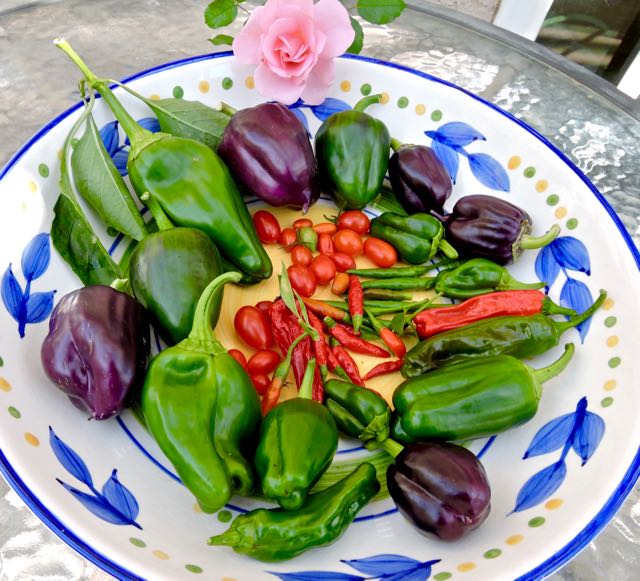
The shishito (pictured above) and the Thai hot pepper (pictured beside it) still have new fruit growing. I’m speechless. Here is my little pre-Thanksgiving display of the pepper-tomato bounty, just picked today. What a year! Thanksgiving indeed.
 From Sacramento to Potomac: Tales of Two Valleys