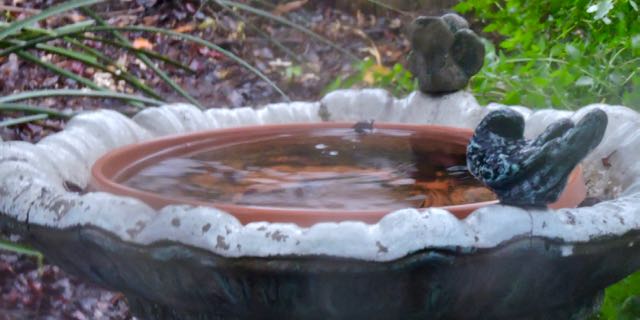
Raindrops in the birdbath early December
Chris:
Wildfires rage in Southern California, with the Thomas fire in Ventura and Santa Barbara counties having consumed 270,000 acres, threatening Santa Barbara city, and having already reached the coast. Higher than average temperatures, the annual Santa Ana winds, extremely dry conditions, and the buildup of fuels from last season’s heavy rains have combined for a record fire season. These SoCal fires come just two months after the record fires in NorCal that devastated wine country counties and parts of Santa Rosa city.
This horrific destruction has prompted Governor Jerry Brown to call what California is facing “the new normal,” making necessary new strategies for anticipating heightened fire risks, as the climate continues to warm and as the rains always expected this time of year become more unpredictable.
Returning to the drought?
The picture above is from last December, 2016, not now. If you’ve read these posts, especially “J Is for January,” you know that last Fall to Spring (’16-’17) we were in a historic rain season, the greatest in more than 35 years: 45 inches of rain, more than twice the average. This December? .03 inches–yes, point zero three. This is one of the driest Decembers on record. The Sacramento Bee knows what’s on everyone’s mind when they wrote this week, “Are we headed for a return to the drought?”
Yes, the 5-year drought that brought historic lows to the Sierra snowpack in 2015 (a mere 5% of normal) and that dropped reservoir totals by more than 60% of normal over five years. The drought led Governor Brown and the legislature to declare severe water restrictions across the state–restrictions that occasioned almost full compliance, such was Californians’ understanding of the seriousness of the crisis.
Ever since Jean and I came to California, I’ve obsessed about water. Jean is sick of listening to me complain and fret. But she was enthusiastic to honor the restrictions and to look for ways to lessen water usage. Our response has included
- installing super low-flow toilets
- taking showers for no more than five minutes
- watering with rain collected in three large rain barrels
- taking out all the thirsty grass on our property and replacing it with drought-tolerant plants on a drip system
- consciously using less water for all household and garden purposes (more on that later).
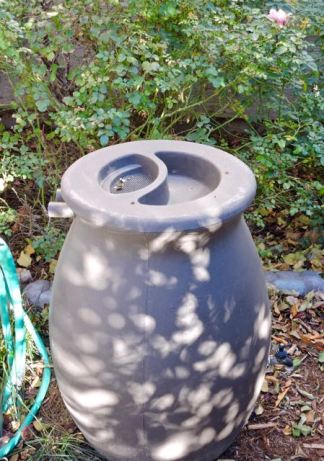
Sun-dappled rain barrel, back garden
She was sicker than I was to see pre-restriction practices in our neighborhood–and even on our own lawn–like sprinklers broadcasting precious water so that much of it fell on sidewalks and driveways, then ran into the storm sewer. Even with restrictions, too much of our lessened water flow would miss the grass and then join our neighbors’ sprinkler spray running in streams by the curb and into the sewer.
So taking out the grass was truly sensible. Happily, the state and the local authorities made it attractive, by offering a $1000 (later $2000) rebate on home conversions from grass to drought-tolerant plants on drip. Our front “lawn” is now a base of part small rocks, part larger rocks in a stream formation, part bark mulch, and part shredded mulch. The drip lines run underneath and nourish each of the more than seventy plants. In three years, our overall water usage is down about 70%–with a concordant drop in our water bills.
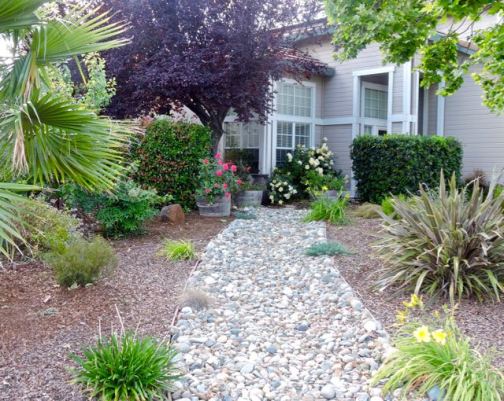
Portion of our front “yard”–2 years post transformation
The rest of the neighborhood?
What is even more gratifying is how our neighborhood is steadily adapting to more California-appropriate landscaping. Each time we take an evening walk along nearby streets, we see more properties with the grass replaced in ways similar to ours, but with each family following their own design–different materials, plants, colors. More often, the grass has not been completely replaced; but the portion has been reduced, with the margins near the house and near sidewalks and driveways de-grassed and now covered with gravel or mulch, often with bushes and flowering plants varying the landscape.
California history–Water obsessed
My obsession is common among Californians–and embedded deeply in state history and policy. How many dams are there on California rivers? Answer: over 1400. How many California rivers are not dammed? Answer: one–the tiny Smith River in the far Northwest corner of the state. A popular joke (of which there are many) about Californians is this one:
“How does a Californian define ‘water conservation’?”
“Making sure that no drop ever reaches the ocean.”
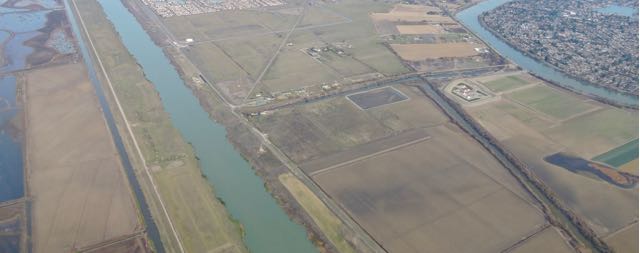
California water management at work, Dec. 2017: L. to R.: Yolo Bypass, irrigation channel, ship channel, and Sacramento River separating irrigated farmland from housing (C. Thaiss, photo)
Indeed, an evergreen topic in the state news is the fighting that goes on between environmentalists and anglers on the one side, and big farmers and municipalities on the other side, over the rights to use the water (for ag, industry, and other human needs) or to leave it alone (to keep natural flows to sustain wildlife and habitats in rivers, swamps, and estuaries). Roughly 80%–yes, 80%–of California river water is cycled through irrigation of the massive farms and ranches that have made California the world’s largest producer of many fruits and vegetables. So environmentalists have a steep, steep hill to climb to have their message heard.
California history has no more dramatic a struggle than that over the diverting of water from the Northern and Eastern parts of the state to satisfy the many thirsts of urbanites in San Francisco and Los Angeles. Just mention “Hetch Hetchy” or “Owens Valley” to any California student of water, and you will get a long, tense lecture on wars that lasted for years, and to many still go on. Just mention “the twin tunnels” to any of us in the Sacramento area, and you’ll get a similar lecture about a battle going on as you read this.
Google any of these terms, and you’ll find much to occupy your time as you contemplate the preciousness of the ever-more-endangered fresh water around the world.
Water and one small garden


Most of the posts in this blog mention water and watering. Without some water, none of the plants would survive. Without the plants, the animals (including us) that depend on them would not survive either. So, in a water-challenged ecosystem the question is always “How much should I water?”
There are no simple answers to this question. Choices and compromises are everywhere. When we first moved to California, we rented for most of a year a newly-built house with no water system in the large back yard. Used to living on the East Coast, where plentiful rain meant that plants would just grow and grow, whether you wanted them to grow or not, the basic question was how often you wanted to mow grass and chop the plants back. Once we moved here, I couldn’t get used to the idea that the unplanted California back yard would just stay sandy dirt–with a scattering of thorny thistles and dandelions when it did occasionally rain–if I (or our landlord) didn’t come up with a coherent plan to turn desert into a green Eden.
Like most Easterners who transplant to the dry West, I was not ready for desert (I must admit that my thinking is still in transition). In that first year, I was awed by the fact that every home in our rural/suburban environs had valves, timers, hoses, and various other gadgets hooked up mysteriously to civic water pipes to deliver water to topsoil, so plants could grow and look as if they belonged there in that spot. Not only that, but, as I quickly learned, in our region this life-giving water didn’t come from the clouds above us. No, where we now lived, the water came from two equally mysterious places.
One of these places we could see in the distance on clear days: the Sierra Nevada mountains to the east, in the form of the snow that built up over the winter into a deep snowpack, which would gradually provide us water all year long–like a gargantuan refrigerator with a mammoth water-and-ice dispenser. So it wasn’t just the skiers who craved the cold white powder, but everyone, even those teeming masses who lived along the Pacific shores–where there’s lots and lots of water, but you can’t drink it.
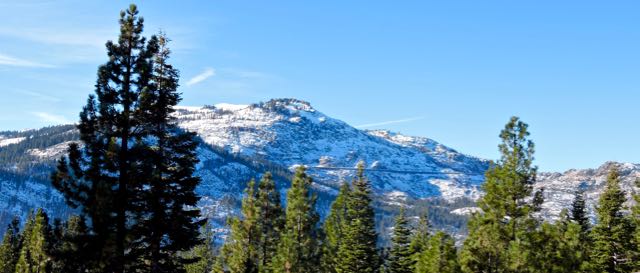
Sierra at Donner Pass–see, that’s our water up there. (C. Thaiss, photo)
The other place was equally strange to me–deep underground, in the aquifer, that buildup of water over many years as rain and river water soak into the soil and trickle down and down into vast lakes. Now, among things I’ve learned in the intervening years is that no one, even the best water scientists, knows exactly how much water is down there. What they do know, painfully, is that if the aquifer is not replenished at the same rate that humans are using the water, the top of the aquifer keeps getting deeper and deeper–and so resourceful humans have to keep digging deeper and deeper wells to reach it. Guess what–during the drought, farmers kept having to drill the wells deeper, so what does that tell you about the future?
Knowing where the water comes from–and knowing that we humans are using it faster than it’s being replenished–helps to focus the mind on the individual choices I make about how much water to use in my small garden. Sure, I could conclude that my use is so minuscule in the grand scheme of water use that I shouldn’t concern myself. But I can’t think that way. Fortunately, neither did the millions of Californians who complied with the water restrictions. That collective action makes a huge difference.
Now that I’ve lived for the past decade in a home that has a water supply system, I have the tools to make those choices.
Most choices are obvious:
- I didn’t need as part of the system the sprinkler heads that waste water. Too many transplanted Easterners, like me, try to maintain the fantasy that a “nice green lawn makes a place look respectable.” In Virginia, maybe, but not in California. I dug up the grass both front and back, and turned off the sprinklers.
- Instead, my watering apparatus includes drip irrigation, with hoses through much of the garden spaces, front, side, and back, and drip nozzles at each plant. These plants include the fruit trees, the rose bushes, and all the new drought-tolerant bushes and plants in the front garden that used to be lawn.
- .All the other plants, including vegetables and herbs in pots and potted flowers, are hand-watered, on an every-other day schedule in spring, summer, and fall. Winter veggies get water from me as needed. Most winters are rainy enough that these plants thrive with no additional water.
- I emphasize native plants and other drought-tolerant varieties, which hold the soil and attract pollinators. Plants like lupine, coreopsis, and ceonothus (Western lilac) are beautiful in bloom and draw honeybees, bumblebees, butterflies, and hummingbirds. The lupine and coreopsis in the back garden thrived this summer with no water.
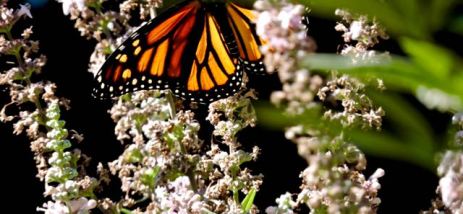
lupine with monarch

coreopsis at top of frame, center
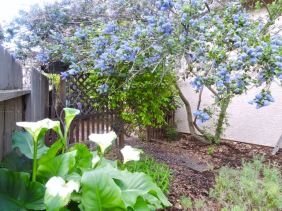
ceonothus above calla lily
- I’ve found over the last six years that I can cut back on water usage without harm to the plants. I used to handwater every day in the blistering summers, but now I do so every other day, around 10-15 seconds for each plant. The water cutback has been huge in terms of overall water use.
- I’ve learned to be guided by the plants. If a tomato looks wilty at 2 PM in July, when the temp is over 100, I don’t immediately add water (which will just evaporate in the heat). I wait to see how it looks in the early morning, which is when I water so that the water will be used by the plant and not evaporate.. If the plant still looks wilty then, I may up the dosage temporarily. I also use the finger-in-the-soil test. It’s amazing how cool and moist soil can remain a couple inches below the surface even in summer. If I feel that coolness near the roots, I don’t worry.
Still, a question remains: “Should I garden?”
The really basic choice for me is to garden or not to garden. If I didn’t try to manipulate my environment at all, I wouldn’t use any water on the ground. I could, if I chose, let my property become like that desert-like yard we had in our first year in California. All over California there are huge swaths of land–the Sierra, the Mojave, Death Valley, and on an on–that barely feel the hand of homo sapiens. Right next to irrigated farmlands lie unwatered flatlands, hills, and mountains. It’s always a choice.
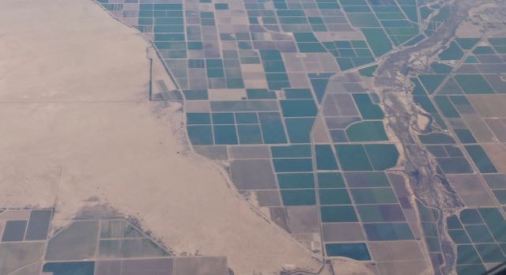
Irrigated farmland next to waterless desert, Imperial County, Dec. 2017–always a choice wherever humans live. (C. Thaiss, photo)
Oh, who am I kidding? That kind of basic choice is long gone in this neck of the woods. The handiwork of humankind is everywhere and there is no turning back as long as humans are around. Where the wildfires rage in this state is mostly in those unwatered mountains and valleys–with most of those fires sparked by humans’ electric power lines downed in heavy winds. And when the fires come close to human estates and roads, all our resources of men, machines, and water go into action to stop the fire and smoke from reaching us. And even when there is not fire, there is the polluted air from the gas and oil burned in cities and on highways changing the chemistry of the mountains, valleys, and oceans. And each day more and more acres of forest around the globe are stripped so that plants can be grown and cattle fed to satisfy human desires.
So the only real choices are of “how” to use the land and water, and “how much” to use and “why” and “when.” We’re human–it’s in who we are to change our environment. If I didn’t build a garden, I’d use the land and water some other way.
So I’ve chosen to build a garden, and I use water, which I try to use sparingly, because I know it is increasingly rare for each of us. And I’ve chosen to want my small garden to be varied and beautiful. And I grow certain plants because I want the garden to attract some of the animals, like bees and butterflies and birds, that are becoming rarer as more and more pristine land is being turned into houses, shopping malls, mines, and concrete. And I’ve chosen to want this garden to produce fruit, leaves, and stems that Jean and I can cook into delicious and healthful food. These are choices I make, even as more and more such choices are taken out of individual hands by corporations and the governments they control. And a necessary tool of those choices is water.

Water-rich cherry plums from our tree become tasty jam every June.
 From Sacramento to Potomac: Tales of Two Valleys
Pingback: February 2020–Heading for the Driest on Record! | A Sacramento Valley Kitchen Garden
Pingback: September 2020: Summer Lingers, Fires Live On | A Sacramento Valley Kitchen Garden
Pingback: March 2021: Travel! (and St. Patrick’s Day) | A Sacramento Valley Kitchen Garden
Pingback: May 2023: Mother’s Day and More | From Sacramento to Potomac: Tales of Two Valleys