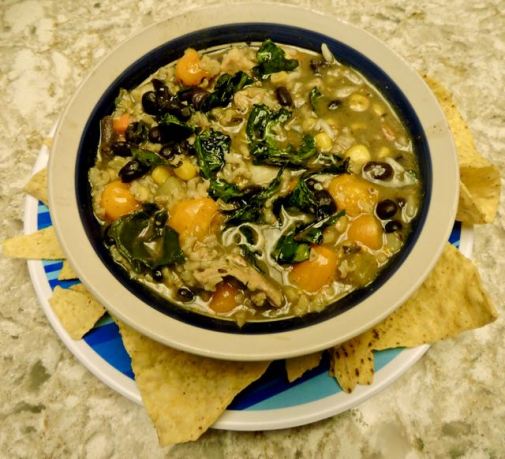
Jean’s Chicken Chard Chili
Jean:
January in the Kitchen
January in the kitchen is time for warm (both in temperature and spices) comfort foods. I love making big pots of soups, stews, and chilis that sit in the refrigerator getting more tasty every day and can be heated up in a few minutes to take the chill off the day. My birthday is at the end of January, and I have always liked that. It’s just far enough from Christmas that people can get up the energy to celebrate with me, and the winter weather tends to warm up a bit at the end of January (they call it the “January thaw” in Boston) before plunging back into whatever challenges may lie ahead in the uncertain early spring.
Chicken Chard Chili
That looks awful, doesn’t it? [photo above] I don’t know how it came out so tasty. Chris named it, and also called it the best thing he ever ate. Now there’s hyperbole. It’s more of a stew, but we like the alliteration of this three-“ch” name. I think, basically, that green-chili-chicken anything is delicious. It shouldn’t have rice in it. It shouldn’t have black beans or chard. But it does and it worked!
I hesitate to talk about my cooking methods because they are often happenstance. I happened to have cooked a package of rice and black beans, and I didn’t like the taste. I had to do something with it because I don’t waste food. I had been wanting to make chicken with green chili sauce, so I chopped some skinless, boneless chicken thighs and browned them with some chopped onions, cumin, and cayenne. Then I added some chicken broth and a whole jar of Herdez salsa verde. Chris brought in some young chard leaves from the garden, and I chopped those into the sauce and let it simmer until the leaves softened and all the flavors merged, about 20 minutes.
I think I intended to serve this over the rice, but we ended up combining them. It didn’t dilute the flavors to add the rice, like I feared. It looks like we threw in some canned corn and grape tomatoes that we had on hand (I didn’t even remember doing that.) Of course, you could and probably should use white beans instead of black, but remember where I started this.
The most important flavor here, besides the green chili sauce, was the chard. It made the mixture taste fresh and healthy. Just a little different and delicious.
Three-Bean Black Mole Beef Chili
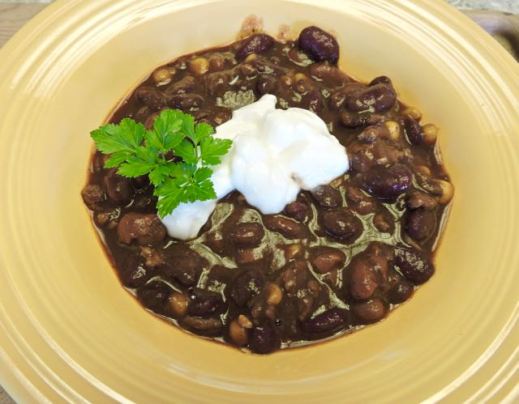
I have subscribed to the New York Times recipe service. Their ideas come from a variety of chefs who have worked for the paper over the years, and I usually find them insightful and delightful, although I still add my own twists. This one looked interesting because it uses a somewhat different list of spices and other ingredients than I usually use in chili. If you like the idea of using up those spices you have sitting around, this one’s for you.
Saute some chopped onions and ground beef as you usually do, seasoned with salt and pepper. Remove any unwanted fat and then add one 6-oz can of tomato paste. Cook that for a minute or two and add 2-3 teaspoons each of the following spices: sweet and smoked paprika, chipotle (and/or chili) powder or paste, ground cumin, onion powder, garlic powder, and mustard powder. Also add 1/2 teaspoon each of cayenne powder and cinnamon, plus 1/4 teaspoon cloves. Cook all the spices until you can smell the fragrances, about a minute or two. Now add a 12-oz bottle of pilsner beer and stir it in, which will deglaze the pan of all those dark flavors on the bottom.
From here on, you can continue cooking on top of the stove or move to a slow-cooker, as you prefer. Add a 14-oz can of diced or crushed tomatoes, 1/4 c. cider vinegar, 2 T. maple syrup or dark brown sugar, 2 tsp. unsweetened cocoa powder, 2 tsp. beef bouillon paste (two cubes), and 1 T. Worcestershire sauce. Exhausted yet? Keep going; it’s worth it.
Now add 2 or even three cans of your favorite beans—pinto, kidney, and/or black beans. For mine, I used them all. They should be drained unless you happen to have beans with chili spices and sauce. (I threw in one can of saucy black beans and I think it made the chili darker and thicker, which we liked.) Simmer this as long as you like.
Get some sour cream to serve on top to cut the rich dense flavors and texture, and some tortilla chips to crumble on top, maybe with a cilantro or parsley garnish. You’re ready for the Super Bowl or any other big evening!
Gingery Winter Stew
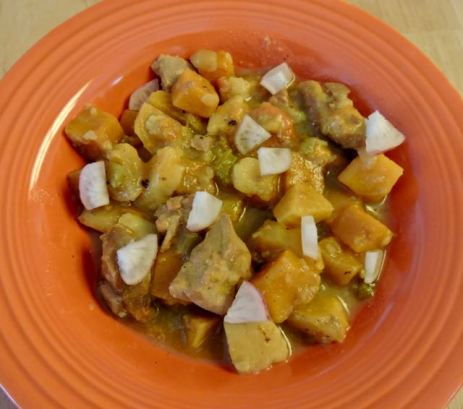
This recipe caught my eye because of the unusual mix of vegetables and because I sometimes like to make a monochromatic dish. You can make it with chicken breasts or thighs, whole or chopped, cooked by your preferred method, or leave them out and make it vegetarian. Roast some hearty yellow/orange vegetables, cut in chunks–sweet potatoes, winter squash, and golden beets–until each type of vegetable is sufficiently soft. It may take about half an hour to 45 minutes, but it varies, so check them all.
Here’s the odd ingredient–Japanese daikon. I didn’t see any in the market that day, so I roasted a large French breakfast radish that Chris had just pulled from the garden. You still get some of the same crunch and spicy bite from a roasted radish as from a raw one, but you could also save the radish to slice or shave raw on top of the finished dish.
For a sweet and tangy touch, I also added some chopped peaches that we’d frozen from last summer’s harvest. If it’s on hand and I think it will fit, I’ll use it. We’ve found that slicing and freezing the peaches we can’t eat or give away in the summer keeps their flavor the rest of the year.
The real secret of this dish is in the sauce. Chop and saute some onions and garlic with salt and pepper and a tablespoon of yellow curry powder or turmeric. Stir in a quarter cup of fresh minced ginger or purchased ginger paste and cook for a couple of minutes as well. Then add 2 cups of vegetable or chicken broth, one quarter cup soy sauce, the juice of one lime, and 3 star anise. Cook the sauce down for about 15 minutes and remove the star anise. (You could leave these in longer, but you would have to remember to fish them out at the end, and they might be hard to find once everything else is in.)
Add the chicken and cooked vegetables and simmer everything in the sauce for another 15-20 minutes. Serve over yellow rice if you want to keep with the color scheme. Serve a green vegetable alongside to brighten it up.
Calvados Apple Bread Pudding
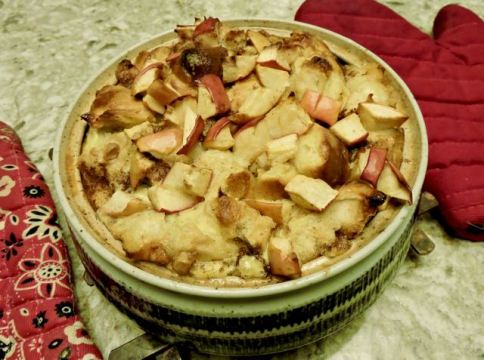
Bread puddings are fun because they do double duty. They make great desserts and also great breakfast items. This pudding was inspired by a large loaf of apple bread I had purchased on impulse as I walked through the bakery section of the grocery store. It was good, with big chunks of cinnamony cooked apple, but we weren’t eating it as fast as we needed to. Before it got too stale or went bad, I decided to make a bread pudding with it because I also had a lot of eggs.
I looked online for the proportions of milk and eggs to bread and whipped up a custard, flavoring it with some Calvados we had. I also had a big chunk of cinnamon sugar butter that had come with the cut squash I bought for the winter stew (above). Chris dislikes much sweetness in savory dishes, so I had set that flavored butter aside in the refrigerator, and now brought it out to melt and pour over the bread before soaking it in the custard. This is just another example of how often I am inspired by what I have, even if it was not purchased for a specific purpose, but just needs to be used up.
This bread pudding baked at 350 degrees for about 45 minutes until it smelled like heaven. I pulled it out, cooled it a bit, and poured a touch more Calvados over it, I must confess. I served it with ice cream for dessert at dinner–and then with yogurt for breakfast.
January in the Garden
Chris:
January is one of our rainier months, and our coolest, with nighttime temps in the low to mid thirties and occasional frosts. Rainfall to begin this new year is higher than normal: almost six inches this month, about two above average. Of course, we have a long way to go–and many stormy days–if we would want to reach our record rainfall of 2016-17, almost 45 inches for the season, more than twice the average of 20 inches.
But who would want that? Surely not the folks up along the Feather River, who had to leave their homes when the Oroville Dam gave way. Our January 2017 entry in the blog details the effects of that month’s rainfall on our little garden.
The ten inches of rain we’ve now had this season is 2-3 inches more than usual, but close enough to the average that this January seems to be pretty much what we expect in this region. So when I peered through our rain-blurred window at part of the back garden last week, I saw what I expected for late January:
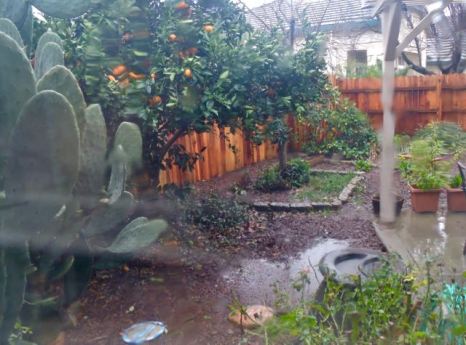
Nopales, ripe navel oranges, ripe meyer lemons, rosemary (in the background), green hibiscus in a pot, puddles in the mulch, and an almost full rain barrel (in the foreground)
What’s growing?
Radishes
The radishes (“French breakfast”) I planted in late November are ready to harvest now: their bright red tops are prominent above the soil. Since this is my first crop of this variety, I was excited to learn how much they have grown below ground. When I picked the first of them last week–Voilà!!

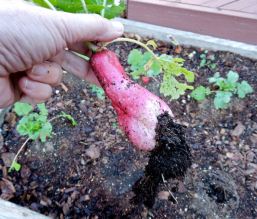
Just look at the size of that beauty! And when we sliced it, it was crispy and spicy all the way through, perfect for Jean’s Gingery Winter Stew (see above). When I pick the rest, will they be just as flavorful?
Stir Fry Broccoli
The five plants have thrived in the raised bed since their planting in late November. In early January, I followed the advice of the online experts for this variety and trimmed off the main trunk of each plant when the head had grown to at least an inch to an inch and a half in diameter. The heads and trunks became part of one of my omelets and one of Jean’s stews. (Delicious!)
As the instructions predicted, and as you’ll see below, multiple heads have now sprung up all around the center of each plant. These, too, I will soon harvest, and make them the basis of one or more veggie stir-fries.

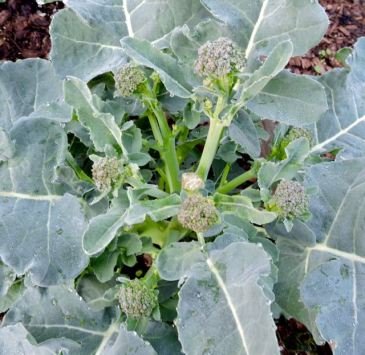
Note the trimmed trunk in the middle of the broccoli and all the new heads around it.
Swiss Chard
At the start of this entry, Jean wrote about her “Chicken Chard Chili,” with a few leaves from this year’s chard as a main ingredient–a real flavor popper with a basil/anise tang! All six plants continue to thrive, with three in pots and three in a row in the ground. The plants have been growing for two months, and are now beginning to show the variegated colors for which they are famous. As they continue to expand and mature, the stems will continue to thicken and their colors will become bright orange and deep red. The new leaves will start bright green, but some will become dark green and even a very deep dark purple. In an entry from two years ago, I called chard the “Queen of the Edible Garden,” and I’m hoping this year’s plants will also merit that title.
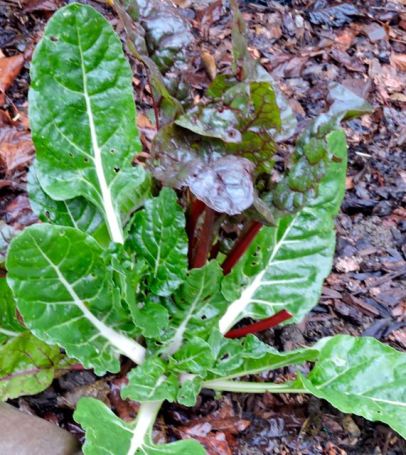
Note the colors of the most mature stems and leaves of the chard. Jan. 2019, two months old.
Two Other Old Favorites and an Infrequent Visitor
What is our typical January without the occasional rose? Every January produces at least a few salmon roses from our back garden thicket…

…like this gem just outside our window.
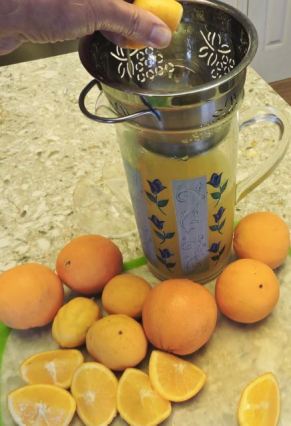
And what is our January without the now ripe navel oranges and meyer lemons, from which I make an ever-ready supply of juice? I like to mix the flavors, as shown below..
Finally, what is any garden, in January or otherwise, without at least one unexpected visitor flying in? Yesterday morning, Jean and I were chatting in the kitchen when I spied this fellow and his friends darting among the branches and along the ground in the back garden. Luckily, the camera was nearby, and this one guest stayed still long enough for me to grab this snap:

…of a male Oregon junco, probably on his way north. I hope he and his friends found something to make their stop worthwhile.
 From Sacramento to Potomac: Tales of Two Valleys