Chris:
A year ago, December 2018, our blog entry reported on the devastating Camp Fire in Butte County that destroyed the town of Paradise and cost 86 lives and thousands of homes. The mood this December feels very different, even though the threat of wildfires is never far from our minds.
As I described last month, this year’s fire season was far less severe, and now with the plentiful rains thus far in December our region is breathing a collective sigh of relief. The holiday season is upon us, and we are preparing in comparatively high spirits.
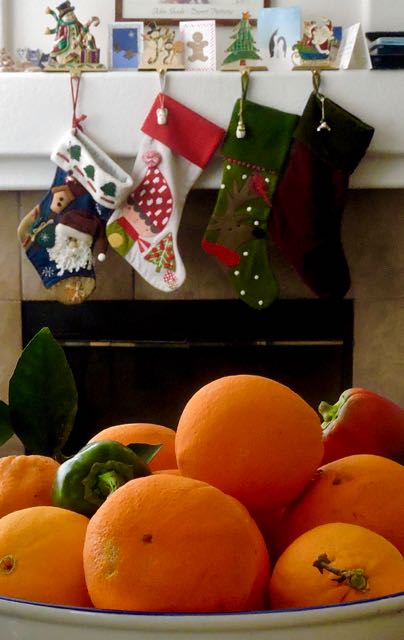
Indeed, we are hosting family for Christmas week (see the stockings in the photo above?). And the garden is doing its part (see the oranges and peppers?) to enrich our joy.
In this post, we begin with Jean’s description of her dishes for our holiday guests. Then we’ll move on to my garden comments–and compare this year’s December garden with that of 2018.
Finally, we’ll close with our gallery for the month.
Our (International) Holiday Kitchen in December
Jean:
(December 28)
In keeping with our theme of an international Christmas, I made the three dishes I describe here, as well as others.
Pozole verde soup: First, on Christmas Eve, and the day before that (when our guests arrived), I wanted a Mexican theme. We had tamales, chili, and this pozole verde soup, which was a particular hit. I boiled a couple of bone-in chicken breasts with onions and garlic to make a good broth, then cooled them and pulled the cooked meat off the bones. Finally, I reheated it with hominy, some chard from the garden, and a green tomatillo sauce before adding back the chicken. You can top it with sour cream and/or cilantro.
For some history on pozole, I suggest the following: https://en.wikipedia.org/wiki/Pozole

My pozole with chard, hominy, chicken, and a dollop of sour cream
Pfeffernusse: I love making Christmas cookies. There are so many different types. I tried some new ones this year, including red velvet crinkle cookies, matcha shortbread, and pfeffernusse. I can see from this Wikipedia article that pfeffernusse should be smaller and not rolled in powdered sugar, but we’re partial to anything rolled in powdered sugar. Because I didn’t get around to making Mexican wedding cookies (AKA Russian teacakes or snowball cookies) this year, so the pfeffernusse got the powdered sugar that these other types would usually get from me. And we and our guests enjoyed them.
I had to ask what the name pfeffernusse means; I could guess the pepper part, but the “nusse” or nuts may refer to the cloves, or the nutmeg. Anyway, I love anything that uses most of my spice rack.
https://en.wikipedia.org/wiki/Pfeffern%c3%bcsse
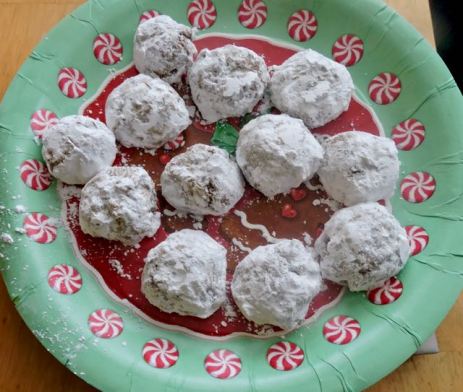
My pfeffernusse rolled in powdered sugar
Shakshouka: I wanted something warm and hearty plus colorful for Christmas breakfast, although we also had sweet breads available like stollen and my pumpkin bread. This shakshouka met all of those wishes. It contains many of Chris’s favorite flavors. (He wanted to add the manzanilla olives, but basically it is just a tomato, sweet pepper, and spice dish.) I also added in a chopped-up Cajun red pepper from the garden for an extra kick. While shakshouka is red and green, it is not per se a Christmas dish–it is a Middle Eastern dish loved by Israelis and Arabs alike. Italians, however, know it as “eggs in purgatory.” You poach eggs in the sauce, but you can’t see those well, so I added hard-boiled eggs on top for visual effect and to give choices of egg styles.
https://en.wikipedia.org/wiki/Shakshouka

My shakshouka with hard-boiled eggs and artichoke hearts added
Comparing the Gardens, 2018 and 2019
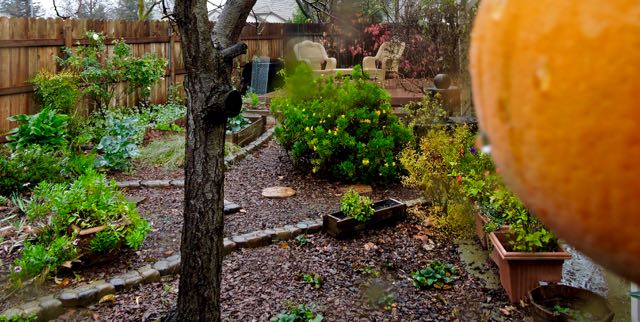
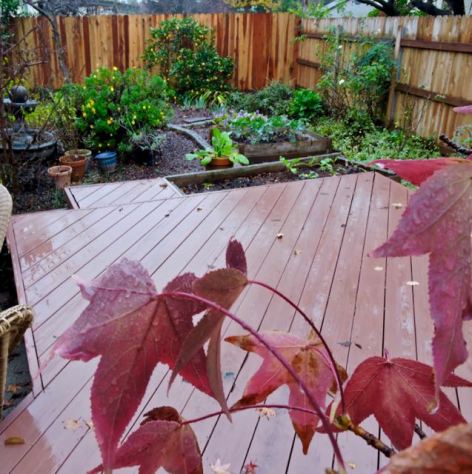
2019 top, 2018 bottom
Chris:
The main reason I started one year ago doing blog entries named month to month was so I could compare one year with the next. These two December photos are taken from opposite vantage points:
- the 2019 photo is taken from behind the orange tree and toward the deck to the north;
- the 2018 photo was taken from behind the sweetgum (liquidambar) trees and south toward the meyer lemon bush.
Both photos are taken in the rain, and you’d have to say the garden looks pretty much the same in both–in its deep greenness, its carpet of brown mulch, and its decorative stone borders. But the photos do highlight different features of the back garden:
- the 2018 shot shows the French breakfast radishes in the nearest raised bed, the broccoli plants in the square raised bed, and the chard in the pot between the beds, as well as the ripe meyer lemons in the background;
- the 2019 shot shows the strawberry plants in the near foreground, the African daisy in the pot to the near left, and the potted hibiscus, Greek oregano, and geranium in the near right, as well as the dwarf pomegranate bush beside them. It also shows the fennel just beyond the African daisy, the broccoli plants in the ground beside the fennel, and the feathery arugula to the right of the broccoli. In the background is the wire-protected chard in front of our black compost bin.
Both photos feature the fountain, the striking Euryops with its yellow blooms, the white rose bush, and the rosemary and calla lily beside the white rose.
What else stands out for you in the photos?
More comparisons
Oranges: The production of the orange tree in December 2018 and in December 2019 is about the same for each year. In 2018, the tree produced roughly 350 oranges. The tree this year looks as if production will be similar (about 90 oranges have been used for juice or for giving away to the local food bank thus far:


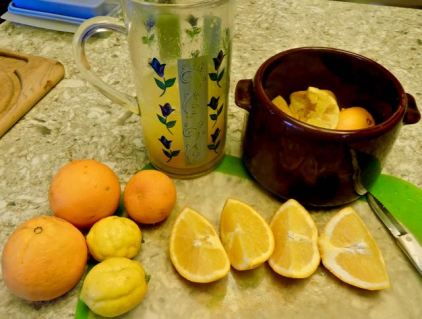
About 15 navel oranges and 5 meyer lemons, plus water to limit the intensity, make a full pitcher of orange-lemonade. We like ours with some pulp.
For years, our orange production varied between a huge crop (300 or more) one year and a small crop (under 100) the next (keep in mind that an orange will grow in the same spot on the tree only every other year). That the last two crops have been about even shows that the tree is now pretty balanced in where the fruit grows from year to year. We’ll see if that keeps up!
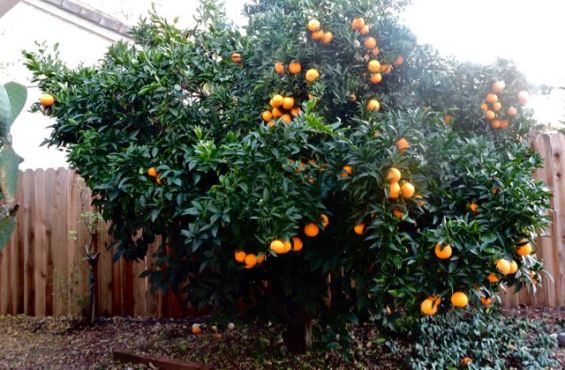
Orange tree December 2019, about 90 already picked
Meyer Lemons: We’ve used about 20 of the lemons already this season for our juice (see photo below), so this year’s total production is about the same as last year’s (about 125). But this year’s crop ripened just a bit earlier and is freer of the blemishes that marked the 2018 crop.

Meyer lemon bush December 2019, about 20 lemons picked so far
Broccoli: In this third consecutive year of growing broccoli in the winter garden, I’m mixing the techniques I used in the previous two years. In 2017, I allowed each plant to produce one large head (multiple florets) in the center. In 2018, I trimmed off the central head in each plant when the head reached about 1.5 inches across, so that multiple much smaller heads (broccolini) would spring up outside the center. So what I lost in the volume of the central head was compensated for by the number of heads. (See the post “February 2019: Cold, Rainy, but Warm in the Kitchen” for a photo of the proliferating heads last winter.)
This year, I have five thriving plants:
- two of these I’m treating like the 2018 plants, with the central heads cut off and the smaller heads growing around the centers (see below)

Notice the four small heads growing around the lopped off central shoot in this 2019 plant.
- the other three I’m treating like the 2017 plants, with the central head of each becoming lush and with multiple florets:
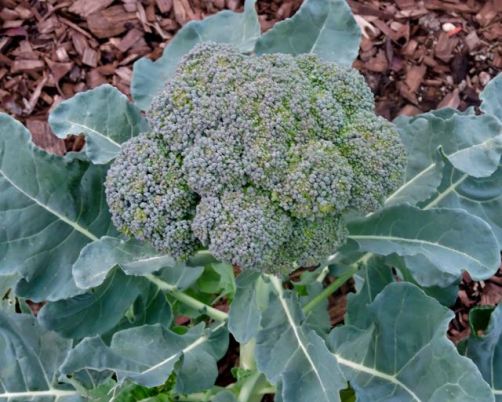
Notice the multiple florets in the rich central shoot of this 2019 plant.
The advantage of the 2017 technique is the lushness of the central shoots, which most broccoli eaters will recognize. The advantage of the 2018 method is that as the smaller side shoots are cut off for eating, other small shoots will continue to grow. However, none of these will have the volume and lushness of the central heads.
In all three years, the broccoli plants have thrived, especially in the cold weather of late November through January and even into February.
Fennel: I can’t compare the 2019 fennel with that from 2018, because this is the first year I planted fennel in the garden. I should have done so years ago, because fennel is a perennial that has thrived in the garden since the spring–and is particularly lush and green now. I started the fennel off in a pot in April, and it took off. I transplanted it into the ground in the summer and it just kept growing taller. I tied it to a stake in August, so it would continue to rise and not fall over. In October, I trimmed off the tallest branches, which appeared worn out. Now in December it is proliferating deep green feathery shoots that are oh so fragrant and beautiful.
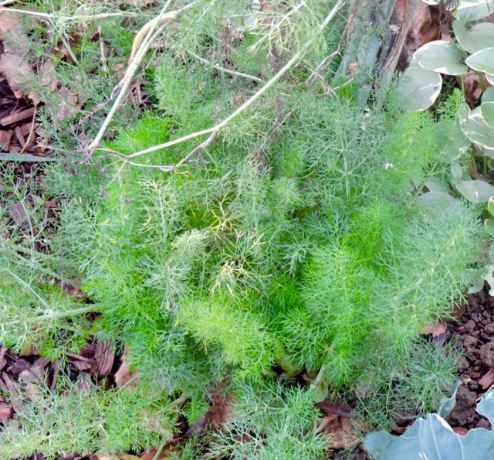
These feathery fronds of fennel have appeared in the last couple of weeks of this December.
A Small December Gallery
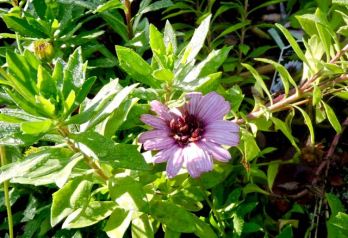
African daisy, back garden

The amazing Cajun red pepper plant, still producing ripening hot peppers in the occasionally frosty December mornings. A champion.
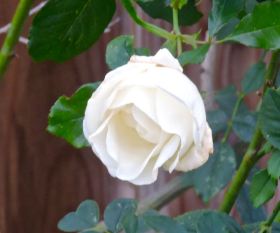
A white rose, back garden–never a month without new roses in this garden

Salmon roses–of course
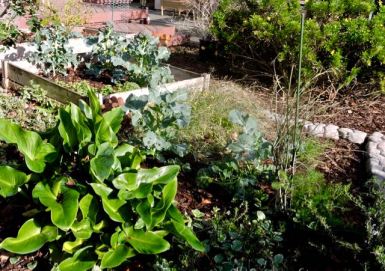
The calla lily front left is the star in this shot, but just look at the broccoli, the feathery arugula, the blooming rosemary, and the feathery fennel!
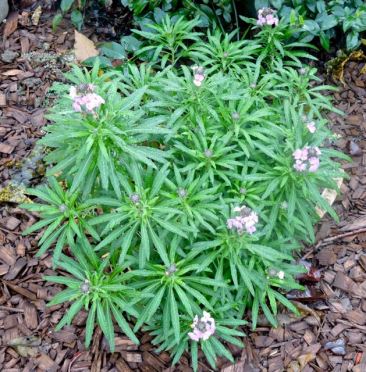
Erysimum, green in summer and fall, blooming now in winter.
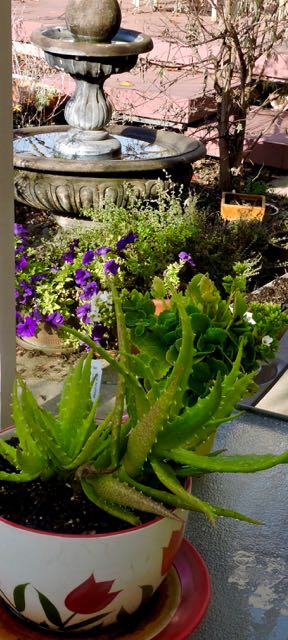
Just as in December 2018, a few of our petunias still bloom even as frost appears some mornings–and look at the hearty aloe and kalanchoe (white blooms) in the foreground of this photo.
On to the New Year!
 From Sacramento to Potomac: Tales of Two Valleys
Pingback: January Surprises, 2020 | A Sacramento Valley Kitchen Garden