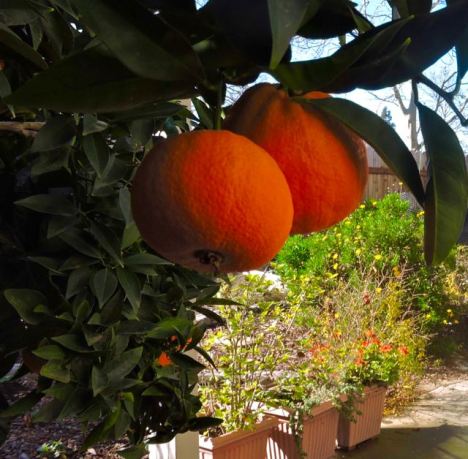
Oranges in foreground shade, with hibiscus, spicy oregano, geraniums, pomegranate, and coreopsis sunlit
In this entry:
- January Surprises
- Fruits and Veggies
- January Garden Friends
- The January Kitchen: Party Time!
Chris:
The opening month of the new decade–the 2020s!–brought us our typical chilly grey mornings of dew and fog, followed by afternoons of wintry sun, deep blue skies with puffy clouds, and temps in the 50s. Days of rain? Some, but fewer than usual, and as the month draws toward a close we’ve received less than 2 inches, more than 2″ below average. But our rainy December–almost 9 inches–gave us a surplus gift for the new year, so the soil is dark and moist, perfect for a bit of transplanting and perfect for growth of the hearty winter veggies, fruits, and flowering plants.
By now, I should have grown to expect color in the January garden, but my deeply ingrained expectations for bleak Januaries from all my years in the East always make our Northern California Januaries an exquisite surprise.

Front garden: Agapanthus in front, with (l-r) flowering garlic, New Zealand flax, breath of heaven, yellow gaillardia, and penstemon in background
For example, the palette of the photo just above isn’t as intense as it will be come March, but it’s still rich and varied.
And we love the January brilliance of some of our perennials in the back garden…
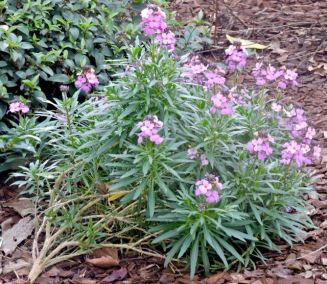
Erysimum
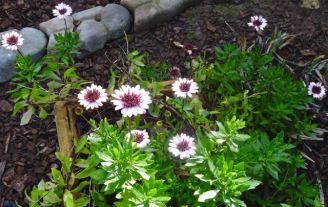
African daisies
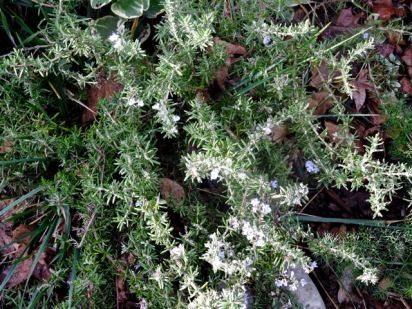
Blooming rosemary
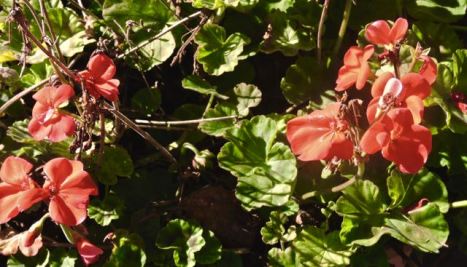
Geranium

Coreopsis
…not to mention the hearty annual petunias that keep going this January after having bloomed all spring, summer, and fall…

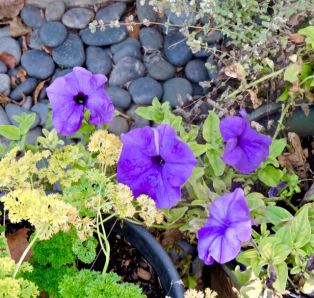
Purple petunias with parsley (left) and marjoram (upper right)
Fruits and Veggies
Oranges and Lemons
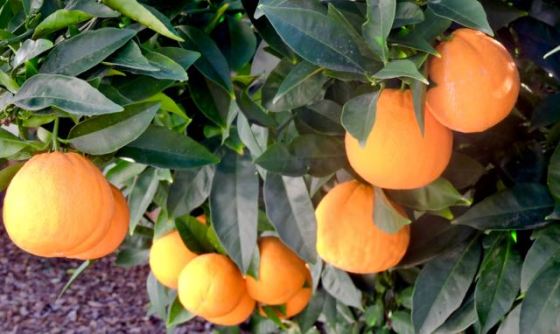
Oranges. No surprises here. Just the colorful, supple, and juicy fruit. We’ve had a steady supply of sweet and tangy juice from the navel oranges, of which we’ve consumed or given away about 65 so far this month, about 155 total used so far this season. I’d estimate about 100 still on the tree, all in all somewhat less than last year’s more than 300 total for the season.
The birds love them, too, especially those fruit higher up in the tree, where the birds feel safer. But there are plenty for us humans.
Mostly, the oranges are much larger than what you’d find in the grocery store; ours are typically 4 to 6 inches in diameter. Those in the clusters below are in this size range, as are the two in the photo at the top of this post.
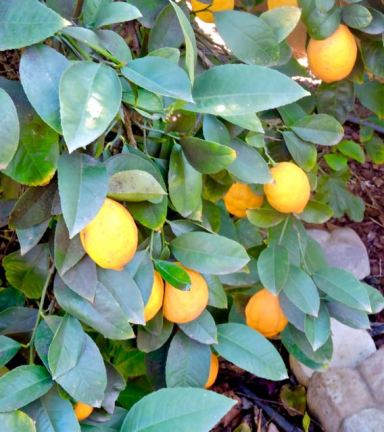
Meyer lemons. When I make juice, I like to blend about 3 oranges for each lemon–so about 15 oranges to 5 lemons for a full pitcher, which lasts us around a week. The fruit is so intense that we like to dilute the juice with water–and I’ll also add a small packet or two of stevia natural sweetener and a bit of baker’s sugar to balance the tang of the lemons.
The lemons this season are above average in size and in clarity of the skins: in size about 2-3 inches in diameter, or smaller than the more common Eureka lemons. In all, we’ll have about 125 meyer lemons this season, about average for the mature bush.
While the orange tree was here when we moved in 13 years ago (though much smaller than the present tree, which we need to cut back every other year or so), I planted the meyer lemon 11 years ago (about a foot high then). It stayed tiny and unproductive for three years, but in 2011 it started to take off; it grew steadily and produced more each year for the next five years (by 2016), when it reached almost its current size and productivity.
Unlike the sweet oranges, which draw the hungry birds, the sour lemons are almost untouched by our garden friends. But wait for the spring buds and blooms, which the bees love.
Swiss Chard
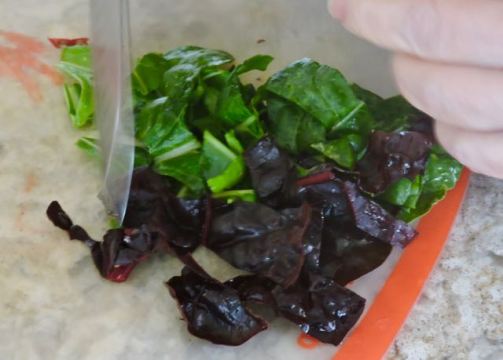
Jean seems to be using our chard even more often this year in her cooking than in the three previous years in which we’ve grown it (see January in the Kitchen: Party Time!, below in this post). Perhaps because when I planted the six seedlings in October, the garden critters quickly devoured two plants and damaged the others–until I moved the remaining four into pots and moved them close to the house on the veranda. So we appreciate their preciousness–as well as the deliciousness of the gorgeous leaves.
In November, I transplanted one of the four into the large raised bed and surrounded it by chicken wire. It has grown and thrived since, even in the cold weather. Then, a week ago, I transplanted another into ground near the strawberries, and did not protect it in any way. So far, so good. I’ll see what happens.
In previous years, such as last spring, 2019, the chard has never needed protection, even as the weather warms significantly, and it has grown prodigiously. So I have my fingers crossed for this new transplant. I have often found that fall and winter veggies that were eaten by insects in October thrive once the coolness of November and the cold of December come along. That’s true of the chard this year.
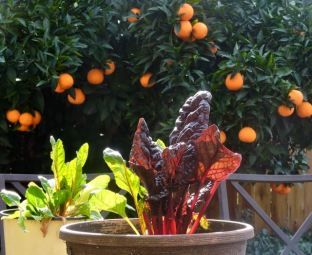
Two chard plants in pots near house, January
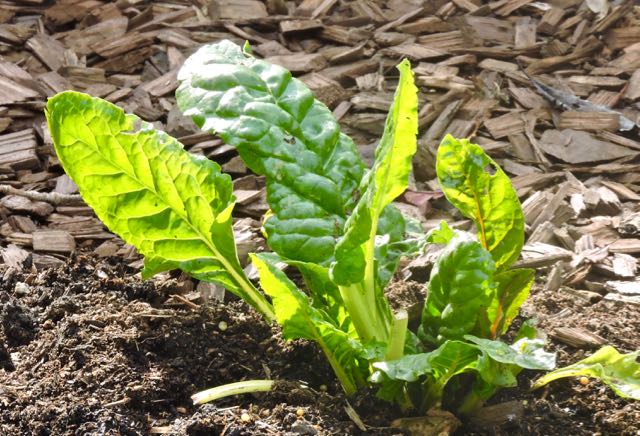
Chard transplanted from pot, January
The Champion Cajun Red Pepper
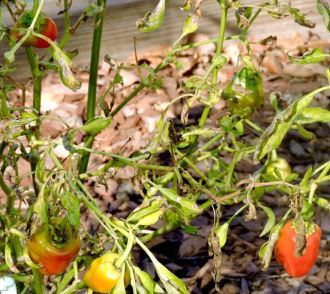
We keep getting ripe spicy red peppers from this sturdy plant.
This hearty plant continues to be fruitful even in January. Planted in April and bountiful each month since May, this Cajun Red is the champion pepper in the history of this garden. I keep wanting to replace it in the raised bed with something new, but I’ll continue to give it space until it gives up the ghost.
Broccoli
In this third year of growing broccoli in the garden, these five 2019-2020 plants are the best so far. All five have flourished this month, and we have used florets in a range of dishes thus far, with no real diminution of the stock. We may soon be cutting off florets to freeze for the coming months, as the heads are just beginning to show their tiny yellow flowers. See last month’s blog entry, December 2019, for a description of the two ways I’ve tended to these five plants, as reflected in the photos below.

Two lush broccoli heads with many florets, late January

The plant with the largest head. Note the few yellow flowers starting to appear, late January.
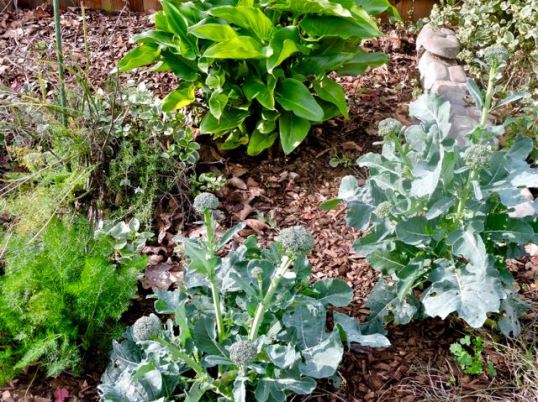
Bordered by fennel and calla lily, these two thriving broccolis feature the broccolini shoots that rise up once the central shoot is cut off.
Alum Root
I’ve never written in this blog about this hearty perennial that loves the fall, winter, and spring (when it flowers), and survives despite deep stress in the summer heat. I tend to ignore photographing it because it doesn’t produce edible fruit and it doesn’t have showy flowers–and in summer it browns out in the intense sunlight, unless I give it extra water, which I do. But it deserves better appreciation than I’ve given it. It’s now lasted a dozen years and has tripled in size since its early years. In many parts of the world, alum root is appreciated for its medicinal properties and has been used for many centuries by people much more considerate and savvy than I. See, for example, https://www.medicinalherbs-4u.com/alum-root.html
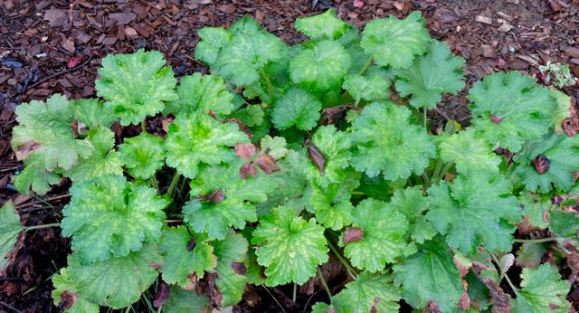
The venerable alum root, back garden
Even strawberries?

See the strawberry at the lower right edge? January surprise.
I always expect that my eleven modest strawberry plants in the back garden are happily keeping their roots warm underground in the cold weather, just waiting for spring to blossom and fruit. But two of the plants have put out a few fruit this January. A very pleasant surprise! We’ll see what this bodes for spring 2020.
January Garden Friends
We share the garden with the Western scrub jays (AKA rock jays), who don’t mind me too much, and who like to cavort around productively in my presence. They are as territorial as I am, but have come to realize that I am not a threat. Not so for other birds who visit, whom the jays can’t abide (especially the mockingbirds!–oh how they squabble!). So other visitors flit around, hope for a bit of food here and there, and rarely perch for more than a few seconds before flitting to another branch or tree or to someone else’s yard.
So getting good photos is not easy (except for the jays!). Here are a few recent ones…

Scrub jay in the peach tree, a favorite perch

Scrub jay by the broccoli, late January

Scrub jay in the peach tree again, looking for intruders.
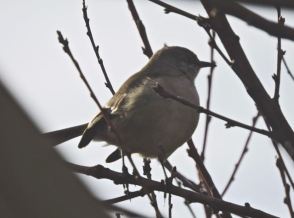
Warbler in the peach tree, when the jays are elsewhere
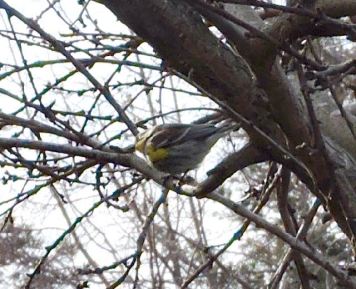
Ruby-crowned kinglet (I think) in the peach tree, just for a few seconds
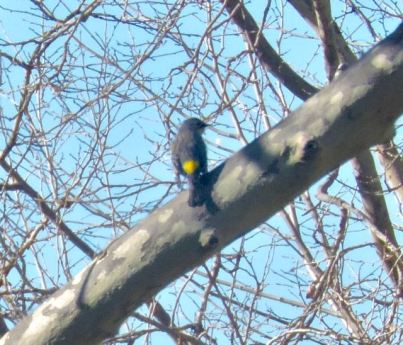
Yellow-rumped warbler in the neighbor’s sycamore. Very lucky to get this shot!

White-crowned sparrow by the coreopsis (euryops)
Oh, and if you are wondering where the Anna’s hummingbirds are, they are around. I heard one whirring close by my head last week, but it disappeared before I could get a look. They are not happy that I’ve cut back the now-dormant Mexican bush sage to await new growth, but the hummers will be showing their iridescence once again, when spring flowers begin to surge.
Ooh, wait a minute! After writing the above, I was out in the garden a few minutes ago and heard the distinctive chirp. I was lucky to get this pic…
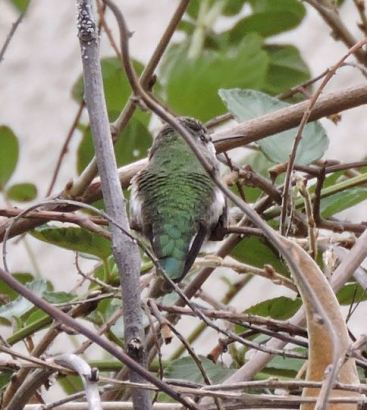
Anna’s hummingbird amid the wisteria branches
Bees
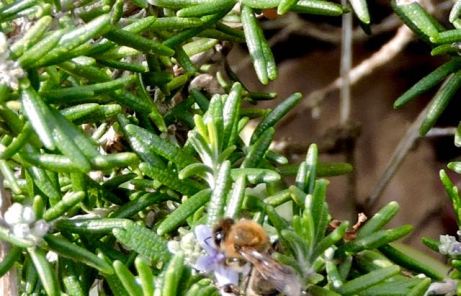
It’s never cold enough around here to chase away the bees, though they lie low on chilly mornings. Thankfully, no matter how foggy and wet a morning might be, the bees reappear as soon as the sun comes out. See this blurry honeybee I snapped three afternoons ago on the blooming rosemary…
The January Kitchen: Party Time!
Jean:
Chris and I have special fondness for the winter months, as they contain our anniversary, our birthdays, and so many holidays, from Thanksgiving through Christmas, Hanukkah, and New Year’s, and on to Martin Luther King Day, the Super Bowl, Washington-Lincoln Day, the Asian Lunar New Year, Valentine’s Day, Mardi Gras, St. Patrick’s Day…. You get the picture.
And special foods seem to be part of them all, so what better time to exercise your cooking muscles and try different dishes?
This month we co-hosted a multi-occasion, food-focused party for friends. The party aimed to celebrate a bunch of these holidays in one big event. We’re calling it the Super Party! Why not? I cooked several dishes, and each couple also contributed a dish of their choice.
The rest of this entry will be a photo parade of some of the dishes at the party, with a comment about each. Here goes:
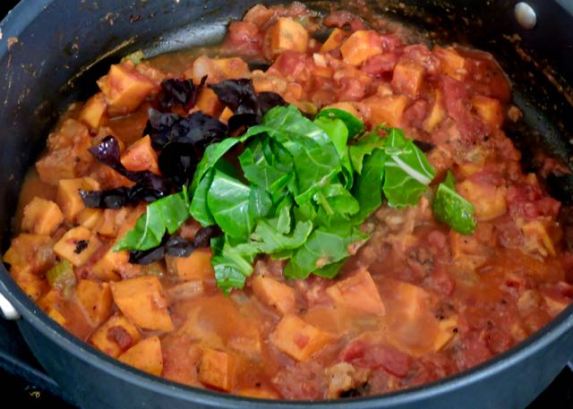
Chard about to be mixed into Jean’s West African veggie stew
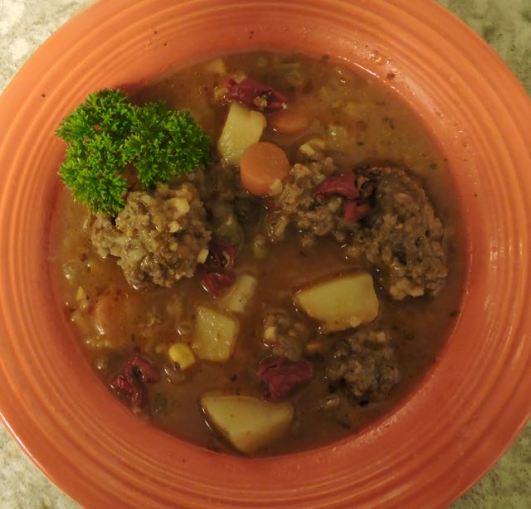
Albondigas soup garnished with parsley and red pepper
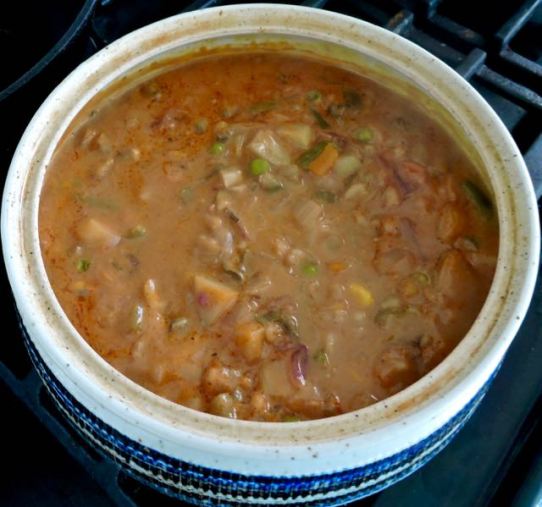
Jean’s Vegetarian shepherd’s pie before potato topping
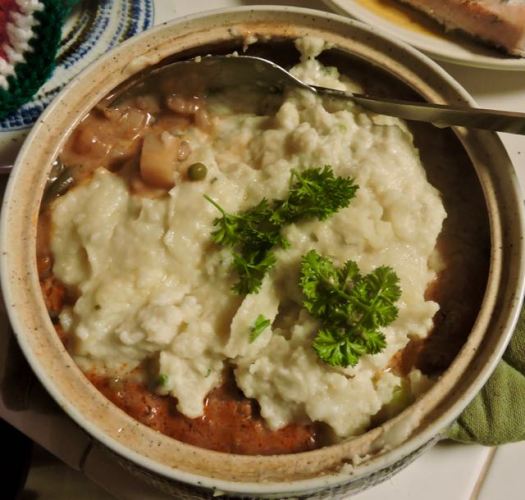
…and with the topping!
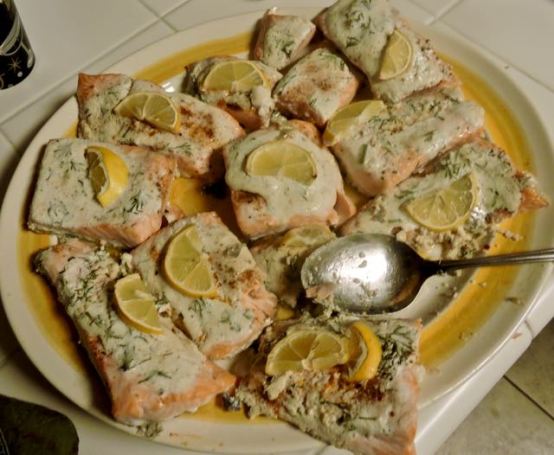
Aparna’s Salmon with dill cream sauce

Brenda’s Broccoli, radish, and peapod salad

Mardi Gras cupcakes
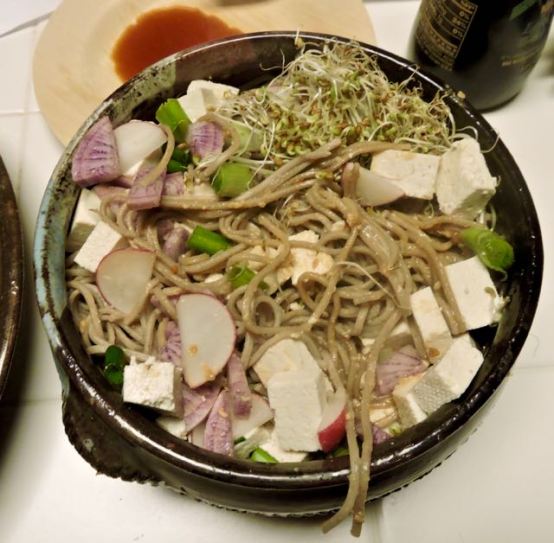
Soba noodle, tofu, radish, sprouts, green onion medley
May all your holiday celebrations be as joyful as ours!
On to February…
 From Sacramento to Potomac: Tales of Two Valleys