In this month’s blog:
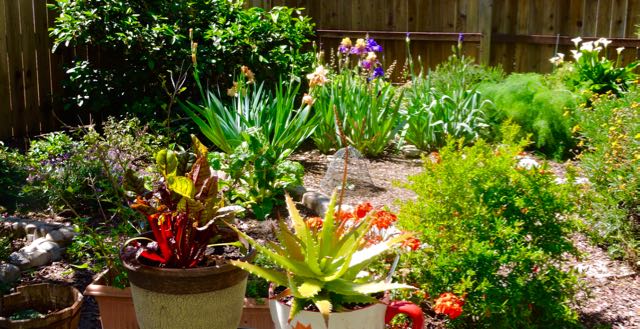
- Social Distance, Yes; Plant Distance, No
- Sheltered in the Kitchen! A Great Place to Be
- Some Garden Gifts of April 2020
- Friends in the Garden
- A Note on Composting
Chris:
Read last year’s April entry, for contrast.
We are now in the fourth month of the COVID-19 pandemic, but only just beginning the second month of the statewide “shutdown” safety measures our governor put in place March 19–the first state to do so. These measures have had great success in limiting the number of cases and deaths in this most-populous of all the states. If every state had the same rate of infection and deaths as California, the US would have in total only 1/3 of the current number of cases and only 1/4 of the current number of deaths.
Meanwhile, Jean and I follow the safety measures, and try to stay creative and hopeful in our home and garden. Our children and grandchildren around the US struggle with this new reality in various ways. Each of them and their families are suffering the pain of narrowed or lost incomes and fear of what the future may hold. But when we speak with them and often see them via digital miracles, we also feel their hope and admire their strength and creativity, just as we admire how they, too, are honoring the safety measures to keep themselves and their fellow citizens disease-free.
Get Your Hands Dirty, Then Wash Them Well
I wrote last month about how our garden provides solace, hope, food, and the opportunity for creativity in a deeply troubled time. It seems that many Americans over this past century have felt as I do, because people have turned to gardening in times of national crisis, such as World Wars I and II, when millions grew “victory gardens.”
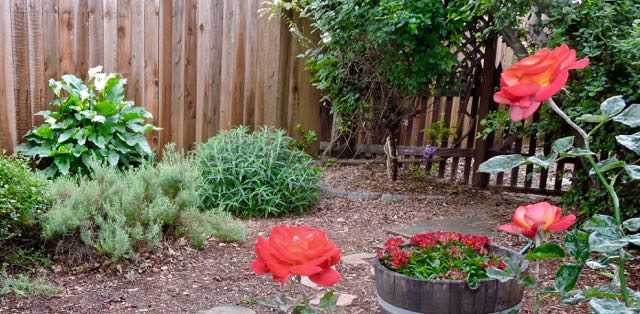
Side garden, with sages, lavender, callalilies, fuchsia, roses, and alstroemeria
While a small garden like ours can only partially make up for food shortages brought about by such crises, the apricots, peaches, oranges, lemons, strawberries, cherry plums, tomatoes, chard, lettuce, arugula, peppers, cucumbers, zucchini, eggplants, and many kinds of herbs do make a small contribution. Maybe more important, the gardener comes to realize that personal, patient effort–when carried out in collaboration with nature–can produce something living, healthful, and almost unbearably beautiful.
Even the smallest garden–say in a few pots on a ledge outside an apartment window–can have these same benefits.
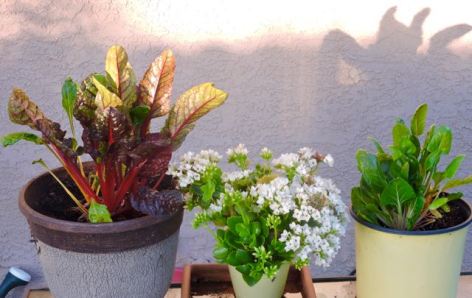
Purple chard, white kalanchoe, and green chard outside our kitchen window
Just from the standpoint of how a person can spend the hours at home, the work of a garden can make that time pass fruitfully and with fun. You basically just have to be willing to get your hands dirty–or wear gardening gloves!
Also, read!
You also need to read. But this is also easy, because if you have internet access, you have an open avenue to 1000s of sites (like this one, for example) that give clear advice on do’s and don’ts. I guarantee it: you can Google or Yahoo any plant you want to grow, and you’ll find good sites for it.
Be patient and have fun!
Remember, planting a seed or a seedling (tiny plant) isn’t like buying food at the grocery. You need to wait for the plant to grow. Follow the instructions on your favorite site, study your plant every day, and be fascinated as it slowly appears and changes.

Some April plantings: two Carmello tomatoes in front, a lemon cucumber in the cage, and a SunGold tomato to its right; two mild peppers and two cherry tomatoes in the square raised bed; two pepper plants, one mild and one Ancho spicy, in the two pots to the left in the picture.
Sheltered in the Kitchen! A Great Place to Be
Jean:
Carrot Cake

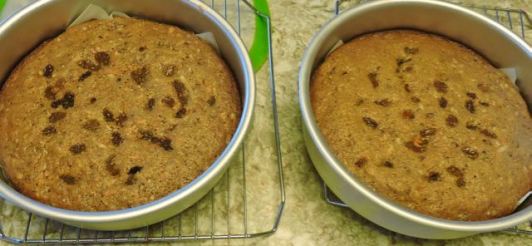
This recipe makes 3 9-inch or 4 8-inch layers, but I cut the recipe in half for the two of us, and it made two nice 8-inch layers.
Here is the full version of the recipe, but I think it is pretty simple and standard:
Butter and flour your pans, or line them.
Sift or whisk the following dry ingredients together in a small bowl and set aside:
- 2 c. flour (you can use some portion of gluten-free flour if you like)
- 2 tsp. baking powder
- 2 tsp. baking soda
- 2 tsp. ground cinnamon
- 1 tsp. ginger or 1 T. chopped candied ginger
- 3/4 tsp. salt
Next, grate, chop, and/or grind the following chunky ingredients in the food processor until desired consistencies and set the combined ingredients aside for the final stage:
- 2 1/2 to 3 c. grated carrots
- 1 c. shredded coconut
- 1 c. chopped walnuts or pecans
- 1/2 c. moist dried raisins (plump them in rum or whiskey for a while if too dry)
- 1/2 c. canned pineapple tidbits
Beat the following ingredients in a large bowl until very smooth:
- 1 1/2 c. sugar (can be part brown sugar)
- 1 c. oil (I used a mixture of vegetable oil, very light olive oil, melted coconut oil for half, and then the other half was cinnamon applesauce)
- 4 large eggs, added one at a time, beating after each addition. (I’ve also used a recipe that required beating the egg whites separately for a fluffier cake, but I don’t think that’s necessary.)
When all three sets of components are ready, gently stir the dry ingredients into the wet ones with a rubber spatula. When the flour is no longer visible, add the chunky ingredients.
Bake at 325 degrees for 30-40 minutes, depending on how many and what size pans you use. They are done when they smell great, look slightly brown at edges and on top, and are not gooey in the middle.
Where I really had fun was with the frosting.
The caveats were that I didn’t have a block of cream cheese, and I didn’t want the frosting too sweet. So I had to cobble the frosting together with what I had, which happened to include some sour cream, white chocolate chips, and some leftover canned cream cheese frosting (which is both too sweet and not all that creamy to use by itself).
First I melted about 1/2 cup white chocolate chips with about 2 T. coconut oil. You could add some vanilla or coconut extract to the warm mixture to help keep it from seizing up.
Meanwhile, beat a stick of unsalted butter (1/2 c.) until creamy. Then you can throw in about a cup of powdered sugar, but keep stirring until you get the right consistency. A little lemon juice can balance out the sweetness if needed.
At this stage I also added about 1/4 c. sour cream and 1/4 c. leftover canned cream cheese frosting (obviously not required). The point is that I kept beating and tasting it at each stage, and it somehow came out just right. I can’t even recreate this myself, but the point is to have fun and be creative. It just might work!
After removing the cakes from the oven, I threw a little pan of coconut and pecans into the oven to toast for a few minutes. (They’ll toast well enough and have less chance of burning if you put them in just after you turn the oven off. Stir them around after a few minutes to make sure they toast evenly.) These look beautiful on top of the frosted cake and add even more crunch.
I love the texture of a carrot cake with all these add-ins. And we’re loving the taste of this one.
Stay-at-Home Spicy Beef Veggie Soup

This soup was an amalgam of sources perfect for sheltering in our comfy home.
The inspiration was a couple of cans of Progresso beef and barley soup I had in the pantry. Then I started adding other ingredients to “beef” it up….
- I had some quick-cooking barley, some beef broth, and some yellow potatoes, peas, and carrots.
- I also found in the freezer a couple of servings of beef stew I had made a couple of months ago.
- Chris contributed some herbs from the garden, plus several large leaves of chard.
- The spice came from a gift sent by one of our kids who is a master griller: homemade hot sauce.
We kept tinkering with the soup until we both agreed it was highly agreeable! After all the additions, we had enough for several days.
Some Garden Gifts of April 2020
Chris:
Irises
This is their month. Enjoy them while they last! They’ll then be back in bloom next spring. We’ve had them five years, and each display has been larger than the previous one. We always look forward to them.


Roses
They all started budding in our unseasonably warm February. But March was cool, and so has been April. They are now busting out all over, and will keep on keeping on as the temps warm.

Red-yellow rose, side garden
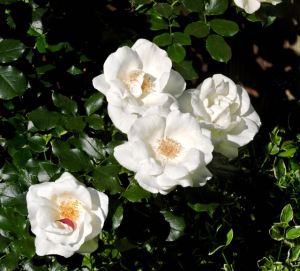
Four white roses, back garden
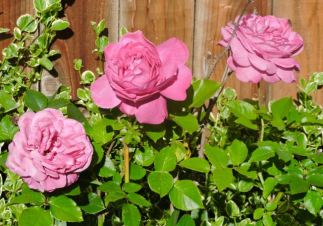
Lavender roses, back garden
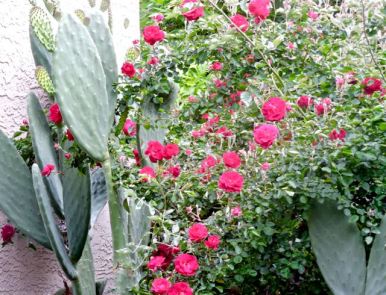
Pink-red roses amid the nopales, back garden

Buds, yellow roses, front garden
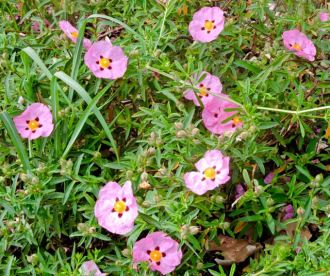
Rock roses, front garden


Red roses, back fence
Lemons and Oranges
Our meyer lemons persisted through five months, from December through April, giving us delicious lemonade and lemon juice for baking and sauces. This was our best crop ever (in nine years), both in volume and quality. And as the last 30 lemons hung on the tree this month, the new buds and flowers, magnificently profuse, were a bee magnet.

Bees come to the lemon blossoms as ripe lemons still wait for picking.
The last oranges were harvested in March. The new buds bloomed in mid April, drew the bees and butterflies, and quickly became tiny, tiny fruit. The new crop will be distinctly smaller than this season’s, as indicated by the relatively few buds and blooms. But see the visitors below…
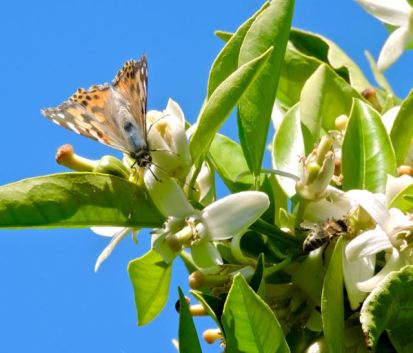
Painted lady butterfly and honeybee on orange blossoms, back garden
Apricots
Whereas the 2019 crop was one of our smallest in several years, the new crop appears to be by far our largest in the 8 years of the tree. We’re on track for a May harvest, but the cool March and April may push it back to June. We still have a few jars of the jam we’ve made from the previous four years!

Baby apricots ripening toward May-June harvest
Cherry Plums
Last year’s astounding crop will maybe not be matched this year, but already the tree is laden with tiny, hard plums that promise an abundant June harvest.
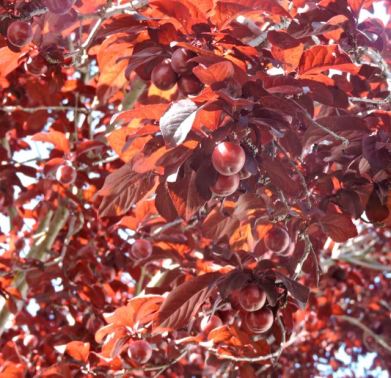
Find the many small cherry plums ripening toward June in the side garden.
Strawberries
We’ve had 6-10 plants in a small patch in the back garden for a good five years. The crop–and the plants–have never been large in our alkaline soil, but augmenting with acid in the watering helps. Spring is our best time for producing fruit.


Herbs
Most of our herbs are perennials, so we can use them year-round. Some are in pots, so I can move them to keep them out of the hottest summer sun (see below). Others are in ground, like the rosemary, fennel, lavender, and the floral garlic with its surprisingly pungent and useful leaves. A few are annuals, such as the basil. All make the air fragrant and brighten Jean’s soups, stews, and sauces.
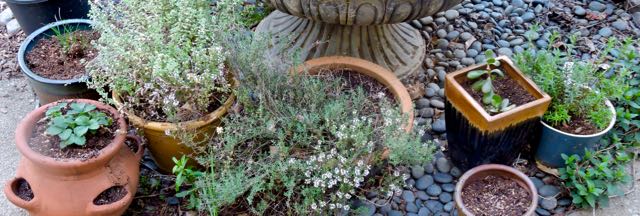
A few of our herbs, mostly potted: L-R, chives, marjoram, thyme, savory, mint
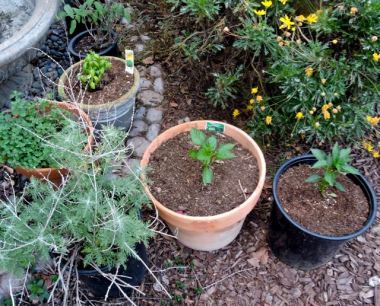
More herbs: on left, from top to bottom, culinary sage, Italian basil, Greek oregano, Russian sage
Friends in the Garden
No, not human friends, though we do invite fellow humans into the garden these days via this blog and FaceTime. These are other welcome friends:
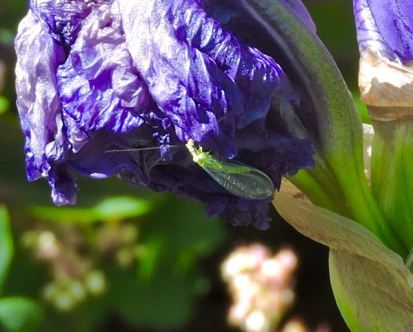
Green lacewing on purple iris, back garden
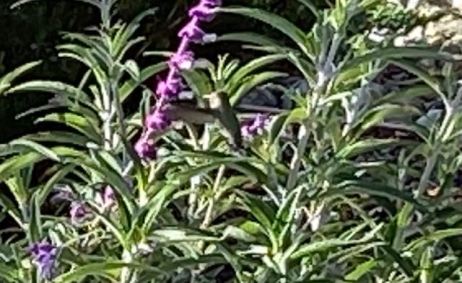
Anna’s hummingbird on Mexican sage, front garden

White-crowned sparrow on back fence

Our very territorial pair of scrub jays on our side fence

Another view of the painted lady butterfly and honeybee in the orange blossoms
A Note on Composting
Recently, a follower of this blog, having noticed our compost bin in a few of the photos, asked me to describe how I compost. Here’s my response:
I don’t have an entry specifically about composting, and I’m no expert. (There are lots of good sites online.) But I’ve had the bin (the one you saw) about 10 years, and we put plant trimmings, exhausted plants, dead leaves, rotted oranges, lemons, and peaches from our trees, veggie and fruit waste from the kitchen (but not cooked), and coffee grounds in it. I add in some of the extra soil left after I plant new plants. So it’s an organic plants catch-all.
But I don’t put in stuff like tree branches that will take a really long time to degrade. Those go into the garden/yard waste toter that the town picks up.
The bin stays covered most of the time to build up humidity and encourage the fruit flies. Whenever it rains, I leave the bin uncovered so the water can get in to soak the contents. In the hot, dry months, I water the contents about once a week for a minute to keep the biodegrading going. The water is important to the process.
I know the bin is working whenever I take off the lid, because the cloud of fruit flies hits me in the face!
Don’t expect quick biodegrading into soil. That takes months, especially because we have such a long dry season. As biodegrading occurs, the pile of debris sinks down. Eventually the stuff stops looking like plants and looks more like wet dirt. At this point, you can pull away the bin and start turning over the mushy contents so the most degraded, now actual dirt, appears. Now you can use it to nourish new plants.
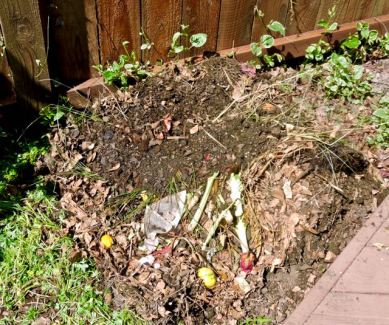
Bin contents after bin is pulled away
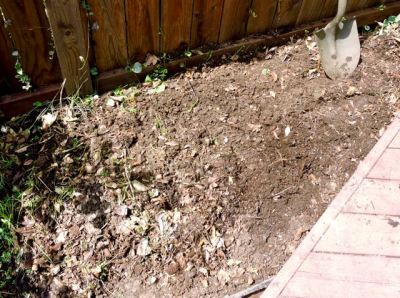
Bin contents after being turned over so most degraded are on top
Every other year, I shift the bin to another corner of the garden and begin the process again.
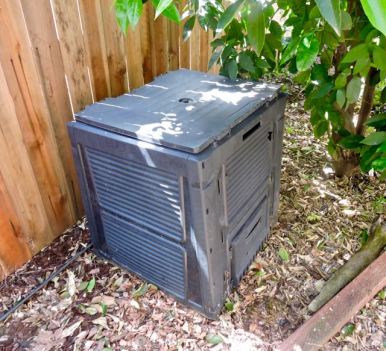
The bin in its new location to start the process anew
When I lived in the East, where it rained a lot, was more humid, and I had lots and lots of fallen leaves from our oaks and maples pile up in the yard, I just raked the leaves into corners of the property and let them sit–no bin. In a year or less, I could push away the top layer of leaves and there was rich humus to use for new plantings.
It’s more work here because of the dryness, but it’s still satisfying, because I know the debris is going to be used to nourish new plants. Nothing is lost.

And on to May!
 From Sacramento to Potomac: Tales of Two Valleys
Pingback: May 2020: Reopening? Or Reinvention? | A Sacramento Valley Kitchen Garden