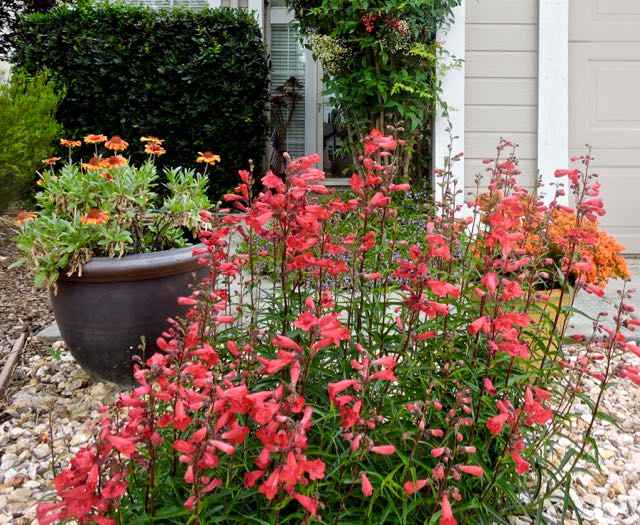
Reinventing the front garden: Red Penstemon in foreground, with Gaillardia, Alyssum Royal Carpet, and Orange Kalanchoe behind. Heavenly Bamboo rises above the Alyssum. The Penstemon, Gaillardia, and Kalanchoe are new since last year.
In this month’s blog:
Reopening? Or Reinvention?
Reinventing the Garden: New Plants and Reasons Why
May 2020 Fruit and Veggie Update
Reinventing in the Kitchen: Bread, Mother’s Day, and Beyond
May 2020 Gallery
Chris:
As of today, the cases of COVID-19 keep rising in the US by 15,000 or more per day–over 1.7 million in total–and the deaths have skyrocketed to more than 100,000–300% worse than in any other country. Nevertheless, every state is being pushed by the White House to “reopen,” almost as if the pandemic didn’t exist, and all states are relaxing restrictions. However, these relaxations include safety recommendations that vary with state and local governments.
Meanwhile, Jean and I have been working within the partial restrictions recommended by national health experts and still recommended here in California for seniors. (All but a few California counties have now been allowed to reopen most types of businesses, including retail, restaurants for sit-down dining, hair salons, etc., as part of Phases II and III of the reopening, but partial restrictions remain in all those counties.)
“Reinvention,” Not “Reopening”
I’d like to propose a different term than “reopening” for what will happen as the restrictions are lifted.
I propose “reinvention.” “Reopening” implies trying to go back to the way things were. “Reinvention” implies learning from the pandemic and making needed changes. Here are just four examples:
(1) The pandemic has alerted people to facts of health and well-being that won’t just disappear. Because so many COVID-19 hospitalizations and deaths have been hastened by such pre-existing conditions as high blood pressure, diabetes II, and compromised breathing, all of us should have even greater incentive to adopt
- better eating habits (and access to more healthful food options for low-income communities)
- regular exercise, and
- reduced carbon emissions.
Moreover, we must push politicians to create affordable health insurance for all Americans, since so many of us have suffered the double whammy of reduced income and endangered health.
(2) The pandemic has disproportionately impacted the poor, immigrants, persons of color, and elderly persons in nursing homes. In other words, this virus brings needed attention to the least powerful and most voiceless in our country: people whom it has been all too easy for the privileged to ignore and keep powerless. BUT, ironically, those who have been labeled during this crisis as “essential” workers are also disproportionately poor and of color: home health aides, hospital personnel, transit and sanitation workers, grocery workers, farmworkers, meat packers, etc. We must address this awful inequality, which undermines our entire nation. We must invest in these essential movers of our economy.
(3) Beyond personal health and financial inequality, the huge move to
- online work
- online schooling
- online socializing with family and friends
- online shopping and
- online travel
will have a massive effect on reinventing the national and world economy. Of course, this shift was already happening well before the coronavirus came along; but now billions of people are realizing multiple benefits of the technologies; more important, we are seeing how humans can adapt to new ways of doing things. Sure, there have been lots of glitches in the transition, and many millions still need much better access to the tools, but, hey, even old people like us are now Zooming and FaceTiming all over the place! As a result, we’re actually having more contact with our family and friends around the country than we ever did.
(4) The focus of countries around the world on trying to stop the spread of the virus, coupled with greater and greater respect for the work of scientists and health care professionals, should signal a huge infusion of public and private investment into epidemiological research and governmental preparedness (horribly lacking at the federal level in this crisis). We can only hope!
Reinventing the Garden: New Plants and Reasons Why
The restrictions have helped me focus on ways that the garden helps us make it through this crisis. See our posts for March and April. The restrictions also have given us time to think of ways to “reinvent” the garden through improvements.
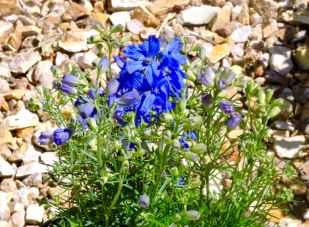
So far in the past two months, I’ve added 14 plants new to the garden, with both of us providing the ideas:
Delphinium Blackberry

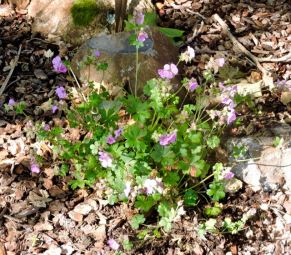
Cambridge Geranium Campanula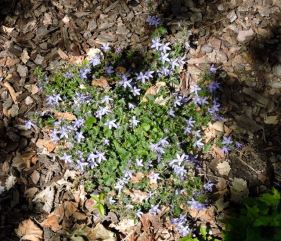
Two forms of Lavender


Milkweed Lemon Cucumbers
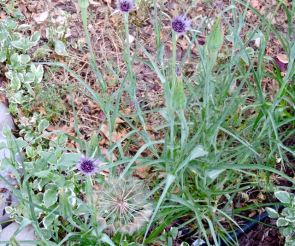
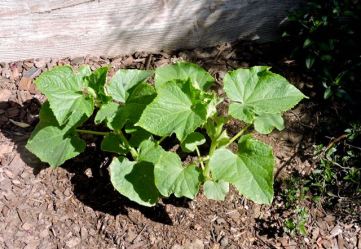
Bottle Brush Columbine
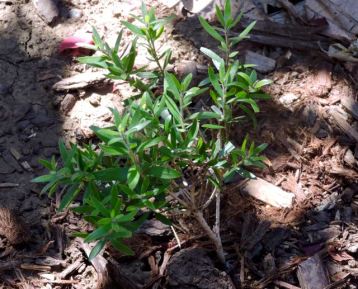
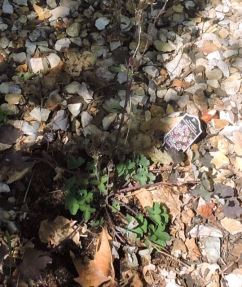
Ancho Chilis Diascia

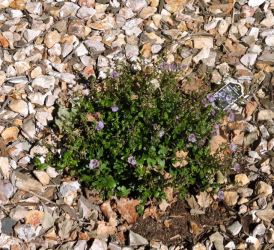
Carmello Tomatoes “Blueberry” Mini Tomatoes
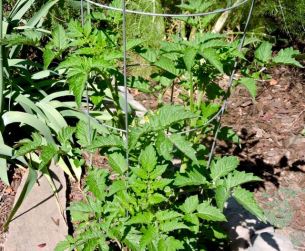

In some cases, the new plants replace other varieties. For example, the Carmello tomatoes replace the T-67 and Ace varieties that had not done as well as I’d hoped the previous two years. So far, there are 50 fruit growing on the 2 plants after 7 weeks in the ground.
Others, like the bottle brush seedling, the delphinium, the campanula, the diascia, and the Cambridge geranium, are meant to add color, variety, and bee friendliness in empty spots of the garden.
Still others, like the blackberry and the lavenders, add edible, pollinator-friendly varieties where purely decorative plants had been.
The milkweed, known for attracting butterflies, particularly monarchs, is a risky addition, because it is also known for taking over gardens, through its puffy, wind-blown seed balls. Jean and I routinely uproot the shoots of milkweed throughout the garden, the seeds having come from a three-block planting of milkweed along a nearby road. But I decided that one small display this season (study the Milkweed photo above) in our garden might attract a few butterflies, add a dash of purple, and be easily controlled. I’m hoping for the butterflies as the summer goes on.
All in all, we have at least 20 new plants in the garden over the past 7 months. Note the photo (top) that leads off this month’s post to see a few more of those new plants.
May 2020 Fruit and Veggie Update
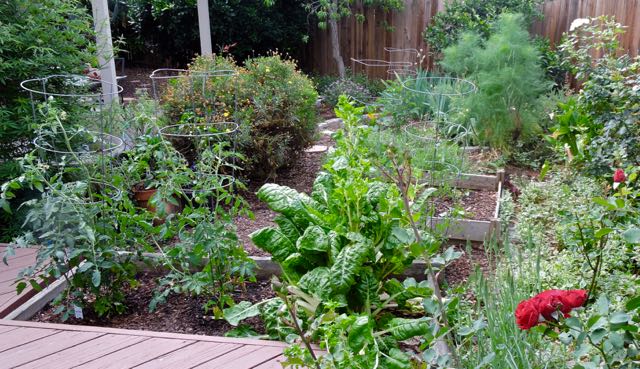
Back panorama: Carmello tomatoes, huge chard, milkweeds, red roses in foreground
Tomatoes
Besides the two new Carmellos described earlier, we have another SunGold grape variety (already 90 green fruit on 1 plant), 2 first time “Blueberry” mini tomato plants (18 green fruit total after 5 weeks), and one Husky Cherry Red (10 fruit after 5 weeks). All are looking good so far, especially the 2 Carmellos and the 1 SunGold.
Peppers
2 mild green peppers, 1 mild yellow, and 1 Ancho Chili (shown earlier). White flowers on all 4, but only 2 growing fruit as yet. 5 weeks in the ground.
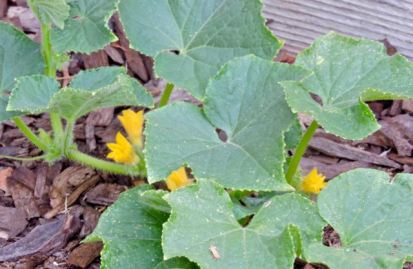
Lemon Cucumbers
2 plants. Growing well, 5 weeks in the ground. Flowers. No fruit as yet.
Rosa Bianca Eggplants
2 plants in the ground, 5 weeks, 10 inches high. No fruit expected for 2 more months.
Zucchini
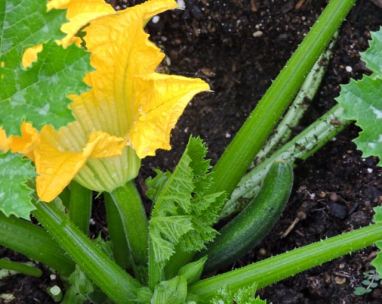
1 thriving plant (below), multiple flowers, 2 fruit growing. In ground 5 weeks.
Apricots and Cherry Plums
Both trees are heavily laden with fruit (see below), but the cool weather has pushed harvest until June, which is usual for the cherry plums, but not usual for the apricots, who usually harvest in late May. But temps over 100 this week are speeding up the apricots!
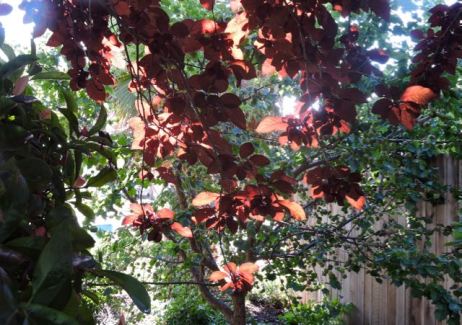
Early AM: laden cherry plum branches, with fruit-heavy apricot branches in background
Peaches
Unlike last year, when we had a bumper crop, this year there are no more than a few tiny fruit growing. Very similar to 2017, when we had a total of one peach for the summer. See July 2019: Hot, Dry–So What’s New? for a comparison to 2019.
Oranges and Lemons
This winter-spring citrus season was excellent, including our best year yet for meyer lemons (over 150). So far, the orange tree is on track for a moderate year in 2020-21, with small green fruit over 100 total. The meyer lemon looks ready for another banner year. But we’re so early in the process.


Mild yellow pepper and Ancho chili in pots, left; two peppers and two cherry tomatoes in square raised bed; Arugula thicket beyond raised bed
Reinventing in the Kitchen: Bread, Mother’s Day, and Beyond
Jean:
Baking Breads: The Joy of Flours
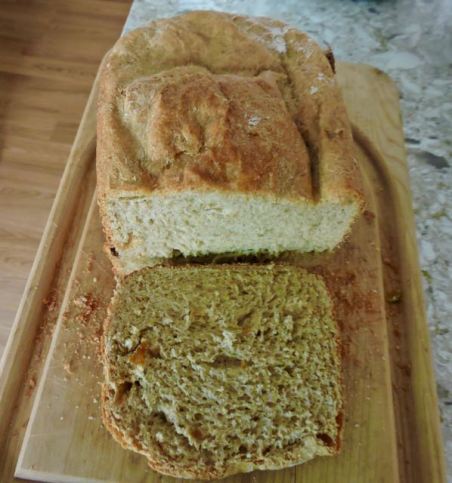
Oatmeal bread, with some whole wheat and semolina flours, plus some golden raisins chopped in
When the stay-at-home began, I had about a bag and a half of all-purpose flour, a half bag of bread flour, and some rye flour, whole wheat flour, and semolina flour. (I don’t think I bought the semolina; our daughters bought it and used it when they were in a pasta-making phase.) I wasn’t worried yet about my flour supplies; I assumed most people did not know how to make homemade bread any more, or didn’t care to do it. Not long after I learned that toilet paper was disappearing from the stores, however, I realized the flours of nearly all types were also gone! That led me to research how to use whatever I had on hand, including the semolina as a bread flour.
I didn’t adequately take into account that I, like so many other people, would find that baking bread was a comforting way to get through the boredom and discomfort of being stuck at home. It’s not like there weren’t any ready-made loaves of bread to be found in the store; I’ve had no trouble finding those. But at least for me, there were a lot of childhood memories around homemade bread. Bread was literally my mother’s favorite food, and she baked it sublimely. For holidays, she made fancy or sweet breads like Swedish tea rings and Sally Lunn. She taught me and my siblings, but I was perhaps her most apt pupil. We worked particularly hard on perfect loaves of white bread to enter in the county or state fairs. I remember my brother winning one time. He could really knead!
(As an aside, my older sister, who doesn’t really like to cook but is always asking for other people’s recipes, some years ago started requesting a recipe for a bread I had made once. I thought she would like that recipe because it did not require kneading, but when I kept trying to tell her “you don’t knead it,” she kept replying, “yes, I do; I really need it.” We finally sorted out our communication problem.)
By the way, one of the most delightful bread preparation methods I have played with during this stay-at-home has been a slow-rising no-knead bread baked in a Dutch oven. I have also resurrected my electric bread machine, essentially for the same reason. I don’t really have to do much, and it confines any mess to one pan.
It is also satisfying and fun, however, to make a hand-shaped loaf or batard, like the one in the photo below with Chris’s pasta sauce. That loaf was an experiment with using the semolina flour in place of bread flour, once I learned that semolina is similarly high in protein and gluten. We have also particularly enjoyed my rye breads, and the oatmeal bread I made (see photo above; it tasted better than it looks, having collapsed a little during baking) after my thoughtful daughter found some bread flour somewhere on the Internet and replenished my supply for Mother’s Day. My mother would have been proud of both of us.
Chris:
For Mother’s Day: Halibut in Creamy Lemon, Garlic, White Wine Sauce
Really going out on a limb this month, I cooked for Mother’s Day Weekend. Jean always assures me that I’m a good cook, but I don’t trust her faith in me. But nothing ventured, nothing gained, so I ruled the stove Friday through Sunday. My largest ambitions were for dinner on Friday, for which I made poached halibut in a creamy lemon, butter, garlic, white wine sauce. For color and veggie flavors, I added onion, roasted red peppers, and garden chard to the sauce, with salt and pepper to taste. I then added a tablespoon of flour for thickening and 1/2 cup of veggie broth.
The trick for this dish was cooking the sauce in a large skillet until the ingredients were cooked down to pleasing flavor and texture, and then adding in the halibut steaks, which cooked quickly in the sauce on low heat (about 9 minutes). If I’d put the fish in earlier and cooked it longer, I’d have had a mushy mess.
I accompanied the fish dish with easy baked potatoes covered with cottage cheese and frozen mixed veggies cooked al dente. All in all, the meal was a lot easier to make than I’d expected. And Jean said she loved it.

Pasta with Arrabbiata Sauce and Sausage
For Sunday dinner on Mother’s Day Weekend, I made a dish I was more comfortable with, since I’m so used to tomato sauces after all these years of tomato growing and jarring. Since I love all spicy tomato-based sauces, I looked forward to making this arrabbiata version.
It actually was an arrabbiata-puttanesca sauce, because my other favorite pasta sauce features green and/or kalamata olives. So what could be better (to me) than a spicy puttanesca? And I knew Jean would be game for whatever I came up with.
Since we had no fresh tomatoes yet, I used one large jar of marinara from the pantry, plus a can of diced tomatoes with basil. The spice came from some spicy lean Italian sausage that I browned in the skillet beforehand, with a chopped quarter of a large onion and two minced garlic cloves, all cooked in a tablespoon of olive oil and the sausage drippings.
Then came the fun, adding in the tomatoes and tomato sauce, about a dozen chopped green olives, 1/4 cup of kalamata olive juice, 1/4 cup of red wine, and a bunch of chopped herbs from the garden: thyme, marjoram, culinary sage, Greek oregano (spicy), and savory (also spicy).
Since I still thought the mix wasn’t spicy enough, I chopped into the sauce a super hot tiny Thai pepper from last year (in the freezer) and sprinkled in some super hot Asian chili powder. I cooked all of this down for about an hour on low heat, and it was ready.
Because I was tinkering with the sauce the entire hour, I knew it would be exactly to my taste: a bit more of this, a bit more of that, etc. I don’t think I could cook any other way. Bottom line–Jean liked this dish, too, and we each had two (small?) helpings.
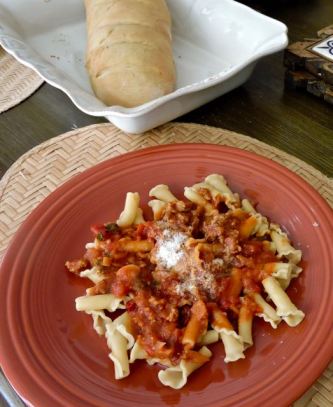
Pasta with arrabbiata sauce and Jean’s fresh-baked semolina bread
Jean:
Beyond the Usual: Lemon “Ricotta” Pancakes
In the imaginative spirit of isolation cooking, I found two interesting uses for some cream that had started to curdle. I often use sour milk for buttermilk, but this time I actually had some fresh buttermilk, and the cream was getting too thick to be used as a liquid. An easy switch was to use the curdled cream in place of ricotta in a lemon ricotta pancake recipe that also called for buttermilk. Now, I have never understood the big deal about lemon ricotta pancakes because I can’t really taste the lemon or the ricotta, but this combination did make for rich and creamy pancakes. And how about those tangy blueberries?
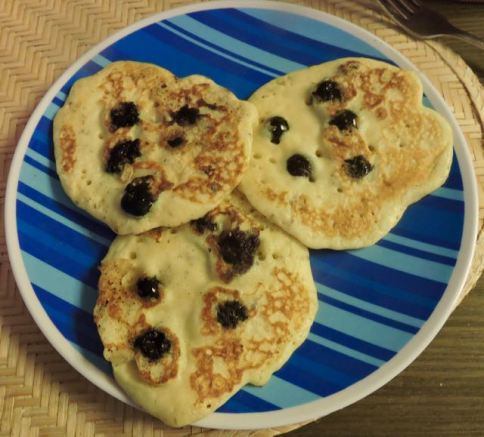
Lemon “Ricotta” Pancakes, with Blueberries
Punjabi-Style Red Beans with Paneer
The second use was more unusual. I was making Tejal Rao’s Punjabi-style red beans (rajma). https://www.nytimes.com/2020/04/28/magazine/punjabi-red-beans-recipe.html
The recipe calls for cream to be poured over the top, which sounded strange. In reading the comments, though, I learned that this dish is often made with paneer. A little more research revealed that paneer is a fresh homemade cheese, actually little more than clotted cream. Although paneer is usually cut in cubes like tofu, I simply poured my curdled cream on the top of the spicy tomato sauce in blobs like drop biscuits. It cooked in the sauce, and we liked the texture. Voila! Cream problem solved.
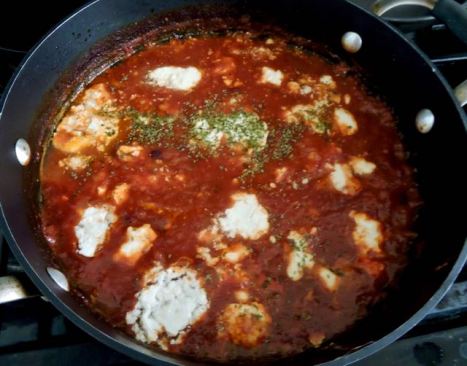
Punjabi-style red beans with paneer (Rajma)
Now to Spain: Patatas Bravas
A frequent item on a tapas menu, patatas bravas are easy to make. I cut baby yellow gold potatoes in quarters and baked them at high heat in olive oil. They need to go past the stage where they are just sufficiently cooked through. You need them to start to harden and crisp up, creating a lovely brown crust on the skin and cut edges. A simple garlic aioli and/or a spicy pimenton sauce are great for dipping. This sauce was merely garlic and pimento (both sweet and smoky) softened in olive oil and thickened with a little flour, then expanded with some broth.
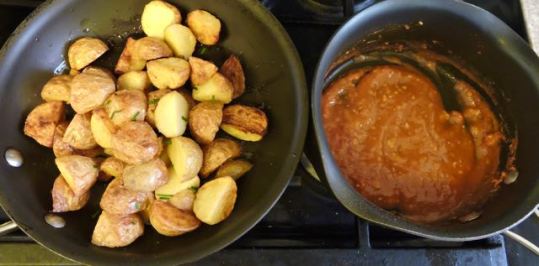
Patatas bravas and pimenton sauce
May 2020 Gallery
Chris:
This month’s gallery continues the theme of reinvention. Whereas my photos usually strive for technical accuracy and clarity of presentation, I’m including here a few that try for something a little less representational, something that plays with light, color, focus. Maybe something a bit more painterly, a bit impressionistic. I’ve always been intrigued by the STEAM movement, that fruitful blending of the scientific and the artistic, the technical and the more imaginative. Anyway, I hope you enjoy these.
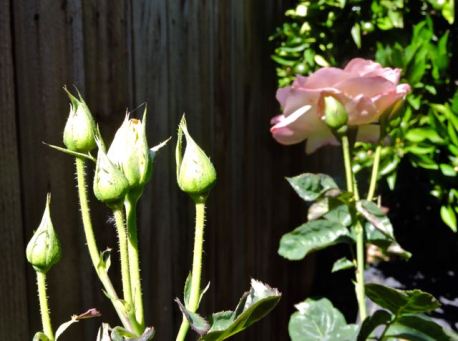
Peace buds

Nopales blossom

Baby nopales
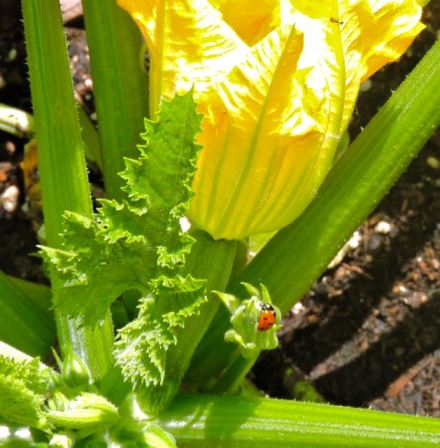
Ladybeetle on blooming zucchini
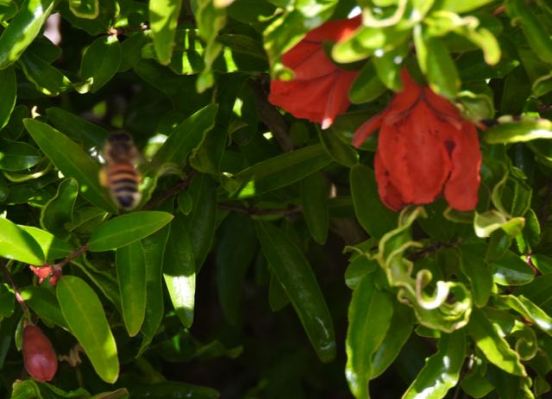
Pomegranate honeybee
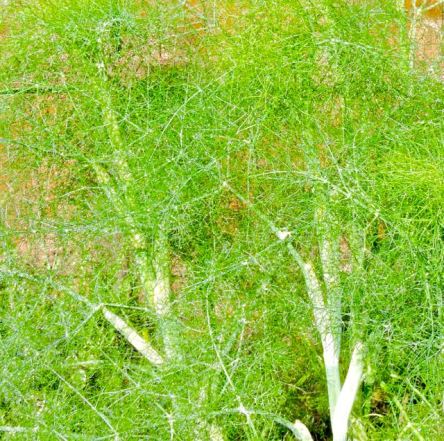
Fennel tapestry
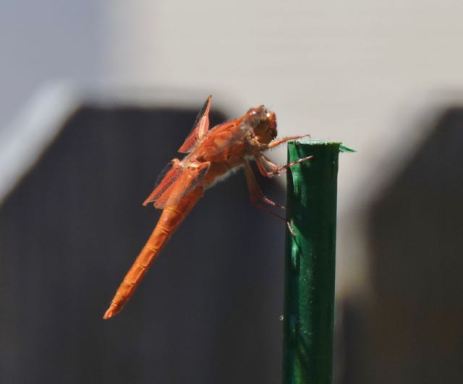
Dragonfly sculpts
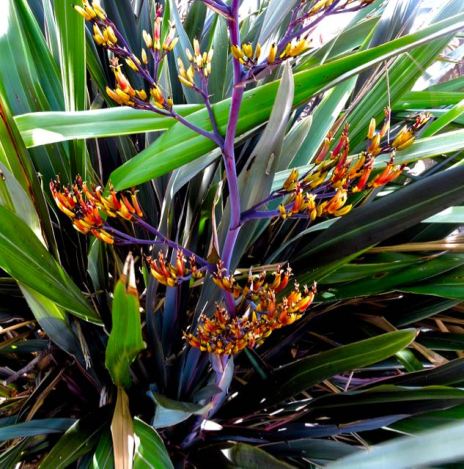
New Zealand flax flowers
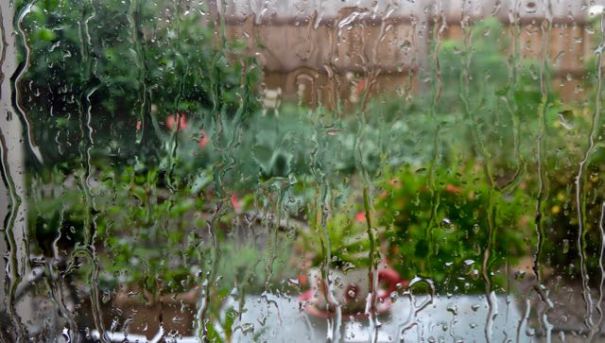
Rainstorm, 5/19, after Giverny
And on to June, with hope for the bees and bumble bees, who always must reinvent in a changing world.
 From Sacramento to Potomac: Tales of Two Valleys
Pingback: August 2020: Heat, Lightning, Fire, and the Garden Goes On | A Sacramento Valley Kitchen Garden
Pingback: December 2020: Coda to a Year of Reinvention | A Sacramento Valley Kitchen Garden
Pingback: May 2021: Garden Surprises in a New Normal | A Sacramento Valley Kitchen Garden