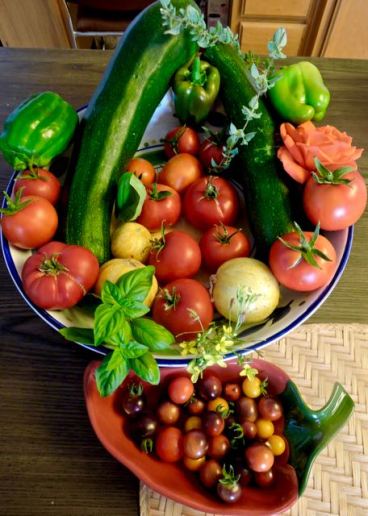
A July week’s harvest from some of our plants
In This Month’s Blog:
1. More Reinvention amid COVID-19
2. Transplanting: Reinvention on a Tiny Scale
3. July in the Kitchen: Garden Stir-fry, Sauces, Pickles
4. The Gallery: MidSummer Sampler
Chris:
1. More Reinvention amid COVID-19
While most other industrialized nations around the world have succeeded in controlling COVID-19 by maintaining effective, coordinated vigilance, the U.S. continues to struggle mightily. But there are examples of strong and effective leadership, even at the federal level.
Check out the video interview that Alice Park of Time conducted last week with Dr. Francis Collins, the director of the U.S. National Institutes of Health. If you don’t know him, Collins, an Obama appointee, is, among many other things, Anthony Fauci’s very admiring boss. (He called Fauci “a national treasure” in another interview last week.)
If you want to be inspired and heartened in this difficult time, watch how Collins describes the international coalition of scientists, including members of the World Health Organization, who are working efficiently to develop viable vaccines for COVID-19 in record time.
Collins exemplifies what’s possible when your method is to submerge your own ego and bring experts together online from around the world to meet essential goals that all nations share. That’s reinvention.
2. Transplanting: Reinvention on a Tiny Scale


In May , I wrote about a number of new plants in the reinvented garden. This month I feature transplanting, a different kind of reinvention I enjoy. In a small, diverse garden like ours, with variations in sunshine, shade, and soil environment, transplanting means taking plants that have been growing in one environment and shifting them to another–in hopes that their new homes will help the plants survive and thrive. For a necessarily frugal gardener like me, I hate to think of any plant as expendable.
Why transplant? Three Reasons
Reason 1: When I transplant, it’s mostly because a plant has not done well in one place and I want to save it. The strawberry plant (above, top left) is one of these. Actually, this plant had struggled in two prior places: (1) in ground, where our alkaline soil and full sun had kept it and its fellow strawberry plants from growing as large and as fruitful as they could be, and (2) in a wide and shaded, but shallow, pot that had not given the rhizome room to spread out. A deep ceramic pot in partial shade has now been home to this formerly struggling plant for most of a year. The new environment has allowed me to build an acid-rich soil that has let it flourish.
Another transplant to save the plant was that of the delicious arugula (below), which now tries to dominate a section of our back garden, so that I continually must cut it back. (This is a good problem!) This arugula had grown from seed in a pot in the shady part of our front garden, but it was dying because it needed more sun and room to spread out. Since transplanting more than a year ago, it not only thrives with only a little water, but its constant bloom of tiny yellow flowers makes it the most consistent bee magnet in the garden.


Reason 2: I also transplant when a plant does well, but where it is growing keeps it from coming into its own. As I wrote last October, our California Fan Palm (two pics above, bottom) was flourishing at 2 feet tall in its large pot on our veranda for three years, but I wanted to see what it could do in ground in full sun in the front. That was eight years ago, and wow! 25 feet tall.
Reason 3: Sometimes I transplant just to spread the lively beauty around. Because cacti and other succulents can be grown from cuttings and need little water, why not plant small bits of these attractive plants around the garden and see how they do? For example: the pale green succulents I recently transplanted into the ornamental pot on our veranda (two pics above, top right) had sprung up in another part of the garden where they couldn’t be seen. Now they bring joy to our eyes each day.
An even better example is this strikingly gorgeous aloe plant:
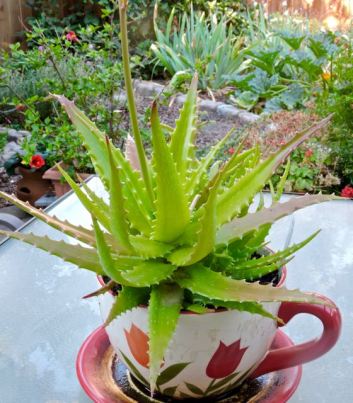
…which has flourished for three years in our tea-cup planter on the veranda–and which has now produced four additional plants, all squeezed into the cup’s small circle. These four cute “pups,” as the growers call them, need their own space. So I carefully separated them from their mother…


…and the four pups now luxuriate (above) in their own comfy homes around the garden; while Mom…
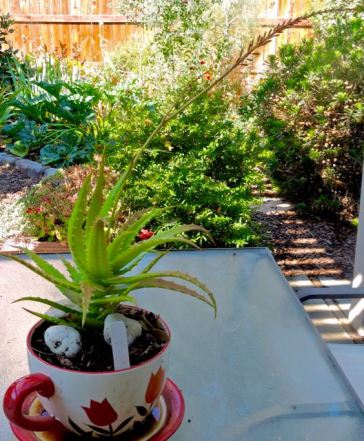
…has the tea cup all to herself.
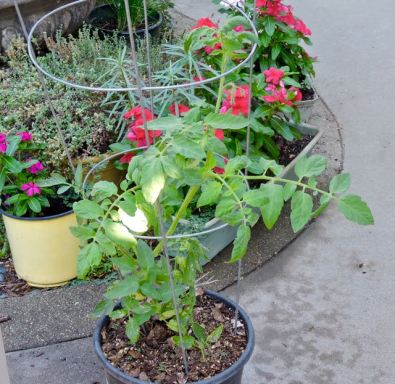
Transplanting doesn’t always work, of course. Sometimes plants are too far gone to be revived, or the new home proves just as inhospitable as the former one. But give your transplants a chance (and regular water). Exercise patience, and you may be rewarded. Example: I thought a scrawny sucker from a Carmello tomato had only a small chance to succeed, and when I snipped it off and transplanted it into its own large pot in mid-June, it suffered in the 95-plus degree heat for two weeks with no improvement. But the new roots were building and eventually took hold, so that by week 3 the sucker turned deep green and was growing. Here it is on July 16, three times as tall and about to produce its first yellow flowers:
3. July in the Kitchen: Garden Stir-fry, Sauces, Pickles
Jean:
What a great month for turning garden produce into easy, light, tasty, healthful dishes! Here are three recipes that employ that bountiful produce in versatile ways.
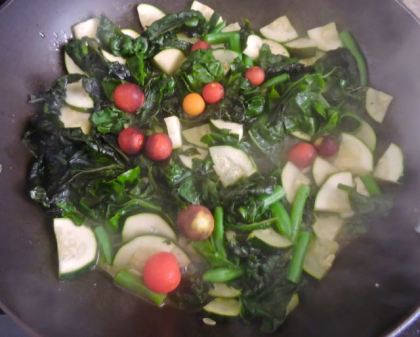
1. Veggie-Herb Stir-Fry
This colorful skillet stir-fry (above) features the garden veggies (below) that Chris brings in from the garden…
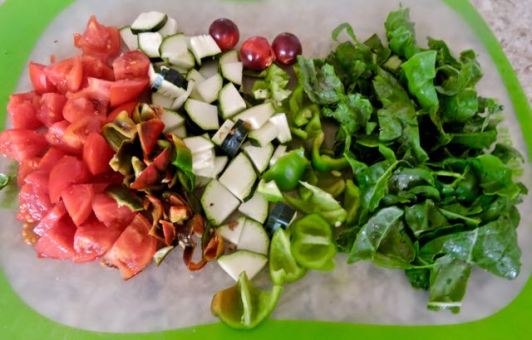
Stir-fry ingredients, L-R: tomatoes, ancho chilis, zucchini, grape tomatoes (top), green peppers, Swiss chard
…and combines with the herbs he also picks:
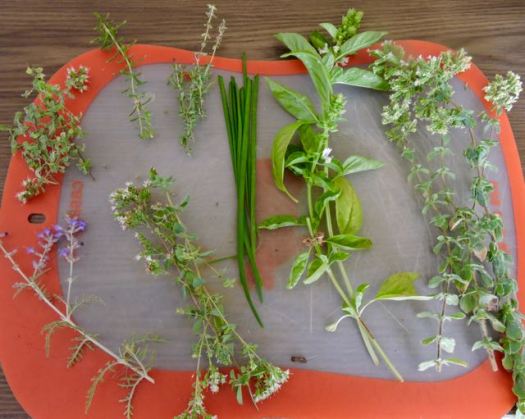
Herbs, L-R: purple Russian sage, marjoram, thyme (top), Greek oregano, chives, Italian basil, spicy oregano
Here’s the tedious part: If you use fresh herbs like these (you don’t have to, if you have the dried versions handy), you have to separate the tiny leaves from the woody stems. But once you get the hang of it (as Chris has), it’s actually quite easy.
Cooking: In no more than a tablespoon of your oil of choice (I use olive oil), fry the mixture of veggies and herbs on low to medium heat until the ingredients reach the softness you prefer.
As for spiciness, if you use spicy herbs or a spicy oil, the mix may be spicy enough, but if you like it more picante, sprinkle in hot pepper, hot sauce, or whatever else you like. Salt to taste.
The key to this dish is to stir it often enough so that the spices and herbs get mixed in, the whole melange swaps around, and the veggies soften without sticking. Paying attention to the cooking is fun, because the aromas of the veggies and the herbs just go to your head.
Use the stir fry as a side or as a meatless main dish–your choice. We’ve also used it as a pizza topping.
2. Tomato Sauces
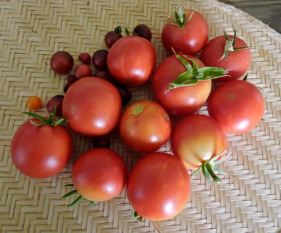
-
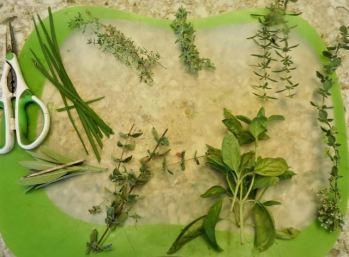
Garden herbs for tomato sauce
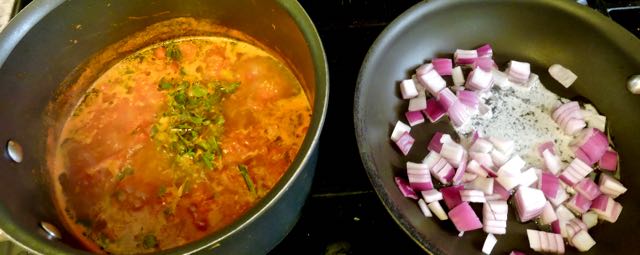
Sauce cooking and onions sauteeing
Our good crops of Carmello and “blueberry mini” grape tomatoes have produced several jars of tomato-herb sauces already this summer. The sauces take more cooking time than a stir-fry does, but the prep time is about the same. All together, we spend about 2 hours prepping and cooking the tomato sauces: about 35 minutes in prep and an hour to 90 minutes in cooking.
Prep: Wash the tomatoes. Chop off the stems. Strip the tiny leaves from the woody stems of the herbs. Chop larger-leaved herbs like basil and culinary sage into small pieces. Chop half a medium-size onion into half-inch pieces.
Cook:
- Place 12 medium-sized tomatoes into 3 cups of water in a large saucepan and bring to a boil. Boil until the skins begin to detach from the tomatoes. Use tongs to remove the skins.
- Saute chopped onions in a skillet at low heat in an oil of choice (I like to use butter or olive oil). Saute until onions are translucent.
- Continue to cook skinned tomatoes on low heat.
- Add in cooked onions and the chopped herbs.
- Add other ingredients to taste: we used red wine, green olives, spices, salt, and pepper in recent sauces, but feel free to use other ingredients you prefer.
- Tasting often, continue cooking sauce mixture on low heat for a half hour or more, or until all the tomatoes have cooked down into a sauce. If you need to add more water before the tomatoes have completely cooked down, do so. Don’t rush this process. Take your time and enjoy the aroma.
- When the cooking is done, turn off the heat. The sauce is now ready to serve as a topping for pastas, meats, or veggies. Let the sauce cool before saving it into jars for future use.
So far this season, we’ve made three different styles of tomato-herb-based sauces: mild, spicy (arrabiata-style), and spicy-green olive (arrabiata-putanesca style). Be inventive with your ingredients!
The great thing about both stir-fry and the sauces is that they keep well in the refrigerator and can be used in a wide variety of dishes. Enjoy!
3. Cucumber Pickles
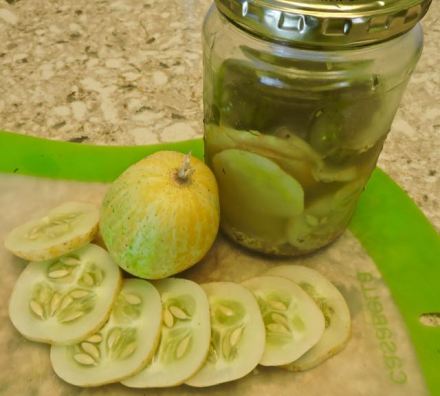
This one is really easy. Just slice the cukes (we’re growing lemon cukes this season, as shown above, but any type will do). Then make your pickling mixture with vinegar (we’re using white vinegar this year), water, and whatever spices and herbs you prefer. This summer’s mix is really simple: salt and black pepper!
As you use up the pickles, just add more slices to the mixture in the jar. Shake up the closed jar to coat the new slices, and then just let them marinate in the refrigerator. Perfect!
4. The Gallery: MidSummer Sampler
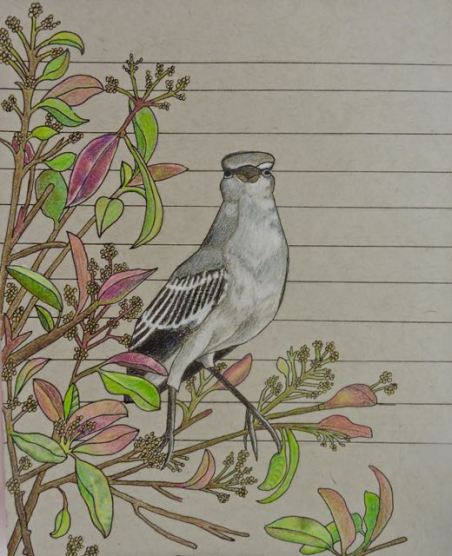
One of our daughters created this pastel rendering of a photo from the February blog. A beautiful gift to us.

Hibiscus bloom in the early morning sun

Two new pomegranate fruit amid the blooms
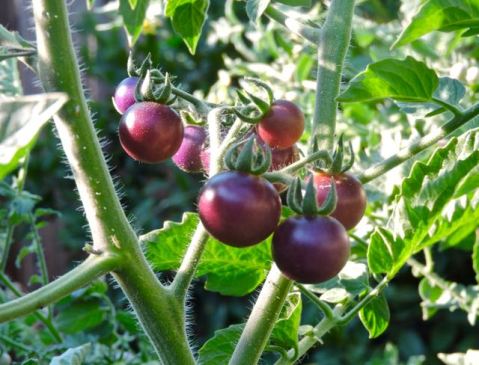
Cluster of ripe “blueberry mini” tomatoes
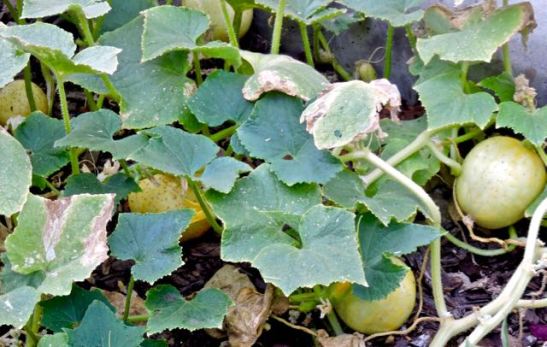
Lemon cucumbers proliferate on the vine.
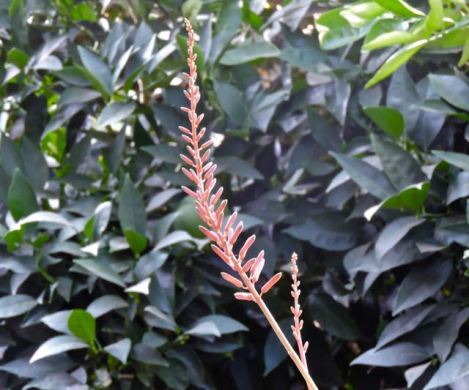
Aloe flower stalk
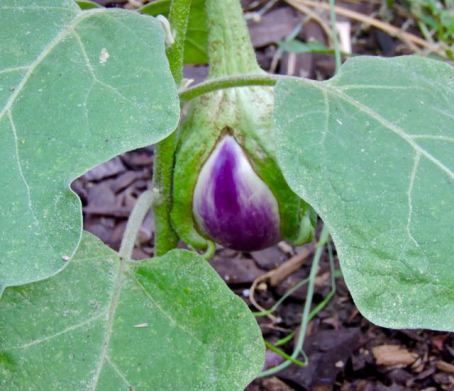
Our first eggplant fruit of the season, still growing.
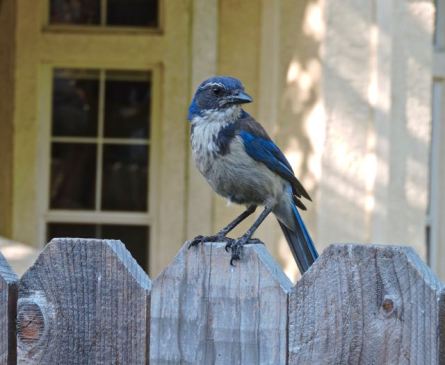
Our scrub jays just won’t stay out of the picture. This one landed next to me, when I had the camera handy.
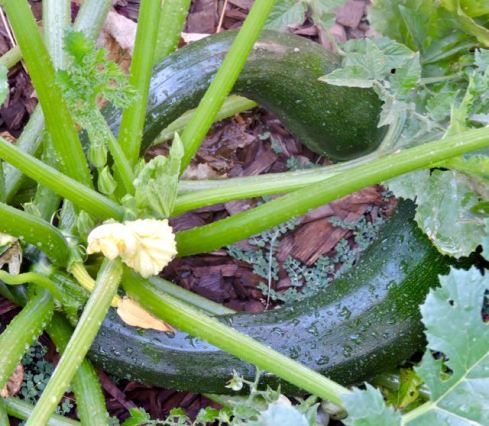
Two of our mighty zucchini: I picked them the same day.
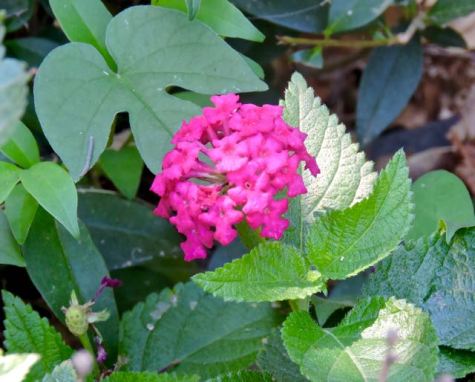
One tiny lantana cluster
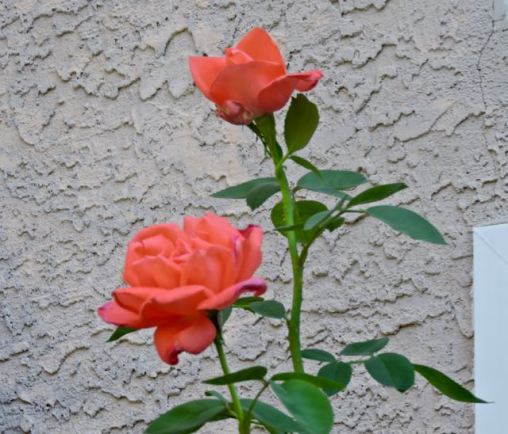
I can never resist snapping the salmon roses.
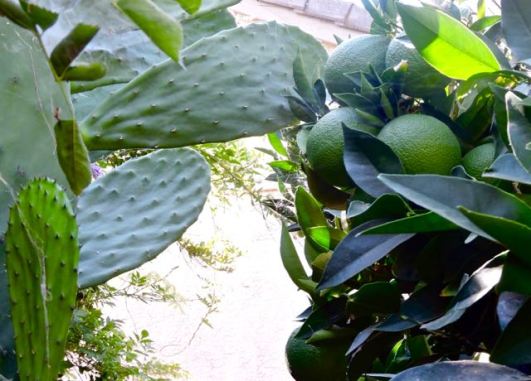
The green oranges and the nopales just love to confront each other.
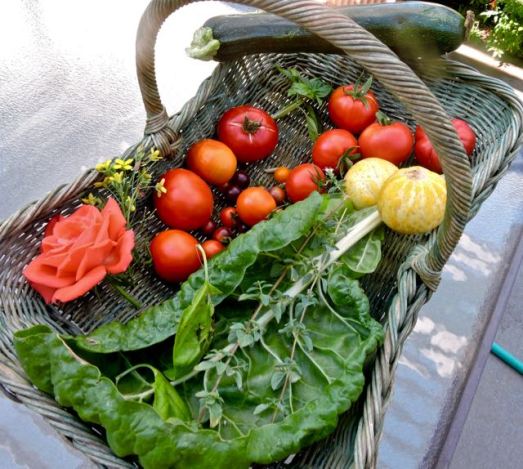
A tisket, a tasket, a garden in a basket

In 2017, our peach tree produced one peach. This year, too. We picked it the next day, and it tasted as perfect as it looked.

This yellow swallowtail visits our garden for a few seconds every day as it tours the neighborhood. I was so lucky to get this photo.

Our two Carmello plants this season have been glorious producers. They love the full sun.
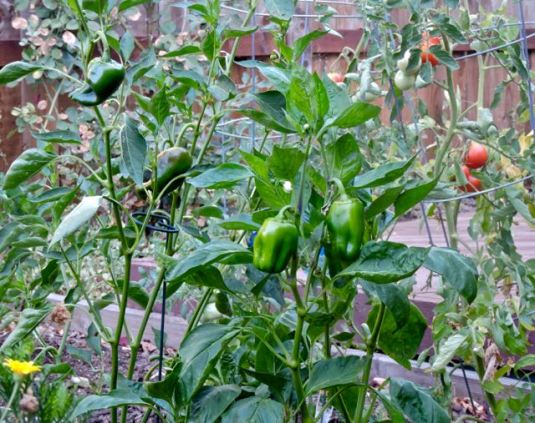
Stir-fry in the making: ancho chilis, mild peppers, tomatoes
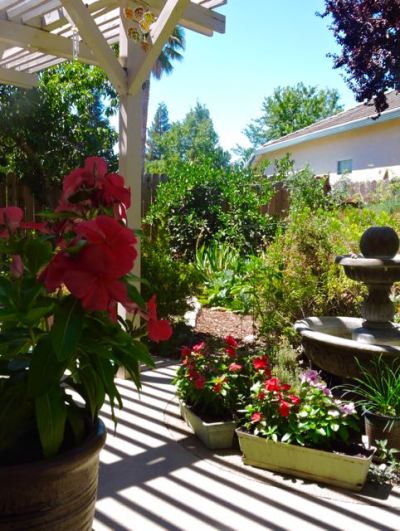
High noon under the pergola, late July
And on to August!
 From Sacramento to Potomac: Tales of Two Valleys
Pingback: August 2020: Heat, Lightning, Fire, and the Garden Goes On | A Sacramento Valley Kitchen Garden
Pingback: September 2020: Summer Lingers, Fires Live On | A Sacramento Valley Kitchen Garden