In this month’s blog:
Coda to a Year of Reinvention
The Garden: Growing in the Foggy Chill
Treats from the December Kitchen
December Gallery: Foggy Photos
Chris:
Dec. 24–And the Reinvention Continues. Even as the outgoing occupant of the White House keeps fantasizing that the voters didn’t oust him from the Presidency in November, most of the rest of us keep moving on in reality, reinventing helpful responses to the continuing–even increasing–strength of COVID-19. Mask wearing, social distancing, the new vaccines, and digital everything–meetings, schooling, parties, family gatherings, performances, and business–are just a few of the many reinventions that people around the world have shown the courage to make.
As I write, America is hoping that the outgoing President will stop doing his cruel imitation of Ebenezer Scrooge (except Scrooge wasn’t so bad that he spent his precious time playing golf and pardoning his convicted cronies). Let’s hope that the outgoing President can still see straight enough to sign the latest COVID-19 relief bill, to help the Americans hardest hit by the pandemic begin to get back on their feet. Come January 20, the new Administration–which a record number of Americans voted for–will really tackle the crisis, which the new elected leaders seem fully ready to do.
My most immediate wish this holiday season is that the bill is signed and relief can start to flow.
Dec. 27, 6 PM–guess what? My wish was granted. He signed the relief bill. Do you think that the outgoing Prez was visited by the 3 spirits of Christmas? We’ll wait and see what he does next.
*************
I’ve been repeating the theme of Reinvention every month in this blog since May. Some folks still cling to the notion of “getting back to normal”–a vision of a past in which many were comfortable but more were not, and which was steadily destroying our planet. Lucky for all of us, most Americans are putting their minds, hearts, and hard work into “moving forward to better”–building a stronger economy that cares about health, and into achieving more inclusive societal and environmental goals that will make the U.S. a better place to live for everyone.
We can do lots better than “normal.” But it will take
*imagination
*patience
*dedication
*cooperation*
*and the willingness to adapt.
The Garden: Growing in the Foggy Chill
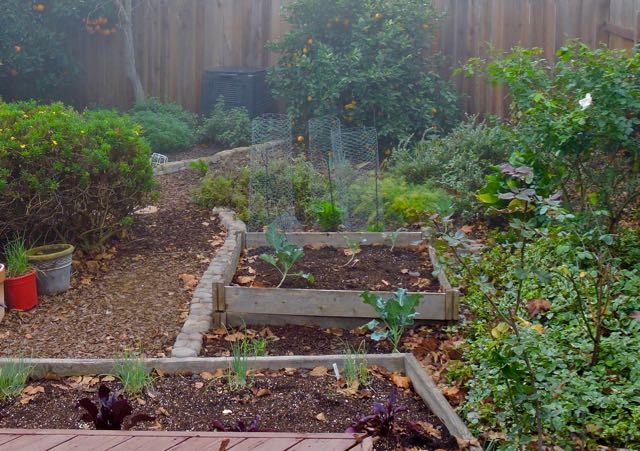
On a foggy late December morning: red beets and green onions in the large raised bed, broccoli in the small raised bed, and lettuce in cages beyond, with oranges (top left corner) and meyer lemons in the background
If anyone knows the need to be patient and willing to adapt, the gardener knows. For a warm, rainless first half of November we were still in fear of new fires in Northern California, and so had to keep the irrigation systems flowing. Since November 17, the inch and a half of rain so far has made a big difference in growing conditions. With temps between 35 and 58, I was able to turn off the irrigation system, because the ground stays moist enough for the winter veggies to grow.
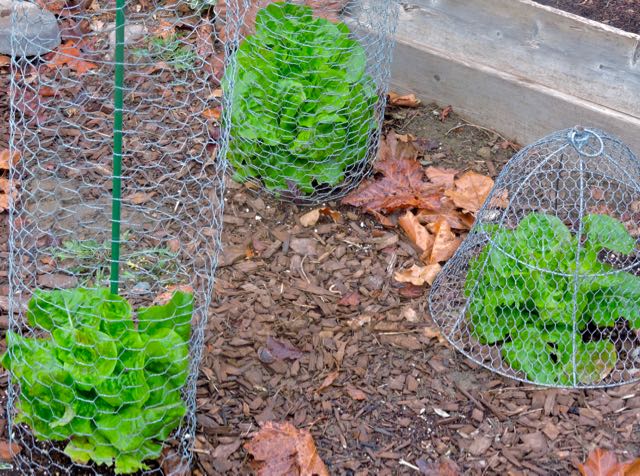
How are our new veggies doing? They are growing apace in the cool, damp weather. The lettuces (left) are thriving in their chicken wire cages, and we are regularly plucking the large leaves for our salads and sandwiches.
The green onions and Bulls Blood beets are also maturing in the large raised bed, for harvest in January we hope (see below). Meanwhile, the broccoli plants (also below, left) get gradually larger, though it’s still too early for the heads to begin to form.
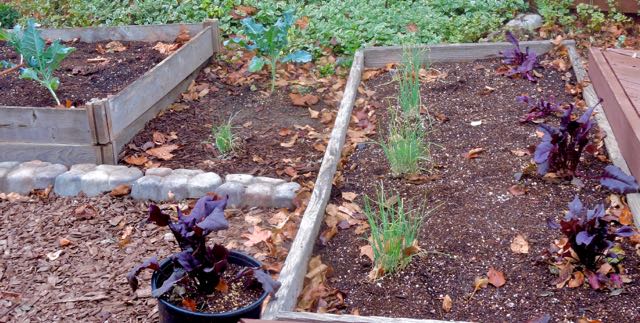
Green onions and Bulls Blood beets in the large raised bed, with Green Magic broccoli to their left in the small raised bed and between the beds.
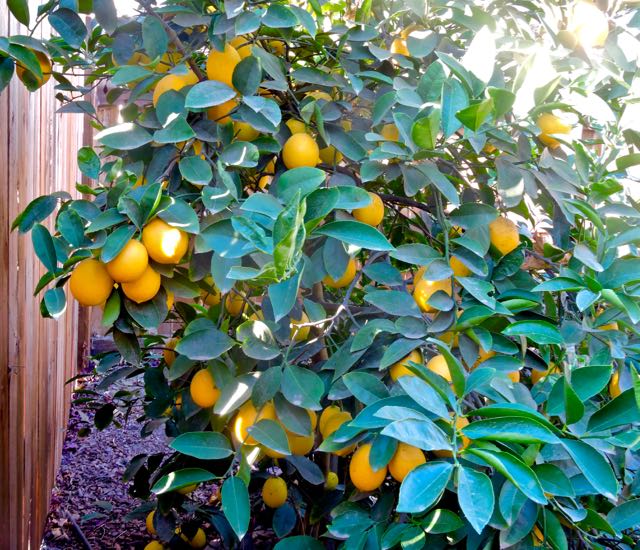
Oranges and Meyer Lemons. These perennial champions thrived in the hot months with twice-weekly watering, as they turned from buds to tiny green fruit and are now close to full size and ripeness. The meyer lemon bush (below) grows larger every year (it’s now eleven years old), and it is more full of lemons than ever (we had 150 last season).
The navel oranges are fewer in number than last season (about 150 vs. 250), but larger in size. Unexpectedly, a few clusters grew so heavy that we had to clip them off the tree this month so that the branches wouldn’t break, even though we knew that they’d not yet be sweet (full sweetness happens in February). See below.
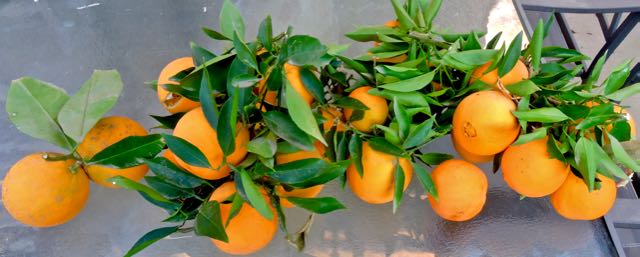
But the early harvest just meant that we’d be making our orange-and-lemonade earlier–with more sugar and stevia!–as both fruits were already plenty juicy, flavorful, and piquant.
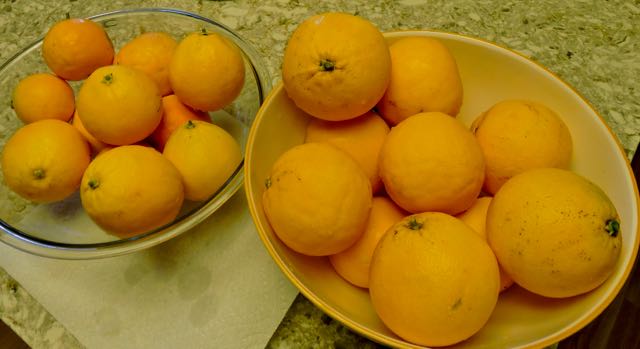
What to do with oranges having to be harvested while still more sour than sweet? Harvest some lemons, too, add sugar and water to the whole batch, and have December orange-and-lemonade!
Swiss Chard: These attractive plants are tasty to the birds (as are all the leafy veggies), so I tend to start them in pots closer to the house, and then plant in ground after they’ve grown larger. Right now, four are in pots and two in the ground, with those in the pots doing better.

After an early morning shower, the sun shines on lettuce, Swiss chard, and aloe in pots on the back veranda, with the orange tree in the background.
Treats from the December Kitchen

Jean:
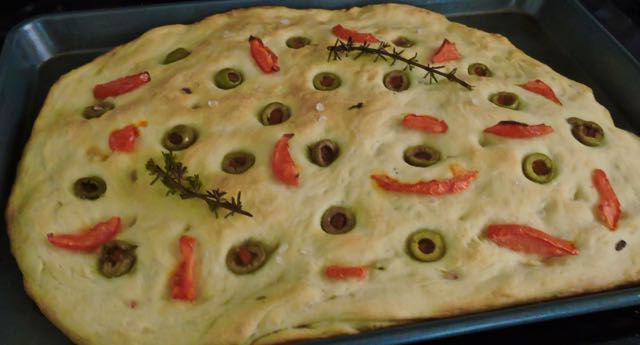
The picture immediately above is my version of focaccia just before it went into the oven. I had recently seen Ree Drummond make a focaccia on the Food Network that I thought looked Christmasy, because she put halved pimento olives and cherry tomatoes into the divots you make in the dough.
I read a lot of recipes for this classic Italian bread, and I particularly enjoyed Anne Burrell’s explanation of why she uses a lot of olive oil to bake the dough in.
Following that advice and using rosemary from our garden (doesn’t it look like Christmas tree sprigs?), Spanish olives, and sliced tomatoes on top, I came up with a festive looking bread. I was sorry I didn’t have cherry or grape tomatoes. (We’ll have more from our garden next summer!) I only had a vine-ripe tomato, and I saw that Jeff Mauro makes focaccia with very thin round slices of tomato on top.
So that was my “Christmas tree” version, which you’ll see fresh from the oven in the photo that heads this blog post. It was fun to make–and turned out yummy and fun to look at as well. Not only did it have a crunchy crust, but it was soft inside and had a hint of rosemary in the aroma. It toasted beautifully the next morning, too.
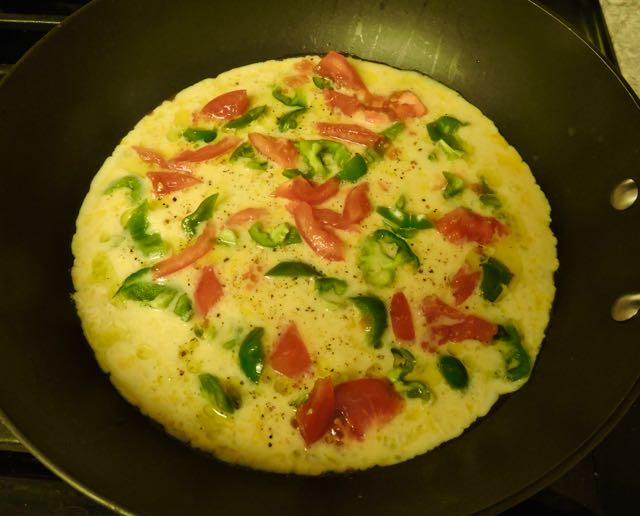
Talk about a Christmasy look: to the left is Chris’s tomato and green pepper omelet (made for one of our holiday breakfasts with the very last peppers from the garden this season). His omelets always turn out super fluffy–he says because of the extra portion of milk he adds to the beaten eggs and grated cheese mixture.
Just below is a bowl of a beef stew I made in the middle of the month. The return of fog, drizzle, and cold always puts me in mind of stews and soups.

Made in the slow cooker to soften the stew beef and the veggies, this aromatic and richly tasty stew included yellow gold potatoes, sweet potatoes, carrots, mushrooms, apple chunks, garlic cloves (2), red wine, vegetable broth, and herbs from the garden: thyme, marjoram, savory, sage, and rosemary; with the entire mixture salted and peppered to taste as the stew slowly cooked throughout the day.
Along with the stew, I made some of Kelsey Nixon’s quick rolls, pictured with the stew above, to which I added some whole wheat flour.
Christmas Dinner: For Christmas, I decided on a classic steakhouse menu–really different from our usual simple fare! It included homemade cream of mushroom soup, green salad with blue cheese and balsamic dressing, grilled Kansas City strip steak (the original New York strip), Yorkshire pudding, twice-baked potatoes, creamed spinach, and fresh green beans, along with red wine from Sonoma.
For Christmas dessert, we had a sort of potpourri trifle made with ginger cookies, pear butter, pear chunks, and blended mascarpone and sweetened condensed milk, accompanied by lemon-ginger tea. It didn’t look great (no photos, sorry), but the fresh, fruity, crunchy, creamy, and gingery flavors made up for that.
The Yorkshire pudding was almost by accident. My daughter mentioned that she was making it with a prime rib. I went looking for a recipe, since I had been thinking of doing a spoon bread. I learned that the recipes and methods were almost the same, and both batters had similar proportions of eggs, flour, and liquid as those in the crepe batter we had made for breakfast. I decided to give it a try and baked the rest of the crepe batter in deep muffin tins with oil and drippings from the steak. Voila! (or whatever else the Brits say). The “puddings” (that’s definitely what these savory treats are called in Great Britain) puffed properly and were devilishly tasty!
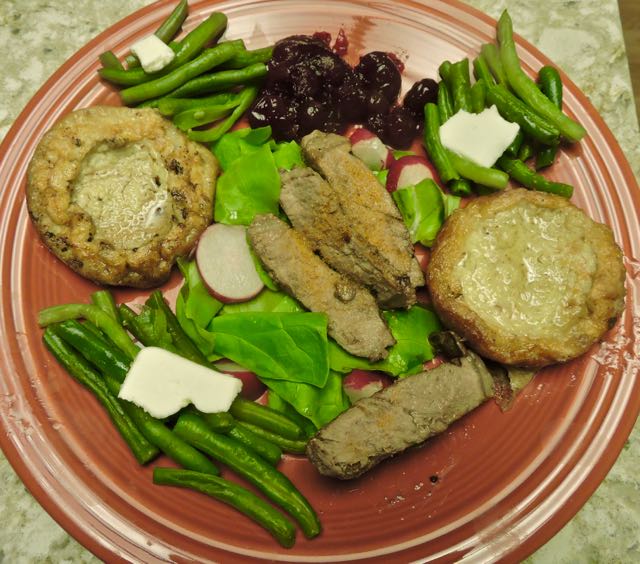
Could we eat on Christmas all we had prepared? No way. The next day, the leftovers made a savory plate, with the steak and Yorkshire puddings warmed in a buttery skillet and green beans still crispy from the microwave. We even added cranberry sauce and leftover butter lettuce salad with radishes for an extra kick.
December Gallery: Foggy Photos
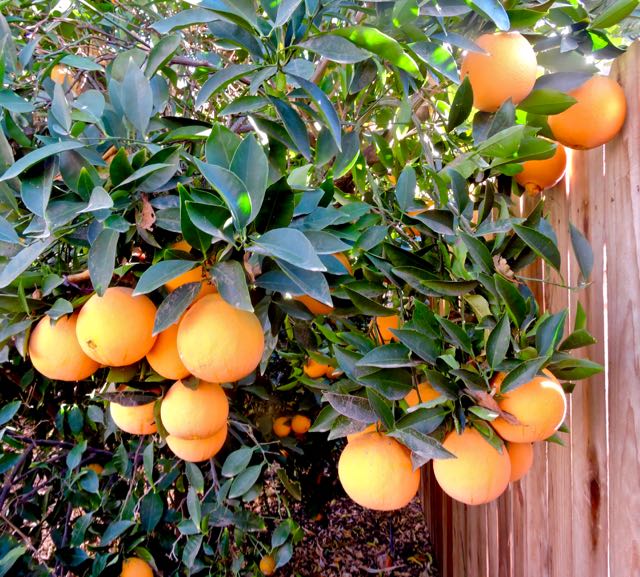
Clustered oranges








As this rose shouts, “Happy New Year!”, let’s keep our new year’s resolutions–or at least try to…
 From Sacramento to Potomac: Tales of Two Valleys
Pingback: January 2021 (Part 2): A Stormy Gift in the Month of Birthdays | A Sacramento Valley Kitchen Garden