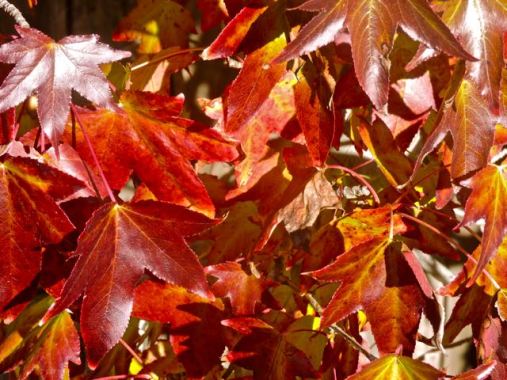
Sweet gum leaves, mid December
In this month’s blog:
Saving the Nutritious Leaves
Garden Update: The Bountiful Rain Continues
The December 2021 Gallery
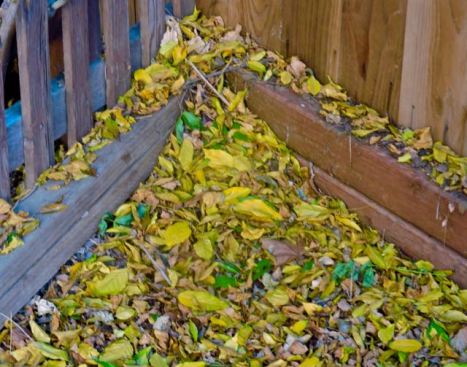
Wisteria leaves, side garden
The Holiday Gift of Fallen Leaves
And the ground spinning beneath us/ Goes on talking.
–Joy Harjo, “For Alva Benson”
A fallen leaf is not dead; it has just moved on to a new stage of its life.
Our sycamore in the front garden sheds its leaves from October to December, slowly covering the dark mulchy ground in a carpet of gold. The peach tree in the back drops its long, pale green, curly leaves in October; the breezes scatter them into every corner of the veranda, beneath the orange tree, and amid the roots of the coreopsis, the alum root, the new callalily shoots, the rosemary, the roses.
The apricot, which gave us its fruit way back in May, sheds its leaves in November, nourishing its own roots even as, in January, its branches will put forth the tiny new budlets. The cherry plum is the last leaf spreader among the fruit trees, building its dark maroon tapestry across the side garden from November into January, nourishing the red flame sage, the photinia, the fuchsia, the lavender, the Mexican purple sage, the Western lilac, and the cherry plum itself.


The winds of autumn make sure that every plant in our garden receives its share of the fallen leaves nearest to its roots. The rock roses in the front are particularly hungry for these nutrients. The winds push the assorted leaves between the rose plant’s sturdy branches, and, once embedded, the leaves decay in the winter rains to let the nutrients make their way into the ground. Natural fertilizer on a yearly cycle.

Sycamore and cherry plum leaves captured beneath purple bush sage
As long as I let nature take its course in the garden, the nourishing process works. But, like most suburban gardeners, I get in the way. I worry about the superabundance of fallen leaves being blown out of the garden and onto the driveway, the sidewalks, the streets, and into our neighbors’ yards. So when the leaves, particularly the large, yellow-brown sycamores, pile up in the front garden, I’m out there with my trusty broad-fanned rake to herd the excess leaves into piles and then move each pile into either my own compost bin or the big compost pile in the back garden, or the 25-cubic-foot green toter that a powerful city compost truck unloads into its innards each week. The truck then whisks away the leaves to make food for fields.
At least those leaves are able to live on and nurture new plants. When I was a small boy in ancient times, my sister and I would help our Dad rake leaves into piles in our chilly backyard in New York. We had the great fun of jumping into those piles and landing softly on the cold grass. Then we’d stand aside as Dad lit those piles on fire. We’d smell the fragrant smoke and watch bits of the leaves sail into the wintry sky on thermal billows until all the leaves were gone.
It’s a good thing that our plants have the branches and stems to trap the fallen leaves that they need to grow strong. Otherwise, I might be trying to pull out the leaves they’ve held onto–rather than cheering that those plants can do such a great job of feeding themselves. Like many of my neighbors, I too often give in to the silly suburbanite notion that a good “yard” is supposed to be a neat-as-a-pin outdoor version of the neat-as-a-pin indoor home that all of us envision as a goal.
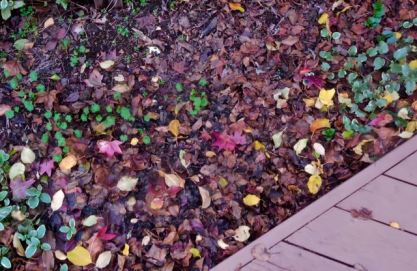
Compost pile, many leaf varieties, back garden
It sometimes ain’t easy to remember that a “yard” can be a living garden, a home for creatures that don’t play by the rules of home decor. If we try to make nature follow those rules, we just plain kill it (and more and more ourselves in the process).
A fallen leaf is only alive and giving when we allow it to feed the future. Here’s to that future and to those countless possible gifts.
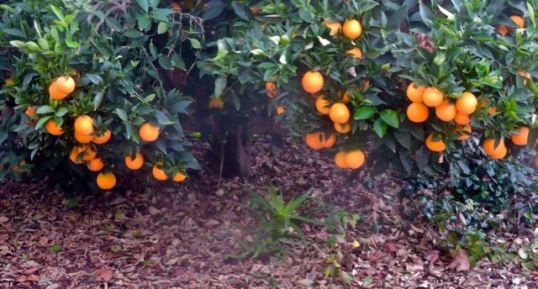
Wind-blown leaf compost beneath orange tree
Garden Update: The Bountiful Rain Continues
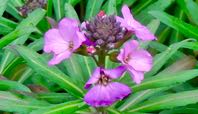
First erysimum bloom of the season, back garden
The big story of this garden month is the plentiful rain. So far this water season (which began in October) we’ve had over 14 inches, the most in that span since 2016-17. Meanwhile, up to 16 feet of snow–a record for December–have fallen in the Sierra: ensuring a healthy snowpack for the spring runoff.
Hallelujah! I’m almost tempted to reconsider my decision in early October not to plant my usual fall-winter veggies: broccoli, leaf lettuce, onions, beets, and Swiss chard.
But it’s getting late to start planting, and, besides, there’s no telling if the rainy pattern will continue. In December 2019 and December 2020, we had normal rainfall (2-3 inches) or better–then the rest of the water season, January to May, produced almost nothing. We were left with an unprecedented drought, which continues to keep the reservoirs in our region at dangerous lows (only 28% of capacity in Lake Shasta, for example). The state was forced to cut off water allocations to farmers, as this blog described last summer. Even with the huge December snowfall and rain this year, the state and the federal governments continue to be skeptical that the drought has been relieved.
While the rainfall lasts, though, we glory in it. The birdbath and fountain are filled to the brim, the ground throughout the garden is squishy, and the fallen leaves at the roots of all our plants (as described in the first section, above) decay beautifully to nourish the soil. It’s really a winter holiday celebration for the Northern California gardener.
Meanwhile, our orange tree and Meyer lemon bush are teeming with delicious ripe fruit, perhaps even more plentiful than in our record 2020-21.
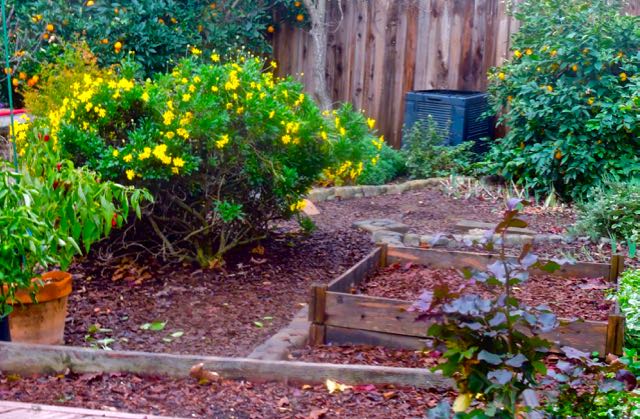
The back garden in the rain: resplendent orange tree and Meyer lemon bush, the brilliant coreopsis, and the fallow beds where the winter veggies usually would be growing.
The December 2021 Gallery


And on to the New Year!
 From Sacramento to Potomac: Tales of Two Valleys