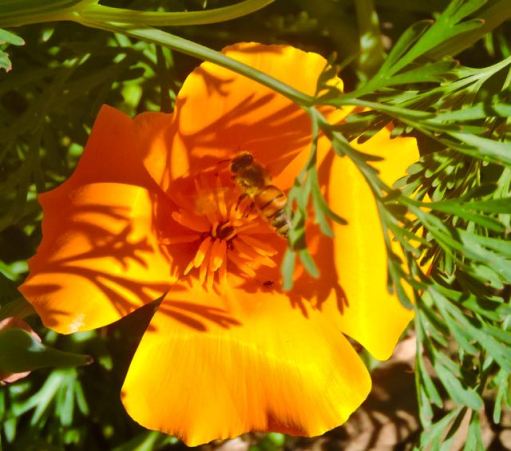
Honeybee in poppy flower, back garden
In this month’s blog:
Swimming in an Ocean of Orange
March Kitchen: Orange Juice! (and More)
Garden Update: Will There Be Veggies?
The March 2022 Gallery
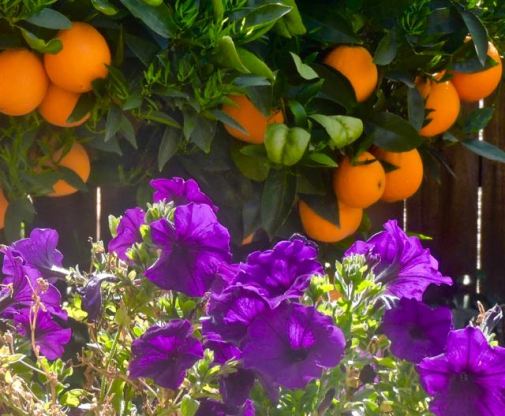
The long-lasting petunias in front of the orange tree
An Ocean of Orange
Now this is not to say that we don’t have a rainbow of colors in the garden in this Spring called March, but sometimes the orange explosion has seemed overwhelming. We always assume an abundance of navel oranges in March, but this season’s production from our single tree is a record, by far.
More than 700 oranges have fallen from the tree since late November, and we have picked them up day by day to squeeze for juice, snack on, and give away to neighbors. That works out to more than 35 per week, or, in squeezed-juice terms, about a pitcher and a half per week. Since we clear the ground of oranges each day, very few have rotted. So what have gone into the compost bin have mostly been the squeezed rinds.
700 is close to twice as many oranges as in any other spring. March has been particularly prolific, as the ripe, sweet oranges are falling more rapidly as their harvest season moves toward the end.


Meyer lemons. I’ve noted about the same ratio (2/1) for our meyer lemons in the past two seasons, compared with years past. The lemon bush, much smaller than the orange tree, has given about 250 total in each of the last two seasons.
Moreover, last season (2021) the lemons stayed hearty and strong on the bush through August, way longer than in any previous year. So we had fresh lemonade through most of the summer. This season promises the same delectable pattern.
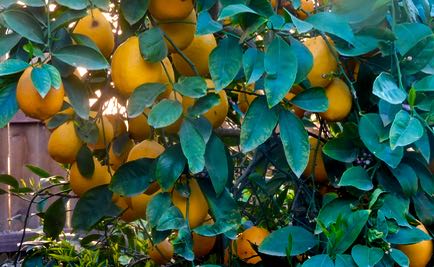
Meyer lemon clusters, late March
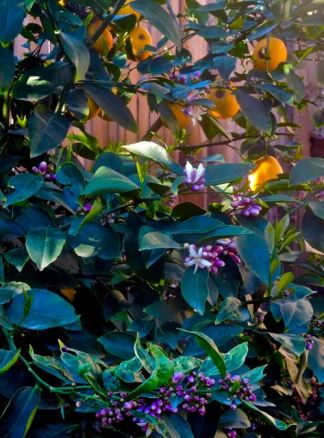
Remarkable profusion of lemon buds while the current season continues…
What really stands out about our meyer lemon bush this March is the remarkable number of buds and new flowers (at right). The buds usually arrive in early summer, prepping for fruit for the next season. What does this very early emergence of buds portend? Another sign of our warming climate?
The Surprising Other Orange. I predicted last month that our first crop of California poppies would burst into magnificent flower in March.
Last summer, I planted six green seedlings, 4 in front and 2 in back. In the dry heat, I watered these hearty fellows for a few seconds 3 times a week. Five grew slowly, one died–I thought. These are spring bloomers, so I didn’t expect flowers until this year.
The 5 little ones stayed small, green, and healthy through the rains of October and December. Then, in late January, tiny clusters of poppy plants began appearing in the sunniest part of the front garden, amid the other green shoots that always spring up after winter rain. Yes, the poppy rhizomes had spread underground. Most surprisingly, the one plant that had “died” in the summer heat had produced the largest spread. By February, a few blooms had appeared on two of the 5 original plants, but not yet on the largest spread of new plants. Here’s how the largest spread looked on February 23:
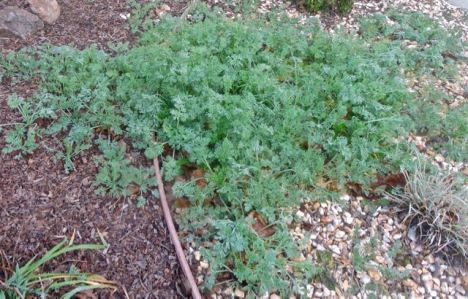
Blanket of poppy plants spreading
Here’s how it looks now!
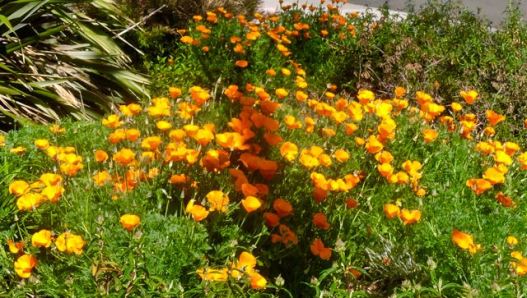
Poppy profusion in sunny front garden
And here are views of the two plants in the back garden:


I’m swimming in an orange ocean, and enjoying every minute.
March Kitchen: Orange Juice! (and More)
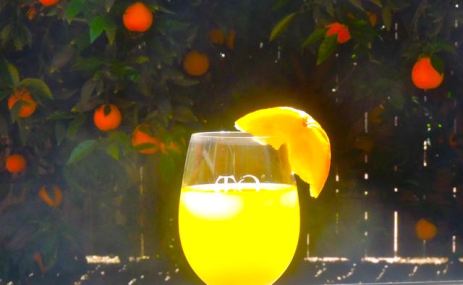
Fresh-squeezed orange juice–and its source!
When we have so much citrus, especially our cascading oranges, we have to think of ways to use them. Over the years, as noted in earlier blog entries, orange chiffon pies and orange juice as ingredient in different desserts, soups, meat dishes, and salads have been featured. But orange juice itself is the staple, and we don’t seem to get tired of this sweet, tangy beverage for breakfast or lunch. It also goes great in teas.
Of course, orange juice as a component with various whiskeys, beers, and liqueurs is also a favorite, as is the ever-popular mimosa, made with champagne or other bubblies. At a recent dinner with friends, we served champagne mimosas with appetizers, and the juice drink–whether with the champagne or by itself–perfectly complemented the cheese, crackers, and spreads.
A Simple, Colorful Spring Chili
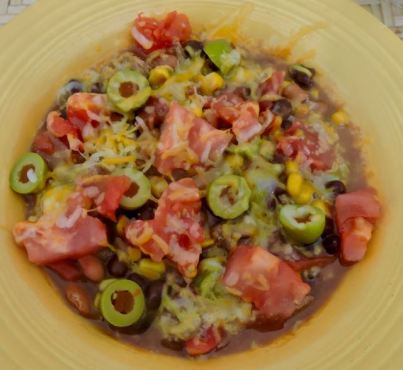
Chili with extra olives and tomatoes
No surprises here, if you’re a chili lover. I use ground turkey, sauteed with onion and garlic until the onion is translucent in a large skillet. Then I pour in one or two cans of beans (I used one can of pintos and one of black beans) with the sauce from the cans included for taste and volume. Then a can of yellow corn and a can of diced tomatoes (I used basil-flavored), again including the liquid from the cans to make a rich flavorful sauce.
Your personality in this dish comes through the seasonings and the ingredients of the sauce. To all the flavors noted above, I added a half cup of red wine and quarter cup of olive brine from the jar, as well as a dozen manzanita olives, cut in halves. I salted to taste with some garlic salt, threw in 20 tiny leaves of spicy oregano from the garden, and ramped up the heat with two of our Fresno chilies, finely-chopped, that I liberated from the bag of home-grown hot peppers in the freezer.
All of this I simmered for about an hour on low heat, until all the flavors melded and the sauce cooked down, so the mixture was more stewy than soupy. Before I served it, I chopped into my bowl a few more olives and some fresh tomato, then heated it a bit more (30 seconds) in the microwave with a grated Mexican cheese blend that melted over the whole concoction (see photo above).
All the ingredients filled up the large skillet, and made enough chili for several days of meals. If you try to make this chili for yourself, feel free to show your personality in whatever you choose to pour into the skillet!
Garden Update: Will There Be Veggies?
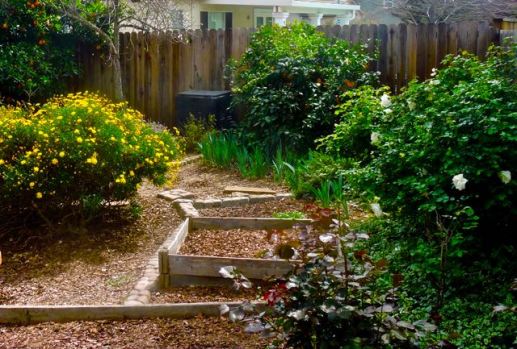
Back garden, with orange tree, coreopsis, compost bin, iris shoots, meyer lemons, and roses–plus empty veggie beds.
Because I chose in October to save water rather than plant my usual fall-winter assortment of veggies, we have no onions, broccoli, lettuces, and beets in our garden beds this season. As a result in this ongoing drought (now over 2 years old), we have cut our water use by almost 40% over previous winters. In the dry January, we used no water outside. In the dry February, I did water outside once per week. Thus far in a bone-dry March, once-a-week watering has continued to keep our splendid trees, bushes, and flowering plants going. With the high temps now in the low 80s this week, I’ll see if I can persist with this meager regimen.
The larger question is if I will plant in April the summer mainstays of our seasonal veggie garden: 2-3 types of tomatoes (7 plants in all), 2-3 types of peppers, cucumbers, zucchini, eggplant, and chard, as well as the basils and parsley. Also on the possible cancellation list are the brilliant multi-color vinca flowers and petunias that usually go in front and back in May. All these plants together double (!) our spring-summer water usage. With no or little rain in the forecast for the rest of the Spring, I’m pretty sure we’ll need to get along without them. Just keeping our trees and other perennials going will be enough. I will try to cut back on frequency and amount of water with those as well.
A third option would be to have a very limited growth of the annuals: say 2 tomato plants, 2 peppers, one always reliable zucchini, and even 1-2 vinca pots. I’ll make that decision in the next three weeks. That option will cut back the 25% on water use that the state may require. We’ll see.
Western Lilac, Wisteria, Callalilies, and More
Meanwhile, the limited water we have been using has helped produce a gloriously colorful March. The Gallery will highlight some of this color, as well as the insects and birds that make it possible. In particular, I want to celebrate the lavender display of two bee magnets: the Western Lilac (Ceonothus) and the Wisteria, which beautify and perfume the side garden. The wisteria particularly hums with bumble bees.


I’ll also raise a glass of orange juice to the callalilies, who draw the pollinators in profusion:


The March 2022 Gallery
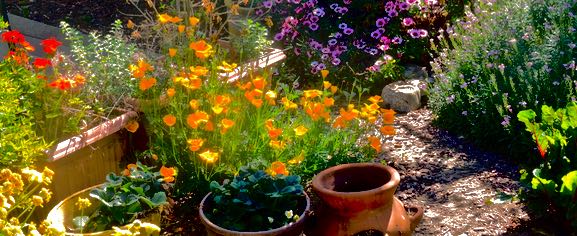
Back garden color: geranium, poppies, strawberries, African daisies, erysimum, chard


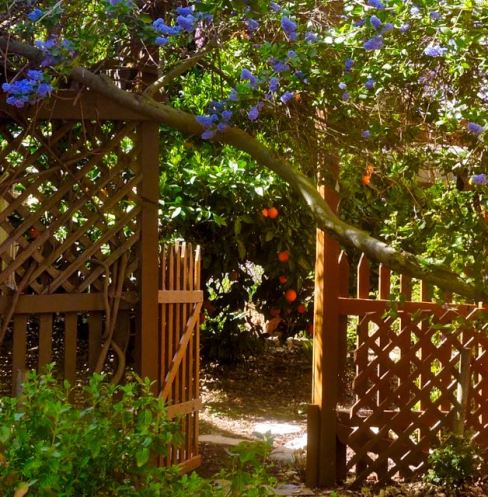
Welcome to the garden, early March
And on to the adventures of April…
 From Sacramento to Potomac: Tales of Two Valleys