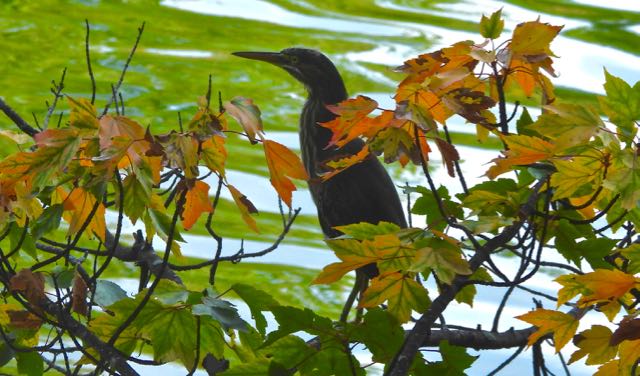
Green heron stalks in red maple, east bank, August 27
In this month’s blog entry:
Who’s Missing as I Walk around the Lake?
A Northern Virginia Climate Impasse
Venerable Lahaina, Rest in Peace
If Not Fires, Then Floods in Cali
More Somber Potomac Valley History
The August 2023 Photo/Video Gallery
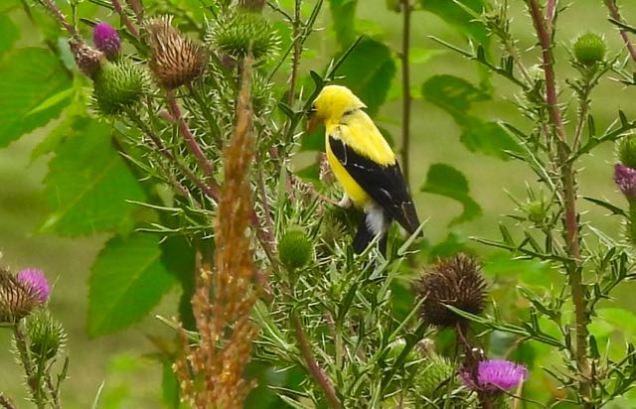
A welcome returning citizen: an American Goldfinch in bull thistles on the northeast bank, August 10
Who’s Missing as I Walk Around the Lake?
I haven’t seen a hawk here since March, when I snapped a red shoulder well below the north end dam.
None of our other hunters here stun the songbirds into silence and camouflage like the red shoulders, redtails, cooper’s, sharp-shinned, and goshawks do. Their visits are always infrequent, only rarely lasting more than a day, but the songbirds always know. These five months have been the longest interval without hawks since I’ve lived here. When will they return?
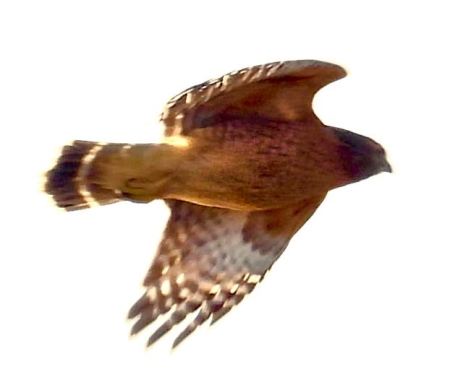
Red-shouldered hawk launches above Lake Cameron in January 2023
I’m not predicting anything dire for our little bit of sanctuary, but North America has three billion fewer birds than it had in 1970, according to a review of surveys published in Science in September 2019. Habitat loss and climate change have been the main culprits. The loss has been about 30% of all birds in North America in those five decades. The steep decline has been pretty much across most species, with shorebirds, songbirds, and prairie species hardest hit. Outside North America, think, for example, of the massive loss of Emperor penguin chicks in the Antarctic this year as the sea ice retreats from their breeding grounds.
Surprisingly, after plummeting before 1970, raptors actually increased after 1970, largely because of the banning of DDT in the 1960s. So there might be some hope left for our hawks. The DDT story, the Science authors say, shows the good that can happen if enough people and organizations unite in an environmental cause to defeat powerful, entrenched corporate interests.
Preserving more and more wild land from destruction is key. Keeping tiny wetland refuges (like ours) safe from ever-encroaching development will also be vital in most communities. We have to start thinking of a “healthy economy” as requiring us to be creative and respectful in adapting already developed space–even “rewilding” some of it–not crunching more precious native land and erasing the species it nurtures.
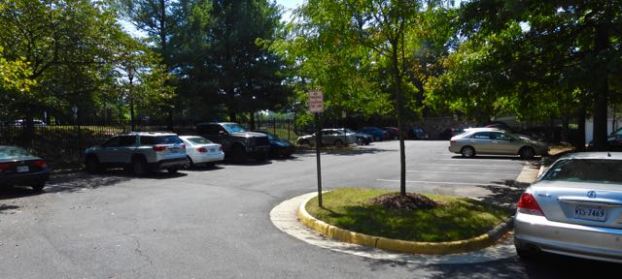
Typical weekday noon: a tree-lined parking lot in our community, August 25
A Northern Virginia Climate Impasse
I apologize for the intrusion of a parking lot into my photo montage of the lake, but throughout our lakeside community are some 350 or more spaces for our residents, at least 90% of which are filled most evenings by gas-burning sedans and mid-size SUVS that are not hybrids. The number of EVs is small and slowly growing, as is the number of hybrids. However, at this rate, the dominance of conventional gas burners will go on for years. And this is the sobering fact that all us climate idealists must always keep in mind.
The photo above is taken at noon on a weekday. Typically, at least 40% of the spaces are empty at noon, about 150 cars, whose drivers commute each morning to work, etc., and return by 6 PM, when the lot is full. Quite a predictable in-and-out-flow. Which means all those conventional tailpipe emissions, year upon year, until any meaningful change occurs.
How many years? Well, if the growth of hybrids and EVs continues at the current rate, about 8% per year at best, then let’s say 12 years or more will pass until the guzzlers are pretty much replaced, the big factors being availability and affordability. Unfortunately, I think 12 years is way too optimistic, given the unparalleled negative power of the fossil fuel lobby and of the governments, like Russia’s and those of a chunk of US states, devoted to the old, poisonous ways, like our neighbor just one county beyond, West Virginia.
Now if auto manufacturers were fully committed to EVs (only some are even partly committed), I’d revise the guess, but where’s the evidence for such commitment? Most automakers are still advertising the heck out of their guzzlers, even if they also push their EVs. And it’s noteworthy that the guzzlers have a lower sticker price, though there’s no real reason for that beyond automaker choice. So where do automakers’ hearts (if hearts they have) really lie?
Venerable Lahaina, Rest in Peace

Lahaina old town and marina before the August fire that wiped it out (Getty image)

Lahaina: cars abandoned as people tried to leave amid the flames, August 10 (Paula Ramon, AFP, Getty)
These pictures seem a world away from my tiny lake, don’t they? I recall thinking that the Northwest Territories of Canada were a world away, too, and then our own skies here were grayish orange in June from the fires that still burn there today.
When we lived in California in 2020, we were shocked that storms coming from another faraway world, up the coast of South America, were spawning lightning strikes that started the wildfire that came within a few miles of our home in the Sacramento Valley that August.
The fire that caused the most deaths in California, the Camp Fire of 2018, was ignited by a faulty electric transmission tower. The larger cause, of course, is the high-pressure drought that plagues Maui and California alike in a warming climate. That 2018 fire trapped cars trying to leave the fire zone. The town that was destroyed was named Paradise, a name often given to Maui, where the fire that destroyed Lahaina last week had similar cause and a similar spark. But California may have seemed a world away and maybe not relevant enough to warn the public safety officials in Maui, where cars were similarly trapped, and where many, many more dead are still unrecovered.
We visited Maui and the venerable old city of Lahaina in 2008. Our memories of that remarkable trip are as fresh today as if they were being formed–today. Now we have even more reason never to forget. We didn’t know we’d be grieving such loss. We certainly didn’t suspect that when we did grieve for the people, fellow creatures, and land that is Maui, the grief would feel like our own in a world that keeps growing smaller.
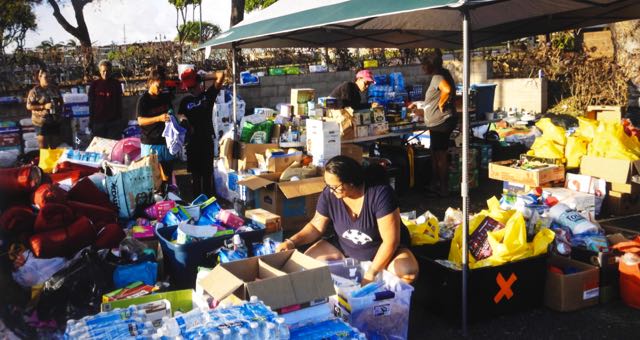
Donations in Lahaina after the fires were out, August 12 (Yuki Iwamura, AFP, Getty)
If Not Fires, Then Floods in Cali

Five inches of rain in the Coachella Valley leaves scenes like this in Cathedral City on Aug. 20 (KTLA News photo)
While Maui was still in the midst of its horrors, California and the Mexican states bordering it were facing their own unprecedented climate event, an August hurricane and tropical storm, named Hilary. Used to withering heat, drought, and wildfires this time of year, Southern Californians were bracing for possibly torrential rains and devastating summer floods, for which they have no infrastructure. Ironically, however, the record atmospheric rivers and mountains of snow last winter east of the LA basin at least had LA and communities east somewhat psychologically prepared for continuing extreme events.
To everyone’s relief, the storm, when it hit, brought the LA region some heavy, but not torrential rain and little flooding. In contrast, toward the desert mountains, including Death Valley, which only a few weeks earlier had almost set a new world record for heat (it did reach 129 degrees F), rain totals were record setting: 2.2 inches in one day in the Valley, with extensive flood damage and closed roads.
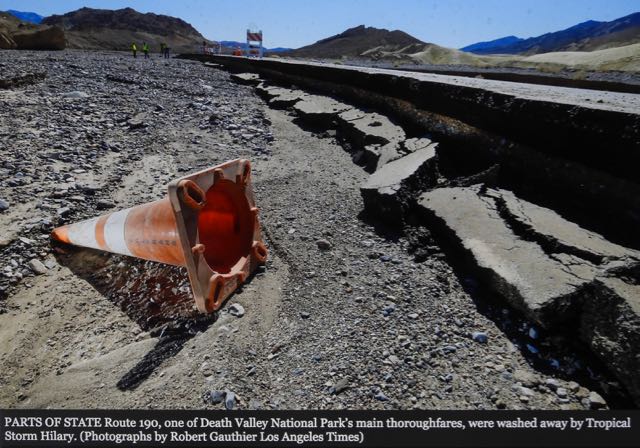
Farther south, however, in the Coachella Valley resorts of Palm Springs, Cathedral City, and Palm Desert, as many as 5 inches came down over a day and a half, leaving streets and homes inundated. Fortunately, there was no reported loss of life.
Alex Hall, director of the Center for Climate Change at UCLA, spoke with Ailsa Chang of NPR on Aug. 23. Chang asked the question that was on every Californian’s mind after this unprecedented winter and now summer of record precipitation: “Where does California exactly stand now in terms of drought after all of these different storms, all the rain and snow last winter?”
Here’s Hall’s answer: “California is the land of extremes. It always has been. We have always had big, wet years and deep droughts. That’s a hallmark of the hydroclimate in California. So we expect drought to return to the state. The challenge going forward is really to capture the water that does come in the wet years, especially in a changing climate where we expect there to be more precipitation in storms. We need to be in a better position to capture that extra water to get us through the inevitable droughts, which, by the way, will also intensify in a warming climate – probably already have intensified somewhat. We know that we will have dry years coming up, and we have to prepare for those.”
Bristow Station: More Somber Potomac Valley History

Tragic events at this little-known site of Civil War conflict are memorialized at this beautiful creekside park near Manassas
I’d heard about the 1863 battle at tiny Bristoe Station, but knew almost nothing about it. So we spent an early August morning tracking down the small battlefield park south of the much more famous Manassas, expecting to find a plaque or two somewhere along the two creeks, Kettle Run and Broad Run, that I could see from the map flowed through that area on their way to the Occoquan River, which then wound its way into the broad Potomac. Learning more about the Potomac Valley is always on my agenda.
Well, as ever in our travels, we were surprised and impressed by what we found. The marker above was by a substantial parking lot and led to several paths, one of which climbs a hill to a broad battlefield from 1863. It has a commanding view miles into the distance. One can easily imagine seeing regiments marching in formation and being confronted by opposing infantry and artillery.
The other main path, broad and well marked, we discovered to be very different. It led into a dark, fragrant forest of wildflowers, tall trees, and some marshland. It revealed itself to be both a nature preserve and a sanctuary to commemorate the many poor souls who had died and were buried there, mostly in the first year of the war, 1861.
Indeed, if you read the plaque above, you will learn much of the tragic story.
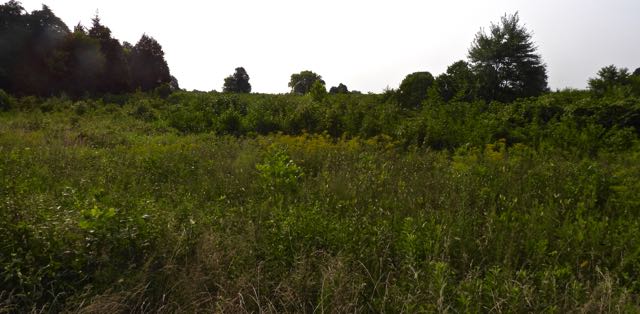
Bristoe memorial park and wildflower sanctuary, August 1
That more Civil War dead succumbed to illness or infections than to wounds received in battle is well known. Just last month, this blog noted deaths of Confederate prisoners and Union soldiers at the Point Lookout prison camp late in the war. But this relatively neglected Bristoe Station battlefield park commemorates soldiers from several Southern states who were new to the war, in its very first year, and who died in unstoppable epidemics from the mere fact of their being camped together with their friends, neighbors, and fellow recruits. I’m imagining surviving officers, sick themselves, writing letters to parents and wives, and these relatives reading them in utter disbelief. I’m imagining the Union troops, a year later, coming suddenly upon these burial grounds, one state after another, in dark woods, and perhaps hurrying on from this morbidly unlucky place.
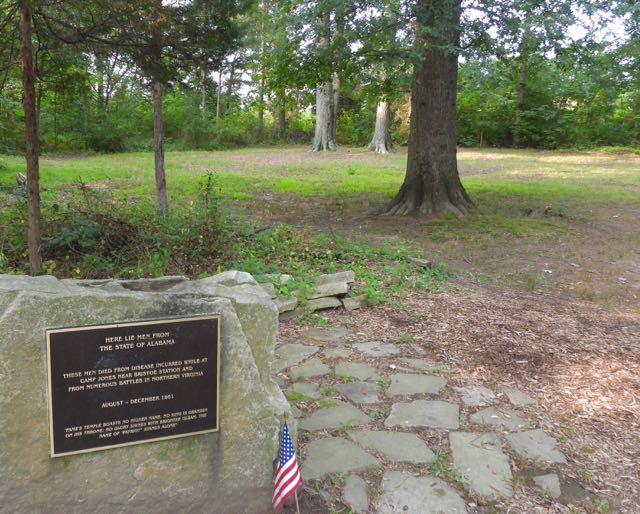
Alabama burial ground in the Bristow Station forest, renovated after the war to honor the fallen youth of 1861.
Walking through the forest today honors the memory of the fallen by devoting the ground to the growth of wildflowers and native trees. Silence and the echo of soft birdsong reign. Three signs in the woods, each saying “Do Not Mow,” reinforce the spirit.
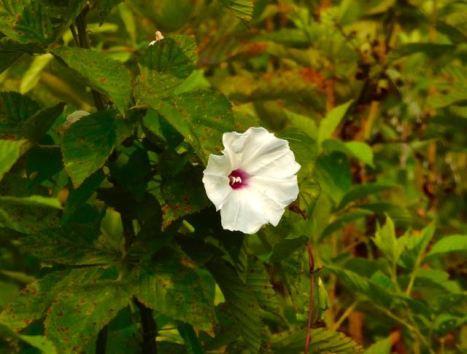
Wild sweet potato morning glory in Bristoe Station sanctuary

Whole leaf rosinweed in Bristoe Station sanctuary, August 1
The August 2023 Photo/Video Gallery
New and returning wildflowers, birds, and other creatures greet us each month. See and hear this month’s bounty.
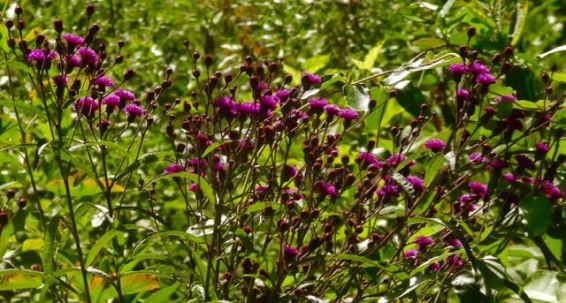
Purple ironweed, south end of the lake, Aug. 23
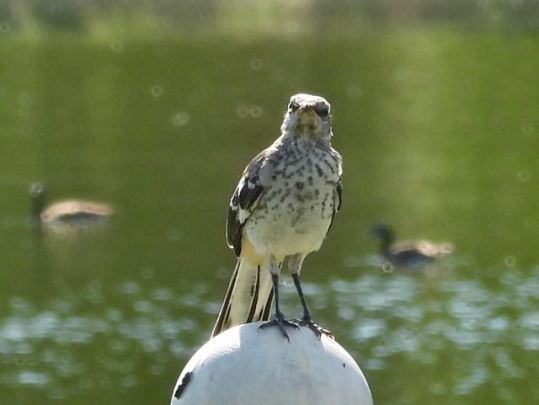
Northern mockingbird poses for the camera, with returning geese in the lake beyond, Aug. 23
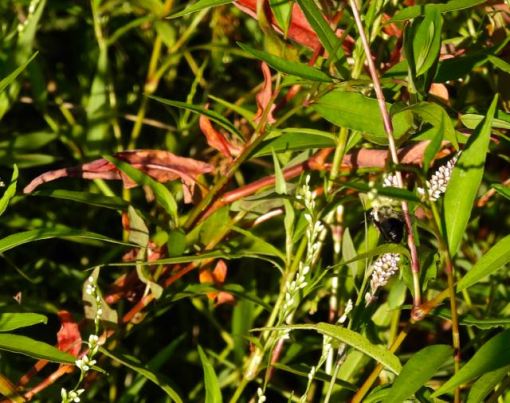
False waterpepper and bumblebee brighten the west side, Aug. 23
A great blue heron preens on the southeast bank, and listens to the late August choir of cicadas, locusts, and crickets
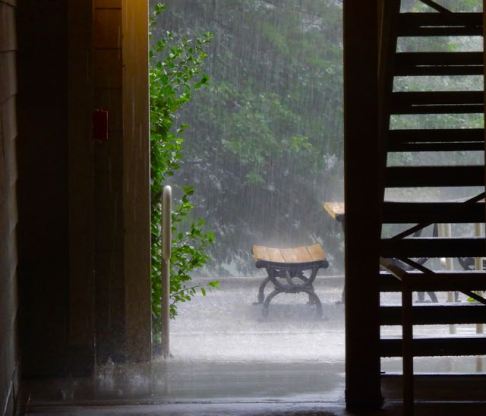
Storm in our community, Aug. 10 (same day as wildfire in Maui)
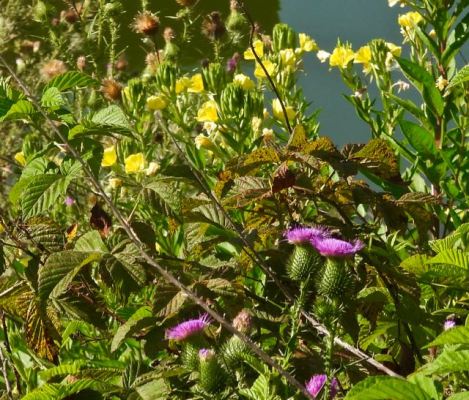
Wild evening primroses and bull thistles beautify the north end of the lake, Aug. 23
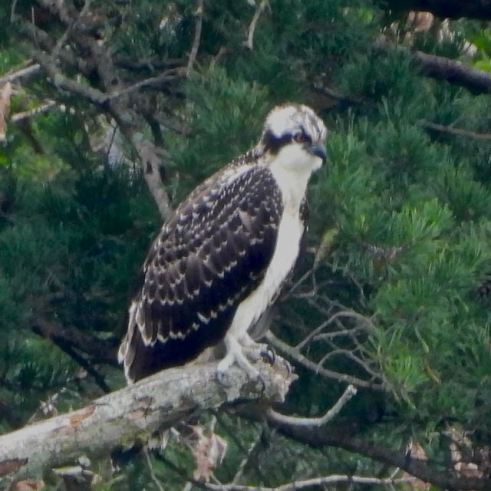
A rare visitor: an osprey from Chesapeake Bay, like those we saw in St.Mary’s, Aug. 10

The lakeshore teems with late boneset and bumblebees in August (Aug. 24)
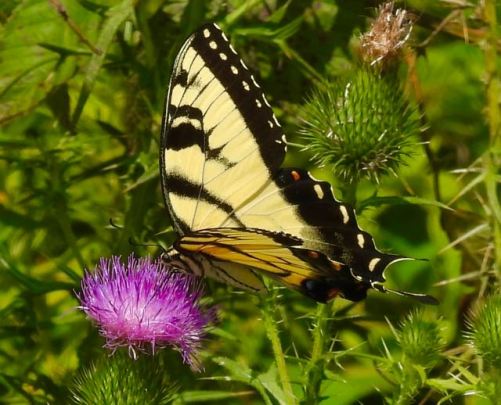
Though few butterfly species inhabit our lakeshore, the yellow swallowtails are prominent (Aug. 24). The purple bull thistles draw them and other pollinators.
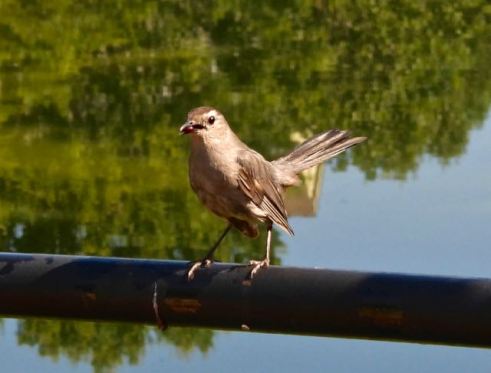
Grey catbirds are regular residents. This one shows off the berry in its mouth, while perching on a rail at the south end, Aug. 12.
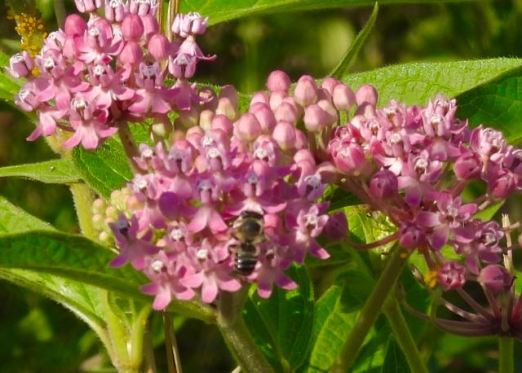
Unlike bumblebees, honeybees are not common on our lakeshore. Here, one feeds on the plentiful swamp milkweed, Aug. 12.
One of our young green herons calls and flutters from the southeast bank early in the month (Aug. 4).

Through most of hot August, the snapping turtles were missing from the lake. But here one glides just below the surface in the middle of the lake this week, August 27
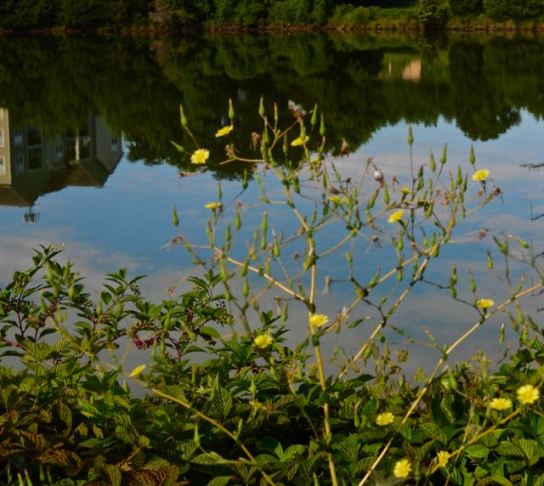
Two more wildflower species coming into their own in August: prickly lettuce and pokeweed, Aug. 23

Another rare visitor, a northern flicker on a dead tree,north end, that it will explore for an insect meal, Aug. 10
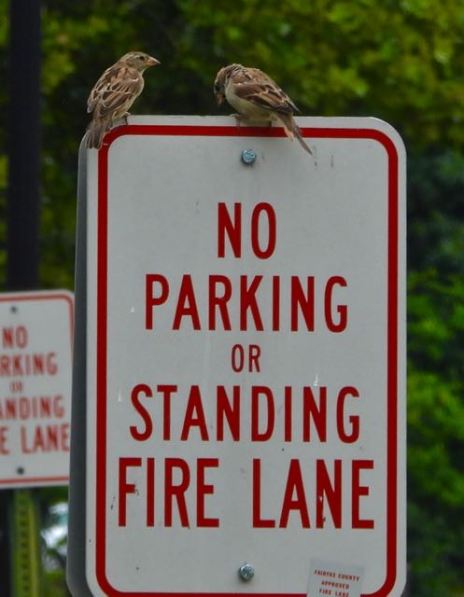
Some citizens, like our ubiquitous house sparrows at the south end, think that signs don’t apply to them (Aug. 10)
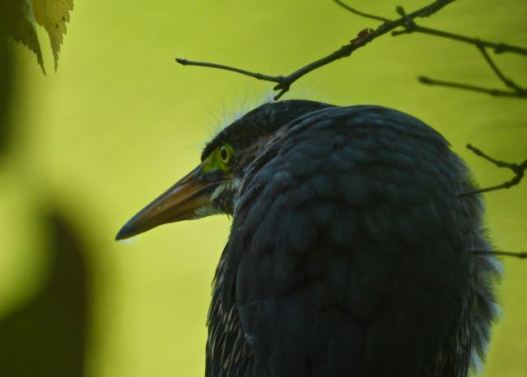
Looking more ominous than they are, one of our young green herons stalks along the southeast bank, August 23
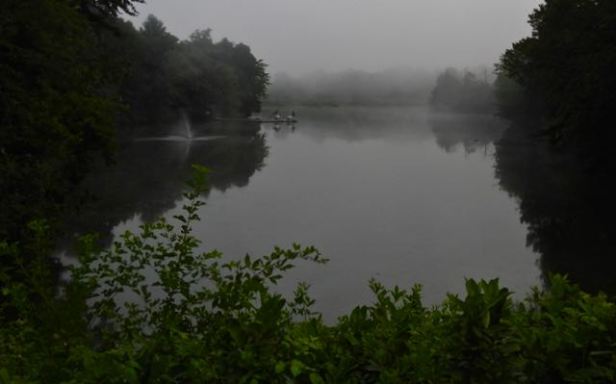
Contrasting moods in August: lake panorama toward north on a misty early morning early in the month, Aug. 5
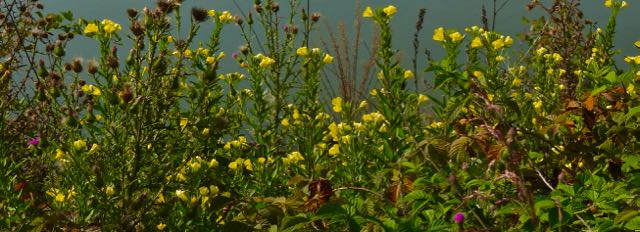
Lush Evening primrose display north end, August 27
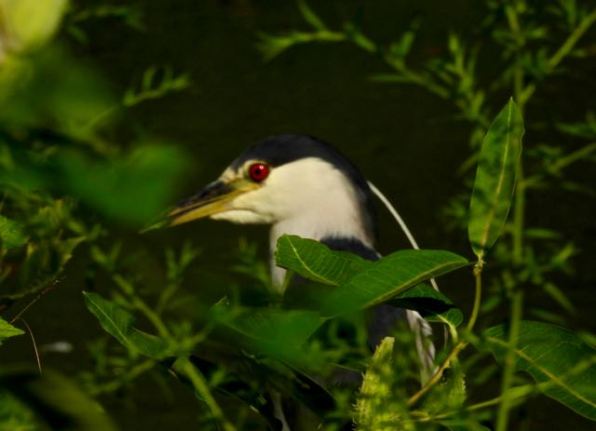
Another rare visitor, a Black-crowned night heron honors the south end, Aug. 12

Equally rare for our lakeside, a sunflower and honeybee perform along the southeast path, Aug. 7
Saying thanks once again to our glorious lake community and with wishes for hopefulness and resilience in an increasingly challenged planet, on we go to September…
 From Sacramento to Potomac: Tales of Two Valleys
Pingback: June 2024: Going to the Source | From Sacramento to Potomac: Tales of Two Valleys