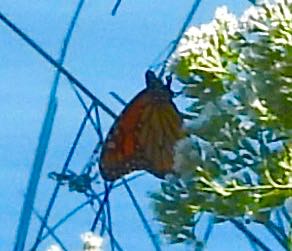
Our first sighting of a monarch, in shadows amid the boneset flowers on the northwest bank, Sept. 15 (see story, below)
In this month’s blog entry:
A Bee, Butterfly, and Wildflower Celebration
More Potomac Valley Discoveries in Maryland and Pennsylvania
The September 2023 Photo/Video Gallery
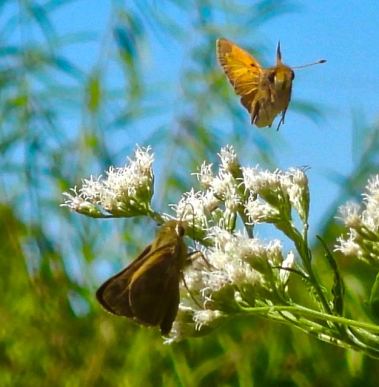
Two Virginia skipper butterflies in boneset flowers on the east bank, Sept. 14
Celebrating Our Bees, Butterflies, and Wildflowers
I had not yet seen an adult monarch butterfly by our lake in the year and a half I’d been walking the lakeside. Last fall I saw a monarch caterpillar in one of our swamp milkweeds, but not the adult. So I almost couldn’t believe my eyes when I glimpsed a flash of red-orange more than 100 feet away as I scanned the north end of the lake. So I snapped a photo of the deep shadows where I hoped the butterfly had landed. I zoomed into the shady foliage as closely as I could. Then, back home, when I could enlarge and brighten the photo, lo and behold, there was a monarch!
The plant that the monarch in the opening photo is feasting on is the favorite host plant for the pollinators this month: the prolific late boneset, which thrives around the lakeshore this time of year.
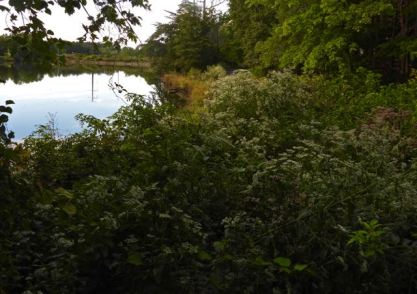
This September, boneset dominates much of the lakeshore, including the southeast cove (Sept. 21)
The second favorite for the past three months has been the brilliant lavender-purple bull thistle, which is now past its bloom time, but still helps to provide a safe home for birds, bunnies, and insects. The blog galleries in July and August featured butterflies, especially the yellow tiger swallowtails, and bumblebees on the bull thistle.
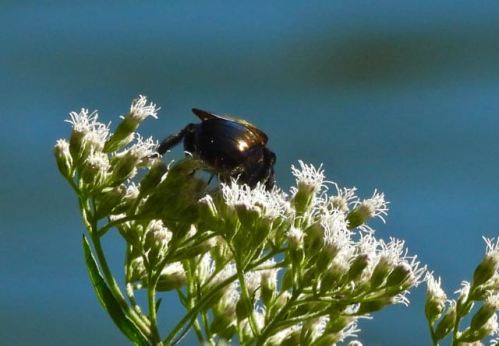
Close-in view of a bumblebee on boneset on the southwest bank, Sept. 19.
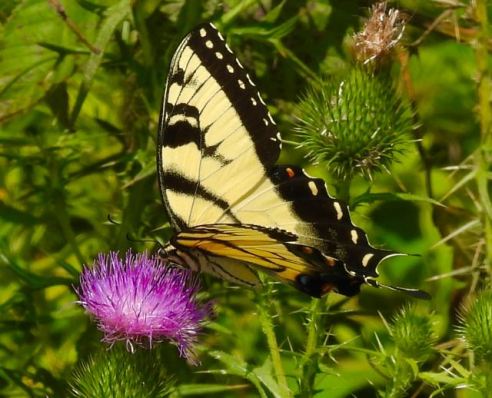
Though few butterfly species inhabit our lakeshore, the yellow tiger swallowtails are prominent (Aug. 24). The purple bull thistles draw them and other pollinators.
Learning wildflowers: every day is different and a reason to celebrate. My daily lakeshore discovery walks, as I call them, have made me ever more aware of the great diversity of wild and domesticated plants and wildflowers along the lake and in the surrounding fields and woods. My walks, with my Nikon P950 camera, help me focus on what I’m seeing, and make me curious to identify the different plants and animals I encounter. Two apps, PictureThis (V3.51) and Merlin Bird ID (from the Cornell Lab of Ornithology), allow me to snap iPhone photos of any plant or bird and immediately get much information about what I’m seeing. I’ve become much more observant not only of the diverse plants, but also of the changes that occur from day to day and month to month throughout this sanctuary.
In this month’s gallery, check out more photos and videos of plants, birds, insects, and a few of our other citizens this September.
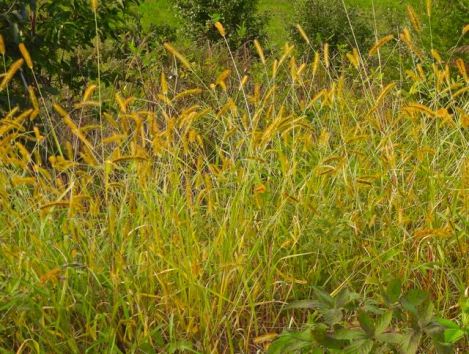
A display of yellow foxtail bristlegrass appears this month along the north end path, Sept. 21
More Potomac Valley Discoveries in Pennsylvania and Maryland
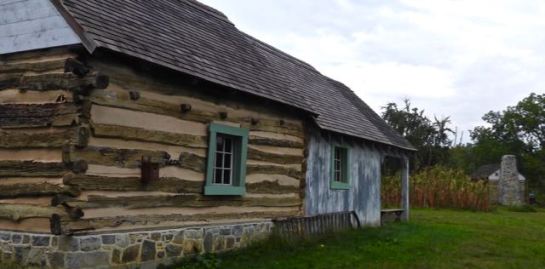
18th century log houses and cornpatch, Conococheague Institute, Welsh Run, PA, Sept. 8
In exploring the Potomac and its tributaries, one of our favorite regions to visit is about 60 miles west and north of our Virginia home. In southern Pennsylvania, just north of Hagerstown, Maryland, is the Conococheague Institute, near tiny Welsh Run, PA. The Institute is a restored 18th century farm, museum, and library dedicated to the study of early settler history and to preserving the natural environment that surrounds the farm. Nearby Conococheague Creek provided water and transportation for the indigenous people who lived in the area for thousands of years before the arrival of the settlers, who were mainly of German origin. The creek is a tributary of the Potomac, into which the creek flows about 30 miles south at Williamsport, MD, as I described in the February 2023 entry.

Fritillary butterfly at Conococheague Institute farm, Sept. 8
The work of the Institute is particularly important to us, because a small cemetery only about a half mile from the farm holds the graves of some of Jean’s immigrant ancestors, who first came to the area in the 1730s. The Institute provides information to support family research, and the researchers in turn help to support the work of the Institute.
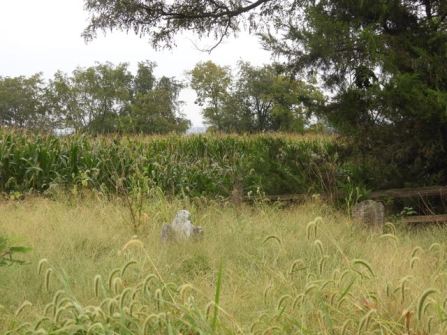
This small cemetery, amid cornfields, is overgrown now with bristlegrass. The cemetery holds graves of German immigrants from the 18th century (Sept. 8)
Fort Frederick State Park. A site we’d been wanting to visit, but had not explored before this month, is Fort Frederick State Park, MD, about 30 miles west and south from Welsh Run, PA, near the town of Clear Spring. Fort Frederick is both an historical site and, through its Friends of Fort Frederick, a center for cultural activities for children and adults, including an annual Market Fair, held in April.
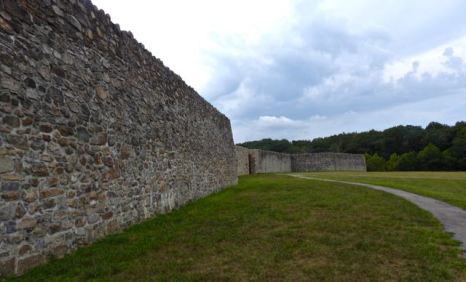
Fort Frederick, built 1756-57, main gate and southside walls, Sept. 8
This imposing edifice, built to hold thousands of troops and withstand a prolonged attack, was testament to the dedication of the British, their North American colonies, and tribes of indigenous peoples allied with them, to defeat the alliance of the French and several other indigenous peoples in what became known as the French and Indian War, 1755-1763. Ironically, the fort never saw a battle in that war, as the armies moved 160 miles west, to contest for control of the Monongahela, Allegheny, and Ohio rivers at the French Fort Duquesne, now the location of the city of Pittsburgh. The British and their allies captured Duquesne from the French in 1759, renamed it Fort Pitt, and the war moved farther north into Canada.

Aerial view of the restored Fort Frederick of today.
As a further irony, Fort Frederick was used in a later war, the War of Independence waged by the colonies against Great Britain, from 1775 to 1783. Instead of being manned by British soldiers, however, the fort was used by the colonists as a prison–to hold the 2000 or more British soldiers captured in 1777 at the Battle of Saratoga in New York! The prisoners from Saratoga and from other battles were held there until the end of hostilities in 1781, whereupon some of those who survived returned to Europe and others chose to stay in the now independent United States.
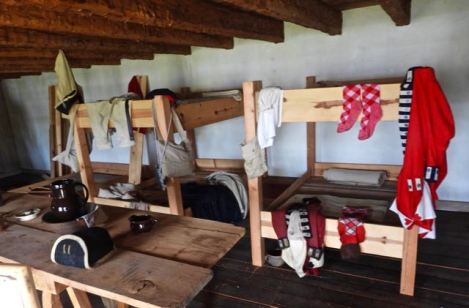
Barracks at restored Fort Frederick made to resemble prison housing for British soldiers in the US war for independence, 1777-81
As for the indigenous peoples who had fought in the 1755-63 war, many of them on the side of the victorious British and the colonists, they fared tragically over the following 60 years of warfare with the settlers and the new United States. The treaties that the natives had agreed to in order to fight were like all the subsequent treaties between the settlers and the natives: thoroughly disregarded by those who had made promises to the indigenous. Those native soldiers and their families who survived the wars, the burning of their villages, starvation, and settler diseases such as smallpox were steadily forced off their homelands and pushed farther and farther west.
Late 19th and early 2Oth century: the Williams family. Another irony is that as Fort Frederick began to crumble because of disuse, it and the land were sold to an emancipated Black family headed by Nathan Williams, who farmed it successfully for many years. In the 1920s, the state of Maryland re-purchased the fort and land, and in the 1930s, in the midst of the Great Depression, the Civilian Conservation Corps, which had been created by Congress to give jobs to poor youth, restored the fort to the original massive grandeur that visitors witness today.
Panorama of the west side of Fort Frederick, restored in the 1930s by the Civilian Conservation Corps during the Great Depression
Fort Frederick: the nearby Chesapeake & Ohio “Big Pool,” the beaver pond, and the Potomac itself. Another reason we wanted to visit Fort Frederick is its nearness to the Potomac itself and to the early 19th century Chesapeake & Ohio Canal. Strategically, the fort was built on high ground only half a mile from the river. But the hilly acres between the fort and the river are mostly marshland, which means that today the great value of the location is its biodiversity of animal and plant life. As part of the state park, this means that this large wetland will be protected.
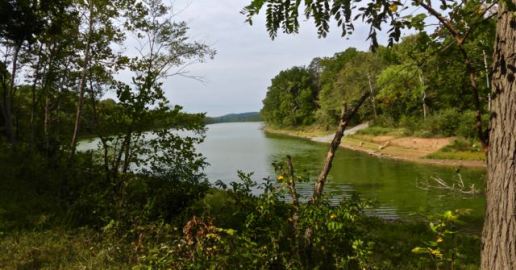
The “Big Pool” wetland just downhill from Fort Frederick, part of the Chesapeake & Ohio Canal built in the early 19th century
As one walks down toward the river, the first part of the wetland one encounters is the “Big Pool,” actually a small lake that was incorporated into the Chesapeake & Ohio Canal in the 1820s. As the photo above shows, the pool is surrounded by dense woods. Then, as one proceeds down toward the river, one next encounters the Beaver Pond, a dense swamp whose composition varies with the water level. Beavers are just one of many species who thrive in the marsh.
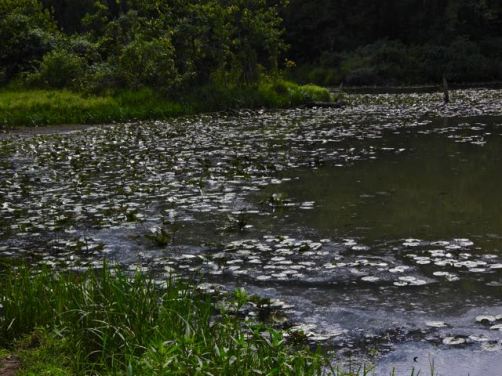
The Beaver Pond, thick with white water crowfoot, below the Big Pool and above the Potomac, all down the hill from Fort Frederick (Sept. 8)
Finally, as one winds forward on the downward trail, the Potomac River itself comes into view. On the hot, cloudy day we visited, the water level was lower than normal, but the crisp, steady flow of the river contrasted with the thick stillness of the Beaver Pond and so sustains its own very different ecosystem.
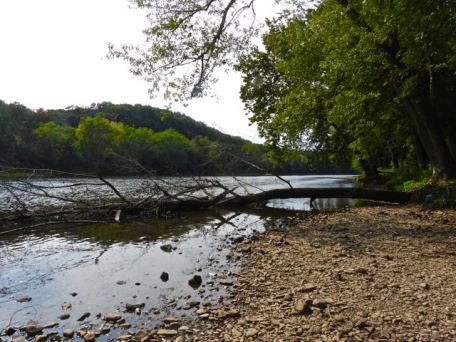
The Potomac River, down the hill from Big Pool and the Beaver Pond, viewed toward the west, Sept. 8
How amazing that in such a short walk, less than half a mile, I could encounter such different ecological worlds.
As you watch the video above, listen for the call of the Belted Kingfisher toward the end.
The September 2023 Photo/Video Gallery
Our gallery celebrates more wildflowers and animals this month, as well as an unexpected tropical storm that lashed our quiet refuge from September 22 to 24.
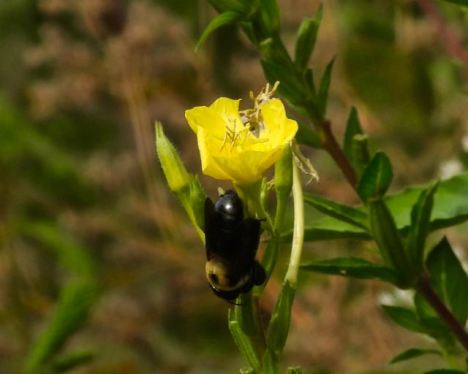
A bumblebee luxuriates in an evening primrose on the east side, Sept. 22
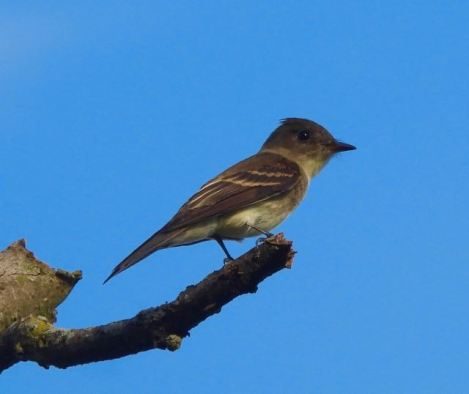
A rarely seen Eastern wood pewee atop a dead tree on the east bank, very hot day, Sept. 4
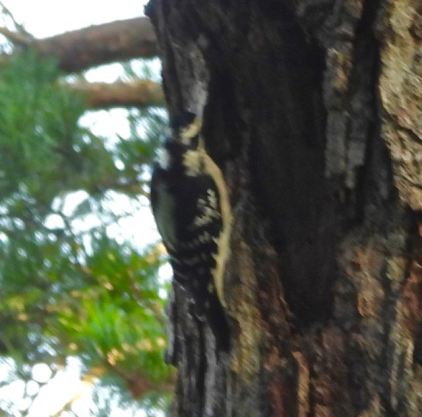
A downy woodpecker on the trunk of the same tree, Sept. 4
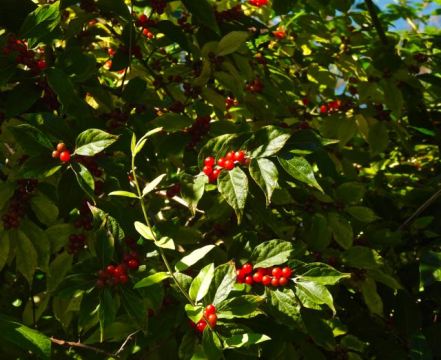
Profuse ripe berries on amur honeysuckle on the east bank, Sept. 15
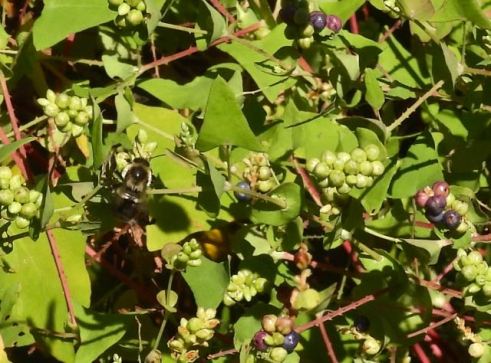
A bumblebee samples a patch of mile-a-minute vines and berries, east bank, Sept. 19
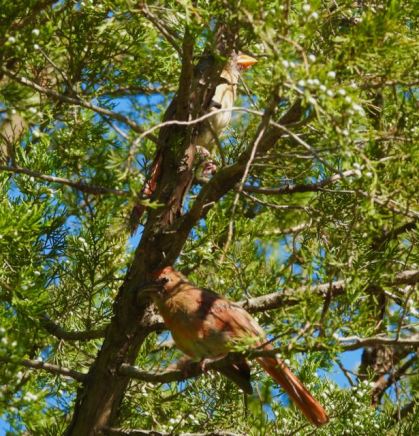
A cardinal couple in a berry-rich juniper tree, southeast bank, Sept. 19
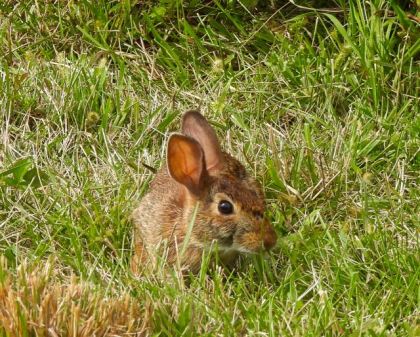
One of our cottontails munches grass along the northeast side path, Sept. 22
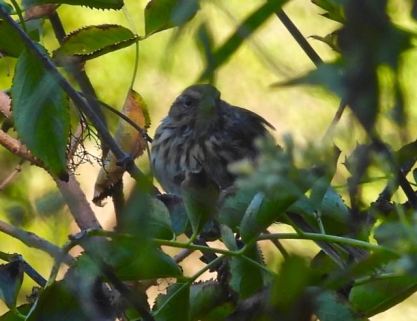
A female red-winged blackbird enjoys one of the elderberry trees on the east bank, Sept. 19
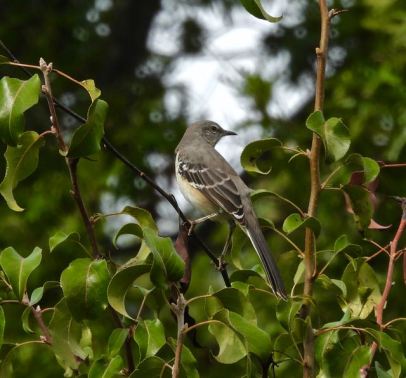
A mockingbird observes in a persimmon tree on the northeast lakeside, Sept. 22
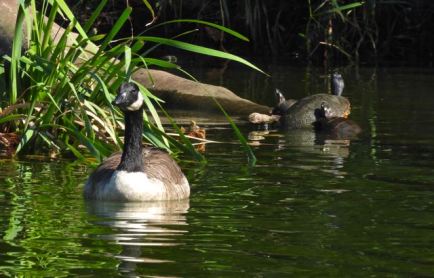
A Canada goose and 3 red-bellied cooters converse in the southeast cove, Sept. 20
A rare female morph tiger swallowtail and several bumblebees engage the wind as they enjoy purple bull thistles on the north end bank, Sept. 5
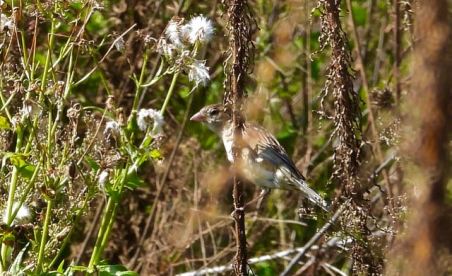
Female blue grosbeak is alert in American burnweed at the north end, Sept. 22
Our newly returned flock of 50 Canada geese fly and call across the lake, Sept. 14
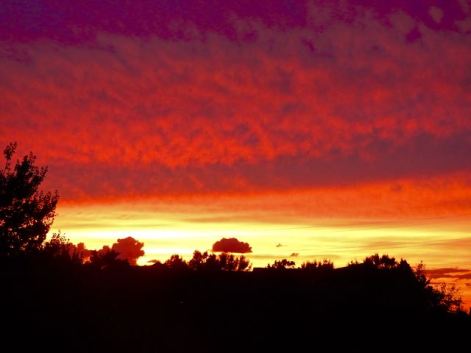
Amazing sunset heralds the Tropical Storm Ophelia, as seen across the lake from the east side, Sept. 22
Rainwater rushes into the lake from the southeast inlet stream during Tropical Storm Ophelia, Sept. 23
Winds and rain from Tropical Storm Ophelia churn the lake and raise its level more than a foot over 3 days, Sept. 22-24
A week of September remains to be explored, with more rain in the forecast. And then on to October with joy and great expectations!
 From Sacramento to Potomac: Tales of Two Valleys