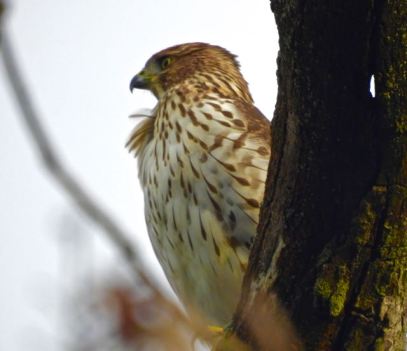
A rarely visiting Cooper’s Hawk, early morning, east bank of lake, Oct. 9 (Indigenous Peoples Morning)
In this month’s entry:
Walking the Lakeshore on Indigenous Peoples Morning
Keeping Alive the Landscape History of the LA Region
From the Renaissance Festival to Maryland’s Eastern Shore
October 2023 Photo/Video Gallery: Fall Colors, Citizens, Visitors
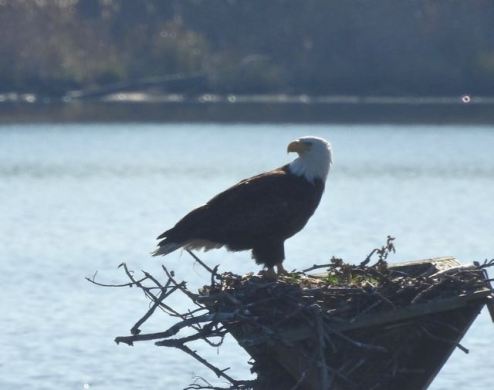
A Bald Eagle, one of many noble citizens of the Blackwater National Wildlife Refuge on Maryland’s Eastern Shore, Oct. 24. See the section on our trip there later in the entry.
Walking Our Lakeshore on Indigenous Peoples Morning, Oct. 9
Walking the lakeshore mindfully seems particularly appropriate on Indigenous Peoples Day, since the indigenous of North America practiced a way of living that appreciates plants, animals, water, air, and the land in ways that our mass culture of unlimited consumption ignores, with the destruction of life on our planet as the inevitable consequence.
Indigenous Peoples Day, the 2nd Monday in October, and Native American Heritage Day, the day after Thanksgiving in November, were established by Congress so citizens of the U.S. would both keep in mind the essential contributions of our indigenous peoples to sustaining our great country and honor the continuing contributions of their descendants today and into the future. These days of commemoration are one very small effort to counteract the centuries of erasure of Native Americans that began with the first settlers from Europe in 1607 in Virginia and that continues today with state laws like that passed in 2021 in Oklahoma to ban children from learning in school about the decimation of the Osage people in the early 1900s (and the massacre of Black Oklahomans in Tulsa in 1921).
“Perhaps someday we’ll begin teaching our children the full, demythologized truth about ourselves, but I doubt it.” Rinker Buck, The Oregon Trail: A New American Journey (Thorndike Press, 2015, p. 720)
The erasure of Native peoples and their cultures is equalled by the ongoing–and closely related– erasure of the land and its plant and animal citizens that has been going on since 1607 by what we call “progress” and “development.” These two pretty words mask the wholesale destruction of true wilderness and its creatures, such as the extinction and near-extinction of thousands of species–and the ever-increasing fouling of air, water, and soil by mining, the burning of fossil fuels, and irresponsible hunting and farming methods that have continued throughout the expanding U.S. over four centuries.
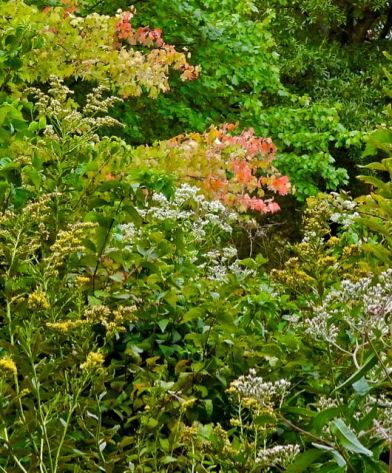
Early fall color palette: white boneset, goldenrod, red maple, and willow oak, at the southeast cove, Oct. 9
A Reciprocal Relationship with the Earth. As I explored in the blog a year ago, part of that erasure meant our never learning–or our forgetting–the native peoples’ brilliant understanding of what Robin Wall Kimmerer calls (in Braiding Sweetgrass) a “reciprocal” relationship with Mother Earth. This relationship requires that what we take from Earth and her creatures must be equalled by what we give back. So, for example, if we feed ourselves fish from the rivers or birds from the air, we never take so much that the species can’t reproduce an equal number or greater. And we never plant so much of the soil to feed or clothe ourselves–especially with a single crop–that the soil becomes so depleted of nutrients that the land cannot easily recover. And so on for all human actions.
An Earth-Saving Lifestyle. So what can I as an aging human in 2023 in the “progress'”-deformed North America do to practice a reciprocal relationship with Mother Earth? I explored this question in the blog for April 2023. There I described my efforts to lead an “Earth-saving Lifestyle,” which included in my list of actions something I do every day toward not forgetting the “more than human” citizens of my world: “I can walk around the lake and glory in the birdsong, the change of seasons, the constant creative work of local animals and plants to survive and share beauty.” In other words, I try to pay attention and learn more and more about my environment, despite all the lures of over-consumption that distract me and most others.
Another writer who tries to live an “earth-saving lifestyle” is Margaret Renkl . Read what she has to say in this essay from October 9 about nurturing the endangered citizens of her Tennessee garden.
So on Indigenous Peoples Day 2023, I walked with my camera slowly around the lake, watching, listening, smelling and tasting the air, and being alert for what I might learn about this place where I live. I was rewarded, as I am in each day’s walk, by bounty that my camera can only capture a tiny part of. Bounty that it is my responsibility to help protect.
Besides the Cooper’s Hawk pictured at the start of this entry, here are a few of those rewards:
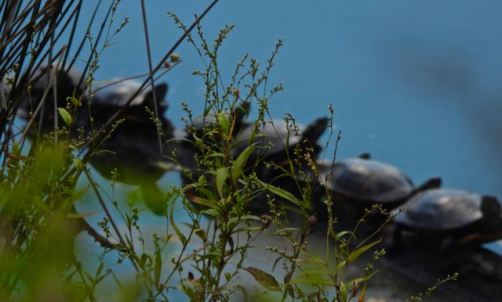
Six red-bellied cooters in formation on a log behind dotted smartweed at the north end of the lake, Oct. 9
A great blue heron landed near me on the northeast bank and then stalked for a meal, Oct. 9
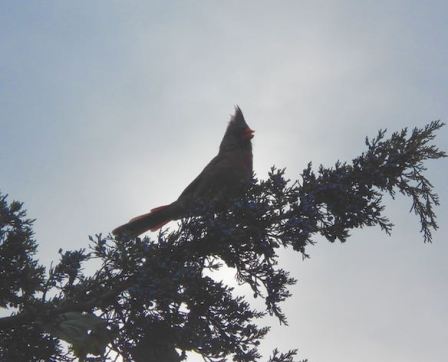
A Cardinal in red cedar on the northwest bank in early morning sun, Oct. 9
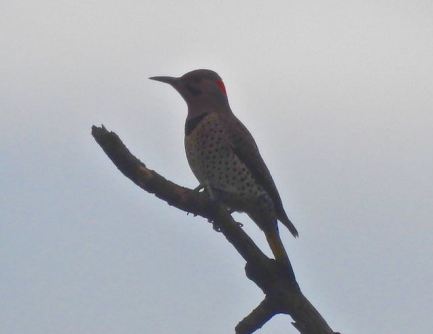
Northern flicker after sunrise in the southeast cove, Oct. 9
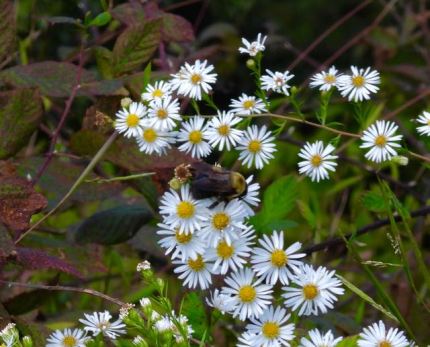
Bumblebee on wild asters and blackberry leaves, north end, Oct. 9
***********************
Keeping Alive the Landscape History of the LA Region
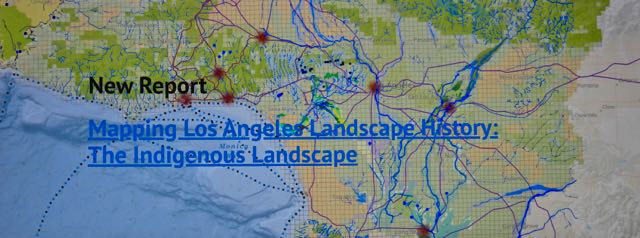
Cover map of the new report on the Indigenous Landscape of the LA region
Often, not forgetting means taking extraordinary efforts to remember. A case in point is the Los Angeles Landscape History Project, begun in 2018 with foundation funding and involving the work of a team of representatives from three tribes (Chumash, Tataviam, Gabrieleño) and geographers, historians, and biologists from four LA region universities (CSU Long Beach, CSU Northridge, CSU Los Angeles, and the University of Southern California). According to the Executive Summary of the brand-new, freely available report–released on Indigenous Peoples Day–the project blended “different approaches to understanding and describing the landscape to produce a set of parallel products that describe…six village sites in detail and provide detailed maps of the natural environment, its flora and fauna, and tools to understand its influence into the modern era for the region.”
The Summary concludes as follows:
“This project is unique because a commonly shared, detailed map of the historical ecology—the flora, fauna, hydrology, and landforms, that evolved within Southern California’s Mediterranean climate over millennia and supported human populations for 9,000 years, has never been developed. Individually and cumulatively, the results of this research are vital resources to all regional and local planning efforts involving sustainability, habitat restoration, and preparing for climate change. This project is unique also because four of its co-Principal Investigators are members of the Indigenous peoples of the Los Angeles Basin (Gabrieleño, Tataviam, and Chumash).”

Fig. 0-4 of the Executive Summary. “Indigenous roads and pathways compared with contemporary road network.”
*******************************
More Exploring: The Renaissance Festival and Maryland’s Eastern Shore
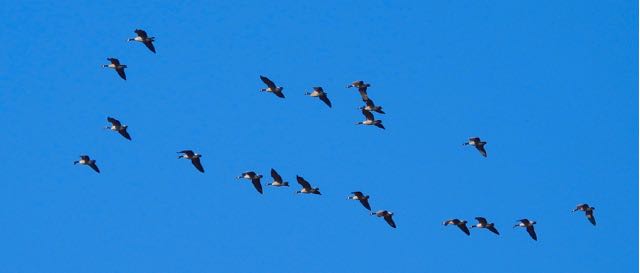
Canada geese flock in flight over the Blackwater National Wildlife Refuge, Oct. 24
Since we moved to Virginia from California last year, we’ve been exploring historic places in the watershed of the nearby Potomac River in Virginia, West Virginia, Maryland, and southern Pennsylvania. Well, last week and this we spent a couple days on the other side of Chesapeake Bay, along part of Maryland’s iconic Eastern Shore. Whereas the western shore of Chesapeake Bay features long, broad rivers like the Potomac and the James, the Eastern Shore (as the map below shows) presents marshes, narrow peninsulas, and many small inlets and creeks, as well as a few broader, winding rivers such as the Choptank, beside which the small, historic city of Cambridge sits.
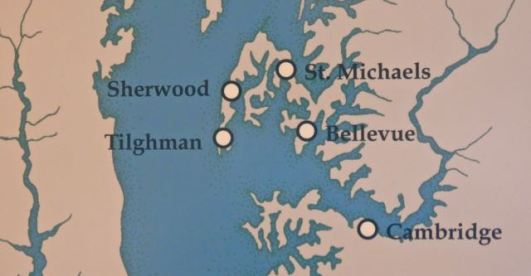
Map of the Choptank region of Maryland’s Eastern Shore (from the Maritime Museum in St. Michael’s)
For thousands of years, the Eastern Shore has had a maritime, riverine human culture, with native tribes like the Nanticoke and Choptanks thriving on the crabs, oysters, and fish for which the region continues to be famous. Many of the English settlers who arrived beginning in the 17th century also took on this water-focused life, although the broad, flat, fertile lands east of the peninsulas and marshes became tobacco fields and plantations, just like their famous counterparts west of the Bay. As the lucrative trade with England in tobacco took over more and more of the land, the tribes of the region, who had thrived on a diversified agriculture and aquaculture, were forced out and decimated, with murder of natives encouraged by a colonial Maryland decree in 1652. (A later treaty gave the remaining Choptanks a reservation that they held until 1822.)
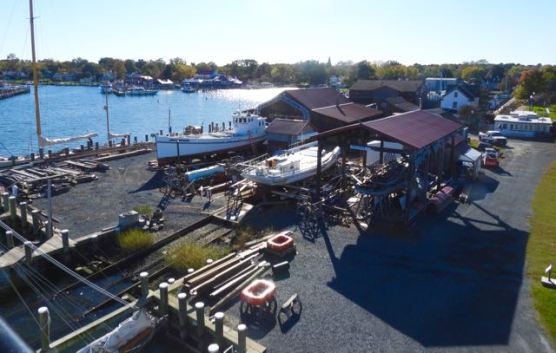
The working boatyard at the Chesapeake Bay Maritime Museum in St. Michael’s, MD, where boats of the historic water culture are restored.
Visiting the Maryland Renaissance Festival
Our short trip to the Eastern Shore began this past Sunday with a visit by us and other family members (three generations of us!) to the annual Renaissance Festival in Crownsville, just north of Annapolis, the state capital. The festival, which draws thousands from across the region, is a different kind of remembering, and features events, food, and costumed staff and visitors recalling the England of the Middle Ages and of the days of King Henry the Eighth and Queen Elizabeth I.
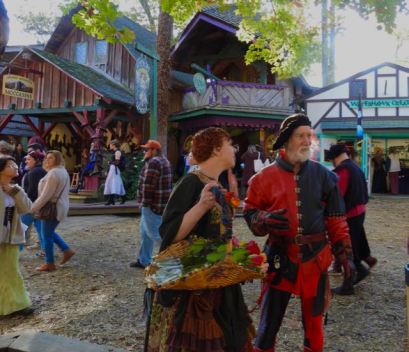
Costumed revelers at the Maryland Renaissance Festival, Oct. 22.
Music and Dancers at the Renaissance Festival, Oct. 22
One of the most anticipated events each year is the medieval jousting tournament, at which each section of the crowd cheers for their favorite competitor.

The royal court of King Henry the Eighth, presiding at the jousting tournament
Moments of the third competition of the jousting tournament, Renaissance Festival
Best of all for us was the time we spent with our family members, including two of our grandchildren, ages 6 and 8, all suitably garbed for the celebration!

Members of our family creatively, even spookily, dressed for the Festival!
Visiting St. Michael’s, Remembering the History of the Waterfolk
Our visit to the Eastern Shore focused on two quite different locales in the region. The first was the village of St. Michael’s, founded in the 1600s, and the narrow peninsula nearby (as shown on the map above) that winds down to tiny Tilghman Island. Water culture is alive and well in this area and is honored in the Chesapeake Bay Maritime Museum, which vividly displays both the history and present of a changing environment. Spread over 20 acres, the Museum includes
- a working boatyard, where historic craft are restored
- an art gallery, which this month focuses on climate change and the depletion of the shellfish
- a historic lighthouse (that you can climb!)
- an interactive display of the most famous water craft, the skipjack,
as well as three history museums. It even includes a cabin once lived in by the sister of Frederick Douglass, who was born in nearby Easton. Set on the Miles River waterfront, the Museum campus offers magnificent views of the river and marshland.

Viewing the Miles River, marsh, and buildings of the Maritime Museum
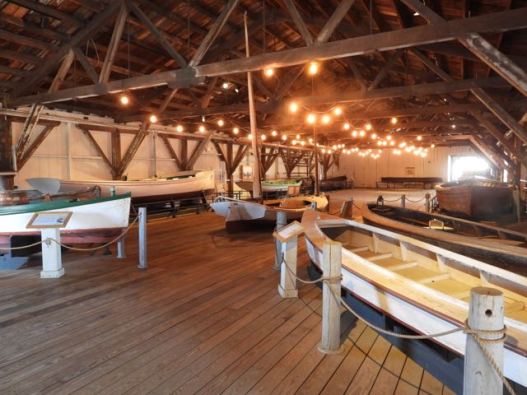
The historic collection of restored rivercraft at the Maritime Museum, Oct. 23

Douglass cabin and garden at the Maritime Museum
Panorama of the Miles River waterfront and Museum buildings from the top of the old Lighthouse, Oct. 23
Nearby Tilghman Island. Twelve miles from St. Michael’s the peninsula ends with tiny Tilghman Island, with much of the sparse land a nature preserve. Here the Choptank River flows into the Bay. A marvelous setting for photography!
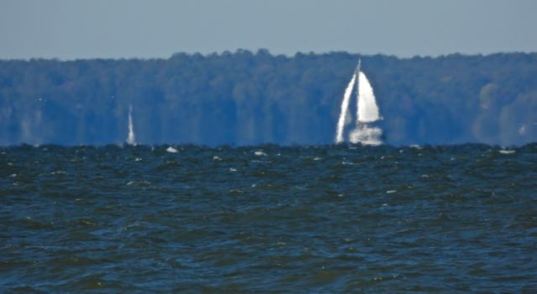
Black Walnut Point on Tilghman Island is a mere 12 miles across the Bay from Virginia, seen in the background beyond the sailboats
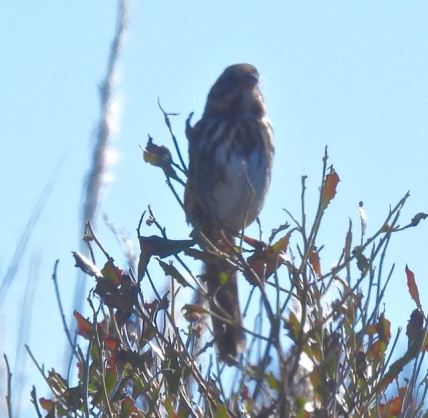
A song sparrow in the Tilghman Island marsh, Oct. 23
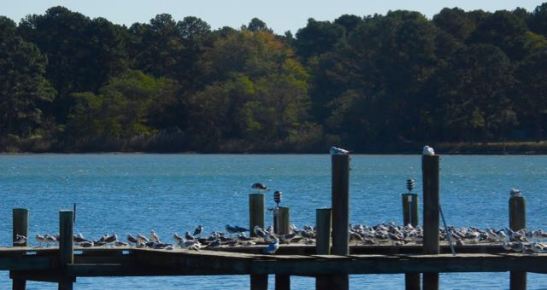
Herring gulls on the wharf, Choptank estuary, Tilghman Island, Oct. 23

Watching from the reeds toward the Choptank estuary, Tilghman Island, Oct. 23
Day Two: The Blackwater National Wildlife Refuge
Since we’d moved back to Virginia, I’d had this wonderful place, south of the Choptank, on my radar. It includes forest and marshes, with a setting beside the broad Blackwater River which draws varied waterfowl, migrating and year-round, and other marsh folk. It has miles of trails and a great 3.6 mile drive that takes visitors to all parts of the refuge. If you have a good camera, you’re in reach of subjects well away from your car. Here are a few of the folks I snapped. (One caution: bring repellant. The skeeters can be ferocious.)
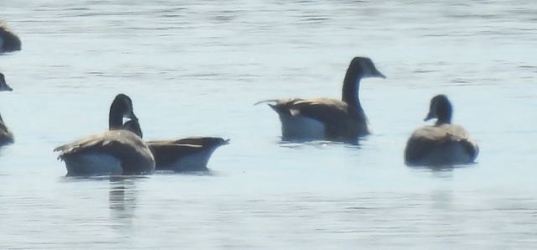
Cackling geese

Devil’s Walking Stick beside a trail
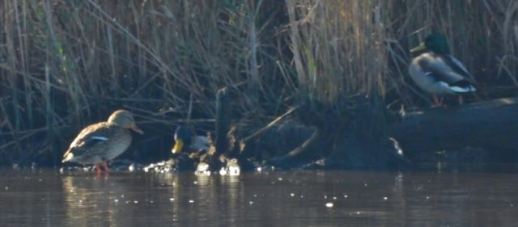
Three mallards in reeds

Female Northern Pintail duck

Marsh Wren in hair-awn muhly reeds
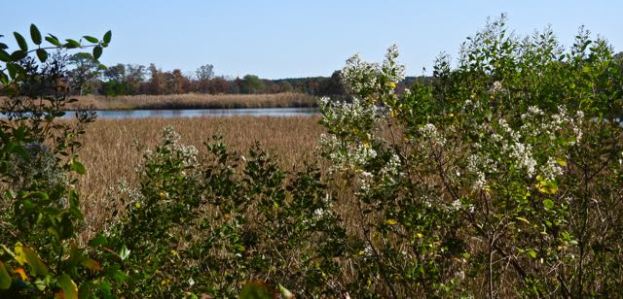
Grounseltree or salt bush at marsh edge
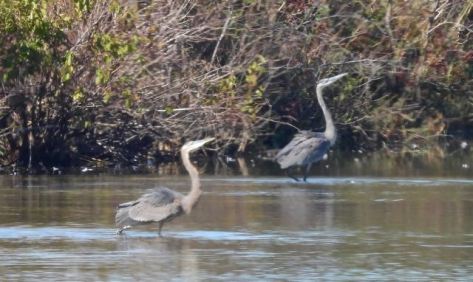
A Pair of Great Blue Herons advance in the river

Rare sighting of a Wilson’s Phalarope in the marsh
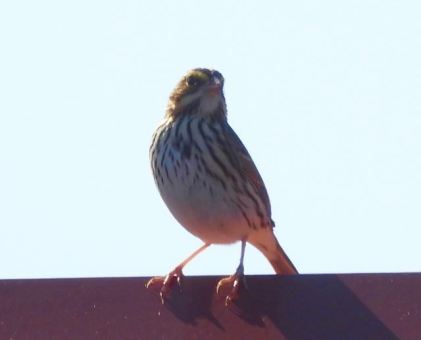
A Savannah Sparrow on a shed roof
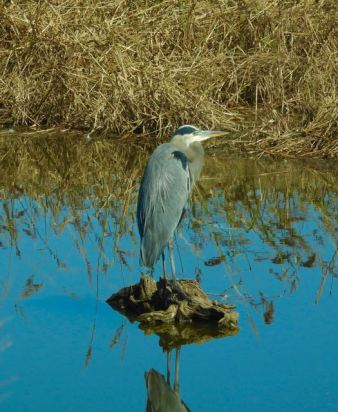
A lone Great Blue Heron on gnarled wood
Panorama of the quiet Blackwater River on a sunny, breezy morning, Oct. 24
******************************
The October 2023 Photo/Video Gallery: Fall Colors, Citizens, and Visitors
Late October is the peak of the autumn color display where we live. Not only do the trees always amaze, but the other lake citizens–and a few migrating visitors–also put on a pre-winter show.

A Blue Jay and Mockingbird scuffle in the elderberry, east bank, Oct. 25
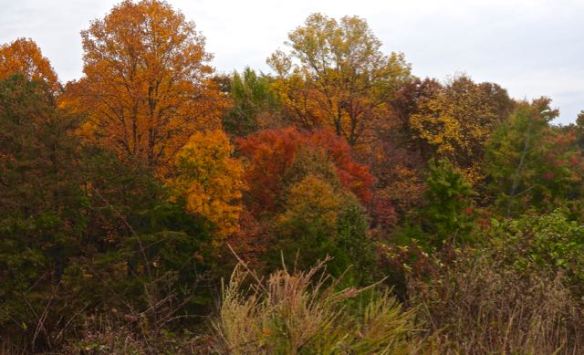
Full fall colors in the north end woods, Oct. 29

Two European Starlings enjoy the view atop a dead tree on the east side bank of the lake, Oct. 29
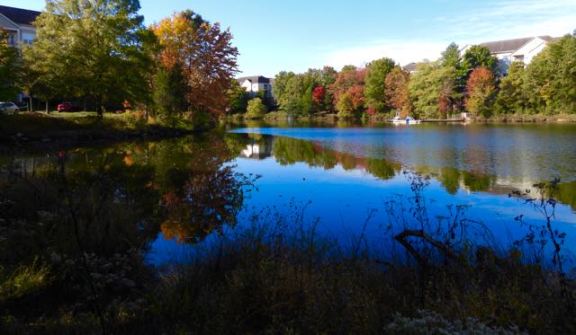
Fall display from the southeast cove to the west side, Oct. 25

A Mockingbird in mid-scuffle with a Blue Jay stares amid Virginia creeper and red cedar on the east bank, Oct. 25
A Great Blue Heron walks, turns, and stalks along the south end of the lake, early morning, Oct. 29

A Warbling Vireo enjoys Poison Ivy berries above the inlet bridge, Oct. 25

Sugar maples show off on the west side path, Oct. 25
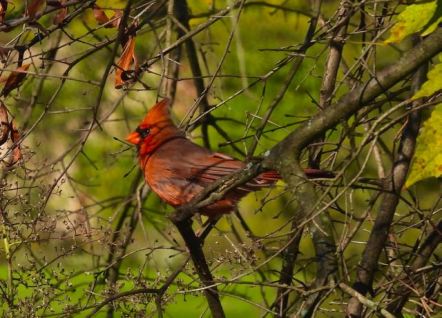
A male Cardinal is always showy, and certainly always in the fall displays, southeast bank, Oct. 25
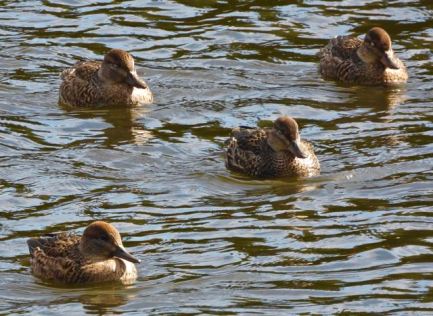
Surprise visitors–4 Northern Pintails–glide along the west bank, Oct. 18
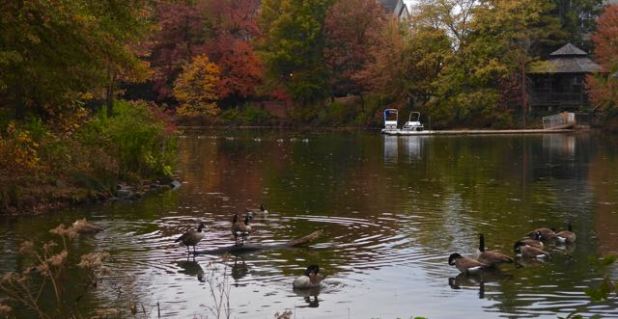
A flock of Canada geese enjoy the southeast cove amid fall colors and the gazebo on the west side, Oct. 29
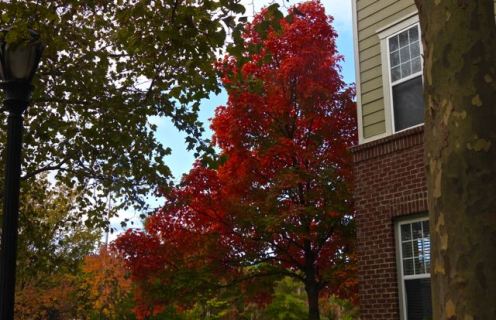
Sugar maple in full color south of the lake, Oct. 21
What begins as a short video of one of our Great Blue Herons with the Pintails and Geese becomes a melee of Heron and Geese that ends with Heron soaring across the lake, Oct. 18. Watch and listen.
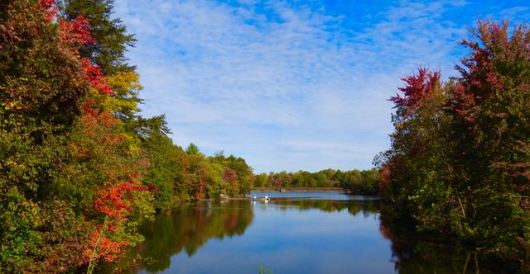
Quiet Lake Cameron fall display toward the north end, Oct. 25

Panorama of our lake refuge toward busy downtown, with fall colors and yellow evening primrose, Oct. 29
All joy from our colorful October toward a thankful November in hope and mindfulness.
 From Sacramento to Potomac: Tales of Two Valleys