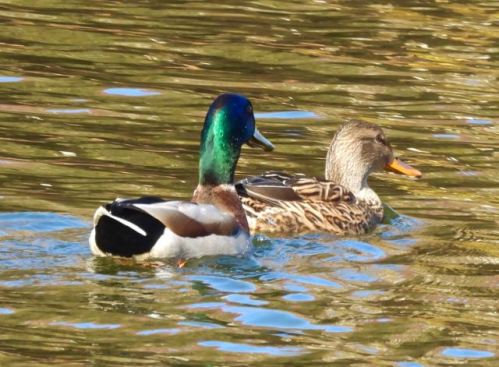
A mallard couple, who arrived two days ago, have the lake to themselves on a cold, breezy day, Nov. 11
In this month’s blog entry:
A Month for Giving Thanks
The Frustrating Joys of Birding
California Odyssey: Visiting Family, Friends, and the Bolsa Chica Wetlands
On the Day Itself: Family and a Bit of Cookery
The November 2023 Photo/Video Gallery: Fall Colors Persist, New Visitors Arrive, and the Mallards Return
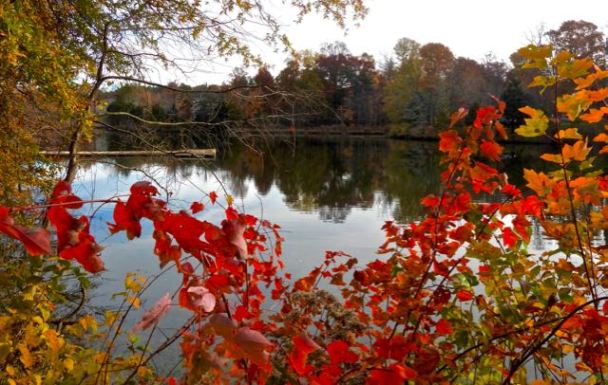
An early morning panorama of the still lake toward the northwest, with red maple in foreground, Nov. 15
*************************************
A Month for Giving Thanks
“Can we all just go to a leaf and thank Mama Willow?” (Pandora Thomas, founder of EARTHseed Farm, Sebastopol, CA (in the LA Times, Nov. 21)
Every store and online advertiser has been telling us all month that Thanksgiving is coming, and so we should get out there and buy stuff for the ones we love. I think the advertisers are on to something, even if it isn’t exactly what they intend. Instead of just on Thanksgiving Day, let’s give thanking its due and dedicate this whole month to giving thanks, whether that means spending money or not. Thanksgiving Month has a nice ring to it. And we certainly have enough people, other creatures, and day-to-day happenings to be thankful for.
Sure, there’s also lots going on that we wish weren’t happening, things that make us afraid and give us difficulty sleeping at night. I don’t need to name those things: you know what they are in your own life. But if every day we also gave a little time to focusing on the so-much in our world that is kind and beautiful and generous, we’d certainly have enough to fill an entire month, and maybe each day in the year. And this grateful focus might, if we give enough thanks, help us sleep better at night.
We’ve been getting together with family and friends this month, including some members that we don’t see too often, and those opportunities are to be cherished. And every day, as this blog records, I am privileged to walk in a place that brings me into the presence of fellow creatures who give me joy and who give of themselves without considering how I might reward them. Now those are gifts that truly deserve my thanks, including whatever gifts I might be able to give in return.
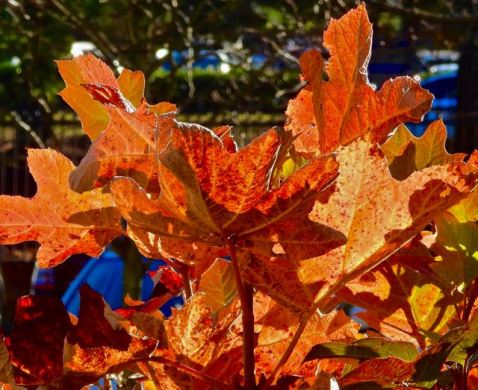
The sunlit, translucent, and generous oakleaf hydrangea just outside the window of the room where I write. (Thank you!)
***********************************************
Joyful Frustration and Frustrating Joys: The Daily Adventures of Birding
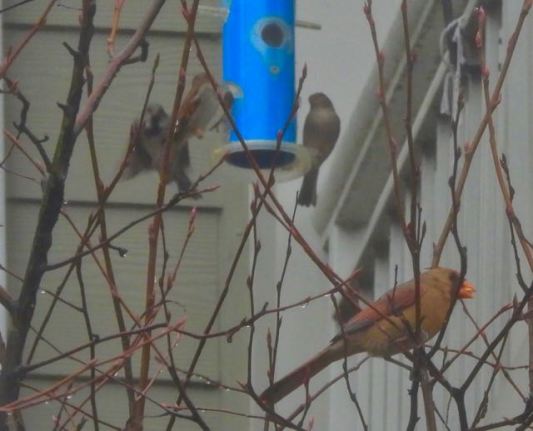
For every serendipitous photo like this one I took on Nov. 21, there are thirty or more that are either too blurred, too dark, too cluttered, or too bright to decipher; are otherwise disastrous; or are set up, and then not taken at all. The frustrations just go with birding, and if it weren’t a challenge, birding wouldn’t be fun.
When I list all the things I do for which I am thankful, birding is high up on my list. On the 21st it was raining steadily and getting heavier, so of course it was ideal birding weather for me. I wanted to see who the other obsessives were (avian ones, not just me) who’d be out in the stormy November cold going about their important business or just socializing. How was my photographic jaunt? Well, when I met my neighbor, who was going out for his walk as I was coming in soaked, he asked me, laughing, “Did you get any good shots today?”, I said, “Oh yeah, I got some great shots!” And I had, though he was just shaking his head.
My tally was 61 shots, probably another 50 set up but not taken, and a whopping 12 saved, of which 6 were of birds and 6 of landscapes. It was a great shooting day, because, of the 6 bird photos I saved, one was of a white-crowned sparrow, a variety I haven’t seen here before (though we had them often in California) and another was of a yellow-rumped warbler, a species that I hear often but see rarely; and a third was the one shown above, with 3 house sparrows scuffling at our feeder while a female cardinal leisurely munched on a seed in the foreground.
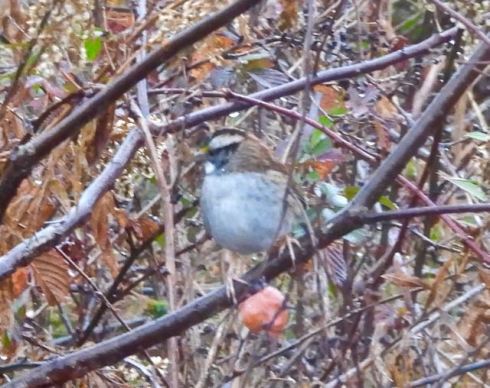
A rare sighting here of a white-crowned sparrow, Nov. 21; they were regular visitors to our home in California
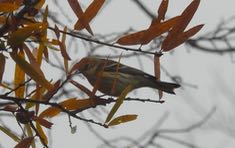
A yellow-rumped warbler brightens this rainy day, Nov. 21, in a willow oak by the east bank of the lake
The daily frustrations of the shots gone awry or the shots not taken (as the little folks hide or fly away just as the shutter is about to click) are more than made up for by the successful snaps and videos. And even if I never got a clear, well-focused, and well-lit picture, the ever-present joy is the opportunity I have every day to listen closely, watch closely, study closely, and so learn more and more about the many fellow creatures who share their lives with me.
For birding is composed of so much more than the myriad birds themselves. Without the insects there would be no birds, so they, too, must be studied. And for so many birds, they would not exist without the water animals and the mammals and reptiles of the land. The plant life in which all the creatures live and which feeds them and houses them have also become my study, for the plants and the animals are a continuum with the humans like me, as are the air we all breathe and to which we contribute, and as is the soil which the plants need and to which they contribute; as is the water which feeds us all and which itself is made up of the atoms of the air and of all the creatures.
Yes, we are all one. It is when humans forget this, as we have so often, that the Earth gets into trouble, as it surely is now. Somehow we humans think we are separate from, even superior to, the rest of the Earth, even though we are younger, mere children compared to other creatures who have been on our planet for millions, even billions, of years.
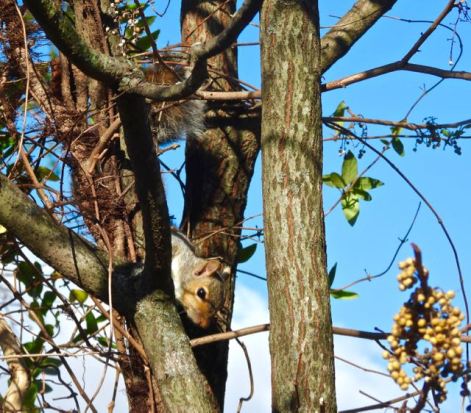
A grey squirrel, another of our essential citizens, alert in a chinaberry tree on the east side
One frustrating, joyful event. On Nov. 20, I was thinking about this idea of joyful frustration when I was on my walk. Sure enough, my revery was broken by a bird sound I didn’t think I’d heard before. A kind of melodious click, then another, and another, and another. It was nearby, so I did as I so often do: I began to scan with my old eyes the trees beside and above me. I always look for movement, though often I see none, no matter how long I look, even as the songs and calls continue. But this time, I saw something appear and then disappear on the trunk of the white oak just to my right. There it was again, slightly farther down the trunk. It was much too small to be one of our grey squirrels, but it sort of moved around the trunk the way that squirrels do.
So I trained my camera–a much inferior tool compared with the senses of any other forest animal–and saw a tiny head–was it a head?–pop around the trunk, then disappear again. Then there it was again, and this time I snapped a picture, and then another and another as the animal, most likely a small bird, appeared at other spots down the trunk. What did I have? I wouldn’t know until I could get my camera home after the walk and enlarge the images I had captured, such is my old human’s sensory incompetence.
Well, after my cumbersome procedure of many minutes later, I discovered that what I had snapped was a white-breasted nuthatch, a type of bird that I had snapped serendipitously last fall, but with much less effort.
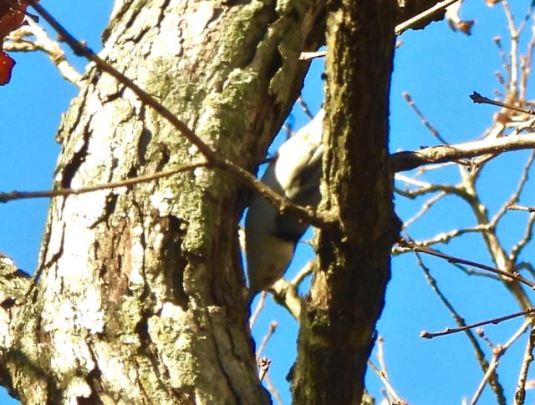
White-breasted nuthatch between trunk and branch of white oak, Nov. 20, west of the lake
So what did I feel? Yes, a kind of satisfaction, sure. But not a satisfaction that might come from a victory in some kind of competition–me against the little bird, if such a thing could be imagined. Rather, it was the sense of a link between me and that little bird, a magnificent being who had allowed me to share a tiny moment of life.
And that is pretty much how I always feel when I take a successful picture, or even when I just am allowed by the bird to see this fellow for a moment before she or he moves on to the next objective. Oh they move so quickly, so often silently, and they hide so mysteriously, and they sing so gloriously. And when they stop just for a moment in my presence, I breathe a “thank you” that I can only hope they somehow feel.
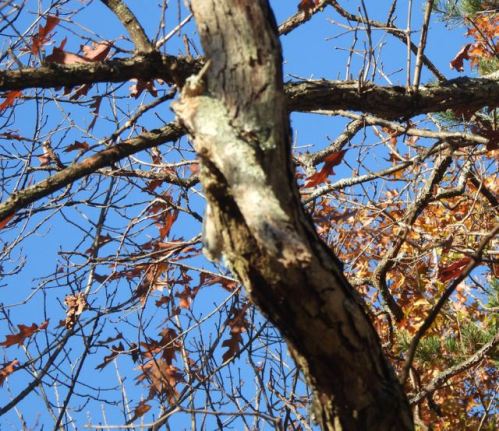
White-breasted nuthatch on the trunk of a white oak, west side of the lake, Nov. 20. Can you see him or her?
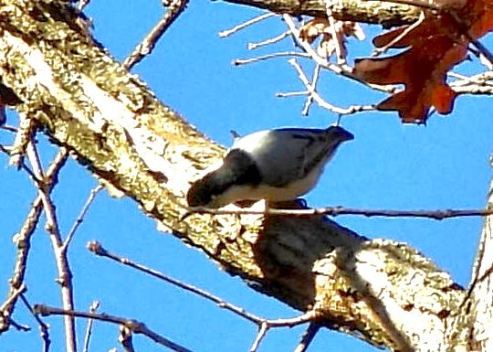
White-breasted nuthatch on a branch of the white oak, clearer view, Nov. 20, west of the lake
*********************************************
California Odyssey: Sharing Time with Family, Friends, and Wildlife
Sea lions in La Jolla Cove, La Jolla, California, Nov. 3
Our first trip back to California since our move to Virginia last year took place in early November. The trip was a celebration in several respects: it was a milestone wedding anniversary for Jean and me, and an opportunity to visit with our two West Coast daughters and share meals with them and their partners. It also meant our taking part in the wedding of two good friends in La Jolla, as well as reconnecting with other old friends there. So the trip became a weeklong odyssey along the California coast between San Diego and Los Angeles.

Brown pelicans on the cliffs at La Jolla Cove, California, Nov. 3
Visiting the Bolsa Chica Wetlands
Besides our planned visits with our daughters and their partners in Seal Beach and Long Beach, and the wedding in La Jolla, our short odyssey featured touristy time in San Diego and Los Angeles, as well as beach views along the Pacific Coast Highway.
Panorama of Sunset Beach, California, early morning, Nov. 6, with shearwater gulls and morning walkers
An unexpected treat was visiting the Bolsa Chica Ecological Reserve in coastal Orange County. The Bolsa Chica Wetlands, next to what is now Sunset Beach in Huntington Beach, California, were an extensive tidal marsh beside the Pacific Ocean, with hospitable use for over 9000 years by native tribes such as the Acjachemen and later the Tongva. Then, extensive coastal destruction by developers came in the later 19th and early 20th centuries. The marsh still existed in part, but without any protection. Then property purchasers wanted to drain it completely and build beachfront houses in the 1970s.
A marina in Sunset Beach abuts the northwest edge of the Bolsa Chica Ecological Reserve, November 6
A concerted effort by local, state, and finally national organizations soon arose, which after several years convinced the courts to halt the destruction plan and establish the remaining marsh as a nature preserve. Today the Bolsa Chica that remains is open to the public to visit and take photos from miles of wooden walkways. Though the rushing traffic on the adjoining Pacific Coast Highway and a large adjacent marina limit the marsh, it continues to provide a home for native plants and the animal life that the plants and water sustain.
A sparrow rests in a Chamiso Saltbush at the Bolsa Chica Ecological Reserve in Huntington Beach, California, November 6
It takes less than a minute for speedy drivers on the PCH to pass by the Bolsa Chica, so it’s easy for people to not even know it is there. But for the wildlife that depends on it, and for the humans who stop and stay to admire it, Bolsa Chica provides a life-giving break from the commercial development along the Orange County coast.
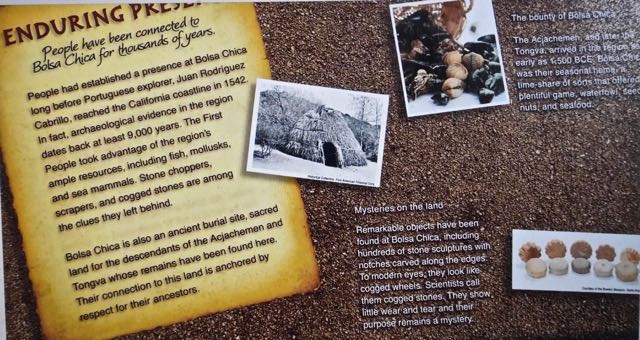
Infographic of history of human presence at Bolsa Chica Wetlands Reserve in California
********************************************
On the Day Itself: Family and a Bit of Cookery
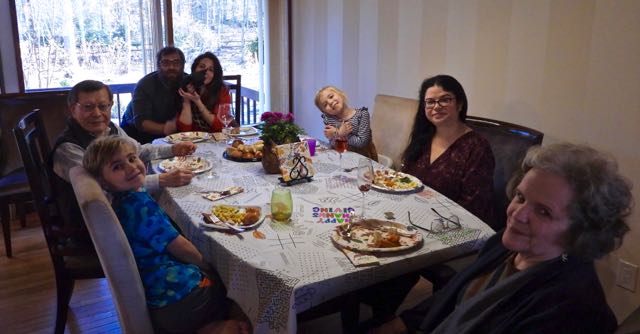
Three generations of family at our Thanksgiving meal
We spent the official Thanksgiving Day with local family members, three generations of us, at their home. We enjoyed a wonderful array of foods, with some contributions by all. Jean and I made two dishes, three sisters stew and corn casserole. Last December, I described in this blog the Native American history of the “three sisters” dish and my adaptations. This year, as I made the stew, I videoed its cooking, with a bit of background music:
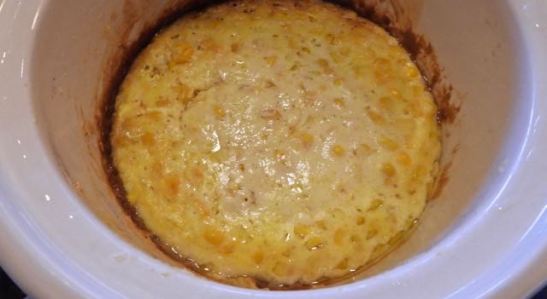
Jean’s corn casserole, with milk, eggs, and corn meal creating a dreamy creamy texture with the sweet whole kernel corn, cooked for four hours in the crockpot and came out a perfect addition to our communal meal:
Then, on the day after Thanksgiving, which for some reason the commercial world calls Black Friday, we continued the family thanks-sharing. First, my sister and brother-in law, who had traveled from downstate Virginia, and my niece and her husband joined us for a celebratory breakfast. And to top off all the festivities, one of our New York sons, our daughter-in-law, and their spunky, energy-filled kids, ages five and three, joined us for a picnic lunch on a crisp, bright afternoon at a nearby park and for hot beverages at a nearby Starbucks:
One day is just not enough for all the thankfulness. Here’s to Thanksgiving Month!
The November 2023 Photo/Video Gallery: Fall Colors Persist, Visitors Arrive, and the Mallards Return

A young deer peeks at me from behind a white oak in the east side woods, far from the north end where we usually see them, and no more than forty feet from where I stand in the path, Nov. 15. A truly serendipitous photo.
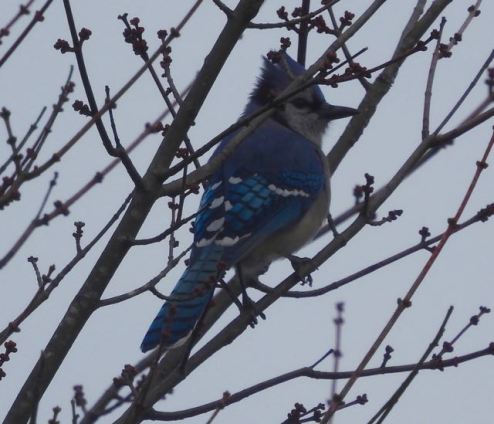
A Blue Jay, resplendent in various blues, calls from atop a red oak on the southeast bank just after sunrise, Nov. 25
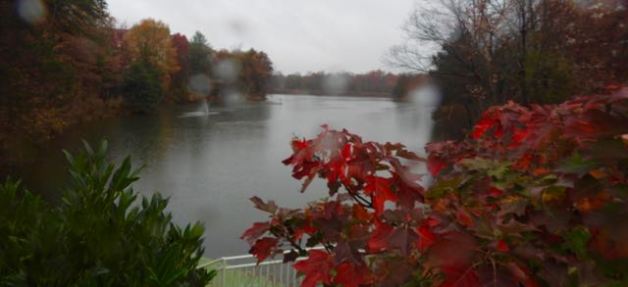
In the cold rain of Nov. 21, the brilliant oakleaf hydrangea contrasts with the misty north end of the lake
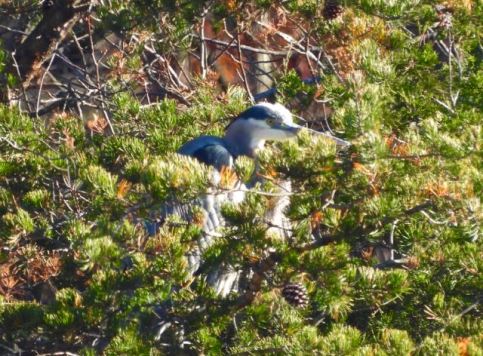
The great blue heron, who usually haunts the shoreline, hides in this Virginia pine in the north end woods, Nov. 19
This great blue follows bird calls while alert on the west bank, Nov. 27

Three pairs of mallards, newly returned, adorn the southeast cove, Nov. 12

And on Nov. 22, another returnee, a cormorant, with bold wingspread, on the west side dock
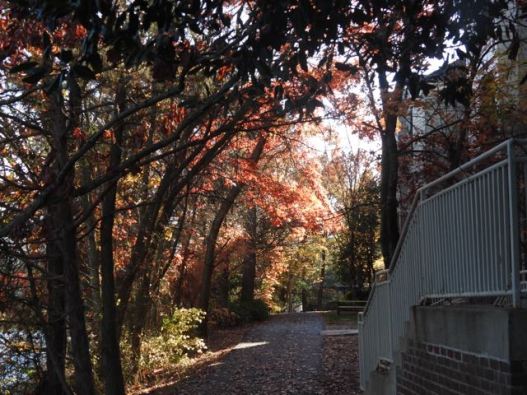
Sunlit late fall colors along the west side path, early morning, Nov. 13
In this short video, a male mallard flies in to join (impress?) a female friend, then takes off down the lake, Nov. 15
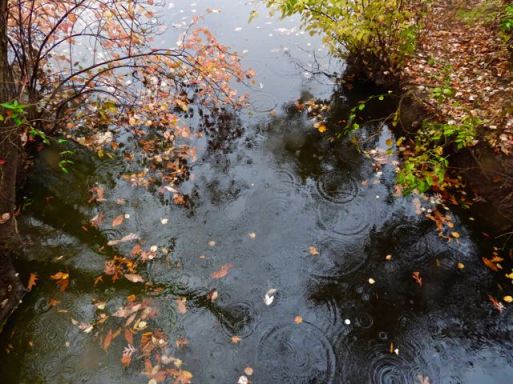
Raindrop circles in the inlet stream beside the bridge, with late fall colors, Nov. 21, in the steady downpour

A male cardinal atop a berry-clustered red cedar in the northwest corner by the lake, Nov. 15
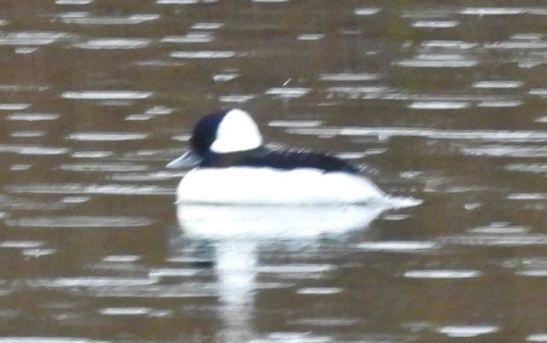
First time sighting of a male bufflehead duck in our lake, Nov. 10, on a rainy morning
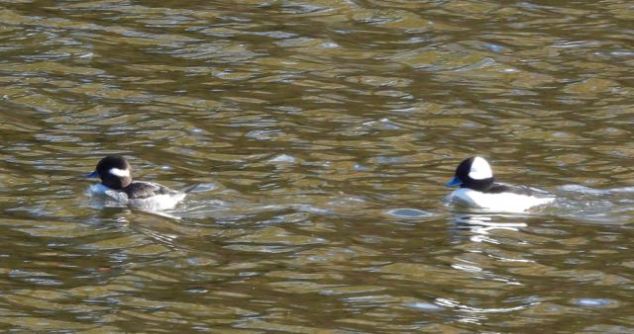
And now, on Nov. 22, the bufflehead returns–and has been joined by another!
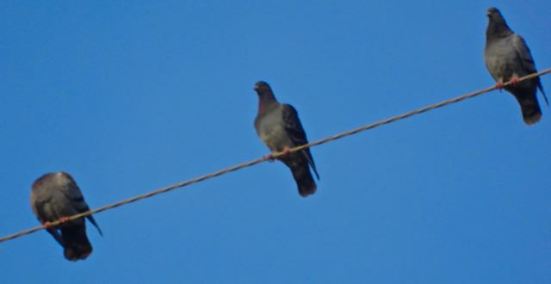
Three rock doves look down on the lake from the power lines to the northwest, Nov. 15
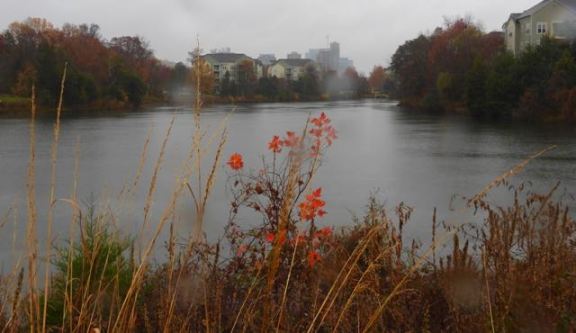
Panorama, with a young red maple , as I look toward downtown in the rain of Nov. 21
Short video of rock dove flock performing aerobatics west of the lake, Nov. 19
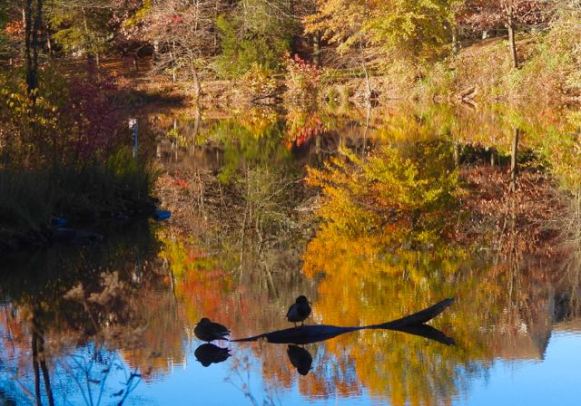
A mallard pair in the southeast cove silhouetted against the late fall colors of the west bank on the mirror lake, Nov. 19

A pair of Canada geese eye a mallard pair in the southeast cove, Nov. 9
In this 2-minute video, watch how this mallard couple builds their relationship in the quiet southeast cove, Nov. 11.
Thank you for reading, viewing, and listening. On to December!
 From Sacramento to Potomac: Tales of Two Valleys
Pingback: December 2023: Bluebirds, Loving Ducks, and a New Kind of Christmas | From Sacramento to Potomac: Tales of Two Valleys