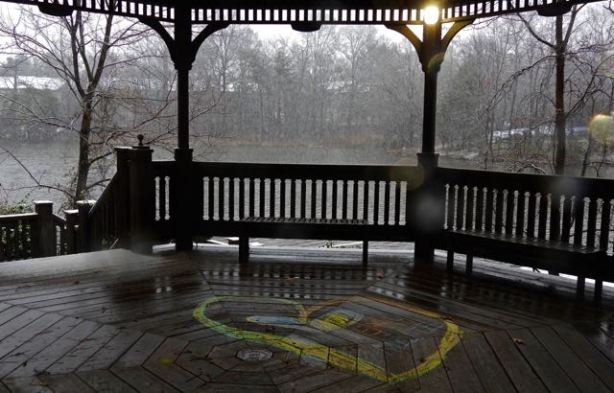
A chalk Valentine adorns the gazebo on the west bank during a brief morning snowshower, Feb. 13
First sighting since August: Beaver swims from cove toward west bank and dives, Jan. 27. Watch videos by researcher Emily Fairfax about ways that beavers, whose populations are steadily declining because of human intervention, create wetlands that restrict wildfires and increase water supply.
In this month’s blog:
Valentine’s Weekend for Birders: The Great Backyard Bird Count
Climate Log: Saving the Rain Forest by Saving Stingless Bees
Climate Log 2: Oh Those California Rivers in the Sky
February 2024 Photo/Video Gallery: One More Beautiful Snow Day (and More Avian Moments)
Two Crows bathe in the northeast corner of the lake on the final day of the Great Backyard Bird Count, Feb. 19
Two snow-covered Geese and teazle plants in the northwest corner during a brief morning snowfall, Feb. 13
Happy Valentine’s Weekend! The Great Backyard Bird Count
The video of the beaver we sighted on Jan. 27 was a Valentine to us before February even began, because beaver sightings are so rare in our lake. But an equally beautiful gift for Valentine’s Day is the annual four-day weekend of birding searches known as the Great Backyard Bird Count. Each February, the National Audubon Society, the Cornell Lab of Ornithology, and Birds Canada/Oiseaux Canada sponsor this multinational birding extravaganza, when enthusiasts from more than 200 countries post their pics and sound files to the site of their choice. This year, more than 600,000 of us feathery fanatics (AKA citizen scientists) from 209 countries posted sightings of over 7800 species. I was out there each of the four days, February 16-19, contributing my pics. Here are a few:
Two Canada Geese exclaim, then preen along the southeast shore, Feb. 19
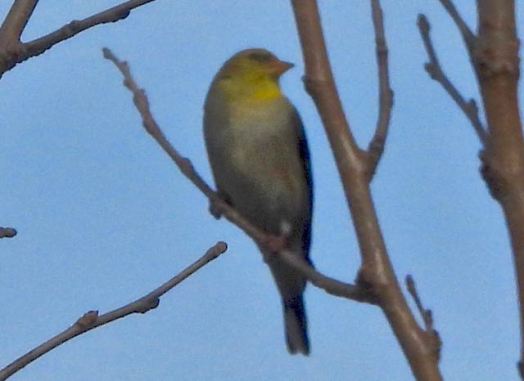
American Goldfinch on the southeast bank, Feb. 16

Great Blue Heron watches from the west bank on a sunny Feb. 18
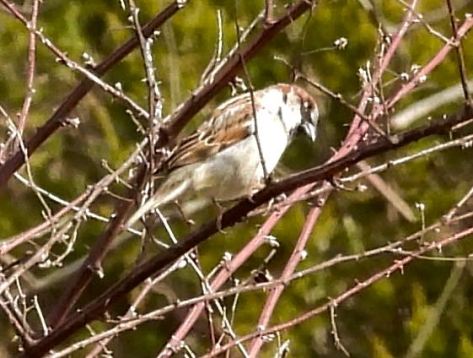
Chipping Sparrow in blackberry canes at the northeast corner, Feb. 16
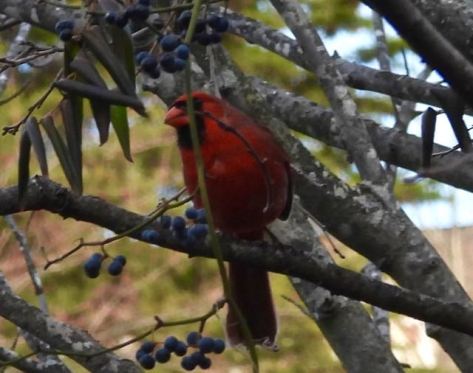
Male Cardinal in greenbrier berries, southeast bank, Feb. 16
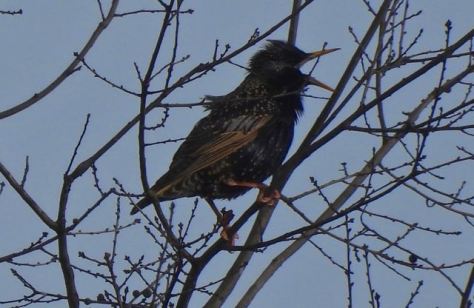
European Starling in mid call from the east bank, Feb. 16

Pair of Red-shouldered Hawks in separate trees north of the dam. Feb. 19
Of course, I get gifts like these from my feathery friends every time I walk around the lake. So February for me is a month of Valentines.
**************************************
Climate Log: Saving the Rain Forest by Saving Stingless Bees

Finding a hive of stingless bees in Peru’s Amazon rain forest (NY Times, Jan. 30; photo by Brenda Rivas Tacury)
The Amazon rainforest in Peru is home to many species of stingless bees, who produce a honey that has been used for generations by Indigenous peoples of the region, such as the Asháninka, as a natural medicine. These stingless species have thrived as pollinators of native plants, who have in turn thrived because of these plants. But as deforestation and mass agriculture have overtaken more and more of the rainforest, and as pesticides used by farmers have threatened species including the stingless bees, both the native plants and the bees are in danger of disappearing.
An article in the New York Times by Katrina Miller and Rosa Chávez Yacila (Jan. 30) describes how Indigenous beekeepers are attempting to keep the species thriving by creating artificial hives out of range of the pesticides, and then by creating a commercial market for the distinctive beneficial honey. Their hope is that the success of the honey sales will incentivize more Indigenous beekeepers and spur more efforts to maintain large areas of undisturbed forest, so that both the bees and the forests in which they mutually thrive can continue their vital work.
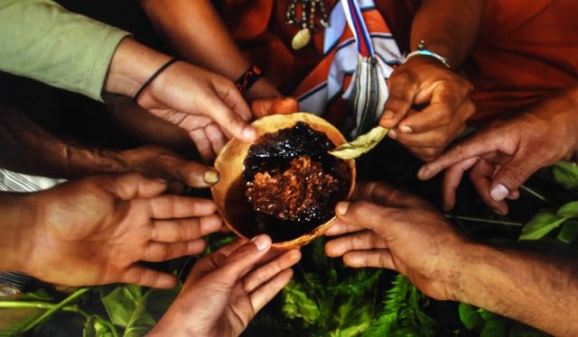
Asháninka community members and Peruvian scientists examine stingless-bee honey in traditional container (New York Times, 1/30/24; Brenda Rivas Tacury photo)
Help for these efforts has come from word of mouth during the pandemic of the medicinal value of the honey, as well as from scientists such as Drs. César Delgado and Rosa Vásquez Espinoza, whose study in the journal Food and Humanity reported this honey’s “anti-inflammatory, antimicrobial, and other health-promoting properties.” The popularity of the product is slowly growing, with half-liters now selling for upwards of $20.
Key to the success of the venture is the expertise of the beekeepers, whose knowledge and skill have come from generations of practice. So, if the economic endeavor succeeds, not only will the bees and the forest be saved, but so will a vital part of the culture of the people for whom the practice is central to their lives.
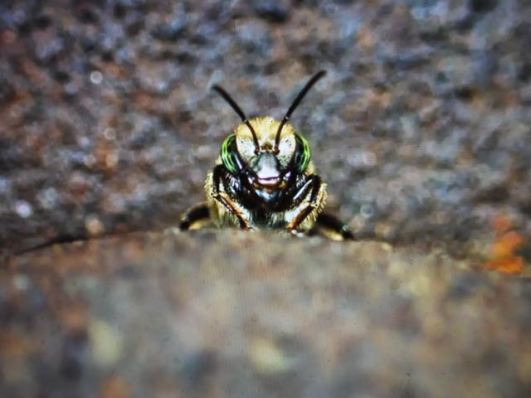
Melipona Eburnea soldier bee at the door of the hive (Photo by Luis Garcia Solsoi)
**************************************
Climate Log 2: Oh Those California Rivers in the Sky!
California’s second “water year” in a row of way above average precipitation has again filled the state’s reservoirs, brought deep snows into the Sierra–and this year caused massive flooding and landslides in the LA region as rain poured down on soil still soaked in many places from last year’s “atmospheric rivers” (or, as I like to call them, “rivers in the sky”).
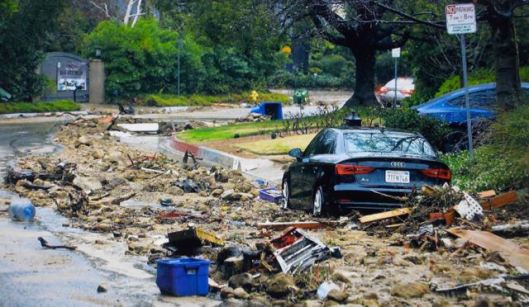
Studio City street swarmed with landslide debris (LA Times photo by Carlin Stiehl, Feb. 6)
Last year at this time, one of the big stories was the re-emergence of historic Lake Tulare, which had covered for centuries parts of several counties in the Central Valley before farmers and ranchers in the late 1800s had made the lake disappear (as well as Indigenous communities reliant on the lake) by diverting its inflows for their own purposes. Last year’s rains were so intense that the lake had come back, but now was contaminated by farm and ranch runoff. The reborn lake now also endangered farm communities that had grown up in the intervening century.
One of the big stories from this season’s storms, besides the floods and landslides in LA County, has been their impact all the way across the Sierra in another historic California locale. As Louis Sahagún reported in the LA Times on Feb. 19, the rains have “been good for LA’s water supply, but have caused costly damage to the aqueduct and dust control systems in the Owens Valley.” These recent storms have just intensified damage that began last year. If you don’t know the Owens Valley, then you don’t know the iconic California story (as loosely depicted in the great movie Chinatown in 1974) of how the city of Los Angeles in 1913 secretly bought up land in the quiet farming valley east of the Sierra so it could divert by aqueduct the region’s water 230 miles south to the burgeoning metropolis.
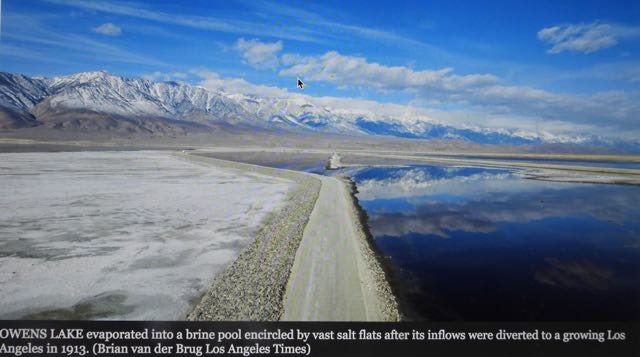
The Owens Lake brinepool and runoff from the 2024 storms (LA Times photo by Brian van der Brug)
After the city had to pay compensation to Owens Valley residents decades after the city’s duplicity was discovered, it also had to create complex systems to monitor and control every year the toxic dust that resulted from the dry lakebed. Sahagún’s article states a cost of $2.5 billion so far (and counting) for this year-by-year environmental disaster mitigation. Now, the deluge of returning water has damaged both the aqueduct and the state-of-the art dust control systems, at a repair cost estimated to be $100 million, which will no doubt be passed on to LA’s 4 million water system ratepayers.
So, climate change is the gift that just keeps on giving. Scientists are predicting that these new cycles of more intense rainfall will alternate with years of ever-warmer drought, creating the need for drastically different, perhaps conflicting, types of infrastructure. (Think systems to capture precious water into deep-below-ground aquifers in the rainy years to prepare for droughts, but also systems to divert excess water away from already soaked land.) California is working on it, as always. And, as always, the rest of the nation will keep looking toward California, as more and more states, like my own Virginia, must adapt to the new normal.
Unless political will actually strengthens around the world to really confront and eliminate the causes of climate change, we Earth humans will have no choice but to pay the ever larger costs, in money, famine, and millions more refugees, that a more extremely erratic climate will bring to all creatures, including the human kind. Sorry, no Valentines.
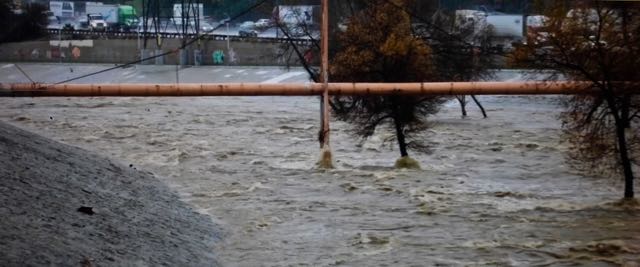
Flood surge in Atwater Village, Los Angeles, Feb. 5 (photo by Dania Maxwell, LA Times)
*************************************
The February 2024 Photo/Video Gallery: One More Beautiful Snowy Morning (and More Avian Moments)
Meanwhile, we enjoy heartily the gifts we receive each day from the birds and other folks who make our fragile lake sanctuary one of their homes. Enjoy these Valentines with us.
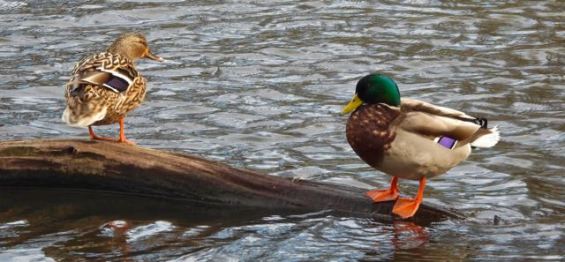
Mallard pair in glorious full color on the log in the southeast cove, Feb. 16
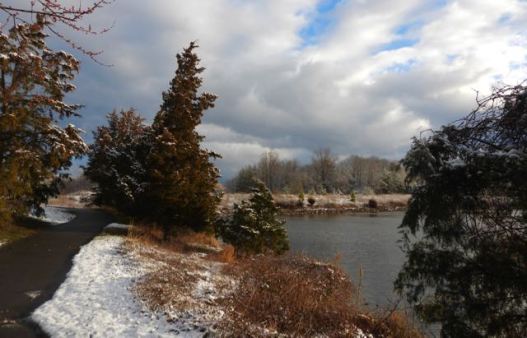
Snowy morning, Feb. 17: Northwest corner path and trees of the north end woods

Male Cardinal on the snowy morning, southeast bank, Feb. 17
Snowy morning, Feb. 17: From the southeast cove along the west bank
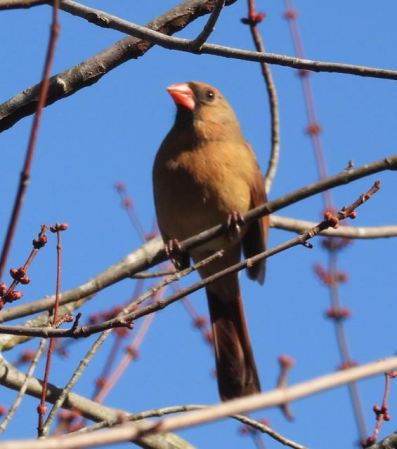
Golden Female Cardinal in a red maple, east bank, Feb. 21
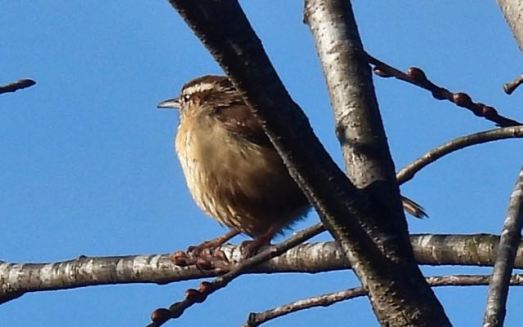
Carolina Wren in slippery elm along the east bank, Feb. 1
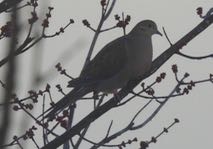
Mourning Dove in red maple, southeast bank, Feb. 17
American Goldfinch feeds and sings at feeder on the east side, Feb. 12
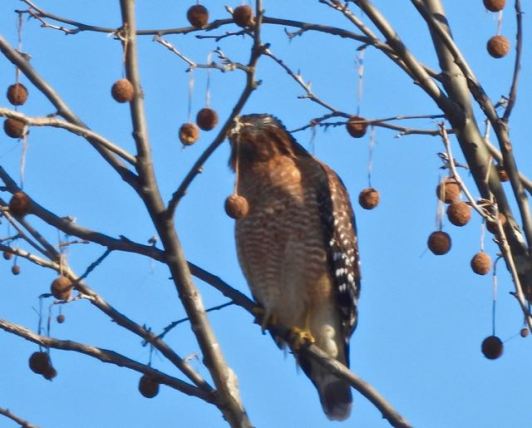
Red-shouldered Hawk in budding sycamore below the north end dam, Feb. 21
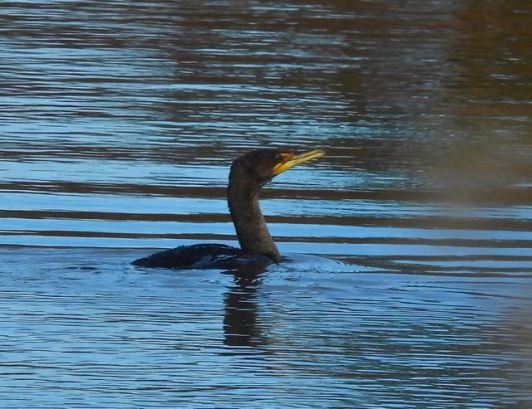
Double-crested Cormorant in mid lake, Feb. 16
On the snowy morning of Feb. 17, winds growl along the northwest path as storm clouds gather

Rare White Female Cardinal perches in the northeast corner, Feb. 21

Two Male and one Female Mallard in the southeast cove, Feb. 21
Goose flock ambles toward southeast lake shore, and one flies toward front, Feb. 16
Watch camera move to reveal a pair of Red-shouldered Hawks on the fence along the highway west of the lake, Feb. 16
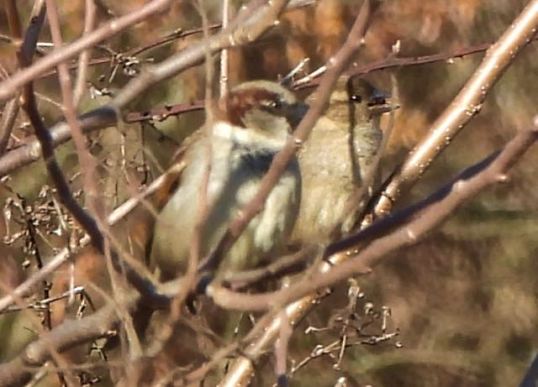
Mating pair of House Sparrows in sumac branches, northeast woods, Feb. 19
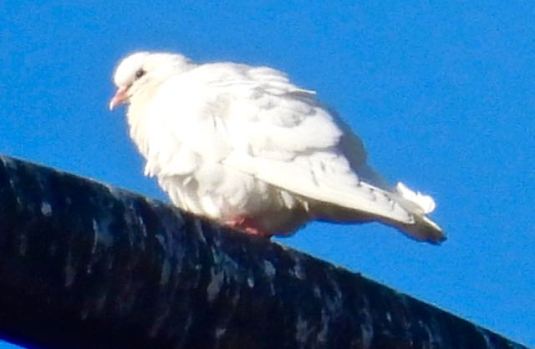
Uncommon White Rock Dove on stanchion high above the lake, Feb. 18
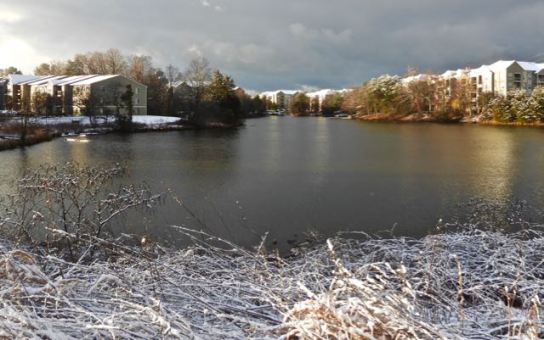
Panorama toward south end from snowy reeds, on the morning of Feb. 17
Yellow-rumped Warbler sings a short song on the snowy morning on the southeast bank, Feb. 17
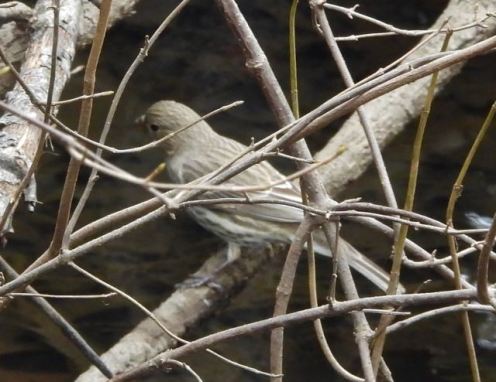
Female House Finch studies the inlet stream by the bridge, Feb. 27
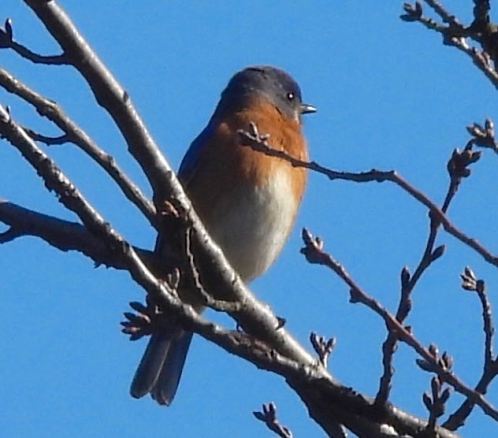
Eastern Bluebird in aspen on the east side, Feb. 25
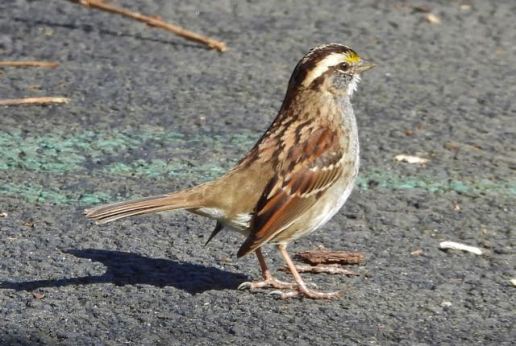
A rare White-crowned Sparrow on the southeast path by the inlet bridge, Feb. 15
Dramatic scene of Great Blue Heron confronting a Cormorant in mid lake, then flying to west shore, Feb. 6. We were amazed.
So many Valentines this February! On to March!
 From Sacramento to Potomac: Tales of Two Valleys