If you’re new to this blog, start with the About page, then come to Home.
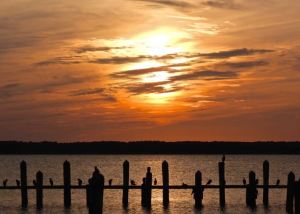
Double-crested Cormorants celebrate sunset on the Tred Avon River, Oxford, MD, September 15
In this month’s entry:
Return to the Eastern Shore: Heroes, Horses, Survivors
Our Newly-Started Garden!
Another Potomac Valley Exploration
The September 2024 Photo/Video Gallery
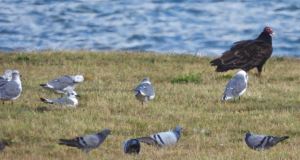
On the Long Wharf in Cambridge, MD, Herring Gulls, Rock Doves, and a Turkey Vulture commune, September 14
Return to the Eastern Shore: Heroes, Horses, and Survivors
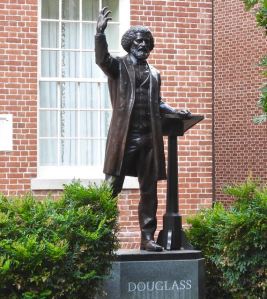
Frederick Douglass statue at County Courthouse, Easton, MD, September 13
One year ago, we took our first trip to the Eastern Shore of Maryland since we’d left California in 2022. On that trip, we focused on the quiet village of St. Michael’s, the even tinier Tilghman’s Island just across the Chesapeake Bay from Virginia, and the Blackwater National Wildlife Refuge. On this year’s two-days-longer trip, we focused on the historic towns of Easton, Cambridge, Vienna, and Oxford–as well as windswept Assateague Island all the way east at the Atlantic Ocean.
Early morning scan along a small beach at the western edge of the town of Oxford, toward the Choptank River, September 16
Heroes
The town of Easton thrives today near where Frederick Douglass grew up enslaved and from which he escaped as a young man. His life and struggles are immortalized in his 1845 autobiography, Narrative Life of Frederick Douglass. Easton reveres its local hero through a powerfully-wrought statue in the town center and an annual Frederick Douglass Day celebration, to be held this year on September 28.
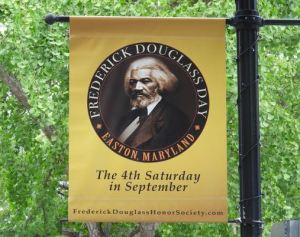
Douglass Day poster, Easton, Maryland (photo, September 13)
A second Eastern Shore hero, Harriet Tubman, the courageous, tireless leader of the Underground Railroad, is commemorated in nearby Cambridge, Maryland, through the Harriet Tubman Memorial Garden, and the Harriet Tubman Underground Railroad National Historical Center, which includes the Museum of the Underground Railroad. On this Veteran’s Day, November 11, Tubman was honored, 160 years after her military service to the U.S. during the Civil War, by being named a one-star general in the Maryland National Guard. Over her lifetime of service, she liberated many hundreds of enslaved persons in Maryland and other slave states.
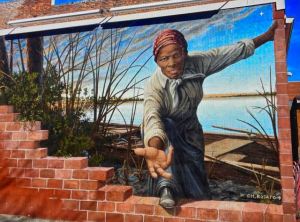
Mural of Harriet Tubman in downtown Cambridge, MD
Harriet Tubman grew up enslaved on the Brodess Farm eight miles south of Cambridge, and from there not only escaped herself, but led others from the farm to freedom. The peaceful fields and forest of this land today, marked by two plaques, are a quiet tribute to the lifetime of heroic service by this American hero.
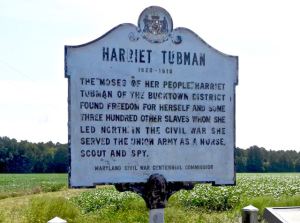
Historic marker to Harriet Tubman at the site of the Brodess Farm, south of Cambridge, Maryland (photo, September 15)
Horses
According to legend, a shipwreck late in the 17th century left a small herd of horses stranded on long, narrow, sandy Assateague Island just off the Maryland coast. These horses survived on the salt marsh grass, and their descendants became over time the darlings of the human community that grew up near them, and were instrumental to the humans’ own success. In the 20th century, Assateague Island became the Assateague Island National Seashore, the land and horses protected by the national and state Park Services. On September 15, we visited the island for the first time in many years, and were enchanted once again by the natural setting and its equine inhabitants.

One of the Assateague horses welcomes us to the National Seashore. We stopped and let the horse pass by to join friends. (September 15)
Not only were we and the other human visitors greeted by several of the approximately 75 horses on the island, but we were able to visit the very quiet, early morning beach, surrounding marshes, and woods. As one would expect, the island is being constantly reshaped by wind, currents, and climate change; so a second large responsibility of the Park Services is to revitalize the beaches and protect the native plant species.
Panorama of the Assateague shoreline, morning, September 15
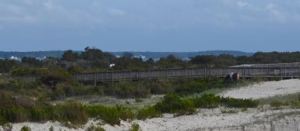
View from the beach across the marsh to the intracoastal bay and the mainland beyond (September 15)
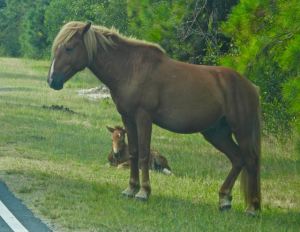
Assateague mare and her foal, along the roadside, September 15
Survivors
Life on the Eastern Shore is about survivors, not only the enslaved humans who managed to escape, or the horses on Assateague, or the native plants and animals challenged by modern agriculture and overfishing, but all those over centuries whose descendants have endured and often thrived in an environment with arable land and plentiful sea life. Perhaps among the most challenged have been the Native American humans of this unique region, who made a living from this land and its waters over many centuries through responsible use of the natural resources–and then were decimated by Anglo tobacco growers, farmers, and fishermen from the 17th through 19th centuries. Descendants of those who survived still call this region home.
We actually came on this visit because we wanted to take part in the 32nd Annual Festival of the Nause-Waiwash Band of Indians, celebrated in Vienna, Maryland, 25 miles east of Cambridge on the banks of the Nanticoke River.
Consisting of displays of foods and crafts, exhibits, demonstrations, ceremonies, and native dances, the annual festival draws members from several tribes and other visitors from the Eastern Shore and well beyond (like us).
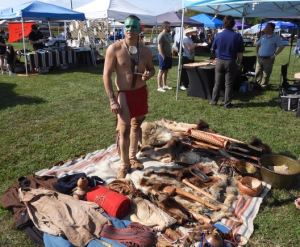
Drew Shuptar-Rayvis, Cultural Ambassador of the Pocomoke Nation, exhibiter at the festival, September 14
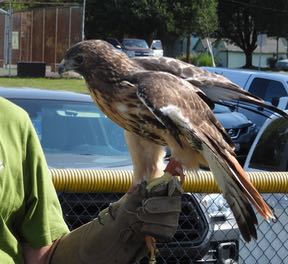
Parks Docent describes habits of the Red Tail Hawk, at the Native American Festival, Vienna, MD, September 14
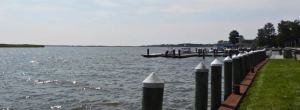
The Nanticoke River, looking toward south, Vienna, MD, September 14
**************************************************************
We Start a New Garden!
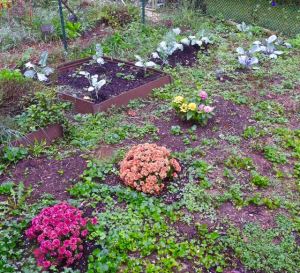
Our first plantings: Broccoli, Cauliflower, Red Cabbage, Mums, Daisies, 3 weeks old, in the rain, September 24
Shortly after we moved into our Northern Virginia community in 2022, I put our name on a waiting list for a 200-square-foot garden plot in one of our suburban city’s array of four areas open to residents for their gardens. Each of the four area clusters includes about 50 plots: the clusters are all fenced in and require a code to enter. These four areas are closely supervised by the community, with each area governed by rules (organic gardening is required, for example), with the rules enforced by managers. Water is provided in each area, and mulch and compost are also available. Each plot holder pays a reasonable seasonal fee.
These plots are so popular that I waited almost two years for our name to come up. In that time, we learned as much as we could about growing vegetables and flowers in the rainier Northern Virginia climate–so different from the year-round, irrigated gardening I did in California for 17 years, and which is captured month to month in this blog from 2016 to June 2022. (Check out some of our entries!)
Here, we are starting very small, to get a feel for the climate and because winter is fast approaching. We planted 6 seedlings each of broccoli, cauliflower, and red cabbage, plus a few hardy fall flowers (chrysanthemums and gerbera daisies), just to see how they will do in the weather and how they are impacted by the squirrels, chipmunks, and cabbage leaf butterflies. We are learning so much from the other garden plots we look at–and we are mightily impressed by the variety and productivity of our new neighbors’ gardens. See the video below.
Keep watching this blog for monthly updates.
Pano-track of plots in the area in which we have our small new garden, in the rain, September 24
*************************************************************************
Another New Potomac Valley Exploration: Rock Creek
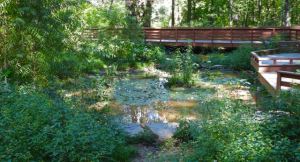
Marsh on Rock Creek tributary above Jones Mill, Rockville, Maryland, September 3
Rock Creek begins in Montgomery County, north of Washington, DC, and flows through the District and into the Potomac at Georgetown. On September 3, we visited the northern-most part of Rock Creek, where the Jones Mill stood in the 18th century. As with the Conococheague Creek region 60 miles to the northwest, some of Jean’s ancestors settled in this Jones Mill area at that time. So visiting this area and observing the waterways and flora helps us begin to imagine what those ancestors might have experienced, though the land has been greatly changed since those times. Fortunately, small parts of this densely-developed area have been preserved as parkland and even as nature refuge, rather than adapted and re-adapted decade upon decade as commercial, residential, and roadway construction.
Indeed, even to preserve this few-acre streambed as a wetland has meant substantial redesign and replanting, plus the addition of paths and bridges for visitors, as seen in the above photo.
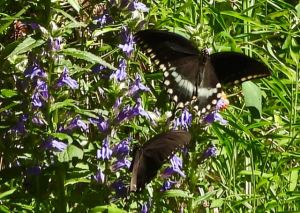
Black Swallowtail Butterflies on Blue Lobelia, Rock Creek marsh, Jones Mill area, September 3

Oxeye Sunflowers, Rock Creek marsh, Jones Mill area, September 3
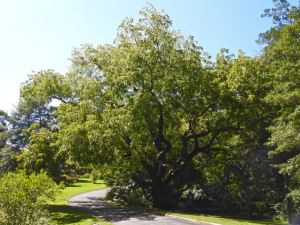
Magnificent Black Walnut Tree, Rock Creek park, Jones Mill area, September 3
***********************************************************
The September 2024 Photo/Video Gallery
More from around our community lake, from our new garden, and from our travels this month
Maybe twice a year, we’ll be privileged to witness a beaver swimming in our lake. On September 26, in the rain just before sunrise, I watched as this beaver explored the swollen shoreline. This is our most extended view of this resident in two years.

A pair of Blue Jays atop an oak east of our lake, misty morning, September 25
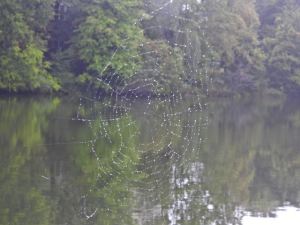
Spiderweb view of the lake, southeast cove, misty morning, September 25
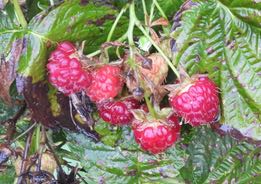
Ripe raspberries from a bush left in our new garden by the previous plot holder, September 24
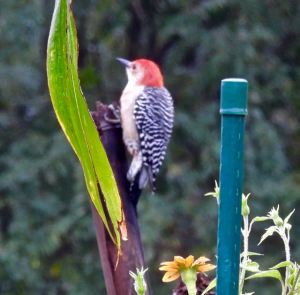
Red-bellied Woodpecker in a neighbor’s plot in the community garden in the rain, September 24
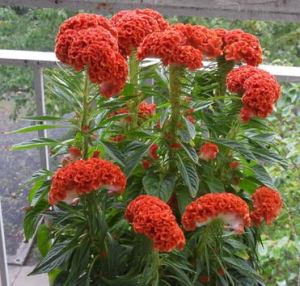
Cocks-comb (Celosia) on porch beside our lake, September 24
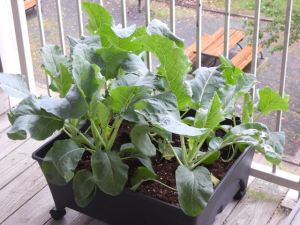
Cauliflower plants thrive in pot on porch beside our lake, September 24

Wildflower montage below the lake’s north end dam: Goldenrod, Late Boneset, Cutleaf Teazle, Purple Thistle, Porcelain Berry, drizzly morning, September 22
Rock Doves by dozens fly on to and perch on stanchion west of the lake, drizzly morning, September 22

Exceptionally rare in the Eastern U.S.: Clark’s Nutcracker feeds on dried Evening Primrose on the Northeast bank of the lake, September 22
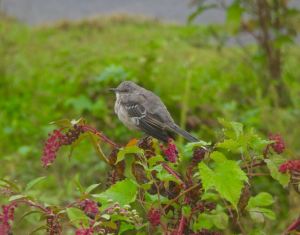
Mockingbird on Pokeberry bush at the north end shore of the lake, misty morning, September 25
Ferry trip: from Oxford, MD, to Bellevue, MD, across the Tred Avon River, September 16
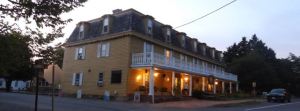
The Robert Morris Inn, built 1710, where we stayed in Oxford, MD, September 15-16

Eastern Shore trip: Passing by a typical Easton area farm with the ubiquitous soybeans that we saw growing in the region, Sept. 13
By the Dorchester County History Museum, Cambridge, MD: Tracking the flora and Mallards in the marsh, September 14
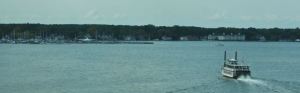
On the Choptank River bridge, September 13: a paddle wheeler heads toward the pier in Cambridge
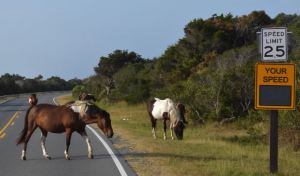
Assateague Island: Herd crosses the road where traffic has stopped, September 15
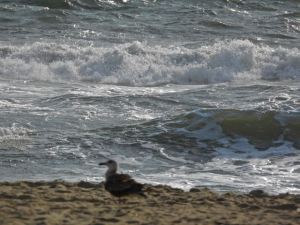
Assateague Island: A Herrring Gull at the ocean’s edge, early morning, September 15
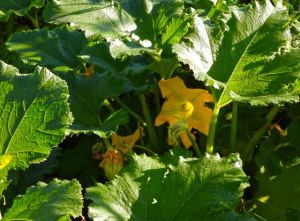
Surprise Zucchini blooms and vine on the north end path by our lake, September 10

Community garden: male Cardinal perches in a neighbor’s plot in the rain, September 24
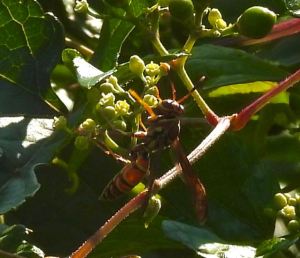
Red Wasp feeds on Porcelain Berry west of our lake, late afternoon, September 9
Snapping Turtle swims across the middle of our lake, always on the lookout, afternoon, September 22
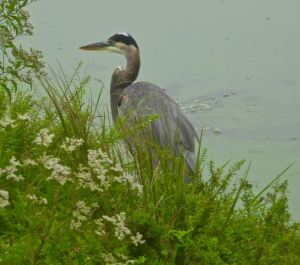
Another patient watcher: Blue Heron amid Late Boneset and Bushclover, northwest corner of the lake, misty morning, September 25
And my camera is always on the lookout, too, as I hope to see, hear, and hold on to more memories. Still a few days of September left, then on to October in our colorful, exciting, fragile world.
 From Sacramento to Potomac: Tales of Two Valleys