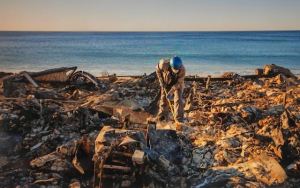
Fire to the Ocean: Homeowner sifts through wreckage after the Palisades Fire, Jan. 13 (Brandon Bell/Getty Images). The Palisades Fire is still not fully contained two weeks after the blaze began, and more high winds occurred this week, but with some rain expected for the weekend.
In this month’s entry:
Apocalyptic Fires, Surprising Ice
Staying Warm with International Dishes
The January 2025 Photo/Video Gallery: Bird and Deer Resilience

Palisades Fire and Los Angeles city lights, from airplane (Reuters photo, January 8)
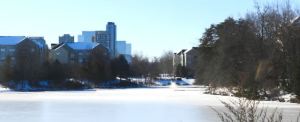
Our frozen lake, view toward downtown, windy morning, January 9
Apocalyptic Fires, Surprising Ice: Two Sides of the Same Oily Coin
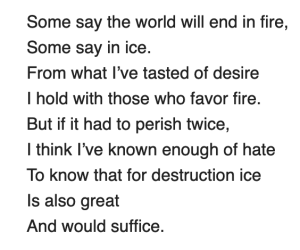
Robert Frost, “Fire and Ice,” first published 1920
Chris:
It’s certainly common in this blog to talk about very different places and experiences, but this January seems to offer–I say “seems”–a brutally stark divide between the fires in Los Angeles and the snow and ice here in Northern Virginia and now through the Deep South. Sure, there’s a difference between the heat and sudden destructiveness of a fire and the combination of sudden danger and long-term deadening action of ice. But, as Frost’s poem makes clear, the contrasting forces both have the power to destroy the world–when weaponized by human desire and hate. So fire and ice, in their destructive power, have a lot in common.

Altadena, CA “neighborhood” after the Eaton Fire, Jan. 16 (Orange County Register); Almost 40,000 acres burned in the two fires; 12,000 homes, schools, libraries, and other structures were lost, and 60,000 or more people were left homeless–one of the worst disasters in California history
Indeed, the LA fires and the extreme “cold snap” now surprising the US South–snow fell in Tallahassee, FL, on Jan. 20, for example–both demonstrate the climate change that the unrestrained greed of the oil and gas cartel continues to bring to the planet and its inhabitants. The unprecedented fires in LA are the result of the rare–but increasing–confluence of a record drought afflicting Southern California and unusually strong Santa Ana winds producing gusts as high as 100 miles an hour. Together, the drought and the winds make wildfires in the parched chaparral landscape much more likely. Climate change science predicts that such a confluence of forces will become more common.
And not only in Southern California. The drought that stoked the fires there is stoking them across many states. According to the US Drought Monitor, as this blog reported in October, as much as 80% of the US is rated as from abnormally dry to being in moderate to severe to extreme to exceptional drought, as this December 2024 map shows:
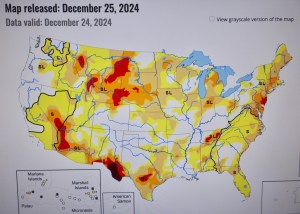
US Drought Monitor, Christmas Day 2024 (https://droughtmonitor.unl.edu/CurrentMap.aspx)
The Onslaught of Ice in the Deep South

Ice, snow, and states of emergency from Texas to Florida to the Carolinas, Winter Storm Enzo (Weather Channel, Jan. 21). David Goodman of the NY Times reports (Jan. 21): “For many Texans, the arrival of snow brought back memories of the devastating winter storm of 2021, which crippled the state’s independent power grid and killed more than 200 people. So far, the state’s electricity market operator has said it has plenty of power.”
Some are calling it a “once-in-a generation” winter storm along the Gulf Coast (CNN, January 22: https://www.cnn.com/2025/01/22/weather/winter-storm-south-wednesday-hnk/ ). So how is this icy, snowy Southern “Surprise” an effect of climate change? The steadily diminishing polar ice cap, perhaps the most dramatic effect of human-caused climate change over recent decades, is producing fluctuations in the “polar vortex” jet stream that are making seasonal weather forecasting more unpredictable across North America. So we shouldn’t be surprised that a sudden surge of very cold air is hitting the Deep South this January. Again, what has been entirely predictable over the past 100 years or more is that the Earth is slowly heating.
And so, the gradual heating produces
the polar ice cap melt that spawns
the fluctuations in the upper atmosphere that cause
the unexpected deep freeze and snows in the South.
In other words, it’s all part of a pattern brought about by our addiction to fossil fuels. That Northern Virginia is experiencing temps this week in the single digits (4 degrees Fahrenheit on the morning of 23rd) would not be surprising if Januaries in the past 20 years had been the typically cold winter months of years long past. But in January 2023 and January 2024, this blog described what amounted to early springs of budding trees–not a surprise, because gradual warming has been the trend, as the world and local temperature records demonstrate:
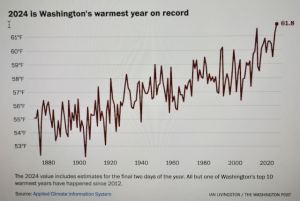
Hottest Year on Record in the DC region (National Weather Service) (Washington Post, Dec. 30): this map records “only” the last 145 years, but the trend is obvious
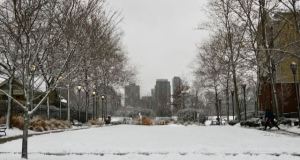
Heavy snowfall on our lake, view from south end park toward downtown buildings in distance, January 19, afternoon
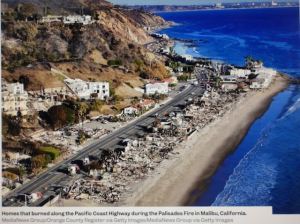
Aftermath of one section of Palisades Fire in Malibu (photo Jan. 16, Orange County Register)
Is there anything we can do about this trend toward ever worsening destruction? Sure, but will U.S. society have the courage and even the awareness to really move steadily with determination away from oil and gas and toward clean energy? We have the technologies and the infrastructure–and the skilled workforce–to do so. But strong-arm politics is the stumbling block.
Just this Monday, January 20, the loudest mouthpiece for the oil and gas cartel was re-inaugurated as the President, and he has already nominated for his Cabinet men who are wedded to the cartel and dedicated to eliminating clean energy alternatives: solar power, wind power, and electric-powered vehicles. These people glory in the fact that the U.S. is already the world’s largest producer of fossil fuels, and they want that destructive leadership to intensify–to their benefit, but not to meet the needs of the people for a safe, productive environment.

According to the Energy Institute (Nov. 2024), the U.S. has been the world’s leading producer of oil and liquid gas since 2017, and further increased this lead under the Biden administration. Even oil companies see no need for this continued mining, as leases already approved go unpurchased. So why is further mining being pursued by the new President?
The result will be that in the next few years more and more events like the wildfires in California, the worsening hurricanes in Florida and the Gulf Coast, the extinction of fish species in the oceans, extreme drought in Texas, water shortages in more and more states, and many more climate-related disasters will occur. Costs already in the trillions have been racked up to repair and prepare for these events, with Americans paying for them in ever higher prices, in lost insurance, and in fear for their lives and homes. Politicians who don’t want to call these catastrophes what they are–“human caused”–will keep calling them “natural disasters,” while nature and her creatures will suffer through our abuse.
A beautiful pair of Mallards push their way through the frozen lake, as snow falls, January 6
***************************************************************************

Jean’s green pepper enchiladas, January 18
Staying Warm with International Dishes
Jean:
As the temperatures have dipped down and stayed down over the past couple of weeks, I have been inspired to serve comfort foods, hot in both temperature and taste. Furthermore, we’ve been staying inside more than any time since Covid, as ice has built up outside, so reusing and repurposing leftovers and pantry items has been a priority.
I started with chili, of course—a staple of cold weather comfort food. I never make chili the same way twice, but this time I was inspired by a recipe by Molly Yeh on the Food Network, except I left out the cinnamon because Chris doesn’t like the taste of Cincinnati chili (but I do). That chili had no beans, so on another day I added chunky tomatoes and pinto beans for a different look and taste.
Green Pepper Enchiladas

My next inspiration came from watching “Moira Rose” make enchiladas on Schitt’s Creek. (Yes, there’s a lot of TV watching involved when holed up inside by the weather.) I don’t know her recipe, so I just pulled something together with leftover bean and corn chili as the filling, spinach tortillas for color, sliced green peppers for crunch, and a canned cheese sauce. They turned out perfectly and were photogenic, too!
West African Peanut Stew

Because Black History month is upcoming in February and Martin Luther King, Jr.’s birthday is this week, I also made a West African peanut stew, which combined chard, tomatoes, sweet potatoes, and chicken with the peanuts in a savory sauce with peanut butter, cumin, garlic, ginger, and onion. The plentiful, colorful stew was good for several days of leftovers. Chris particularly liked the chopped chard and tomato flavors, and peanuts are favorites of ours in any form. (The peanut stew was also a tribute to my late older sister, whose birthday was the same as MLK’s. She worked in Africa with the Peace Corps in her youth.)

Orange Chicken and Tempura Green Beans for Lunar New Year
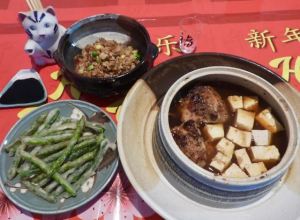
For Lunar New Year, I also checked out Molly Yeh and came up with her orange chicken recipe. I decided to opt for our favorite cut, whole chicken thighs, rather than go to the expense and trouble of using chunks of chicken breast. The point of this recipe for me is the delicious orange sauce, although you can buy a similar preparation in the Asian food aisles at many grocery stores. Here is her recipe: https://www.foodnetwork.com/recipes/orange-chicken-12245113. I substituted whole seared chicken thighs that I then baked for 45 minutes in the sauce.
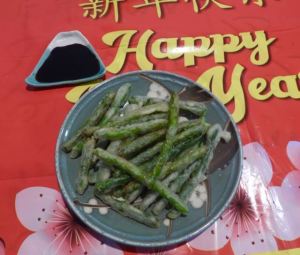
The coating on her chicken nuggets, although I didn’t use it, inspired me to try tempura green beans as a side dish. I checked around on the Internet and looked at various recipes for the tempura batter and ended up using something that was half rice flour, half all-purpose flour, a little baking powder and salt, plus enough sparkling water to make a batter that was neither runny nor too thick but just the right consistency to adhere to green beans dipped in it. Then about 4 minutes in piping hot oil and a sprinkle of salt when they come out to drain on paper towels. Great when hot, but a fine snack when cooled or rewarmed briefly as well.
The key to tempura really is the batter, and there are lots of ways to make a good one. You just have to experiment. I remember eating tempura shrimp one time in the kitchen of a Japanese neighbor who said she used some pancake batter mix for a coating that was a little thicker, puffier and browner than the typical tempura batter. That was so delicious I think we ate the family’s entire week’s supply of shrimp; I just kept asking for more.
And for dessert: Japanese Mochi Bars

I decided to turn part of the rice flour mixture into mochi bars for dessert as well, since this mixture is the starch that is used to create the dense texture of mochi. I chose bar form because it’s easier than making the batter into balls: https://cooking.nytimes.com/recipes/1022347-butter-mochi
I made these the afternoon after I made the tempura green beans, and they emerged from the oven just in time for an impromptu afternoon tea. Chris joined me after editing his new batch of bird photos. On a fifteen-degree January day, inside or outside activities can both be good choices. But tea and mochi bars back inside always work.
What can I say? If cold weather keeps me indoors, I turn to cooking. Let Chris go outside to commune with the birds. We both think I made the right choice.
**************************************************************************
The January 2025 Photo/Video Gallery: The Resilience of Birds and Our Other Citizens
Male Cardinal calls and listens in a Cherry tree in the Southeast cove, as a Tufted Titmouse and a Downy Woodpecker also call from the nearby woods, on a cold, windy morning, January 7
Chris: They are hanging in there, marvelous creatures that they are. This blog continues to celebrate avian courage, as we note that H5N1 “bird flu” is now making its presence felt in Virginia, at poultry farms (so far 7 of them) in the Delmarva (Delaware, Maryland, Virginia) region. And cranes have now died of the disease at the Richmond (VA) Zoo (Dana Hedgepeth, Washington Post, January 22). We are constantly inspired by these small bundles of energy as we hear them calling and watch them surviving and building lives amid the snow and ice this month.

150 yards away, a beautifully-antlered White-tailed Buck stares at me from the snowy field north of the Lake Cameron dam, January 17
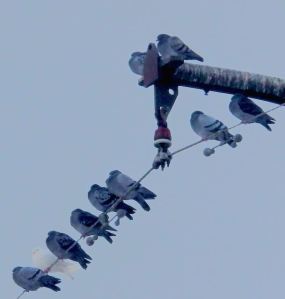
Faithful flock of Rock Doves huddle in the cold of the power stanchion west of the frozen lake, January 16
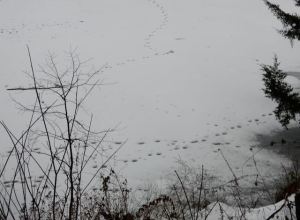
Citizens leave distinctive tracks across the frozen lake from the west bank, January 16
The White-tailed Buck ambles toward the woods west of the field, eyes me, then moves on, January 17
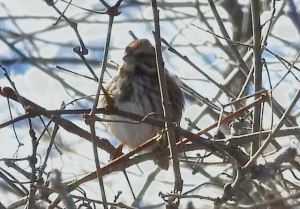
Song Sparrow perches in Persimmon against a snow bank above the north shore, January 17
Panorama toward the west bank of the lake from the southeast side in snow and ice fall, January 19, afternoon

House Sparrow in winter plumage scans from Mulberry tree on the Northeast corner of the lake, January 17
Amid a chorus of other birds, House Sparrow flits in dry Blackberry canes by the frozen lake, along north shore, January 19
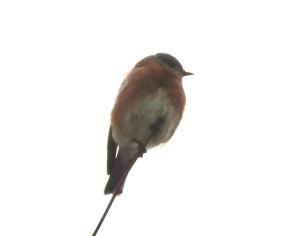
Eastern Bluebird atop Katsura tree, Southeast side of the lake, January 19
Mockingbird dances in the Greenbriar on the Southeast bank of the frozen lake, January 16

Dark-eyed Junco camouflaged in Serviceberry tree, East side, late PM, January 16
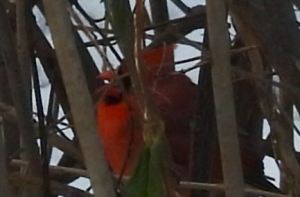
Male Cardinal hides in Japanese Honeysuckle along the Southeast cove by frozen lake, January 16
Female Cardinal calls, listens, flits in Cherry tree, Southeast side, January 19

American Robin in Serviceberry tree, East side, late afternoon, January 16
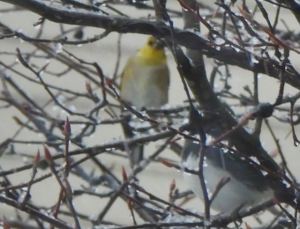
American Goldfinch in snowfall in Katsura tree, afternoon, January 19
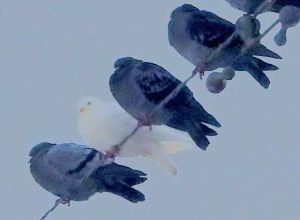
Four Rock Doves on a wire watch the frozen lake from the West side, January 17
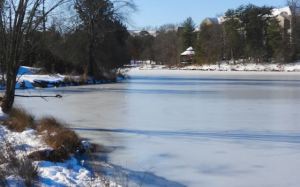
View of frozen lake to gazebo from the Northeast corner, January 9
Pair of Mourning Doves in a Tulip Tree, North end woods as snow falls, January 6
Our large flock of Canada Geese all along the North shore of the lake, January 7

Seven Mallards in our lake amid ice as snow falls, January 6

American Robin pair on roof, Southeast side of the lake, on a very cold and icy January 22
And on to the month of Valentines with hopes for our own resilience among challenges!
 From Sacramento to Potomac: Tales of Two Valleys
Chris, thank you for sharing your blog info. I didn’t know we have ducks visiting. I’m going to have to spend more time around our lake to see all the activities. Love seeing the fox and deer. Love the info you share and Jean’s recipes. Pat
LikeLike