In this month’s blog:
Wildfire USA: The New Normal
We Start a New Garden in a New Climate
Always Time for St. Paddy’s Day and Cherry Blossoms
The March 2025 Photo/Video Gallery: New Sightings in Nearby Places
A Tree Swallow–first sighting!–and a male Red-Winged Blackbird share the rail of the dam structure at nearby Lake Newport, on a cool, cloudy March 16
***************************************************
Climate Log: Wildfire USA: The New Normal?
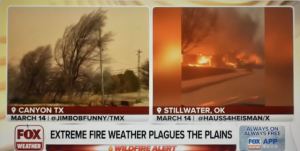
Exceptional drought in Plains states leads to wildfires from Texas and Oklahoma north through Kansas and Missouri (USA Today and Fox Weather, March 14)
Though you’ll never hear a word about this from the new federal administration, for whom climate change, they say, “does not exist,” even the Fox Network can’t ignore the extreme drought conditions that have been ongoing for at least two years now in the Plains states–and the frequent wildfires that are now defining late winter in the middle of the country.
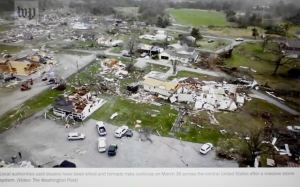
High winds and storms in the Plains states were accompanied by tornadoes, like this one that touched down in Missouri, March 14
Wildfires in the drought-plagued Plains states are dreadful enough, but now Florida joins the parade of drought-ridden states with fires up and down the peninsula.
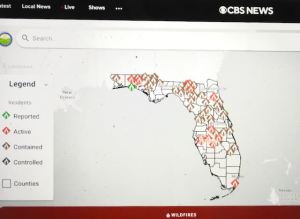
This map from CBS News on March 20 shows “active fires” in most regions of the state, even toward the Keys and across the Panhandle.
While we’re used to hearing about hurricanes there in summer and now fall, plus high ocean temps and sea level rise along its coasts year-round, drought has become yet another climate concern in the Sunshine State.
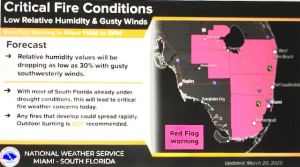
National Weather Service warning for Miami and South Florida, March 20
Much farther north, the climate news this month (and this is no surprise at all) is that yet another record was set for the earliest melting of the Arctic Ocean ice cover, as reported in the Washington Post by Brady Dennis, March 6.

Greenland ice chunk in melting Arctic Ocean (Evgeniy Maloletka, AP photo , March 5)
It’s particularly noteworthy that the Trump/Musk administration is very interested in the U.S. acquiring Greenland as a territory. If they truly believed that there was no climate change, they’d assume that this melting was a temporary weather event. But their claim that climate change doesn’t exist is really just pretense, used by the fossil fuels cartel to justify the administration’s rollbacks of environmental protections and their attacks against renewable energy. The cartel and their political enablers know that the melting is part of the worldwide warming trend, and so the administration wants Greenland–just as they want to acquire Canada–as a military and trading launch pad for shipping across the now watery Arctic, as Forbes’ Garth Friesen, among others, reported in January 2025 in “Why Trump Wants Greenland.”
In this new normal of drought and higher temps, and while environmental rollbacks continue, we can look forward to more wildfires in more places. Indeed, just today (March 26) there are National Weather Service “red flag warnings” in the western edges of Northern Virginia.
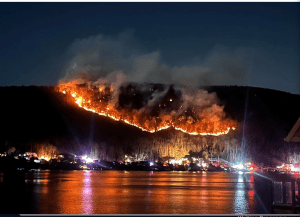
Wildfire on New York/New Jersey border, as this blog reported in November 2024
***************************************************************************
We Start a New Garden in a New Climate
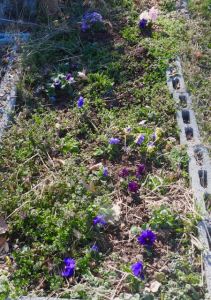
In our new garden plot, our first flower seedlings, March 22
For the first two years since our move from California in 2022, we had been on a waiting list for one of the highly-coveted garden plots in the four large clusters of plots maintained for residents by our urban/suburban town association. Finally in late August 2024, a 190-square-foot plot 2 miles from our home lakeside community came open and we leaped on the opportunity. Although this plot would be a far cry from the almost 2000 square feet of garden we had gloried in for 17 years around our home in the Sacramento Valley, and which had been the basis for this blog from 2015 to 2022, we promised to make the most of this new setting.
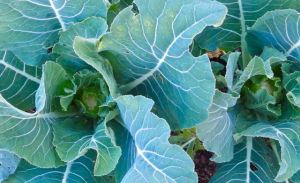
Cauliflower growing in our first small fall/winter garden plot in our town, November 24, 2024
On this small new plot, we planted three veggies suited to fall growth: broccoli, cauliflower, and red cabbage. In hopes that they would also thrive, we experimented with flowers, too: the perennial chrysanthemums we knew would be happy in October and November, celosia, and gerbera daisies–plus bright yellow and purple pansies, who, as we knew from prior experience in this climate, could go dormant over the winter, then come back in spring.
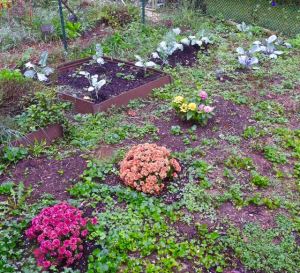
Our first plantings in our first small Virginia garden: broccoli, cauliflower, red cabbage, mums, daisies, 3 weeks old, in the rain, September 24
The broccoli and cauliflower plants did well enough before winter to give us some tasty heads, and the cabbage produced colorful purple leaves. The mums (as expected) were champs for a couple months before the current flowers wilted, as were the pansies. But the other flowers died with the first freeze, along with our wishful thinking (!) that Northern Virginia in winter would prove as hospitable as California. Because this winter, as we reported in our January and February entries, proved far colder and snowier than our first two winters here, we got what we should have expected.
A New Garden Plot!
In early February, current plot holders were informed that there were several slightly larger plots that had become available, and we were invited to apply for those. One such plot, 225 square feet, seemed particularly attractive, as it was both closer to the road (for unloading purposes) and more sunny than our first spot, which was beside the woods of tall trees. So we applied and got lucky. We have now for the past month been clearing the new plot of plants that had taken over (mainly tough little blue speedwell and purple-flowering henbit), getting the soil ready, and stocking up on flowers and veggies, so that we could begin planting as soon as the weather warmed up enough to avoid any more freezing nights.
We have also met other nearby gardeners, who cheerfully answer our questions about their experiences in this climate and in these spaces. Routinely, gardeners also share equipment, such as buckets, wheelbarrows, and used wood for raised beds. Moreover, we’re assured, among the rules of use is the promise by each plot holder not to steal or damage others’ plants or produce. The better we get to know each other, the more we look out for each other.
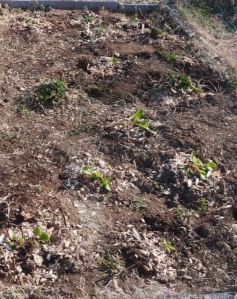
Cleared third of our new garden plot with seedlings of chard, mint, basil, thyme, tomatoes, peppers, zucchini, and strawberry plants, March 22
Besides the veggy plants listed in the caption above, we’ve also planted two blueberry bushes–a plant unsuited to the hotter California climate–with more plant varieties being planned. The blueberries are already budding, just one week in. A third of the plot will be for flowers, with three “Ps”: pansies, petunias, and peonies already in ground, plus dianthus (see photo at the top of this section.)
Another advantage of these well-used garden plots, which have been cared for by a range of gardeners over the years, is that the soil is free of rocks (!) and is easily diggable as far down as needed. Another great feature of these garden clusters is that, for the reasonable yearly fee we pay, the town association provides mulch, compost, and manure, as well as convenient faucets around the cluster for watering.
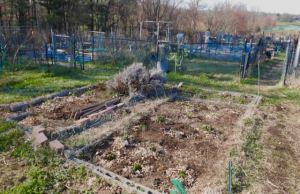
Our plot, early in our design process, with part of the rest of the plots cluster in the background, March 22. More photos to come, as the garden grows!
*******************************************************
In March, Always Time for St. Paddy’s Day and Cherry Blossoms
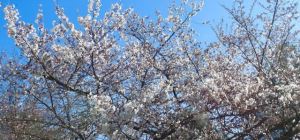
Last year at this time (see the March 2024 entry), we had a lovely, but also sobering, visit to the Tidal Basin in nearby Washington to see the Yoshino cherry blossoms in full bloom and visit the Jefferson Memorial, an annual pilgrimage for us in all our years here before 2006 and our move to California. This year again we are making this trek–and will describe it in detail in next month’s blog.
Two hints: we’ll be updating readers on the huge renovation project in the Tidal Basin in response to climate change and sea level rise, and we’ll be profiling three real American heroes who are honored amid the blossoms. (No, not Thomas Jefferson.)
Two St. Paddy’s Day Treats
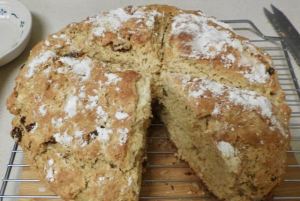
Jean’s homemade Irish soda bread, March 17
Jean:
I’ve been streaming a lot of old British Baking Shows recently, and I especially enjoy Paul Hollywood’s master classes on bread. His strong arms and hands are made for the magic of kneading bread. But St. Patrick’s Day includes a bread that doesn’t get kneaded–Irish soda bread, of course. It’s rather an acquired taste, not the most exciting in its basic form, so in addition to studying Paul’s simple, classic technique, I checked out some recipes that called for a more enriched dough.
Hollywood makes soda bread either with all white flour or half white and half whole wheat, which I prefer, as a way to increase the fiber and protein. The most important ingredients are baking soda and buttermilk. I used a mix of flours (including one cup of oat flour and and one of white whole wheat out of the total four cups of flour), plus some sugar, butter, and egg, as recommended in this recipe.
The added sweetness is up to you; you could try a couple of tablespoons of sugar instead of 1/4 cup, if you want it less sweet. The egg also is optional, as it is in scones, but it does make the dough richer. https://natashaskitchen.com/irish-soda-bread/
In addition to golden raisins, I added caraway seeds because I like that flavor and a bit of crunch as well. As always, make this to your taste and have fun with it.
Here’s one more of my treats in honor of St. Patrick’s Day: making these a sandwich cookie was a spur of the moment inspiration!
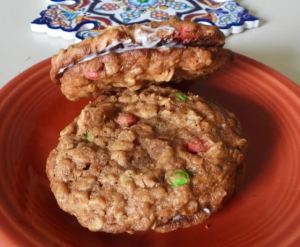
Jean’s oatmeal sandwich cookies with cream cheese frosting inside and mini-M&Ms for an added pop of color and flavor, March 19
************************************************
Venus, high above the lake, and beneath the moon, 7 PM, a clear, calm March 3 (yes, that orb is 25 million miles away)
The March 2025 Photo/Video Gallery: New Sightings in Nearby Places
In last month’s entry, I gave the impressive statistics from the worldwide Great Backyard Bird Count. Check it out. So many species in so many countries, recorded by so many devoted birders. As impressive and heart-warming as those numbers are, this month’s news from Audubon and the Cornell Lab of Ornithology sobers us to the fact of the continuing sharp decline in the U.S. numbers of birds. https://www.audubon.org/press-room/us-bird-populations-continue-alarming-decline-new-report-finds
Habitat loss to development, air and water pollution, global warming, use of pesticides and herbicides, and other factors have not only killed birds, but have killed off the insects and plants needed by bird populations to thrive. And the same factors that are killing birds are making our own human hold on life more tenuous for billions around the world.
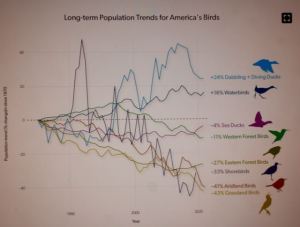
Decline year by year of many classes of birds in the US since 1970 (Cornell Lab of Ornithology), March 2025
The Good News
But still, day by day, our local and migrating birds call all around us, and their songs thrill us, and when we spot them and take pictures of their beautiful evanescence we feel the same joy that we always have in the presence of birds. Indeed, their fragility makes us appreciate them even more and perhaps even pushes us to try harder to help the rest of the human world pay attention.
And sometimes, as you’ll see below in a video and two related snaps, the unexpected and truly serendipitous happens on a bird walk.
So here are a selection of this month’s photos, taken not only along our local small lake, but also at another nearby lake and at a local woodland park.
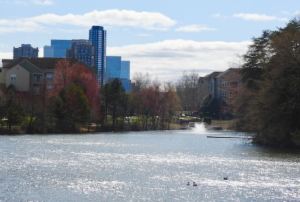
Three Canada Geese in a panorama toward downtown buildings on a sunny, sparkly, windy March 17
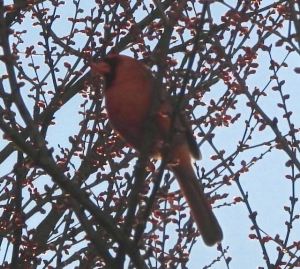
Male Cardinal in a budding Cherry tree east of our lake, at sunrise, March 19
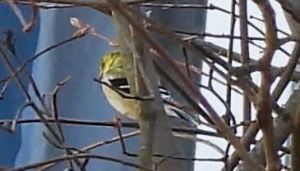
American Goldfinch in Serviceberry tree, southeast side of our lake, on a warm, windy noon, March 18
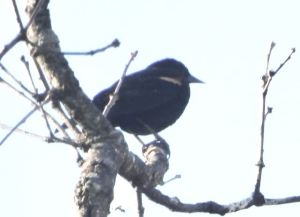
Young male Red-winged Blackbird atop an Oak east of the lake, warm morning, March 20
On a chilly afternoon, March 13, I pan the treetops southeast of the lake, and hear the calls of a Cardinal, a Tufted Titmouse, a House Sparrow, a White-Throated Sparrow, and a Carolina Wren–and, as always, local traffic
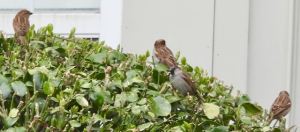
Song Sparrow and House Sparrows on Japanese Spindle Bush, southeast side of the lake, damp, chilly March 15
Song Sparrow sings in Red Cedar along the north shore, warm March 11
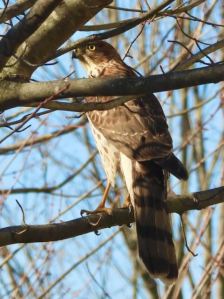
Sharp-Shinned Hawk perches in Red Maple very near our home, just after chasing, but losing, a Sparrow out of a nearby bush, February 28. See next video.
This Sharp-Shinned Hawk flew just past me after chasing a Sparrow through a Spindle Bush, and then perched in this Red Maple along our path, February 28. A totally unexpected and serendipitous shot!
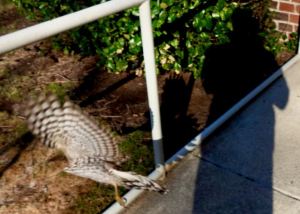
My photo of the Sharp-Shinned Hawk flying past me in pursuit of the Sparrow, who got away, February 28
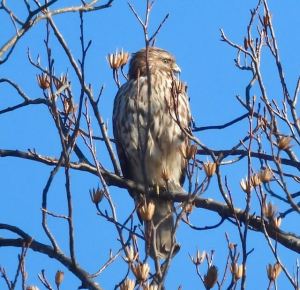
Red-Shouldered Hawk in Tulip Tree, southeast woods, March 10
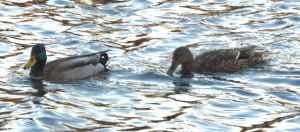
Mallard pair along west shore of our lake, in twilight, March 4
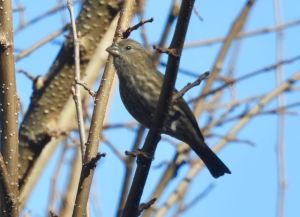
House Finch female in Mulberry tree along the southeast shore, warm March 11
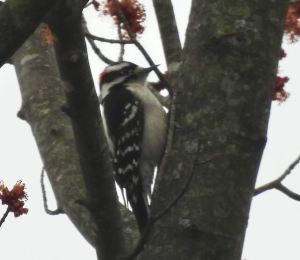
Downy Woodpecker scans on Red Maple, southeast bank, damp, cold March 15

I’m part of a town association birding party at a nearby park and lake, cool, cloudy March 16
Double-Crested Cormorant–first sighting of the year–at nearby Lake Newport, March 16
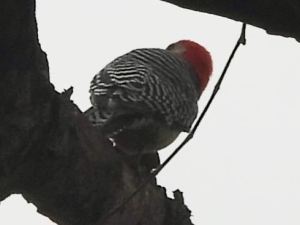
Red-Bellied Woodpecker high up in Oak, nearby park, March 16
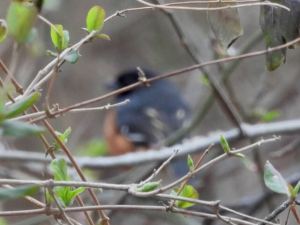
Rarely seen Eastern Towhee behind Honeysuckle, in woods of nearby park, March 16
At nearby Lake Newport, as part of the birding party, I see these 2 Ring-Neck Ducks, a first sighting for me, dive into the water, but then more of the ducks break the surface! March 16

Two pairs of the Ring-Neck Ducks in Lake Newport, March 16
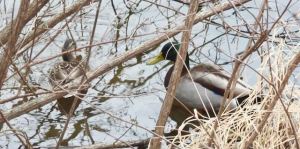
Mallard pair in lakeside rushes, beside me, Lake Newport, March 16
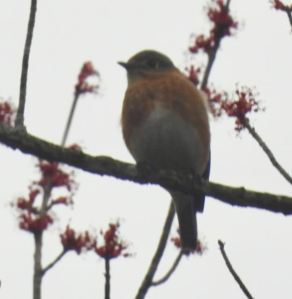
Eastern Bluebird in Red Maple at local park, March 16
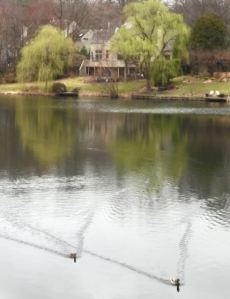
Wakes of Mallard Pair in Lake Newport, March 16
Female Cardinal calls as Red-Winged Blackbird calls, in Red Maple, southeast woods by our lake, cold, windy, March 7
And on we go in the last week of March, toward April, and hopes for Spring…
 From Sacramento to Potomac: Tales of Two Valleys