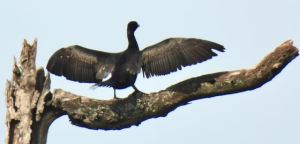
Double-crested Cormorant with spread wings scans atop the dead oak on the east bank of our lake, late afternoon, May 29. Usually regular visitors, this is only the third Cormorant we’ve seen this year
In this month’s blog:
Tiny Refuges in a Could-Be-Great Nation
Garden Update: Buds Appear, Flowers Thrive, the First Fruits
The May 2025 Photo/Video Gallery
Our two families of Canada Geese enjoy the late afternoon of May 19 along the Southeast side path
Tiny Refuges in a Could-Be-Great Nation
A truly bizarre scenario: the President of the United States was in the Middle East (May 17-18) meeting with the ruler of Qatar about the possible gift (or maybe sale?) of an unused “luxury Boeing 747” to the President, so that this jet might be retrofitted to become the next Air Force One. The US journalism elite (CNN, Fox News, New York Times, etc.) were giving this “breaking news” their undivided attention.
Meanwhile, back home in the USA, a wave of tornadoes and furious storms left at least 28 people dead, dozens more injured, and many homeless as they passed through multiple states in the Midwest over the weekend. More than 80 tornadoes had been confirmed as of Monday morning, according to USA Today (May 19):
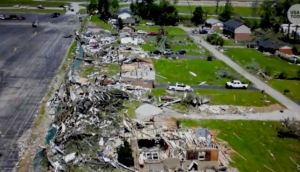
This disaster was big news only on the Weather Channel; a minor story at best on major news sources. And more such storms were forecast for the coming week across the South, Midwest, and into the mid-Atlantic.
I realized that before this President, who took office just four months ago, the disaster at home would have been top news (think of Hurricanes Helene and Milton just last fall), and the nation would be watching to see how the President and the Federal Emergency Management Agency (FEMA) responded with compassion, necessary funding, and emergency expertise. But this President unilaterally gutted FEMA last month and, with nary a thought or prayer, said victimized states would have to fend for themselves now and into the future. So much for compassionate leadership.
Since that weekend, he made no mention of the deadly storms, so focused was he on the possibility of his getting the luxury superjet.
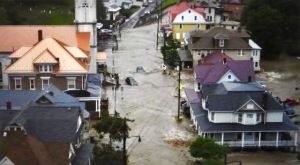
Westernport, Maryland, just one state away, May 14 (Wash Post photo)
It’s easy to understand why he wouldn’t want anyone to care about disasters at home. They just remind people of the fossil-fuel-caused climate change that he says doesn’t exist. So what if people suffer? So what if farms and businesses and schools and hospitals are ruined, and habitats for other creatures are destroyed? For him and for the fossil fuel cartel to which he is beholden, the only thing that matters is business as usual–the domination of US culture by gas, oil, and coal.
What’s particularly sad and strange, as David Gelles writes in the New York Times (“Under Trump, the US Is Alone in its Climate Denial,” May 19), the US is the only rich nation in the world that has allowed the cartel to have such power. In contrast, China, other Asian nations, and Europe keep moving forward with renewable energy. China is only too happy to exploit our nation’s deplorable weakness in renewable energy and so become the dominant energy power in the world.
For the first time in two months, Blue Heron, usually a frequent resident, honors us with a visit on the afternoon of May 29, stalks the north shore, then takes off…
The Escalating Price Paid by US People–and by Our Fellow Creatures
Besides increasing drought (which this blog reports regularly) and the intensifying of
- heat,
- storms,
- sea-level rise (see a study published Tuesday , May 13)
one more result of fossil-fuel poison is the drastic decline of North America’s bird species. The Washington Post’s Dino Grandoni summarized on May 2 the results of a 3-year study reported in the May 2 issue of Science that showed significant decline in 75% of 495 species. “Birds are rapidly vanishing from North America, with dramatic population losses in places that were once thought safe.”

With Allegheny Blackberry blooms in the foreground, I look across the lake at sunset toward the high rise buildings downtown, May 15
I try to think of our little lake community as a tiny refuge for the wildflowers, birds, fish, turtles, bees, butterflies, squirrels, rabbits, and other wild creatures I’m fortunate to take pictures and video recordings of as I circle the lake path most days of the week. And yes, this little lake is still a sparkling gem of a home or nurturing spot for these creatures. But in its fragility–tightly surrounded as it is by suburban sprawl and the incessant emissions of vehicles and buildings–it also mirrors the larger US culture. If we allow that larger culture to continue to be dominated by forces that put glitzy baubles like “luxury superjets” ahead of we the people and the survival of plants, animals, land, water, and air, this refuge, too, will disappear.
It’s just a question of priorities. Will the US achieve the greatness of which it would be capable if we had a sensible, life-generating energy policy? Or will it stay hostage to the cruel forces that are steadily destroying us?
*********************************************

Zucchini flowers and a growing fruit, our garden patch, May 20
Garden Update: Another Tiny Refuge?
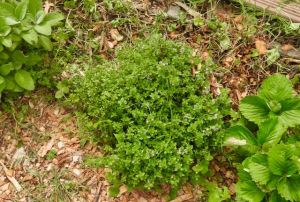
Sage, Thyme, and Strawberries are among the plants thriving in our tiny garden, May 18
In the month since our last update, our tiny plot in the community garden has flourished: warm temps and frequent rain spells have combined with the healthy, well-mulched soil to bring about steady growth that is now producing the first fruits and a rainbow of blooms. As we walk through the coded gates into this multi-acre community of individual plots, each one devoted to the vision of each gardener, I think of it, just as I think of the community lake beside where we live, as a cared-for refuge from the thick network of roads and speeding vehicles no more than a hundred steps away.
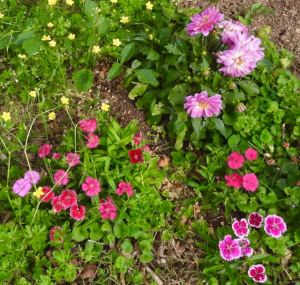
Dianthus, Dahlias, and volunteer Buttercups are featured stars in our English-country-style flower display, May 18
The community works because of the dedicated work of each gardener, and our agreeing to abide by rules determined by the community. Unlike some homeowners associations (HOAs) that dictate strictly a single style for any display, this very diverse, multi-national community of we who pay rent for our spaces each year encourages unique visions of what we plant and how we arrange the plantings. Still, (1) we must be organic gardeners, (2) we can’t grow tall trees, and (3) we must not intrude on others’ gardens or (4) take produce from other folks’ plots without permission. (5) We must prepare our gardens for spring plantings and (6) we must remove exhausted summer plants as winter arrives. (Perennials, of course, stay in and survive underground.)
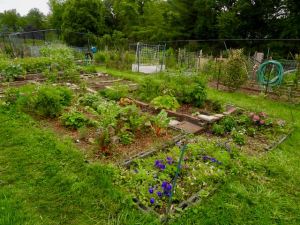
Our garden plot, viewed toward northeast, on a cool, cloudy May 29
This simple rule structure encourages a multitude of visions. One nearby gardener has labelled her plot a “monarch haven,” with lots of milkweed, for example. Another grows lots of potatoes, another an array of bean trellises, another an explosion of peonies, and on and on. Some have neatly rectangular raised beds, others interspersed veggies and flowers. Some, like us, are almost daily tinkerers. Others show up weekly. Still others plant and then seemingly disappear for a month or more.
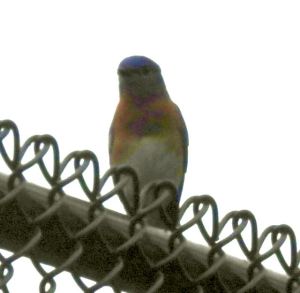
Eastern Bluebird perches atop the high fence surrounding our community garden, cool, misty May 29
The structure of simple rules coupled with the spirit of experimentation provides a nice, friendly balance for gardeners. So far we’ve not gone far out on any experimental limb: yes, our first planting was of two blueberry bushes, which were not suited to Northern California’s dry heat; they have done really well so far here.
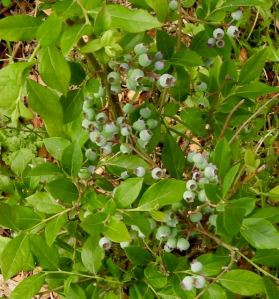
Blueberry bush bursting with forming berries that we are learning from as they mature, May 18
But most of our plants were ones we had success with in the Sacramento Valley: of flowers, we have thriving stands of dianthus, dahlia, vinca, and pansies. We also benefited from a native surprise: buttercups that emerged in April and quickly spread.
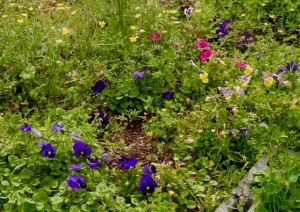
Yellow and Purple Pansies, Magenta Petunias, Yellow Buttercups on the Southwest end of our flower display, May 18
Of veggies and herbs, 3 kinds of cherry or grape tomatoes (juliet, husky cherry red, sweet millions); bell peppers (green, yellow, orange, and red; herbs (mint, English thyme, oregano, rosemary); Swiss chard; chilis (ancho); squash (zucchini, cucumber, crookneck; eggplant.
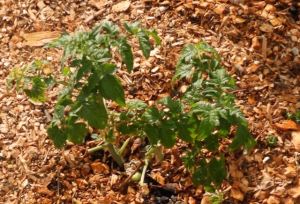
Our Husky Cherry Red Tomato, late April; now it’s 3 times as big, in a tall cage, and with 30 growing fruit, May 27
We would have planted strawberries–but we saw on our first exploration of our new space in February that we had two perennial strawberries already in ground–these beauties have come back stronger than any we ever planted in California.

Our latest Strawberry harvest from our two perennial plants, May 21 (we and our grandkids have already eaten some!)
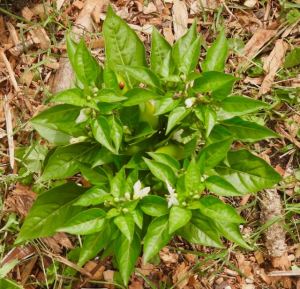
Ancho Chili plant, with a tiny visiting ladybeetle (can you see?), May 18
*********************************************************
The May 2025 Photo/Video Gallery: Some Regular Citizens and Guests, and a Few Newcomers to the Refuge
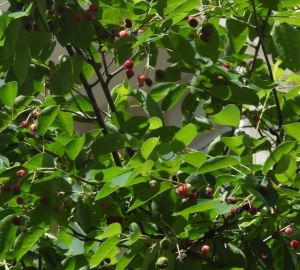
The Serviceberry trees in our community are a haven for birds, especially now that the berries are ripe. I hear so many more birds than we can see, but their calls let everyone know they are here, May 19
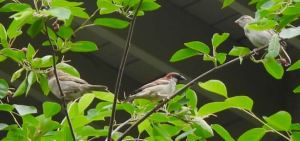
Three House Sparrows in the Serviceberry tree, May 27
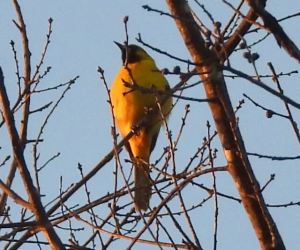
This Mourning Warbler is a newcomer to our refuge, its bright yellow feather tinged orange at sunset in the dead Willow Oak on the east bank, May 15
I asked this Red-winged Blackbird male to face me as he perched in the Willow Oak on the 15th, but no cooperation. Still, this preening dance at sunset is a classic of surprise.
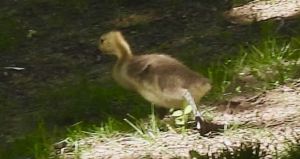
In the evening shadows near the Southeast path, this fuzzy yellow Canada Goose chick walks to catch up with the family, May 19
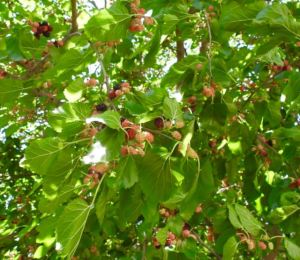
Like the Serviceberry trees near it, this Mulberry’s ripe, sweet berries are a lure for many birds, May 17
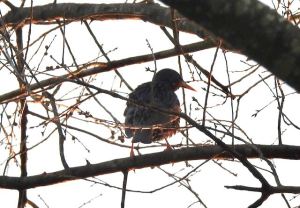
Our year-round Citizens, the European Starlings love the east bank of the lake, including the dead willow Oak. Another sunset shot, May 15
The Gray Catbirds are all around with their distinctive calls and conversations this month. This one was particularly acrobatic in the birdbath on the east side of the lake, on a very warm May 19
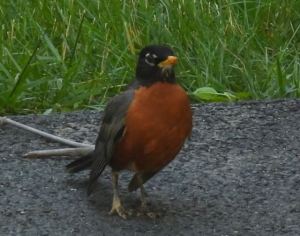
This American Robin on the Southeast side path was deciding whether to mix it up with the Catbirds in the Mulberry Tree on May 19
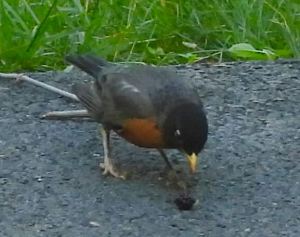
Whadya know–Robin got one of those Mulberries!
Back to sunset in the Willow Oak on May 15, Eastern Kingbird, a sometime visitor, calls
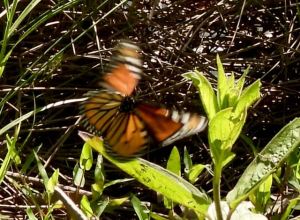
Our first magical Monarch of the year, in mid-flutter in the Swamp Milkweed by the Southeast cove, May 19
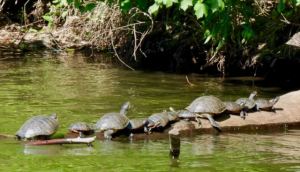
On a warm afternoon, 12 Red-bellied Cooters take the sun on a log along the Southeast shore, May 19
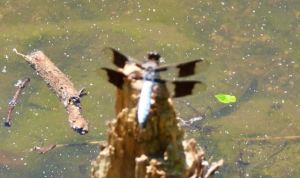
A Whitetail Skimmer, our first dragonfly of the year, enjoys the Northeast shore on a warm May 18
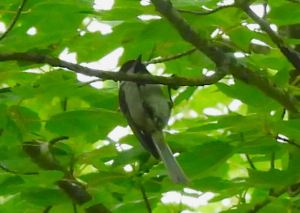
Black-capped Chickadee in Red Maple, southwest bank, on cool, cloudy May 27
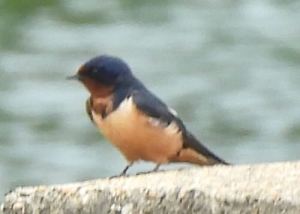
Barn Swallow perches on the dam structure in the lake, on a cool, cloudy May 27
Also on Mother’s Day, May 11, Red-winged Blackbird atop the dead oak on the east bank, calls to his mate

Our Mother’s Day bouquet, indoors, May 11. Humans celebrate the day, too
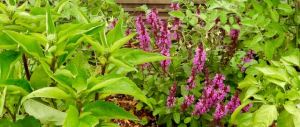
In our garden, Budding Coneflower, Purple Salvia, Juliet Tomato, on that cool, cloudy May 29
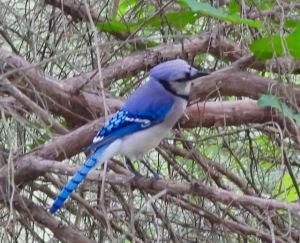
Bluejay in vines, west side, cool, cloudy May 27
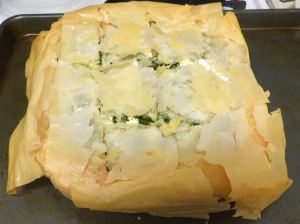
Our one kitchen contribution this month, Jean’s spanakopita, with spinach and filo dough, just from the oven, May 14. Jean says the hardest part of the recipe is the chopped spinach, which clings everywhere.
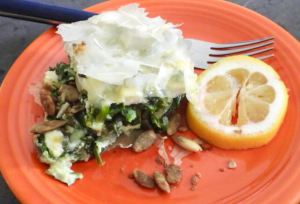
A serving of spanakopita with a slice of lemon and candied pistachios.
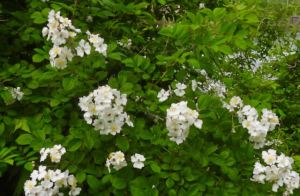
Oh so fragrant Multiflora Rose, along the east side path on a warm May 6
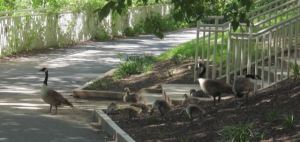
The two Canada Goose families gather together on the steps along the Southeast path, May 19
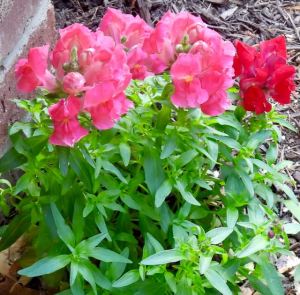
Snapdragons on our porch on Mother’s Day, May 11
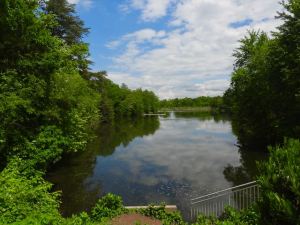
Lake panorama toward the North end on a sunny, warm May 6
Song Sparrow calls and listens in the Willow Oak, east side, on the gorgeously warm May 6
Growing up fast, Canada Goose chicks begin to grow black feathers as they walk on the south end path, May 27
With still four days to go in May, here’s hoping for a greatness where all the Earth is a refuge.
 From Sacramento to Potomac: Tales of Two Valleys