D Is for Dirt

garden-three-soils-1“Dead and buried” goes the phrase.

But any gardener knows that buried does not mean dead. What goes on underground we usually don’t see and is easy to forget, but is surely as lively, interesting, and complex as what goes on up top in the sunlight. From the plant’s point of view, both parts of its life–in the air and in the ground–are equally important and each contributes with the other toward the whole plant’s survival and prolonging its species. Since we’re usually more interested in what’s going on above ground–except in the case of root plants like beets, onions, carrots, and potatoes–we tend to think of the roots as supporting the stem, leaves, flowers, and fruits, and not the other way around.  But roots can’t survive without the breathing of the leaves, just as the leaves can’t survive without the minerals taken up through the roots. Just as the land itself can’t survive as a home for plants without the roots holding the earth together amid drought, winds, and floods.

Our preoccupation with certain plants’ prettiness and tastiness makes us disregard the basic life-giving role of the plant parts we want to make prettier or more tasty for us. That thinking also lets us ignore the value of plants that aren’t obviously pretty or tasty according to our narrow standards. And no living thing  is less obviously pretty or tasty to most of us than dirt

Not until I got serious about planting did I begin to appreciate dirt as the living, breathing, incredibly varied thing it is. I’m still far from understanding even the basics of the mixtures of elements, compounds, textures, and moistures needed to make different plants thrive in different temperatures and times of the year. That’s a big reason why I rely so much on the plants themselves to tell me day by day how they are doing.

A Lesson: Poke a Finger in the Dirt 

garden-arugula-seedling-1

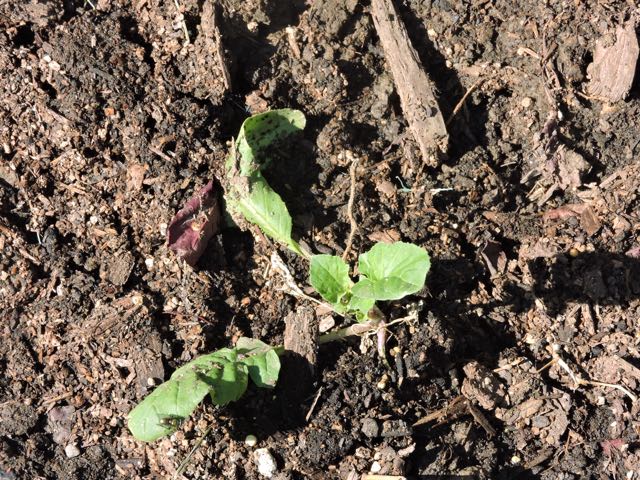
If, for example, I plant a tiny seedling of arugula in September in the same spot where I grew a tomato plant in the spring and summer, I’ll usually fill the new hole with a mix of compost and the existing soil, plus water, to give the seedling a boost to get started. Then I’ll keep an eye on the seedling and the ground around it each day–maybe more than once a day–to see if the plant is taking up the mineral-rich water and growing firm. If, in the September heat in the high 80s, the ground seems to dry out quickly and the seedling wilts, I’ll poke a finger in the nearby ground to see if the dirt just below the surface is still moist. One thing I’ve learned is that the dirt in the sunlight may not be a good indicator of the moistness of the dirt just beneath, which is markedly cooler.

Just last week I discovered that a mild yellow pepper plant that I’d been watering in its pot every other day June through August, and whose soil seemed dried out on the surface before each watering, was actually floating in thoroughly soaked soil a few inches down because the drainage holes in the pot had become clogged. I’d ignored my own rule of testing the soil below the surface, and it was a wonder that the plant had stayed green and productive of fruit despite the swamp that was growing underneath.

Knowing that the soil beneath the surface may be significantly wetter than the soil in the sunlight can keep us from our tendency to overwater. Just as in human nutrition, more food often does not mean better health. I’ve learned this lesson better and better as the years have gone by, with the result that I’ve used less and less water during the summers with each passing year, even as our garden has grown in variety of plants. And saving more water year to year is a smart thing in our drought-ravaged climate.

Eating Dirt: Love That Umami

Gardening means messing around in dirt. Poking my index finger in the dirt to check for moisture beneath the surface is the dainty act that follows from the much more intimate acts of digging holes, pulling out rocks and roots, hand-mixing residual soil, compost, and fertilizers, and mucking about in the mud. Mud-caked shoes, grit-embedded knees, dirt-smeared clothes, black fingernails, and the lovely mixture of sweat and dust all over the body and hair are consequences of this intimacy between humans and the dirt to which we shall all return. Indeed, if we are what we eat, and if what we eat derives its own nutrients from the dirt, then not only are we in a sense eating dirt, but we are even now made up of dirt.

Am I exaggerating? Well, sure. I mean most of us are not the folks who actually eat kaolin clay in the southeast US and other parts of the world. But keep in mind that one of the five main flavors of our favorite foods is the mysterious umami. Not sweet, sour, bitter, or salty, umami is that, yes, earthy flavor that we crave in meats, mushrooms, chocolate, coffee, and fermented foods from breads to cheeses to beer, red wines, and countless other foods. So while we may not think of ourselves as digging our mouths into a heaping bowl of peat, clay, sand, leaf mulch, or humus, we are drawn to the smells, textures, and flavors of the earth in less obvious forms. (See our post “C Is Also for Coffee” for another take on umami.)

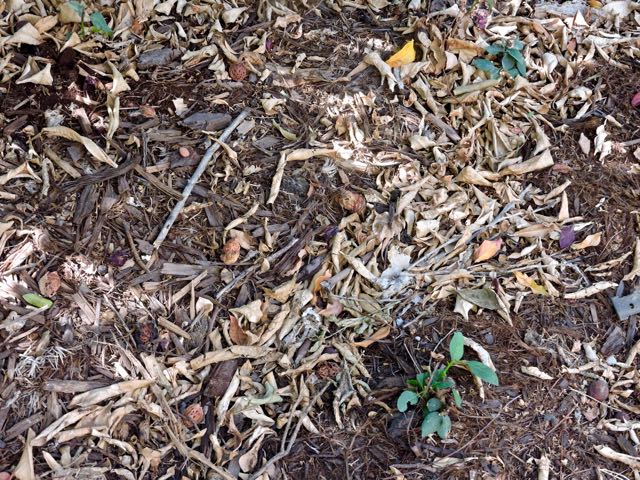
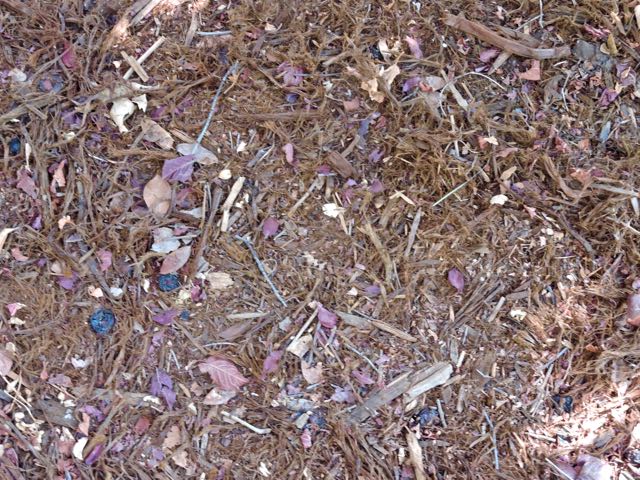
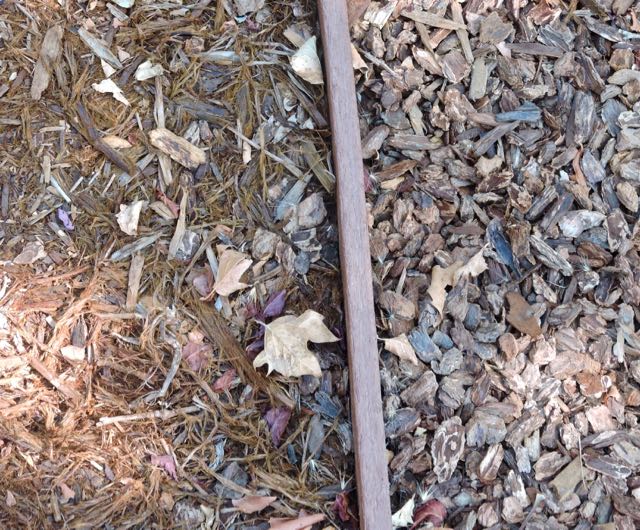
And if you do garden, you must admit that you just love mucking about in the many types of dirt that you will encounter, and that nothing smells better to you than dirt. And the more you love the smell of dirt, the more different aromas of the various dirts you’ll come to recognize, and there will be no end to the joy you derive from getting down and dirty.

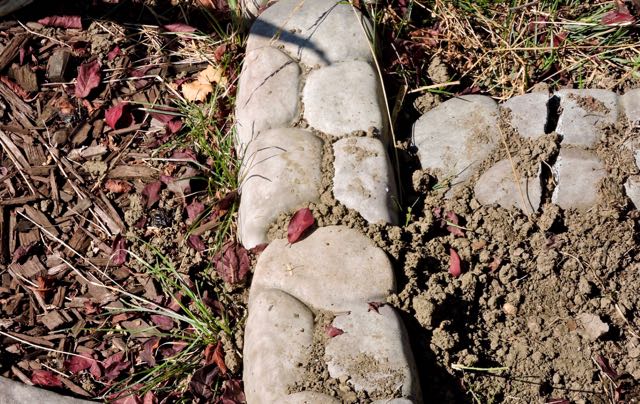
garden-soil-and-leaf-mulch-under-orange-1garden-redwood-mulch-and-plum-leaf-mulch-1garden-border-between-redwood-mulch-and-brown-bark-1

C Is for Cherry Plums

garden cherry plum plucking - 1Written June 24, 2011 (addition August 2016 below)

Chris:

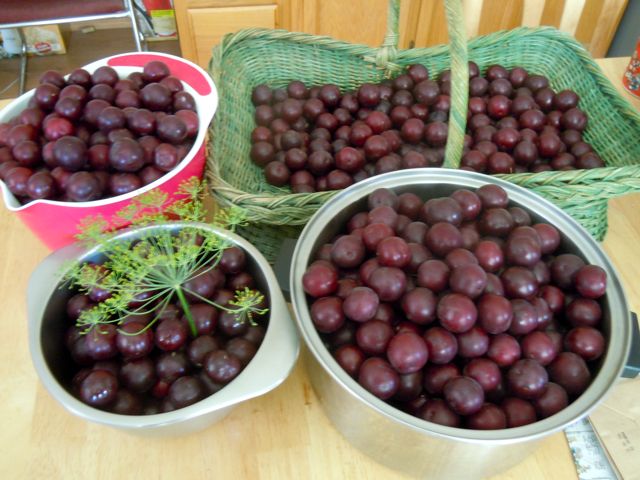
Even slower than last year, it took April, May, and half of June before the Valley heated up the way it should. So I’m not surprised that the purple jewels are behind, even more behind than last year. By June 22 in 2010, I had harvested a few hundred ripe ones from the tree in our yard and from the third of the neighbor’s tree that hangs over our back fence. I had help–my daughter Ann Louise, who was visiting, then young co-worker Elliott and his wife Elise. A big bucket two-thirds full of little round fruit just bursting with tart-sweet flavor. Not super sweet like bing or rainier cherries, but tarter, like baking cherries. Elliott, a gardener and cook, to whom I gave half the pickings, kept asking, “Are you sure they’re cherries?”

I, too, had doubts from the very start. They were the size of cherries, and the pits were like cherry pits, but they were not as solidly meaty as cherries and they were juicier. And the juice was sweet and sour, and when you bit into the fruit, the skin seemed like…and the juice squirted like…a little plum. You know, sort of like the round, red kind about the size of a tennis ball—but these were lots smaller and darker—but not at all like the little Italian purple plums that turn into prunes.

Now, if you had a cherry that acted like a plum, or vice versa, what would you call it? That’s right. So I googled “cherry plum,” and knew what I had.

Now cherry plums won’t lose their sourness as they ripen. That’s who they are: citrusy sour with a nice sugary promise. You can eat them off the tree or from a bowl if you like, but expect to pucker, a lot. I guarantee that your dinner guests won’t like them, unless they’re adventurous eaters.

So why pick them at all—other than perhaps to keep your garden floor from getting covered in splatted little plums in July and August, when they fall, overripe? Pick them because they make an absolutely stupendous cherry plum jam. More on that later.

Right now I want to rhapsodize on the picking itself. What’s so much fun is how the little buggers hide. Well, they don’t hide exactly, but the tree does nothing to make them stand out. Imagine this: a purple tree, well sort of maroonish purple, like a Japanese maple, but with little leaves that curl, so the curled leaf looks like the little plum and the little plum looks like the leaf. The first, or even the second, or even the third time you look at a branch, trying to find the plums, you won’t see them. Or you’ll grab at a leaf because you think you see a plum. Finally you’ll see them—aha!—and you’ll grab its smooth, plump surface and pull it easily, with a snap, from the twig. Then gradually you’ll see another and a few more and suddenly you’ll see clusters where you thought there were only leaves. And you’ll pick them steadily, still being fooled sometimes by leaves, until you’re sure that no more plums could possibly be found in that part of the tree. But tomorrow, or the next day, as you pass under a branch on your way to pull a creeping vine from your fuchsia, you’ll look up to see more plums. Not new ones, you know, but ones you missed.

Adding to the fun, of course, is being old and not really enjoying anymore climbing ladders into fruit trees. Oh, who am I kidding? I feel like the boy in Frost’s poem swinging birches or like my own self as a kid hoisting myself limb by stout limb into Mark Diamond’s willow tree and looking down with a bird’s eye view. Nowadays, that bird’s eye view is from four rungs up, not high enough to even hoist myself onto the lowest branch, but it feels high to me at 63, and what I like best is to be surrounded by plum branches, cooled on a hot June day, and peer at the light filtered through a bright screen of purple leaves, shadows and beams flickering in the breeze, and—aha!—another cluster of purple pearls magically appearing where none had been the moment before.
DSCN7177

Now, about that jam:

Step 1: Since the cherry plums are bing size or a bit larger, you can use a cherry pitter on most of them to pluck out the pits. Beware of spurting juice—wear an apron or old clothes and rinse your hands frequently. Any plums too big for the pitter will need to be sliced and de-pitted by hand. It’s not a quick process, but you’ll get into a rhythm.

Indeed, if you don’t have a pitter, no problem. This year, my pitter broke early in the process. So I just dug into each plum with thumb and fingers and squeezed the pit out, taking care to keep the plum over the bowl and guard against squirts of juice by cupping each plum in my left palm as my right hand dug in.

Step 2: Let the de-pitted plums fall into a nice big bowl, so the juice won’t get lost. You’ll gradually accumulate a big pile of skins, meat, and juice. Note: The pits you place in another saucepan and set aside–you’ll come back to them.

Step 3: Now place your saucepan with the plum mixture (I had so many I used a large souppot) on low heat and watch the plum mixture as it cooks down, stirring as much as you need to to keep the mix from sticking to the sides as the mixture thickens.

Step 4: Remember, these little guys are more sour than sweet, so you’ll need to add sugar or other sweetener to taste. (I like to add other fruit juices, like apple or grape, along with about a cup of sugar, to my largest pot, which holds at least 400 little plums.) As the mixture cooks down, taste the syrup and see if you need more sweetener. I don’t like mine too sweet; I’d much rather have the fruit flavors dominate.

It’s also your choice if you want to add pectin for thickening. Again, how much you add depends on how thick you want your jam. I put a small package in a mix of 200-300 plums last year, and the jam was more syrupy than your usual store-bought version, but not runny, especially because you keep the jam refrigerated after cooking.

This year I didn’t use pectin and kept all the skins in the mixture. I cooked the mixture for about 90 minutes and the result was excellent in texture, the skins soft, the juice syrupy when cooled.

DSCN7178

Step 5: As the mixture cooks down (it’ll take at least an hour on low heat), the skins will come away from the plums. Old-time preservers often kept the skins in the mix, as I did this year; your choice. Last year, I plucked them all out with tongs, and the results were great. But the skins-in version this year may be even better.

Step 6: Remember those pits? You can’t get all the meat and juice off in the pitting process, so you’ll want to add a couple cups of water to the saucepan in which you saved them, bring the mix to a boil, and let it boil for about 15 minutes, enough time for the pits to blanch and the meat and juice to separate off into the water. Then scoop out the pits with a slotted spoon and discard them. Pour the meat and juice mix into the rest of the plums and keep cooking on low heat.

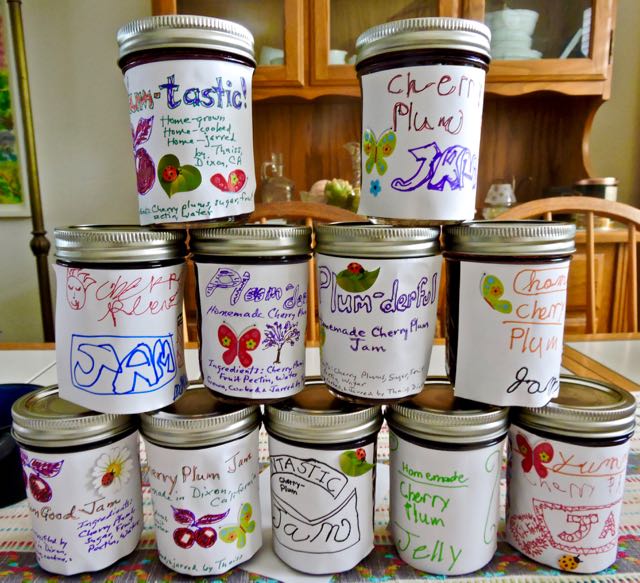
Step 7: Last year’s product filled two 10-ounce jars and one 30-ounce jar, 50 ounces in all, and with regular refrigeration, we had plum jam for ten months—or until the new plums were on the tree and almost ready for harvesting! Some we gave away in small jars and the folks we treated loved the product. My daughter Irene made original labels for the 10-ounce jars. She called one “Plumderful” and the other “It’s a Plum!” I don’t know what the names will be this year, but the jam will again be an inspiration.

This year’s skins-in version made lots more: about 160 ounces divided among jars of different sizes, some for eating and gifting, a few for freezing. For me, the great fun of this adventure is feeling all year long, as I spoon the purple delight onto my toast, the memories of the good times that went into the making. What a miracle that all this bounty comes from these silent gems that do their best to hide in the garden just above your head.

Addition, August 2016

kitchen canning cherry plums - 1

Six years into the jamming and still going strong. After our more abundant rains in the 2015-16 season, this year’s crop of cherry plums was our best yet. I plucked more than 600 from our side-yard tree, and didn’t have to get above rung three on the step ladder. (Last year, with meager rain, we had our worst crop–only 200 from the entire tree up to rung four!)

I’m happy to say that the cooking method described above is still producing delicious jam. I gave up trying to use the cherry pitter two years ago–just a bit too narrow for these little plump plums. But finger and thumb plucking the pits works just fine, and practice improves efficiency. Just be sure to take a short break in mid-pitting if your back starts to ache. This isn’t an endurance test or a race. Give yourself a half a day at least for the whole process, from pitting to cooking to canning.

About canning (or, more accurately, jarring): Jean uses 8-ounce Ball jars with their tight-seal lids and follows the instructions for boiling and sealing. This process ensures that the “Plumderful” can be kept in the pantry indefinitely until the seal is broken. Once the jar is opened, keep refrigerated. We’ve found it’s best to use up the jam in an opened jar in no more than a couple of months, as the contents will eventually get moldy. That’s why it’s a good idea to use small jars rather than jars more appropriate for pasta sauce.

We’ve also had good luck freezing jam jars that are not vacuum sealed. We’ve kept jars for a couple of years this way. Once thawed, the jam keeps its texture and is still full of flavor.
kitchen labeled cherry plum jars in stack - 1

And, oh yes, there’s nothing more fun than labelling the jars, especially if you have a grandchild to help you, as I did this year, with grandson Adrian.

kitchen grandson adrian labels cherry plum jars - 1

__________________________________________

C Is Also for Coffee

September 10, 2016

Jean

Coffee interests me in several ways besides being a bracing hot drink that pairs with my favorite breakfast pastries.  (I’m trying not to get distracted thinking about those, despite having just watched an episode on the Cooking Channel dealing with Parisian pastry shops.)

Chris is making a fresh pot of coffee right now.  Decaf actually, since neither of us needs the electrical jolt of caffeine, even first thing in the morning.  I can’t wait to smell the aroma wafting through the house.  First, though, I cleaned out the grounds from our last pot by taking them to the garden.  The first way in which I am interested in coffee other than as a drink is as a soil enhancer.  Coffee is expensive; I figure we might as well get all the benefits we can from it, and Starbucks has long pushed the benefits of its grounds in the garden.  In fact, I like to pick up large bags of used grounds at our local Starbucks to spread not only under the trees and around the flowers but also around the foundation of the house.  The last time I was at our Starbucks, however, they had rearranged things a bit and done away with the basket in the corner that held the bags of grounds.  I’ll have to ask them about that.  Maybe I can get some under the counter.

I was somewhat skeptical about the value of coffee grounds at first, so I’ve done a little investigation.  Overall, the reviews are quite positive.  You can read some of the facts and opinions at sites like these:

The part I like best, however, is the second benefit of coffee grounds in the yard, and that is as a natural pest deterrent.  It seems that snails and slugs don’t like the grounds, nor do ants and roaches.  (We have roaches in the soil in northern California.)  Since our beautiful Norwegian forest cat died after we had some spraying done for a massive ant invasion a couple of years ago, I have vowed to invite no more commercial sprayers to the house.  Instead I put coffee grounds all around the edges of the house where the ants liked to enter and I have seen almost none of the little pests.  Chris is also exclaiming that he has seen far fewer snails.  He may not realize why.
In addition to these benefits of coffee, of course, I love to bake with it.  My favorite coffee drink is mocha and my favorite pastries have a little espresso or mocha flavor as well.  Leaving aside for the moment the wonders of coffee with chocolate, I need to comment on its use in barbecue sauce.

Let me first say that I love barbecue sauces of almost all kinds.  Coming from Kansas City, my favorite has long been that dark, spicy, sweet and sour K.C. sauce.  Chris, however, has always complained about “sweet” barbecue sauces, even when the balance of sweet with sour is quite complex.  He claimed to like only the vinegar and mustard based sauces but those can be a bit too puckery for my taste.  Actually, he can do without the sauce entirely, preferring dry rubs most of all.  I get his point, but I do regret giving up that gooey sauce that gets all over your fingers (and chin, in my case) and mixes so well with the beans on the side.

I have finally realized that the answer to this dilemma is a coffee based barbecue sauce.  I’ve tried a couple of different recipes, and they are just delicious.  You can get that unctuous, sticky, carmelized coating on the ribs or whatever meat you are using without it tasting either sweet or sour.  It’s just simply full-flavored and seriously delicious–umami, if you will. (See our post, “D Is for Dirt,” for another take on umami.)

Here are a few of my favorite recipes, although of course, I take liberties with the recipes when I feel like it.  (I might feel like adding a little chocolate to take it in that mocha direction!  You can make it spicy like mole as well.)  These recipes are basically simple, no long list of spices and ingredients like some barbecue sauces.  So long as that coffee flavor comes through, you’re gold.   Have fun with it.

One final touch that really sent my coffee ribs over the top for Chris was a sprinkle of finishing salt–specifically, a dark, smoked salt I got in some packet of specialty salts, but you could use a different chunky salt.

http://abc.go.com/shows/the-chew/recipes/Coffee-Barbecue-Chicken-The-Chew

http://www.foodnetwork.com/recipes/paula-deen/michaels-coffee-braised-short-ribs-recipe.html

http://www.foodnetwork.com/recipes/food-network-kitchens/chile-coffee-bbq-sauce-recipe.html

http://www.foodnetwork.com/recipes/michael-chiarello/michael-chiarellos-babyback-ribs-with-espresso-barbecue-sauce-recipe2.html#!

Speaking of Zucchini

Jean:

Anybody else inundated with the stuff?  Don’t get to hating it quite yet.  You might want to try this recipe for zucchini bread.   I took some to our neighborhood Fourth of July picnic, and people said they hadn’t had any in a long time but this was better than any they remembered.  (I am the Mrs., by the way, to our Garden Guru who showed you a picture of our naughty zucchini plant in “Z Is for Zucchini.”  We also took some of its missiles to the neighborhood July 4th party last month and I made a little joke about comparing sizes that got a few chuckles even from the guys.)

Now about the recipe.  I originally got it from my sister-in-law (more about her later), who typed it up for me on a pretty recipe card the way people used to do.  I have few of these kinds of recipe cards left.  Some of my better ones have gotten lost over the years.  My sister who can’t cook is always rooting through my recipe box and may have made off with them; I don’t know.  She thinks the secret is in my recipes but that’s yes and no.  I make changes to every recipe I collect.

This recipe says it makes two 5×9 loaves.  I have had so many problems over the years getting fruit and nut breads to bake in the center in those loaf pans that I got one of the new types of bread pans that are much longer and thinner.  I halved the recipe but then it made a very short loaf.  I think probably I could put the whole recipe in that long pan and it would cook well, or you could try a tube or bundt pan, but with loaf breads, you have to play it by ear and test the center no matter what.  Particularly with zucchini, a very wet ingredient, you just can’t be sure how much moisture it’s packing.  Anyway, I’m just going to give you the recipe and let you bake it your favorite way.

2 cups packed, grated, unpeeled raw zucchini (I love making the Man grate it.  Put a little salt on it and set it aside to drain for at least 15 minutes while you beat the eggs and oil together as follows:)

3 eggs, beaten

1 cup oil (originally intended to be vegetable oil, but here is where I play a little.  I use half olive oil (green, right? and Italians use it in baking with great success) and half applesauce to save the calories and add a little more sweetness.  I actually found a pear applesauce that is green, too.)

2 cups sugar, added to the eggs and oil until you get kind of a thick paste.  If you like alternative sugars like unrefined sugar or Stevia products, I have tried several of these with success, although I generally keep it to no more than half the total sugar.  (If you have the applesauce, you can also cut down a little on the sugar here, even if you used no-sugar-added applesauce, if you are being careful with your diet.)  Meanwhile, mix the following dry ingredients together with the fruit and nuts:

2 cups flour (here, again, I try to make it a little healthier by using part whole wheat flour, part soy flour, maybe a tablespoon of ground flaxseeds.  You don’t want to go overboard on these things because they change the taste and texture of the bread, but not much; if you like to add extra fiber, protein and other nutrients to your recipes, try this sparingly.)

1/2 tsp. baking powder

1 tsp. salt (or less if you used a lot on the zucchini)

1 T. vanilla (yep, that’s a tablespoon; don’t leave this out–it adds nice flavor.  Some recipes for zucchini bread also use a tablespoon of cinnamon; I love that as well.)

1 c. walnuts (again, I make a change here and use pistachios (green!) when I can get them

1 c. raisins (I always use golden raisins in baking because I think they are prettier, and they kind of sneak up on people who might otherwise be trying to dig the dark raisins out.  If I have a Granny Smith apple (you know what color those are), I chop that into little chunks to use instead of or along with the raisins.

Add the dry ingredients, after giving them a whisk, to the wet mixture.  Don’t forget to add in the zucchini, after giving it a squeeze to get out the extra water and salt.  And don’t forget to prepare your pan with some cooking spray or whatever you like to use.

Bake at 350 degrees for about an hour, but it might take 15 minutes more depending on your oven and pan.  Smell is an important indicator that the bread is getting ready, and you don’t want the edges to get too dry and tough, but you must take the measure of that center because it will fall as it cools if not thoroughly cooked.

If this sounds time-consuming, think of my sister-in-law while you work on this.  I think she gave me this recipe when she was young and very healthy looking.  She and my brother had a nice baby boy who was great friends with my daughter, born a couple of years later.  A few years after that, however, they found a spot on her lung.  It was cancer, although I don’t think she ever smoked.  Boy, did she fight it, trying to live long enough to see her son grow up.  She had immunotherapy that was experimental at the time, blew up on steroids, and had several operations, including on her brain, after it spread there.  A couple of months after my nephew’s graduation from high school, she mercifully died.  So if this recipe card is all I have left of her strength and determination, I’m going to make it over and over again in her memory.  Thanks, Joy.

B is for…

 B that rhymes with P–that stands for pollinator.

This entry is about the three pollinator B’s that visit our garden and who can never outstay their welcome. Bees, butterflies, and birds. People get annoyed with visitors who just seem to take over the house and just go about their business as if the hosts didn’t live there, too. Sort of like the hummingbirds who occasionally whir up into my face and stare at me as if I’m in the way. And the bumble bees who’ve taken over the lupine next to the pergola and always buzz me to let me know who’s in charge. And certainly the rock jays who set up a racket at dawn in their incessant fights with the mockingbirds, warblers, and cooing doves–oh those sweet doves–over who has rights to the cherry plum trees.

But, like I say, I can’t get annoyed with any of them. Without them, there wouldn’t be much purpose for our garden, it wouldn’t be as productive, and it wouldn’t come close to being as beautiful and fun. Besides, if they weren’t there, I’d just worry about why they weren’t.

Bees

DSCN1935When I was much younger, I thought of bees as a nuisance in my urban, suburban life. They’d always show up to land on my sticky sno-cone at the ball park or fly up around me when I was mowing the grass at my childhood home. Sure, I liked the honey that I knew they were responsible for, but of course I never thought about why they made the honey (wasn’t it for me?). When I became a Dad, my annoyance with bees became fear of their stinging my children, which happened rarely over the years, but just enough to reconfirm the fear.
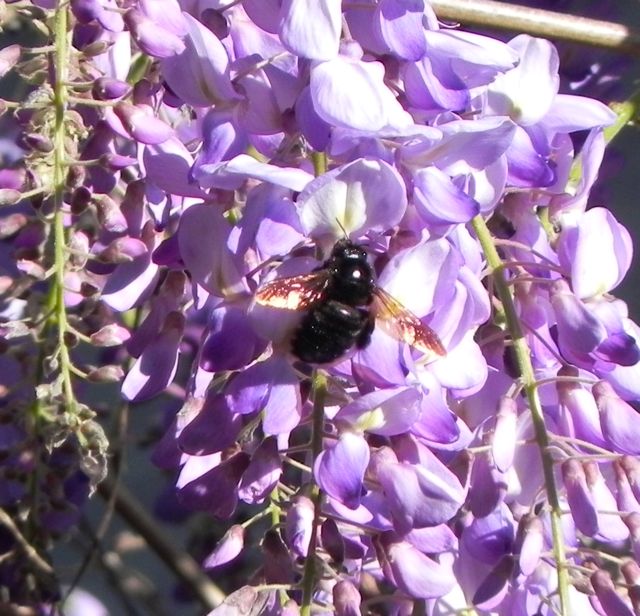
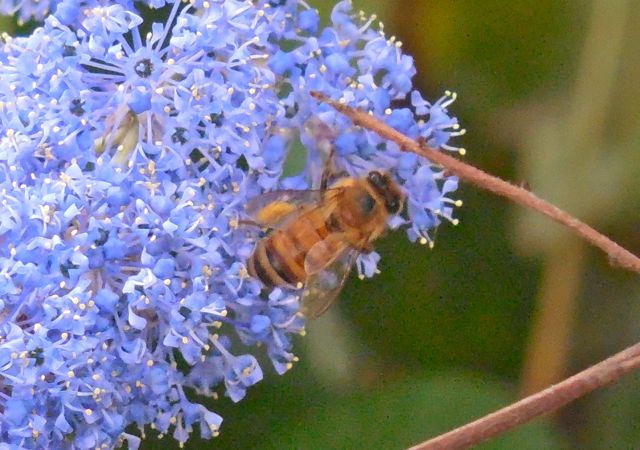
It wasn’t until my love of plants became deep enough that my fear of bees turned gradually into appreciation, then reverence, and finally deep concern. With scientists’ and farmers’ realization of the stark decline in honeybee populations, and their naming of the phenomenon Colony Collapse Disorder (CCD), my own emergent devotion to plants became joined with a commitment to gardening as a way to stave off that collapse at least a bit in my own environment. With our move to California and our becoming Friends of the UC Davis Arboretum I gained practical ways to put that desire into action, specifically with planting of native varieties and other bee-attractive plants, as well as avoidance of  insecticides. More great ideas came from periodic visits to UC Davis’s Haagen-Dazs Bee Haven  , where hundreds of bee-attractive plants grow across all the seasons.

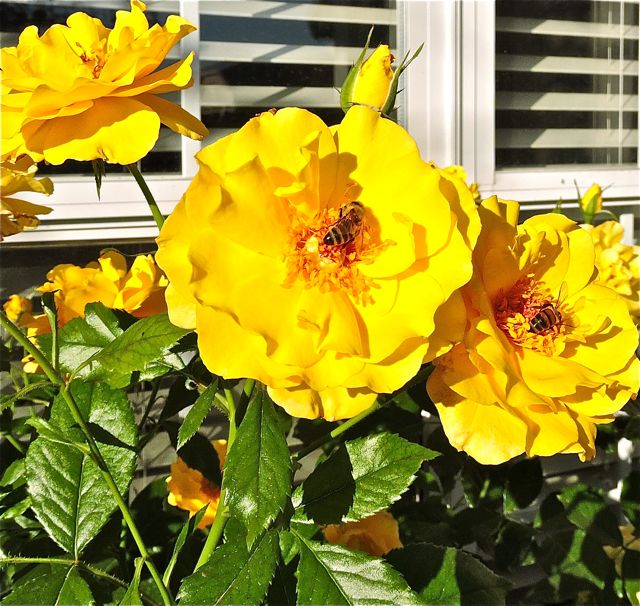
Gradually, I’ve added plants from these collections, nurtured some–like the lupine–that just spring up by themselves, and just generally become more attentive to the bees of all shapes and sizes that make our garden home at some time during the year. Because our growing season is year-round, there is always something growing that attracts bees. Since all plants flower, the plants I deliberately grow for their edible fruits are just as likely to attract bees as those that are advertised primarily for their flowering. The tiny yellow flowers that sparkle all over the tomatoes through the spring and summer may not be as large or vari-colored as the roses, but they have their own apis devotees.DSCN5784

At this stage in my education, there is nothing to match the springtime bee celebrations when the ceanothus and the wisteria are in bloom, closely followed by the orange blossoms, the cherry plums, and the meyer lemon. On some days the hum of the bees as they festoon the lavender, pink, and white blooms is almost a roar, and I’m drawn to stand amid the busy swarm as they go about their vital work. At these times, I am truly the visitor to what is most assuredly their home, and I try as much as I can to be a grateful guest.DSCN0270

Butterflies

My favorite butterfly visitors are a pair of white cabbage leafs that flit about the garden from spring through summer, occasionally landing on leaves and flowers of different plants, where their whiteness in some lights takes on the color of the leaf where they sit. But often they just appear from over the grey fence, then  dart and flutter across the garden before zipping back over the fence on the other side. Then there are the occasional what-look-like yellow monarchs that come into the garden and poke around before going on their way. One afternoon, I was returning from our mailbox down the street when one of them passed me like a yellow blur, turned 90 degrees into my front yard, and flew into the garden. I didn’t know from how far away he or she was coming nor how far he or she was heading, but the turn into our garden seemed purposeful, and I felt good that our garden may be a sort of destination, a regular stop along a route perhaps.garden cabbage leaf butterfly on zucchini leaf - 1

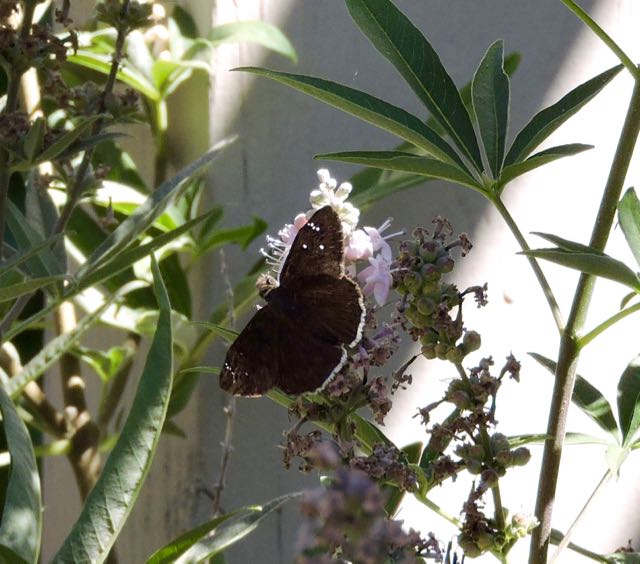
Then there are the little orange guys that stop by from time to time, as they did this August morning–oh yes, and the funeral duskywing (what a name!) that occasionally appears and that, just by chance, I was able two weeks ago to get a picture of on the ever-popular lupine.garden funeral duskywing on lupine - 1

A few butterflies come and go every day, but they never come in the numbers and with the humming show that the bees do at some times of the year. I can’t help feeling that one of these years they will stop coming altogether, because there will be no more of them, and these silent, flitting, flashing beauties will have gone the way of all those thousands of species that we humans will have systematically, even if sometimes stupidly unwittingly, destroyed. The numbers are startling. Numerous sources agree that monarchs, the showiest and most-storied of North American species, have declined by 90 percent, as habitats have been lost and necessary foods, such as the milkweed, have been lost with the habitats and through herbicides.

Birds

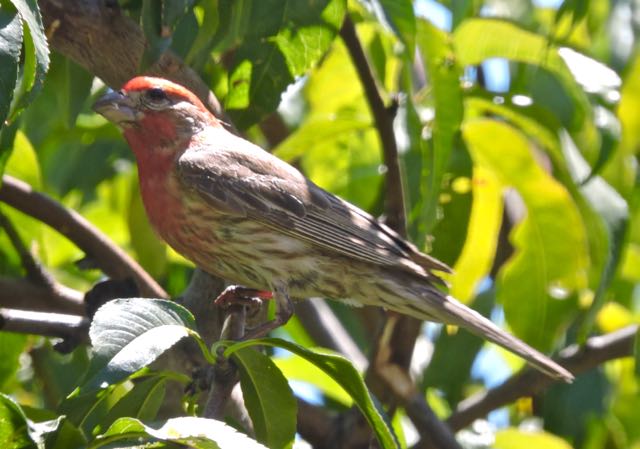
garden male house finch in peach tree - 1

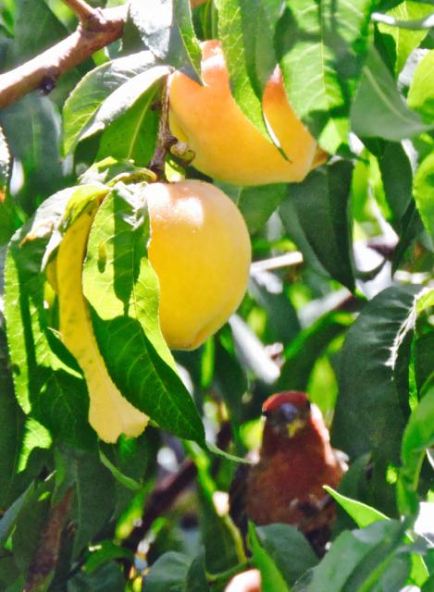
While the peaches were in profusion in July, our heartiest competitors for the fruit on the tree were the house finches (see one above). They’d pick apart some of the best ones, and sometimes we’d be left with part of a peach. Other times we’d beat them to the peach. Overall, there were plenty for us all. When just one peach remained on the tree, we figured it belonged to the finches. Beauty before age, I guess.

If I could come back after my human death as another creature, I would want to be a bird. Granted, it’s no doubt a pretty fearful and hectic existence–the birds who visit our garden move fast, hide in the foliage, and rarely go out on a limb for more than a few seconds. As soon as they become aware of my presence as an observer, they scoot away, or at least find an interior spot among the leaves to spy back at me. But, wow, they get to do it from way above me, and they can almost in an eye blink swoop to another perch from which to scan the world around them. Meanwhile, I just plod along on the ground and hope to keep from tripping over a tomato vine, a jasmine root, or the shovel I left upturned this morning by the Japanese eggplant.DSCN1334

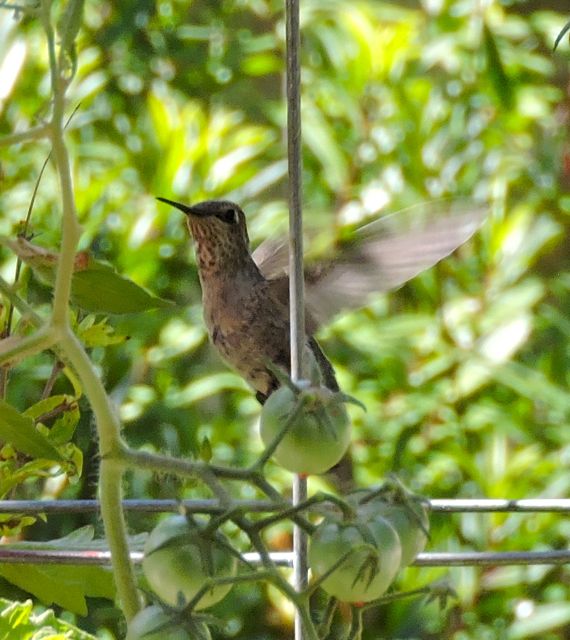
Chief among the swooping scooters are the hummingbirds, who helicopter around the garden and zip (and sip) from plant to plant during most of the year. I’ll be watering or pruning or weeding, with my eyes toward the ground, when all of a sudden I’ll hear a whir near my ear. The little bird is either just zipping past or sometimes hovering near me, sometimes waiting to look me right in the eye. I always blink first. A few times I’ve been lucky enough (as above) to catch one still enough for a photo. Other times I’ll hear their classic “tick tick” and get my camera ready, only to have my friend tantalize me by stopping for a second, then flitting to another short stop, then another and another, but never long enough for me to get off a good snap. Many’s the time I’ll look at a series of hummer pics I’ve taken, but I’ll have beautiful leaves in nice sharp focus and a ghostly blur where the bird has been.

Last week, I saw one through a side window sipping from an orange fuchsia bloom, but by the time I got my camera, my friend was gone to another place in the garden. I went outside and heard the tick tick, and I caught a glimpse in the wisteria, and then gone. Imagine the hummingbird in the fuchsia, below.

garden fuschia in bloom - 1

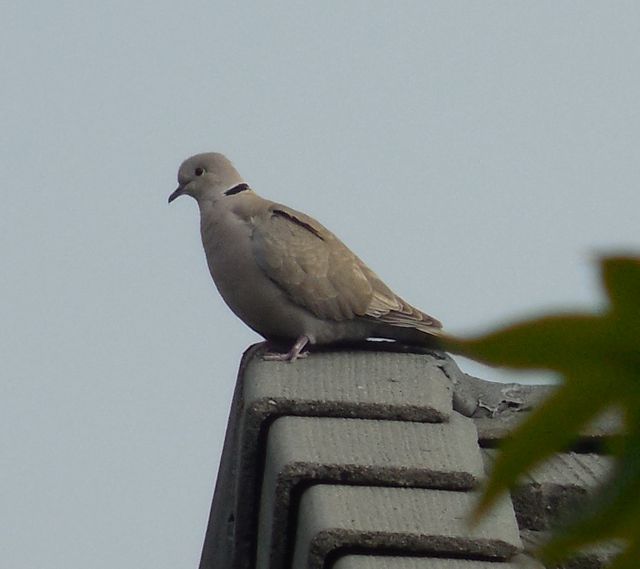
Of all the glorious songs of the birds who live in or near our garden, the one that most moves me is the plaintive “woo woo hoo” of the Eurasian collared doves. Our local pair calls all day long and spends part of the time in the cherry plum tree that overhangs our garden from our neighbor’s yard. Many years ago, a pair of doves lived in my neighborhood in Virginia, which bordered a small park. Often I’d be up early to walk in the park, full of tall old oaks and maples, and I’d stop to listen to the calling birds and try out my own plaintive dove call. I got pretty good at it, good enough that I imagined we were calling back and forth. Here’s a photo of one of our local residents, perched on the corner of our neighbor’s roof, a favorite spot for different species of our neighborhood avians to scan the territory and await the answering call.

DSCN0467

Z is for Zucchini

garden zucchini plant early july - 1

Chris:

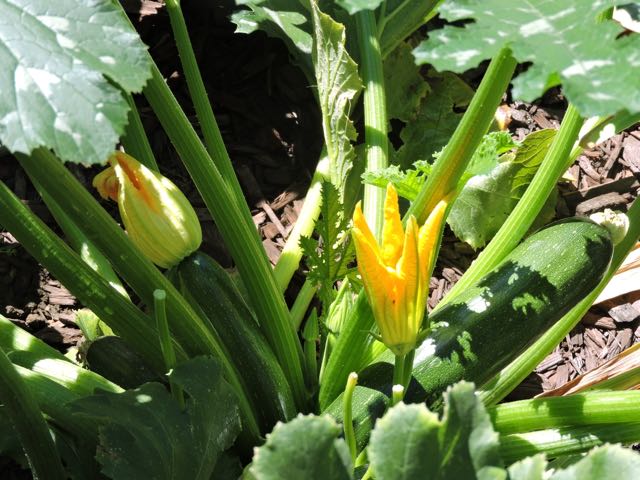
I know that Z doesn’t come right after A, but when the Z stands for Zucchini, that lonely letter at the end of the alphabet just demands that it be paid attention to. Beware the summer gardener who plants zucchini. He or she will likely be knocking on your door to plead that you take some of these rampant dark green torpedoes off the grower’s hands. Or you will be finding some monster veggies on your doormat, placed there by the grower who is too embarrassed to ask yet again.

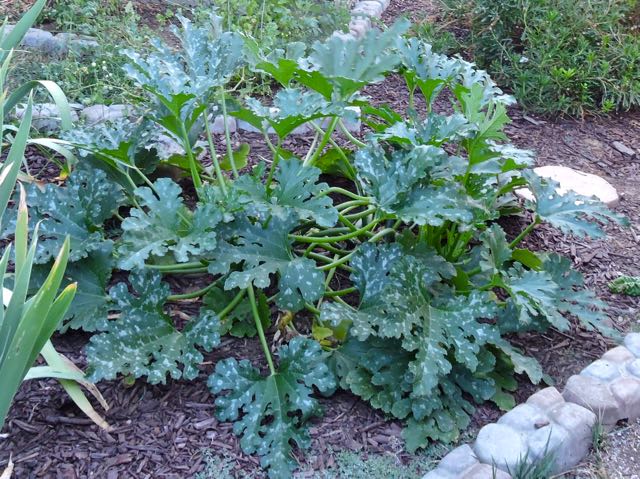
Lucky it is that zucchini is such a tasty and versatile veggie, because even a single plant that started from a two-leaf seedling in mid April can become a prolific producer by July, spread out over 30 to 50 square feet of huge multi-hued green leaves and gorgeous deep yellow blossoms, and keep producing into September. The zucchini is also amazingly efficient. Baking under the heat of a Sacramento Valley summer, our dry season, my current zucchini plant, almost a jungle in itself, needs only a few minutes of water spray a week to stay deep green and rich in succulent shoots and thick fruit.

Last spring was my first planting zucchini. I just popped the tiny seedling into our loamy, slightly alkaline, well-drained soil with some compost to get it started, and it didn’t take long, maybe two weeks, for new leaves to begin sprouting. By the end of May it was already a large, multi-leaved plant spreading over the ground, about six square feet, when, one morning, it was suddenly covered by white aphids. Rather than spray chemically, which I will not do, I cut back a bit on the water and just waited. Within a few days, ladybeetles began appearing on the leaves–a beautiful color contrast of orange amid the green–and in a week the aphids, and the ladybeetles, were gone, the plant healthier than ever.

This year’s plant–I now know better than to even think of planting more than one–followed the same growth pattern, but never developed the aphids, gets less water than last year’s plant, and covers three times as much square footage than last year’s. What we can’t give away of the produce we have used in salads, a tomato-cheese casserole, as “boats” for a mixture of cheeses and breadcrumbs, in loaves of delectable zucchini bread, as cups of grated ballast in large jars of homemade tomato sauce (see the entry “Speaking of Zucchini”), and as a layer in lasagna. Since the zucchini and our tomatoes flourish at the same time, they appear together in a range of dishes and create a Christmas-in-summer color pallet (With lasagna noodles and parmesan, we have the colors of the flag of Italy.)

garden zucchini and blossoms - 1.

A tip on regulating size of the zucchini fruit:

If you see small zucchini and large zucchini in the store, that’s not because they grow on different varieties of the plant. As I’ve learned the hard way, a zucchino (zucchini is plural in Italian) will just keep getting larger if you let it grow, but the plant will not put out new fruit–or at least fewer of them–as long as a large one is still unharvested. I’ve found thick foot-long monsters hiding beneath shoots and leaves, and if a new veggy appears beneath a yellow blossom one day, it takes less than a week for it to grow to a foot or more. So it you want petite zucchini, twist or clip them off within a few days of their first appearing.

Another amazing thing about this magic veggie is that, regardless of size, it has pretty much the same mild, fresh flavor. And I didn’t mention that these succulent items, encased in their tender, dark green rinds, keep for a long time in room temperatures. So, unless you use them or give them away, they’ll stay looking pretty on your table and waiting for more of their friends from the garden to join them.

A is for Apricot

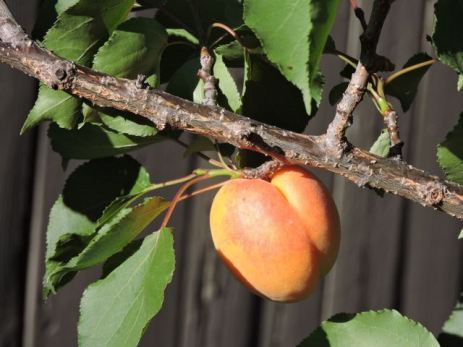
garden apricot closeup on branch - 1

Chris:

(NOTE: See the Addendum for May 2017 at the end of this entry.)

(NOTE: See further Addendum for May-June 2018 at the end of the entry.)

Jean suggested that I do a “garden alphabet,” just to give readers a bit of the variety of what grows and thrives in the garden. I’m choosing Apricot for A because the apricot tree that flourishes in the front part of the garden, unlike the hearty peach I wrote about earlier (“Lazy Fair Peach Tree”), is one I planted four springs ago as a skinny 6′ sapling and have nurtured fairly closely ever since, until now I know enough of its habits to let it be most of the time.

In its first year I paid close attention to the online guides, which was important, because I learned not to be afraid to prune away parts of the sapling that were not thriving–including two feet of the trunk–so that the roots could nurture what was healthy. Of course, I worried that I might just whittle the sapling down to nothing, as bit by bit the upper trunk’s leaves paled and withered. But after those first two feet the withering of the leaves stopped. The remaining leaves stayed bright green and, soon, still in the tree’s first year, new branches began poking out.

The apricot is a thirsty child, particularly in its infancy, and its base needs to be kept moist. A bed of mulch and regular watering kept the young tree healthy, and by its second spring branches had sprung out in all directions and we had our first small crop of apricots, about twenty in all. Apricots appear early in the spring in the Sacramento Valley, roughly in February, and by mid-May they are ready to harvest, the earliest of our trees.

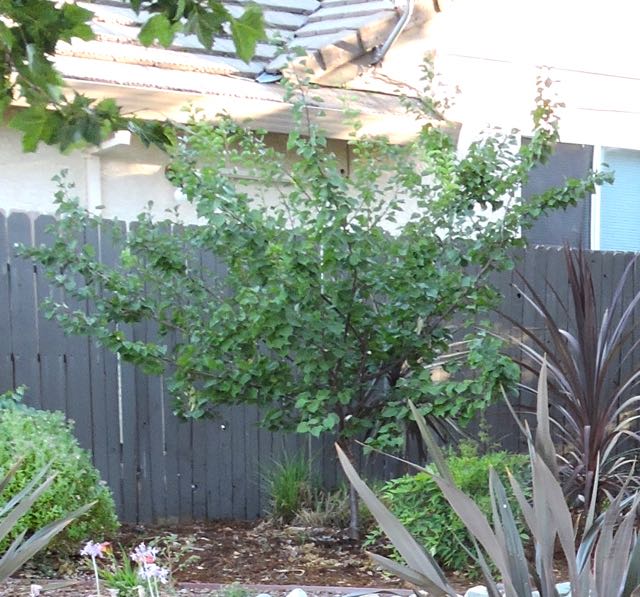
Now an established tree, about ten feet high and about the same in diameter–though she’s still growing–the apricot no longer needs intense watering . I have it on our drip system now a couple times per week in the dry season, and just rely on the rains between October and April to take care of the rest. In 2014-15, our driest season in the past 5, it survived during the water restrictions in California, although the fruit crop was small, only about ten apricots on the still young tree. This past fall and winter, with rainfall close to normal (almost 17 inches for the rainy season), I didn’t turn on the drip until May, by which time the new fruits were almost ready to pick. This May (2016) we had almost forty of the little beauties, firm and sweet and perfect for Jean’s pies, tarts, and jam.

.garden apricot tree in late July - 1

If you look closely, you can still see where I lopped off the top of the trunk in that first early spring, but now the younger branches have crowded around the gap and have reached four and five feet straight up toward the sun.  The stubby end of the original trunk is still there to remind me of that critical first year, even if no one else looking at this thriving young creature could imagine that it was ever in such danger.

Addendum: May 2017–Bumper Crop and New Cooking

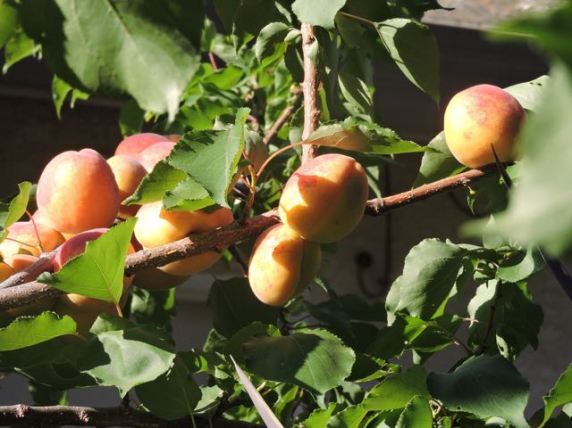
garden apricots ready to harvest late may - 1

2017 produced our biggest crop yet

Chris:

The huge rains of the 2016-17 season–over 45 inches!–led to by far our biggest crop of apricots, almost 100 on our tree, most in clusters such as the one above. The branches have spread to about twelve feet wide and high, from about ten feet last year. We’ve harvested about a third of the fruit so far (May 26), and will be harvesting the rest over the next week or so. Jean has ambitious plans to cook and dry the apricots, which are particularly large and sweet. Some will also go into jam. We don’t want to waste a one.

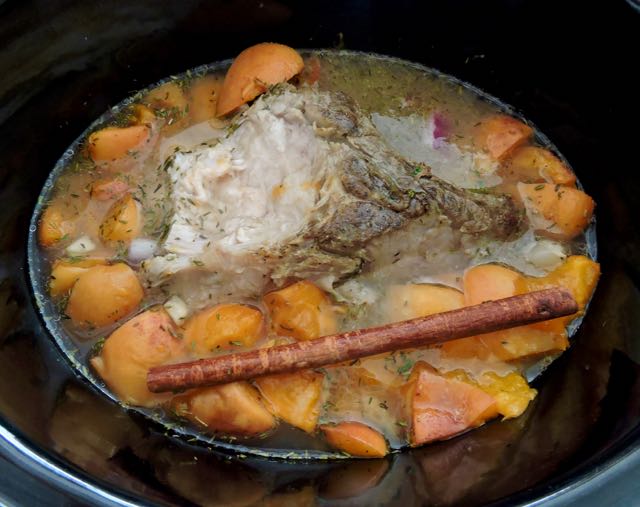
Here’s cooking plan Number One: Stewed pork with fresh apricots, with cinnamon, onions, spices, and herbs (marjoram and thyme) from the garden. (More to come!)

kitchen pork stew with fresh apricots late may - 1

Jean’s pork and apricot stew, 2017

Addendum 2: May-June 2018–Cool Spring and Even Larger Bumper Crop

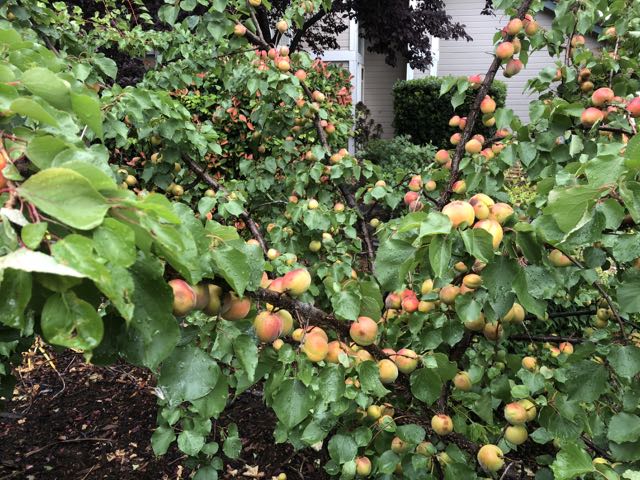
For the first time in the six years of this tree, the spring has been so cool (4-5 degrees below normal) that the apricot harvest did not occur until the last week in May. As you can see in the top photo below, the fruit were still greenish on the 21st, and so it was an additional week until most of the apricots were yellowy-orangy-red and soft enough to pick (next photo below from the 27th). Similarly, the cherry plum next to the apricot tree is full of hard red-purple fruit that won’t be ready until later in June, a week or more later than usual.

But what is really amazing about the apricot tree this year is the abundance of fruit. The pictures just below gives you some indication of how many fruit there will be over the whole tree, which is now fifteen feet high and similarly wide. The crop is so great (500-600 jewels?) that we will need to give most of the bounty away to neighbors. There will still be plenty for all of Jean’s culinary and freezing plans–and surely enough for the birds to feed on the many that fall to the ground..

The abundance also comes about after a winter of below-normal rainfall (16 inches, 4 inches short of normal), but the abundance may also be a lingering effect of the huge rains in the previous winter.

I’ll remind the reader that this tree is watered during the six-month dry season (May-October) by a drip system that runs twice a week, and there is no fertilizer besides the leaves that drop in winter. Of course, I don’t spray for insects. The fruit are what the tree puts out, and they are beautiful.

garden apricots ten days away from ripe may 18 - 1

Middle of May 2018

garden apricot bountry on tree may 27 18 - 1

Early June 2018

Cooking the Harvest

This June we’ve added to our culinary plans for the apricots several dishes and uses:

  • a chicken stew (to go along with last year’s pork stew) made in the slow cooker with boneless chicken, lots of apricots, and tomatoes
  • a cobbler with oatmeal, lots of apricots, and strawberries
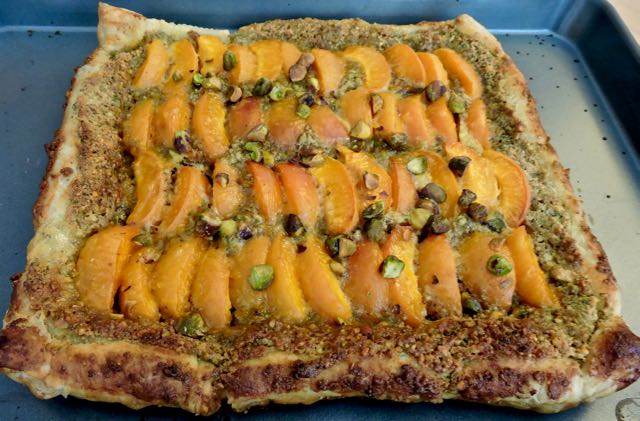
  • a puff-pastry tart with apricots, a minced pistachio filling, and chopped pistachios on top (see photos below)
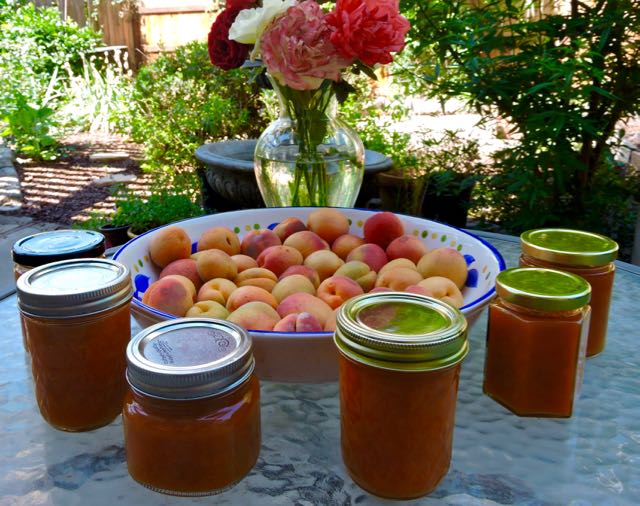
  • and a cauldron full of apricot jam (using 100 of the apricots), ladled into jars (refrigerated) and plastic containers (for freezing) (see photo below).

Making this jam is so much easier than making the cherry-plum jam (see “C Is for Cherry-Plums”) that we make yearly. Apricots come apart for pitting with one knife cut to split the fruit, and the pit doesn’t cling to the meat of the fruit, so there is no staining mess of juice. Moreover, each fruit is much larger than a cherry-plum, so 100 apricots is like 400 cherry plums in a batch.

To the 100 apricots, you can add a about a cup of water in the pot, but do this according to how thick the cooking fruit turns out to be as you cook it on medium to low over the burner.  You may want more or less water. Remember, the more water you add the longer is takes to boil down the fruit to the right consistency. As an alternative to water, you can add some sweet fruit juice–like apple or grape–for tang and a slightly different flavor.

The three other key ingredients are sugar, fruit pectin, and lemon juice. As the apricots cook, taste to see how much sugar you need to add. Keep sprinkling in baker’s sugar as the fruit cooks, again only according to taste. If you use fruit juice instead of water (see above), you can use somewhat less sugar. But all this varies according to your taste as the fruit cooks.

Fruit pectin is also optional, depending on how thick you want the jam. Remember that jam thickens as it cooks down, and it will also get thicker as it cools. I used about a tablespoon of pectin with the 100 apricots, but I don’t like jams particularly thick.

Lemon juice adds tang to the mixture and also helps in thickening. But, again, it’s not essential. Have a lemon ready for squeezing as you cook the apricots, if you want that lemony tang.

kitchen apricot jam and fresh w roses june18 - 1

Apricot jam in jars to be refrigerated (plus fresh apricots and roses) June 2018

kitchen apricot tart w pistacios june18 - 1

Jean’s apricot tart–puff pastry, fresh apricots, pistachio filling and topping

kitchen apricot tart w ice cream june18 - 1

Apricot tart, with butter pecan ice cream–can it get any better?

Here are the year by year totals so far:

Year                Height               Harvest

2012-13          6′ (-2′)=4′                 0 (just planted)

2013-14          7′                             20

2014-15           8′                            10 (worst draught)

2015-16           9′                             40

2016-17           10′                          100 (45″ rain)

2017-18            15′                          600


Lazy Fair Peach Tree

garden peaches early july - 1

It’s the middle of July in Northern California, where our tidywild little garden is soaking up the heat of the Sacramento Valley. The highs have varied between 85 and 105 in the last month, typical, with the cooling breezes from the Sacramento River Delta to the south easing us to the 50s or low 60s by every dawn. The last peach of the season was munched by the finches earlier this week, but the birds and the gnarly tree that grew the peaches shared so many yellow-orange gems with us in the last month that it’s taken all our ingenuity to think up ways to use them. Gifts to neighbors and friends, plus Jean’s pies, a cake, muffins, compote for pancakes, topping for cereal, homemade peach ice cream, and fresh snacks plucked right off the tree have still left us with a box of beauties in the fridge.

I’d like to take credit for this tree, but like so much else in the garden it was a gift to us as part of the purchase price for the house. It was smaller then, but already mature, and it presumably had been bearing for several years by the time we became its caretakers. Or am I just more of an onlooker, or cheerleader, or occasional tidy-upper?

One thing about inheriting trees that you didn’t plant is that you don’t have too many illusions about who’s responsible for the bounty each year. The peach tree, the orange tree, the cherry plum, the nopales, and almost all the rose bushes were here when we moved in. Mostly what I do for these hearty creatures is prune and water (and think about pruning and watering), but the roots and health of the plants were established before I came along. Seriously, what I mostly do is try to stay out of their way, so they can do their thing. Well, that’s less true of the rose bushes and nopales than of the orange, peach, and cherry plum. If I didn’t regularly lop new leaves off the nopales (AKA prickly pear), it would have built an impenetrable barrier in the south side of the garden and taken over the orange tree. And if I didn’t trim the dead heads off the rose bushes about once a month and regularly trim back the shoots, there’d be thorn thickets galore. A great virtue of this part of the country is that many plants grow year round, so, for example, no month goes by without new roses or nopales. And that means pruning.

The peach tree, though, has now gone several years without pruning or fertilizing, and it hasn’t missed a beat. I have lazily mulched the tree by just letting the leaves that fall each autumn lie where they come to rest, and in the spring this year I added to this leaf mulch by tossing in the last patches of grass I had dug up nearby to make room for a new venture, strawberries (more on that in another post). I don’t know if there’s a connection between this laissez-faire attitude to the tree and its health and productivity, but I have noticed in the past few springs that the tree has not suffered from leaf curl (a shriveling condition), which had happened a few years earlier.

Now where my “lazy fair” attitude may be a problem is in what happens when the peaches in April and May start to turn from tiny green tufts of fuzz into real fruit, and they multiply on each branch and get bigger. The guides all say that I should be thinning out the new fruit on each branch, lest the branches get so heavy that they break. But I hate to lose the luscious, beautiful fruit–even if by mid-July I’m wondering why I wanted so many!

So I get what I deserve. Indeed, as May turns into June, all the fruit-laden branches start to bend. Last year, with my hesitancy to thin out one of the branches, the branch splintered in late June, right near harvest time. But it didn’t break clean through; instead, enough of the vital connection remained that nutrients continued to flow through the branch and the peaches thrived. This year, the same branch, partly broken, continued to bear peaches, though fewer than in 2015.

Meanwhile, the most fruit-heavy branch on the tree this year bent lower and lower, and the same thing happened. To keep the break from getting worse, I propped it up on our step ladder. Again, the peaches were fine all the way through harvest. But this time, because of the way the branch hung over my strawberry patch, I decided immediately post-harvest to lop it off. C’est la vie.

It’ll be interesting to see what happens next year. I’ll probably be doing some more pruning in the fall, to even out the branch symmetry and keep the tree from growing too tall, and from growing too far into the orange tree next door. We’ll see. The lazy fair has mostly worked out so far, but there may be a limit to the fun.

garden-last-peaches-and-finch-lurking-1

Last peaches of summer 2016, with finch posing