February 2025: Simple Acts of Love

In this month’s entry:

Celebrating Love in the Midst of Fear

Finding Birdsong: the Great Backyard Bird Count

Dishes to Warm the Heart

The February 2025 Photo/Video Gallery: Abundant Life in the Cold

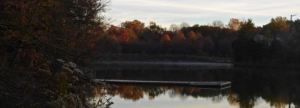
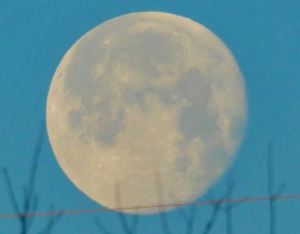
The February “Snow Moon” setting west of the lake, Valentine’s Day

Celebrating Love in the Midst of Fear

I always end each month’s entry with a “bon voyage” message for the next month. January’s message was “And on to the month of Valentines in hopes for our own resilience among challenges.” Well, there certainly have been challenges, as the new regime in the White House has torn through agency after agency with mass firings, and has left all three hundred million US citizens wondering what’s next:

  • Will any of our personal data be left un-pillaged for illegal use by Elon Musk and his uncontrolled band of data miners riffling through all Americans’ tax files, internet messages, and Social Security records?
  • Can we count on any payments and services from this new federal ruling class, which day after day punishes people if they have the courage to speak up?
  • Will US farmers survive the triple-whammy of extreme drought/floods, loss of foreign markets, and the bird flu epidemic that so far the administration ignores? https://www.youtube.com/watch?v=_3oXl_-viAg
  • Will the changed climate ever be addressed, as heat rises, storms become more deadly, and fires proliferate around the country and the world?

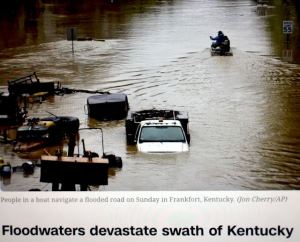
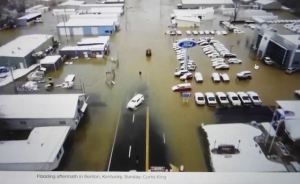
Flooding and loss of lives in Kentucky, February 16 and onward (Curtis King photo, CNN)

  • Finally, will the US keep any trust among the nations of the world, as the President cozies up to the Russian tyrant and threatens sovereign nations with land grabs and budget-busting tariffs? Will the US be left with any friends around the world in our own time of need?

Yes, the time for resilience is truly upon us.

But still we have so much to take joy in and celebrate–it’s Valentines Month! Let’s celebrate the love and care of those we are close to, and of the friends we’ve made through the years. Let’s comfort those in need and bring joy to as many others as we can.

One place to start is in our own back yard…

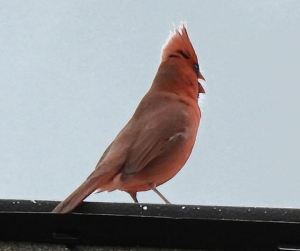
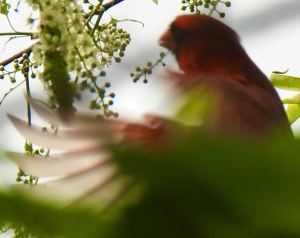
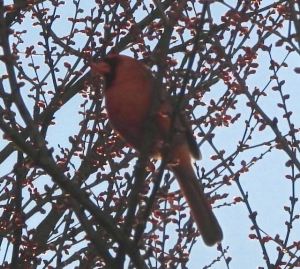
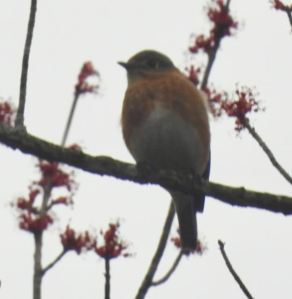
One of our Community’s resident Cardinals listens and calls to friends in a Red Maple along the east shore of the lake

*************************************************
Finding Birdsong: the Great Backyard Bird Count

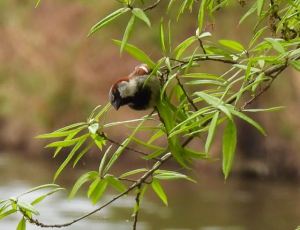
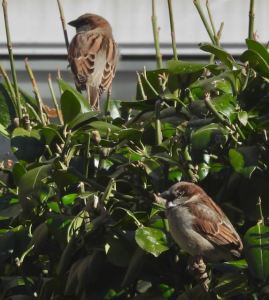
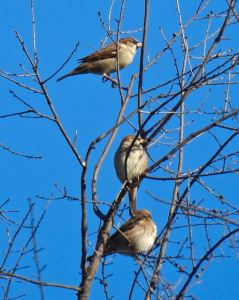
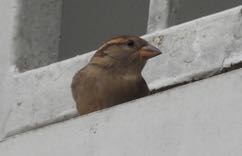
Pair of our abundant House Sparrows in a Japanese Spindle bush by a window in our community, on a cold, windy February 17

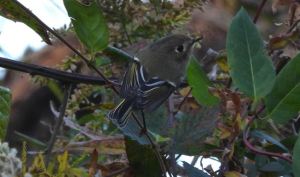
Yes, it’s that wonderful time of year again, when over 800,000 birders from around the world head out to their favorite places to record in picture and sound the inspiring lives of all the species they can discover. Just in the U.S., the Great Backyard Bird Count (GBBC), February 14 to 17, so far this year has found 655 species from almost 150,000 participants. Worldwide, so far almost 300,000 searchers have discovered almost 8000 species. Just in touring each day around the lake over the 4 days, I’ve found 25 species.

****************************

Update (March 14): Final Stats from Cornell Lab of Ornithology:

  • 8,078 species of birds identified
  • 217 countries or eBird subregions
  • 387,652 eBird checklists
  • 611,066 Merlin Bird IDs (step-by-step, sound, or photo)
  • 189,741 photos, videos, and sounds added to Macaulay Library
  • 838,113 estimated global participants
  • 409 reported community events

****************************************

In part because this winter has been distinctly colder and snowier than last year’s (as this blog explored last month), the roster of local birds in this year’s GBBC is somewhat different from last year’s. For example, this month I’ve heard a Carolina Wren and a Yellow-rumped Warbler, but not seen one. Last year, they were on my photo roster. Nor have I seen any Double-crested Cormorants for three months–a regular winter presence when the lake is not frozen–nor a White-Crowned Sparrow, also more used to warmer temps. In contrast, American Robins have been here in profusion since this December; Dark-eyed Juncos have been here continuously since the Fall; and–lo and behold–for the first time since we moved here in 2022, Bald Eagles–at least 3–have been soaring 500 feet or more above the lake, close enough for me to get a couple of blurry, but definite, pictures.

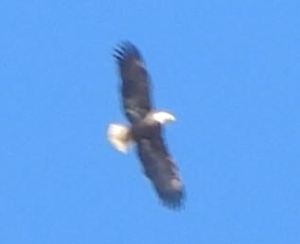
Bald Eagle soars about 500 feet above the north shore of the lake, close enough for me to get a hazy zoom shot, on a windy, cold February 17

Here are a few more from this year’s visible species list:

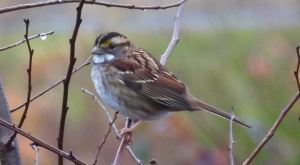
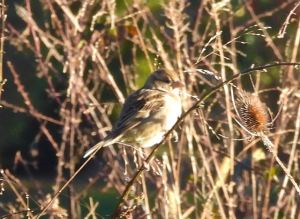
Not seen in the last GBBC, nor the year before, White-Throated Sparrow hunts seeds near a feeder on the Southeast side of the lake, February 15

New on this year’s GBBC roster, Savannah Sparrow feeds in the marshy waters in the Northwest corner of the lake, February 15

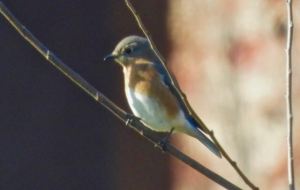
As last year, a few Eastern Bluebirds brighten the winter with their presence, like this one perched at a feeder on the Southeast side, February 15

As these 2 House Sparrows enjoy the blue feeder, listen for 3 other species: White-Throated Sparrow, Song Sparrow, and–surprise!–a male Red-Winged Blackbird, who is a warm-weather bird who doesn’t show up in these parts until June. Why he’s here now is just one of those birding surprises. February 19

The forecast for the coming week indicates more cold weather and perhaps snow coming our way, so we’ll see how the roster of birds in our community adapts. Every day offers surprises to birders. But as long as we have the lake, the woods, the diverse plants, animals, and insects along the lakeside–and the humans who care about their surviving and thriving–we’ll be fine.

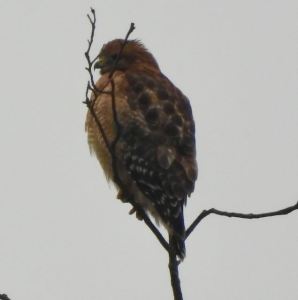
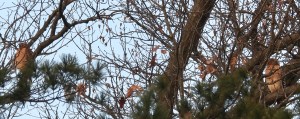
A Red-Tailed Hawk’s vigil atop a Tulip Tree across the lake on the west shore, February 15.


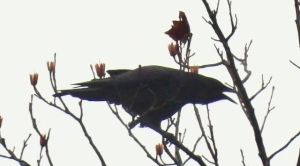
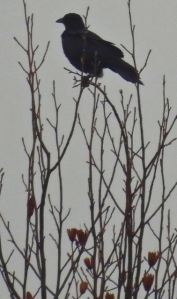
From across the lake I hear this Common Raven calling, atop a Tulip Tree in the East side woods, February 16

Of course, now that the Trump/Musk administration has suddenly fired 3000 local workers at National Parks and Forests (New York Times, February 18), including many trained to prevent or fight fires, the chances that birds and all other animals and plants can survive in an ever-more-extreme climate have become that much more fragile. Not to mention the weakening chances of employment of these former workers, all of them small-town residents across our country, and not to mention the even smaller chances that the now-unguarded towns near these forests will themselves survive the fires and other disasters sure to challenge their and our resilience. SEE Update, below, February 25.

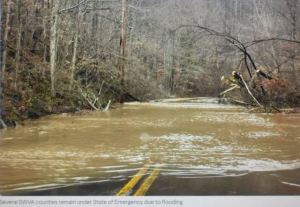
Flooding brings state of emergency to counties in Southwest Virginia, February 17. (Kenzie Hagood photo, WJHL, TriCities)

UPDATE, February 25: “Plan to Cut Park Workers Reversed: After Public Outcry, Administration Gives OK for Hiring of Seasonal Employees” (LA Times, Jack Dolan)

According to the Times article, the sudden rescinding of the order might bring as many as 7000 seasonal workers to the National Parks and Forests this summer, though the firing of 1000 probationary and permanent workers still stands, as of this moment. The pushback on social media and in messages to Congressional offices to the Trump/Musk firing assault seems to be having an effect. Let’s see how this all plays out as we move into March.

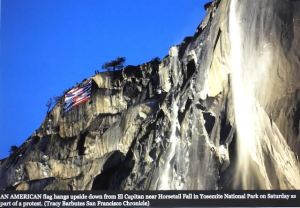
Sign of protest: US flag upside down on the face of El Capitan in Yosemite Park (Tracy Barbutes, SF Chronicle, Feb. 25)

****************************************************

Jean’s Borscht with Sour Cream “Butterfly,” February 14

Dishes to Warm the Heart: The Valentines Month Kitchen

Jean:

I decided to make borscht for Valentine’s Day because it’s very red, first of all, and I know Chris likes it.  (I also wanted a tribute to poor, long-suffering Ukraine.)  I love a beet salad, too, so I bought enough fresh beets, plus a can of sliced beets, to allow me to make plenty of either or both.  Frankly, I did not enjoy trying to roast the fresh beets; they seemed to stay tough in the oven for a long time and then they suddenly went dry and a different kind of tough.  But combining my questionable roast beets with some canned beets and pureeing them in the blender or food processor worked for this.

 
I checked recipes online for borscht and came up with so many possibilities.  Some include potatoes, some have cabbage; there are some with meat, some vegetarian, different levels of tomato inclusion or not.  I love that because it means I can do what I want and use what I have.  But having a special place in my heart for monochromatic dishes and meals, I made a point of using chopped red onion, quite a bit of red cabbage, small red potatoes, and the reddest carrots I could find, as well as a roasted red pepper and tomato sauce.  I couldn’t tell you what the proportions were.  I can’t reproduce it, and it doesn’t matter.  Even after blending, there’s a hearty texture to the soup from all the vegetables, whether or not you add some ground meat.  It was delicious and good for us, too.  Be sure to top it with some sour cream and dill fronds.
 
Here are some ideas to get you started.  Take a look and take your pick.  We probably have some more winter nights coming, even with Valentine’s Day behind us, so enjoy some nice hot soup.


Chris’s Chayote, Green Pepper, Tomato, Garlic Stir Fry

Chris’s chayote stir fry sizzles on the stove, February 10

Chris:

Chayote, a Mexican squash, gets little publicity, but it’s inexpensive, tasty, colorful, crunchy, keeps well in the fridge, and is full of nutrition and easy to cook. Just chop it up, add any other veggies you like, season to your taste, and fry on medium heat in a tablespoon of oil until you like the texture. I sauteed chopped onions in the oil to begin, then added the chayote, mild green pepper, and grape tomatoes, plus a splash of green olive juice. I then added minced garlic, salt, black pepper, red pepper flakes, all to my taste.  I frequently flipped the mixture with the spatula, so it would cook evenly. That was it–done in twenty minutes. Perfect tummy warmer on a cold day!

Two More of Jean’s Cold Weather Hot Dishes this Valentine’s Month:
 
Jean’s Shrimp and Veggie Gumbo
 

Jean’s Shrimp and Veggie Gumbo, Rice, and Andouille Sausage, February 14

Jean’s Baked Potatoes Smothered in Chili and Cottage Cheese

Jean’s baked potatoes smothered in chili and cottage cheese, with broccoli and homemade corn muffins, February 12

*************************************************

The February 2025 Photo/Video Gallery: Abundant Life in the Cold

Along with more of the champions from our local Great Backyard Bird Count, this month’s gallery includes some provocative scenes from our deep winter of 2025. And the stars of course are the residents and the visitors.

Black-capped Chickadee calls and flits in Serviceberry tree, early AM, Valentine’s Day

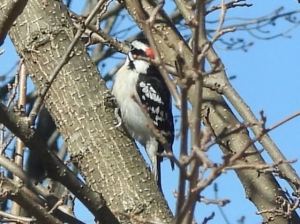
Downy Woodpecker in a Sweetgum tree, Southeast side of the lake, frigid February 17

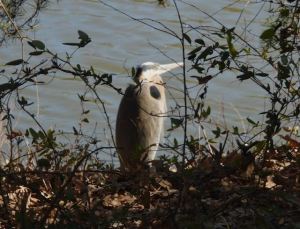
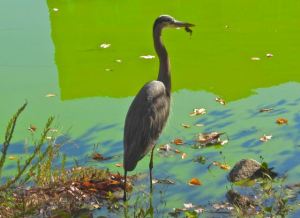
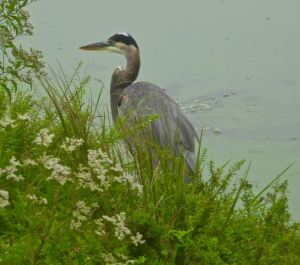
Great Blue Heron, in west bank shadows, braves the cold on February 17. No herons came while the lake was frozen in January.

On February 4, at noon, I capture a Canada goose skating (!) on the frozen lake near the fountain

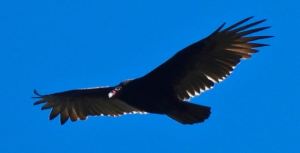
Turkey Vulture soars over the lake on a sunny, but very cold Valentine’s Day


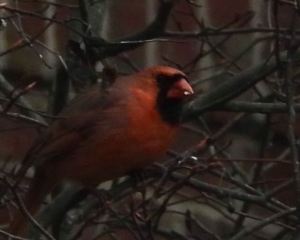
Male Cardinal holding seed in shadow in red maple on the Southeast side, February 15

Song Sparrow forages, as the House Sparrow chorus practices, Southeast side, during afternoon snowfall, February 11

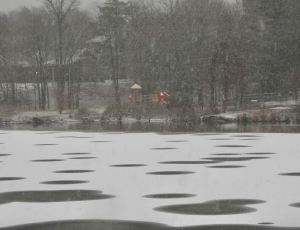
The community playground in mist across the snow dappled lake, as new snow falls, February 11


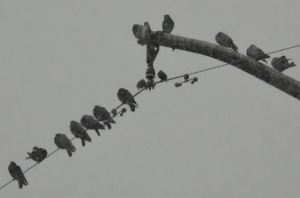
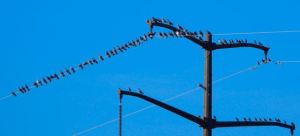
Our resident flock of Rock Doves stays warm amid company on the west side stanchion in thick afternoon snowfall, February 11


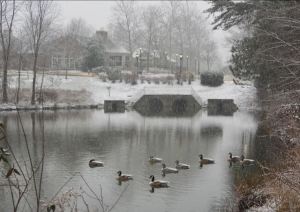
Your classic wintry scene (as if from Currier & Ives): Canada Geese pose in the calm lake before the community park, as the snow gently falls, February 11

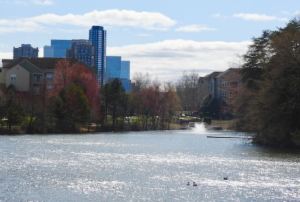
Change of pace: Panorama toward downtown buildings as the lake sparkles in the bright sun of a windy, cold afternoon, February 17

Another change: Panorama toward the north end, with the Geese, the dock, and the gazebo, in the thick snowfall, February 11


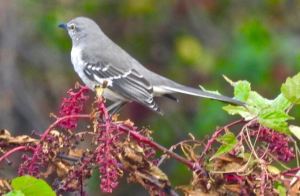
Mockingbird walks beside me and searches for seeds on the path by the Southeast cove, February 16


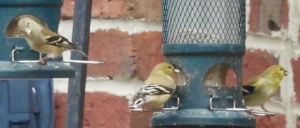
Three American Goldfinches at feeders, Southeast side, February 15

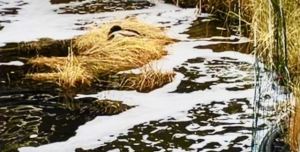
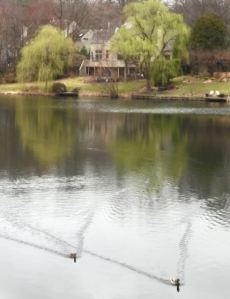
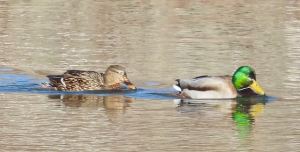
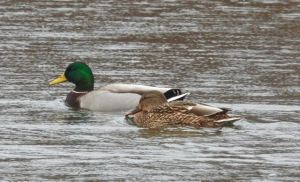
Mallard pair, having returned once the lake unfroze, swims along the north shore on a very cold morning, February 16

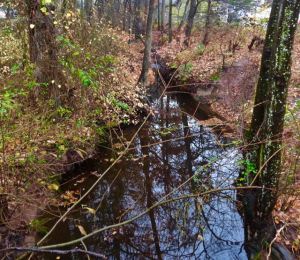
Back to the falling snow on February 11: I follow the burbling outlet stream below the north end dam. Calm and cold.

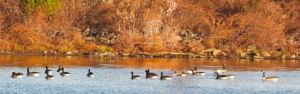
Just as cold, but less calm, is this mingling of Canada Geese, a Mallard pair, and 2 American Crows in the Northwest corner of the lake, February 15

House Sparrow pair won’t sit still in the Serviceberry tree in that February 11 snowfall


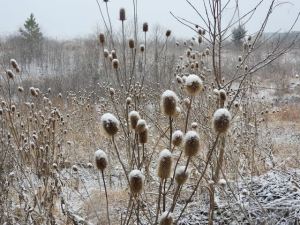
Dry Cutleaf Teazel like ice cream pops by the outlet pond below the north end dam in the snow, February 11


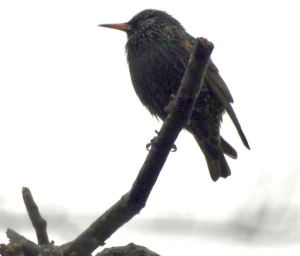
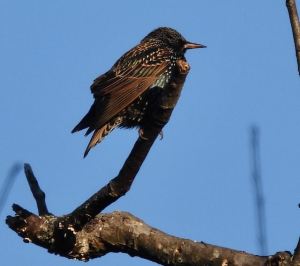
European Starling atop the dead White Oak on the east bank, February 16

Strolling with their Valentines: Mallard pairs swim 2 by 2 along the north shore, very cold morning, February 14

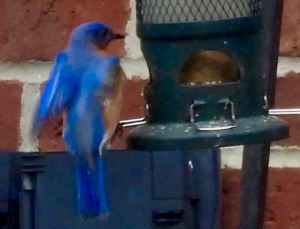
Brilliant Eastern Bluebird lands at a feeder, Southeast side, February 15


Dark-eyed Junco in Downy Serviceberry on the Southeast side, Valentine’s Day

Downy Woodpecker in Serviceberry tree scans the area as the Sparrow chorus sings and a jet roars overhead, and there’s snow, too! February 11, of course.

And the stolid Great Blue Heron scans the shore in the bitter wind of February 17 and thinks: “It’s all about resilience.”

And on we March to March: Let us hope that the loving spirit of Valentine’s can stay alive in all our hearts and be shared with all creatures.

January 2025: Fire and Ice

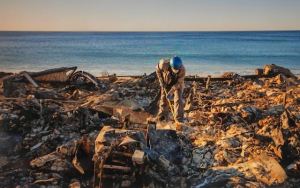
Fire to the Ocean: Homeowner sifts through wreckage after the Palisades Fire, Jan. 13 (Brandon Bell/Getty Images). The Palisades Fire is still not fully contained two weeks after the blaze began, and more high winds occurred this week, but with some rain expected for the weekend.

In this month’s entry:

Apocalyptic Fires, Surprising Ice
Staying Warm with International Dishes
The January 2025 Photo/Video Gallery: Bird and Deer Resilience

Palisades Fire and Los Angeles city lights, from airplane (Reuters photo, January 8)

Our frozen lake, view toward downtown, windy morning, January 9

Apocalyptic Fires, Surprising Ice: Two Sides of the Same Oily Coin

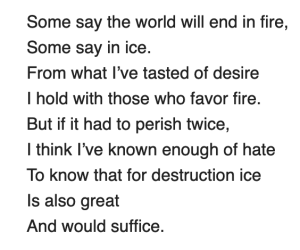
Robert Frost, “Fire and Ice,” first published 1920

Chris:

It’s certainly common in this blog to talk about very different places and experiences, but this January seems to offer–I say “seems”–a brutally stark divide between the fires in Los Angeles and the snow and ice here in Northern Virginia and now through the Deep South. Sure, there’s a difference between the heat and sudden destructiveness of a fire and the combination of sudden danger and long-term deadening action of ice. But, as Frost’s poem makes clear, the contrasting forces both have the power to destroy the world–when weaponized by human desire and hate. So fire and ice, in their destructive power, have a lot in common.

Altadena, CA “neighborhood” after the Eaton Fire, Jan. 16 (Orange County Register); Almost 40,000 acres burned in the two fires; 12,000 homes, schools, libraries, and other structures were lost, and 60,000 or more people were left homeless–one of the worst disasters in California history

Indeed, the LA fires and the extreme “cold snap” now surprising the US South–snow fell in Tallahassee, FL, on Jan. 20, for example–both demonstrate the climate change that the unrestrained greed of the oil and gas cartel continues to bring to the planet and its inhabitants. The unprecedented fires in LA are the result of the rare–but increasing–confluence of a record drought afflicting Southern California and unusually strong Santa Ana winds producing gusts as high as 100 miles an hour. Together, the drought and the winds make wildfires in the parched chaparral landscape much more likely. Climate change science predicts that such a confluence of forces will become more common.

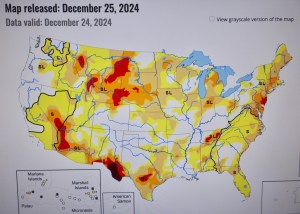
And not only in Southern California. The drought that stoked the fires there is stoking them across many states. According to the US Drought Monitor, as this blog reported in October, as much as 80% of the US is rated as from abnormally dry to being in moderate to severe to extreme to exceptional drought, as this December 2024 map shows:

US Drought Monitor, Christmas Day 2024 (https://droughtmonitor.unl.edu/CurrentMap.aspx)

The Onslaught of Ice in the Deep South

Ice, snow, and states of emergency from Texas to Florida to the Carolinas, Winter Storm Enzo (Weather Channel, Jan. 21). David Goodman of the NY Times reports (Jan. 21): “For many Texans, the arrival of snow brought back memories of the devastating winter storm of 2021, which crippled the state’s independent power grid and killed more than 200 people. So far, the state’s electricity market operator has said it has plenty of power.”

Some are calling it a “once-in-a generation” winter storm along the Gulf Coast (CNN, January 22: https://www.cnn.com/2025/01/22/weather/winter-storm-south-wednesday-hnk/ ). So how is this icy, snowy Southern “Surprise” an effect of climate change? The steadily diminishing polar ice cap, perhaps the most dramatic effect of human-caused climate change over recent decades, is producing fluctuations in the “polar vortex” jet stream that are making seasonal weather forecasting more unpredictable across North America. So we shouldn’t be surprised that a sudden surge of very cold air is hitting the Deep South this January.  Again, what has been entirely predictable over the past 100 years or more is that the Earth is slowly heating. 

And so, the gradual heating produces

the polar ice cap melt that spawns

the fluctuations in the upper atmosphere that cause

the unexpected deep freeze and snows in the South.

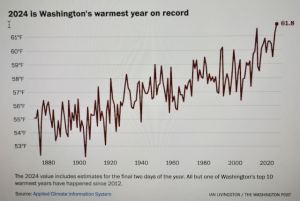
In other words, it’s all part of a pattern brought about by our addiction to fossil fuels. That Northern Virginia is experiencing temps this week in the single digits (4 degrees Fahrenheit on the morning of 23rd) would not be surprising if Januaries in the past 20 years had been the typically cold winter months of years long past. But in January 2023 and January 2024, this blog described what amounted to early springs of budding trees–not a surprise, because gradual warming has been the trend, as the world and local temperature records demonstrate:

Hottest Year on Record in the DC region (National Weather Service) (Washington Post, Dec. 30): this map records “only” the last 145 years, but the trend is obvious

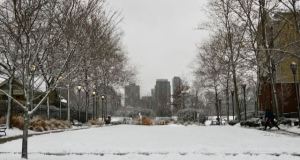
Heavy snowfall on our lake, view from south end park toward downtown buildings in distance, January 19, afternoon

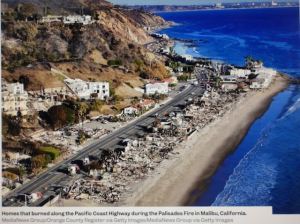
Aftermath of one section of Palisades Fire in Malibu (photo Jan. 16, Orange County Register)

Is there anything we can do about this trend toward ever worsening destruction? Sure, but will U.S. society have the courage and even the awareness to really move steadily with determination away from oil and gas and toward clean energy? We have the technologies and the infrastructure–and the skilled workforce–to do so. But strong-arm politics is the stumbling block.

Just this Monday, January 20, the loudest mouthpiece for the oil and gas cartel was re-inaugurated as the President, and he has already nominated for his Cabinet men who are wedded to the cartel and dedicated to eliminating clean energy alternatives: solar power, wind power, and electric-powered vehicles. These people glory in the fact that the U.S. is already the world’s largest producer of fossil fuels, and they want that destructive leadership to intensify–to their benefit, but not to meet the needs of the people for a safe, productive environment.

According to the Energy Institute (Nov. 2024), the U.S. has been the world’s leading producer of oil and liquid gas since 2017, and further increased this lead under the Biden administration. Even oil companies see no need for this continued mining, as leases already approved go unpurchased. So why is further mining being pursued by the new President?

The result will be that in the next few years more and more events like the wildfires in California, the worsening hurricanes in Florida and the Gulf Coast, the extinction of fish species in the oceans, extreme drought in Texas, water shortages in more and more states, and many more climate-related disasters will occur. Costs already in the trillions have been racked up to repair and prepare for these events, with Americans paying for them in ever higher prices, in lost insurance, and in fear for their lives and homes. Politicians who don’t want to call these catastrophes what they are–“human caused”–will keep calling them “natural disasters,”  while nature and her creatures will suffer through our abuse.

A beautiful pair of Mallards push their way through the frozen lake, as snow falls, January 6

***************************************************************************

Jean’s green pepper enchiladas, January 18

Staying Warm with International Dishes

Jean:

As the temperatures have dipped down and stayed down over the past couple of weeks, I have been inspired to serve comfort foods, hot in both temperature and taste.  Furthermore, we’ve been staying inside more than any time since Covid, as ice has built up outside, so reusing and repurposing leftovers and pantry items has been a priority.

I started with chili, of course—a staple of cold weather comfort food.  I never make chili the same way twice, but this time I was inspired by a recipe by Molly Yeh on the Food Network, except I left out the cinnamon because Chris doesn’t like the taste of Cincinnati chili (but I do).  That chili had no beans, so on another day I added chunky tomatoes and pinto beans for a different look and taste.

Green Pepper Enchiladas

My next inspiration came from watching “Moira Rose” make enchiladas on Schitt’s Creek.  (Yes, there’s a lot of TV watching involved when holed up inside by the weather.)  I don’t know her recipe, so I just pulled something together with leftover bean and corn chili as the filling, spinach tortillas for color, sliced green peppers for crunch, and a canned cheese sauce. They turned out perfectly and were photogenic, too!

West African Peanut Stew

Because Black History month is upcoming in February and Martin Luther King, Jr.’s birthday is this week, I also made a West African peanut stew, which combined chard, tomatoes, sweet potatoes, and chicken with the peanuts in a savory sauce with peanut butter, cumin, garlic, ginger, and onion. The plentiful, colorful stew was good for several days of leftovers. Chris particularly liked the chopped chard and tomato flavors, and peanuts are favorites of ours in any form. (The peanut stew was also a tribute to my late older sister, whose birthday was the same as MLK’s.  She worked in Africa with the Peace Corps in her youth.)

Orange Chicken and Tempura Green Beans for Lunar New Year

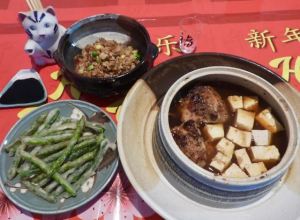
For Lunar New Year, I also checked out Molly Yeh and came up with her orange chicken recipe.  I decided to opt for our favorite cut, whole chicken thighs, rather than go to the expense and trouble of using chunks of chicken breast.  The point of this recipe for me is the delicious orange sauce, although you can buy a similar preparation in the Asian food aisles at many grocery stores.  Here is her recipe:  https://www.foodnetwork.com/recipes/orange-chicken-12245113.  I substituted whole seared chicken thighs that I then baked for 45 minutes in the sauce.

The coating on her chicken nuggets, although I didn’t use it, inspired me to try tempura green beans as a side dish. I checked around on the Internet and looked at various recipes for the tempura batter and ended up using something that was half rice flour, half all-purpose flour, a little baking powder and salt, plus enough sparkling water to make a batter that was neither runny nor too thick but just the right consistency to adhere to green beans dipped in it.  Then about 4 minutes in piping hot oil and a sprinkle of salt when they come out to drain on paper towels.  Great when hot, but a fine snack when cooled or rewarmed briefly as well.

The key to tempura really is the batter, and there are lots of ways to make a good one. You just have to experiment. I remember eating tempura shrimp one time in the kitchen of a Japanese neighbor who said she used some pancake batter mix for a coating that was a little thicker, puffier and browner than the typical tempura batter.  That was so delicious I think we ate the family’s entire week’s supply of shrimp; I just kept asking for more.

And for dessert: Japanese Mochi Bars

I decided to turn part of the rice flour mixture into mochi bars for dessert as well, since this mixture is the starch that is used to create the dense texture of mochi. I chose bar form because it’s easier than making the batter into balls: https://cooking.nytimes.com/recipes/1022347-butter-mochi

I made these the afternoon after I made the tempura green beans, and they emerged from the oven just in time for an impromptu afternoon tea. Chris joined me after editing his new batch of bird photos. On a fifteen-degree January day, inside or outside activities can both be good choices. But tea and mochi bars back inside always work.

What can I say? If cold weather keeps me indoors, I turn to cooking. Let Chris go outside to commune with the birds. We both think I made the right choice.

**************************************************************************

The January 2025 Photo/Video Gallery: The Resilience of Birds and Our Other Citizens

Male Cardinal calls and listens in a Cherry tree in the Southeast cove, as a Tufted Titmouse and a Downy Woodpecker also call from the nearby woods, on a cold, windy morning, January 7

Chris: They are hanging in there, marvelous creatures that they are. This blog continues to celebrate avian courage, as we note that H5N1 “bird flu” is now making its presence felt in Virginia, at poultry farms (so far 7 of them) in the Delmarva (Delaware, Maryland, Virginia) region. And cranes have now died of the disease at the Richmond (VA) Zoo (Dana Hedgepeth, Washington Post, January 22). We are constantly inspired by these small bundles of energy as we hear them calling and watch them surviving and building lives amid the snow and ice this month.

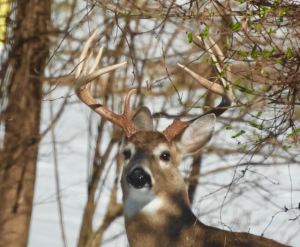
150 yards away, a beautifully-antlered White-tailed Buck stares at me from the snowy field north of the Lake Cameron dam, January 17

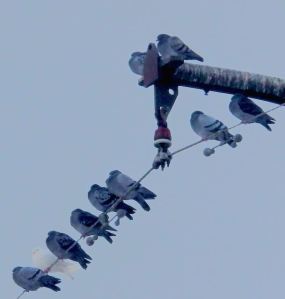
Faithful flock of Rock Doves huddle in the cold of the power stanchion west of the frozen lake, January 16

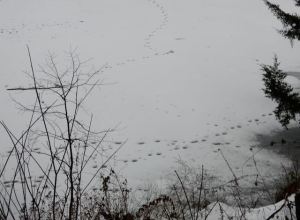
Citizens leave distinctive tracks across the frozen lake from the west bank, January 16

The White-tailed Buck ambles toward the woods west of the field, eyes me, then moves on, January 17

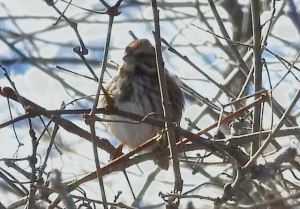
Song Sparrow perches in Persimmon against a snow bank above the north shore, January 17

Panorama toward the west bank of the lake from the southeast side in snow and ice fall, January 19, afternoon

House Sparrow in winter plumage scans from Mulberry tree on the Northeast corner of the lake, January 17

Amid a chorus of other birds, House Sparrow flits in dry Blackberry canes by the frozen lake, along north shore, January 19

Eastern Bluebird atop Katsura tree, Southeast side of the lake, January 19

Mockingbird dances in the Greenbriar on the Southeast bank of the frozen lake, January 16

Dark-eyed Junco camouflaged in Serviceberry tree, East side, late PM, January 16

Male Cardinal hides in Japanese Honeysuckle along the Southeast cove by frozen lake, January 16

Female Cardinal calls, listens, flits in Cherry tree, Southeast side, January 19

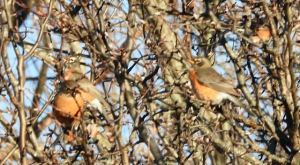
American Robin in Serviceberry tree, East side, late afternoon, January 16

American Goldfinch in snowfall in Katsura tree, afternoon, January 19

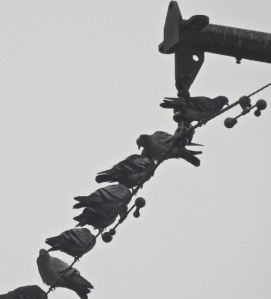
Four Rock Doves on a wire watch the frozen lake from the West side, January 17

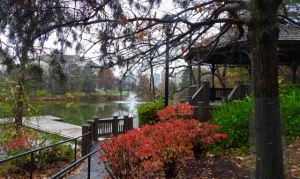
View of frozen lake to gazebo from the Northeast corner, January 9

Pair of Mourning Doves in a Tulip Tree, North end woods as snow falls, January 6

Our large flock of Canada Geese all along the North shore of the lake, January 7

Seven Mallards in our lake amid ice as snow falls, January 6

American Robin pair on roof, Southeast side of the lake, on a very cold and icy January 22

And on to the month of Valentines with hopes for our own resilience among challenges!

December 2024: Closing the Year in Celebration and Hope

A small flock of Canada Geese swim past the west bank gazebo on our lake in a gentle snowfall, December 20

In this month’s entry:

Rains Return and So Do the Birds
Our Holiday Season Kitchen
More Holiday Celebrating with Family
Climate Log: Good News and a Dilemma
The December 2024 Photo/Video Gallery

A driving rain begins to attack the drought: looking north across our lake, December 11

A “Sort of” Winter: Rain, Cold, Ice, Warm Temps, and Yes, More Birds!

In last month’s entry, we lamented the ongoing drought and the disappearance of most of our late autumn  birds. Just at the end of November, we began to get some rain, and we’ve now had about two inches this month–a hopeful start to impacting the drought. It’s even been cold enough in the past two weeks–high teens to low 30s–to bring us a bit of snow and ice, though nothing sticks for more than a few hours, and warming is in the forecasts.

Panorama of the fountain and the sleet-covered lake from the southeast bank, Christmas Eve, morning

The even better news is that our mallards have returned, along with some songbirds we’d not seen for a while. Here’s hoping that the moisture keeps coming and, with it, even more birds. A warming trend is predicted by the end of the month, plus more rain, so we’ll see how much winter is still in store. Fingers crossed.

Seven Mallards on the frozen lake in the early morning cold, December 23

Our first sighting here of a Golden-crowned Kinglet, in the Willow Oak on the southeast bank, December 12

Look for more of our December birds in this month’s Photo/Video Gallery, later in this entry.

Our faithful flock of Rock Doves stop at the north end shore in the early morning cold, December 23

**********************************************************************

More to Celebrate: Our Holiday Season Kitchen

Jean’s Pulled Pork Chili, with tomato, cheese, romaine salad garnish, December 9

Jean: Like many others, we have had patches of cold, rainy, snowy and icy weather already this winter, and more is probably yet to come. During these times, I like to make big pots of hot, hearty food that can be enjoyed for days without going out shopping or seeking food elsewhere from day to day. It also needs to be something we can change up to prevent monotony. To these ends, I got a 6-pound pork butt/shoulder to put in the Crockpot with broth, onions and garlic. I simmered it for most of a day to get it tender enough to cut down after it cooled. I didn’t weigh the big bone that I cut out, but I probably ended up with three pounds of meat.

Once I had the bone out and chunks cut, I made four dishes with the meat. Each required some more cooking with the vegetables and other additions appropriate for that dish.

  • First was a simple stew, softening the meat some further with potatoes and carrots.
  • Then my favorite, a Mexican posole, made by adding green peppers, jalapeños, green salsa, and hominy.
  • The next was a chili, simply adding chipotle and other spices, some different kinds of beans, canned tomatoes, and corn.
  • Fourth was barbecue, cooking sweet potatoes with the meat and topping with our favorite BBQ sauces: Kansas City BBQ for me (go Chiefs!) and a mustard-vinegar (Carolina) sauce for Chris. All yummy, stick-to-the-ribs food. I think I may go out and get another pork butt.

Chris’s Three Sisters Stew bubbles, as Christmas jazz plays, Dec. 21

Chris: For an alternative pre-Christmas celebration, we chose my vegan “Three Sisters Stew” (pictured above), based on the  traditional, Indigenous-named “three sisters”: beans, corn, and squash. These make complete protein, which I first wrote about in this blog in December 2022 in describing examples of “Blue Zones” cookery. Each time I make this hearty dish I vary somewhat the other ingredients I add, so I get new flavors, level of spice, color, etc. For example, this time I used 12 ounces of Beyond Meat (with avocado oil), which I sauteed with yellow onion, then added in cannellini and black beans (instead of kidney and pinto), then sliced fresh zucchini, canned sweet corn, and two cans of diced tomatoes with oregano and basil. A quarter cup of red wine and a dash of red pepper flakes completed the mixture. Once again, the dish was plentiful (enough for several days) and full of flavors.

In addition, Jean made a casserole of wild rice, mushrooms, celery, and white onions, to accompany the stew. The flavors of the two dishes were very different, but totally compatible, demonstrating once again the vitality and beautifully-varied characters of vegan recipes.

Split bowl of 3 Sisters Stew (L) and Mushroom/Wild Rice Casserole (R), with grape tomato and green olive garnish, December 23

And For Dessert…

Jean’s Tiramisu with Milano Cookies on top, Dec. 26

Jean: I love tiramisu.  We’ve seen it prepared in many ways, and I’ve tried different ways to prepare it myself, with varying degrees of success.  It should be pretty easy, right, layering cookies and cream?  What could go wrong?  See https://whatsgabycooking.com/classic-italian-tiramisu/.  The trick is to get the right amount of flavor and liquid from the coffee and any liqueur you want to use.  It’s easy to overdo it and get a soggy mess, or maybe taste nothing but whipped cream, although that’s not the worst that can happen, from my point of view!

This time, for our pre-New Year’s Eve party on the 28th, I was inspired by Chobani’s coffee flavored yogurt, and they even have a tiramisu flavor in their “Chobani Creations” line.  Not only do I love these, but I found a recipe for tiramisu that says you can substitute Greek yogurt for mascarpone (expensive!) and egg yolk in the traditional recipes.  https://pyskitchen.com/pyskitchen-recipe/tiramisu-without-mascarpone

I was having a little trouble getting my whipping cream to whip, so I did not whip or fold the whipped cream and yogurt (both flavors) together, but merely layered them over the lady fingers.  (Those were hard to find, but I finally scored some real Italian ones at Wegman’s.)   The result?  A soggy mess, and a little too sour for my taste with all the yogurt speaking louder than the whipped cream.  But Chris loves the “notes of sourness” (as he says) and so did our guests! You try it out, and adjust the recipe as you like. 

***************************************************************

Christmas: More Celebrating with Family

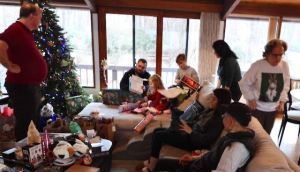
As described in last month’s entry, we had family from Georgia, from New York, and from across Virginia visiting for Thanksgiving. For Christmas, our get-togethers were of the local family members, but were no less festive, focusing on outstanding food (including the dishes described in the Holiday Kitchen section above), catching up on what everyone has been doing, and the exchange of presents.

Needless to say, many of the gifts were for the youngest members of the crew, who made the most of the occasion by spreading wrapping paper through the house and starting to get into the toys, books, and games. Again, three generations of revelers took part, including one precocious pup, who popped up in surprising places! For those who couldn’t be there in person, they were still with us through their cards, calls, and FaceTime.

********************************************************************************

Climate Log: Good News for FEMA, but a Dilemma for the Incoming Regime

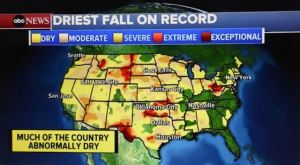
ABC News : “Driest Fall on Record,” Oct. 24, 2024

Warmest Year on Record in the DC region (National Weather Service) (Washington Post, Dec. 30): but Republicans still won’t acknowledge climate change or global warming, though they will appropriate hundred of billions for disasters

Just before Christmas, the Republican-controlled House of Representatives passed a bill that I never thought we’d see: $110 billion (yes, billion) that “Provides much-needed relief to Americans struggling to recover from natural disasters” (https://appropriations.house.gov/news/press-releases/house-passes-critical-disaster-relief-americans). The terms “climate change” and “global warming” are never used in this massive relief bill, because Republicans are way too intimidated by their leaders and by the fossil-fuel cartel to admit these obvious truths. Nevertheless, the bill is the first of more and more that will be needed to address the effects (not the real causes, of course) of what the bill erroneously calls “natural disasters.”

Warming oceans, more intense storms, and coastal sea level rise combine to make unprecedented coastal damage more frequent, as this week in Santa Cruz, CA, as reported by Grace Toohey in the LA Times, December 28

Particularly noteworthy is that the two largest items in the bill are

  • $31 billion for “disaster and economic assistance to agriculture producers” and
  • $29 billion for “FEMA’s response, recovery, and mitigation activities related to Presidentially declared major disasters, including Hurricanes Milton and Helene.”

These open-ended statements leave ample room for further appropriations to address future disasters caused by extreme heat, drought, extreme storms, wildfires, sea level rise, etc. That the two main emphases here are “agricultural producers” and “major disasters” reveals Congress’s tacit, but unspoken, understanding that climate change will continue to devastate farmland, and will continue to produce hurricanes of unprecedented size, spread, and sudden emergence, like October’s Helene and Milton, which suddenly developed in the Gulf of Mexico very late in the hurricane season.

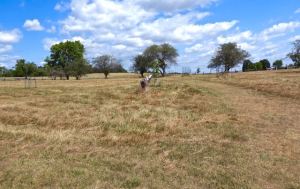
Burned out farm field we visited, New Market, VA, Aug. 2, in the midst of the 2-year drought in the Shenandoah Valley

Trump’s Response?

It is further noteworthy that the once-and-about-to-be President, Donald Trump, tried to force Congress to scuttle this bill, even at the cost of shutting down the government. Why would he do such a thing? Does he want to be known as a President who won’t provide disaster relief (as he failed to do in his first term in his callous lack of response in 2017 to Hurricane Maria in Puerto Rico)? Does he not want to meet the needs of the farmers in states like Texas, Oklahoma, and West Virginia, who are suffering massive crop losses because of extreme heat and drought? Farmers in these states and others overwhelmingly supported him in his run to the Presidency, because he promised to help long-suffering rural America, and they believed him. But, his promises aside, he might be more concerned that passing such a bill will draw attention to the vast scope of a problem that he’s always claiming doesn’t exist, but which will continue to dog him throughout his final term and just get more painful, tragic, and costly to Americans.

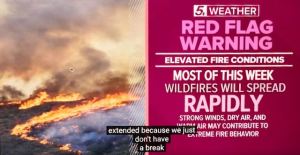
Close-captioned TV weather forecast from CBS-affiliate in Central Texas, summer 2023 (clip from YouTube video)

Fortunately, enough of the Republican House members, aided by the votes of almost all Democrats, defied Trump’s effort to kill the aid, and so the money will flow, because the Senate and still-president Biden moved it forward immediately.  As the majority of the House realized, something bold had to be done, and even the President-to-be, despite his fearful wishes, had to give in. Remember, House members will be up for re-election in just 2 years, so they know, unlike their leader, that they can’t afford to ignore the needs of their constituents now.

But passing such an open-ended bill leaves President-elect Trump and all his fellow climate-change deniers in a dangerous spot.  Hundreds of billions in relief can pretty quickly turn into trillions, as the climate sins of the fossil-fuelers exact more and more sacrifices and pain. As lack of farm production destroys farms and ranches, and causes prices to rise for all of us, and as more and more of the country becomes harder to live in, people will blame the party in power, as they always do. At some point the people will demand answers as to why those leaders failed to admit that the hurricanes, warming oceans, wildfires, and burned-out fields could have been–and future ones still could be–avoided.

US Drought Monitor, Christmas Day 2024 (https://droughtmonitor.unl.edu/CurrentMap.aspx)

***********************************************************************

The December 2024 Photo/Video Gallery

All photos and videos this month come from in and around our lake, all celebrating the increased precipitation and the return of some of our citizens, plus visits by a few welcome guests.

Our year-round residents: Song Sparrow munches grass in the field west of our lake, cold morning, December 23

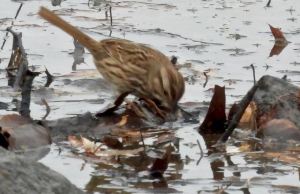
Savannah Sparrow sips from the rainy north shore of our lake in the rain, Dec. 9

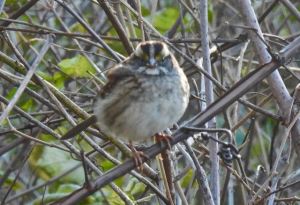
White-throated Sparrow poses for the camera, southeast cove, December 6

Male Cardinal munches seeds in an east bank tree, amid flurries, morning, December 20

Panorama toward downtown, partly frozen lake, early morning, December 23

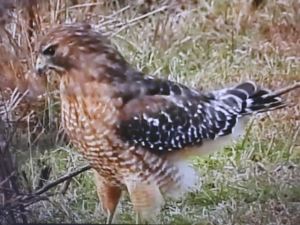
Rare sighting of Red-shouldered Hawk not in a tree, but on the ground, eyeing bird in the brush, north end path, cold morning, December 19

Pair of Red-shouldered Hawks in Tulip Tree and Virginia Pine, southeast side woods, December 19

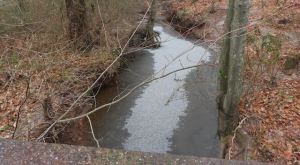
Sleet-covered inlet stream under bridge, early morning, Christmas Eve

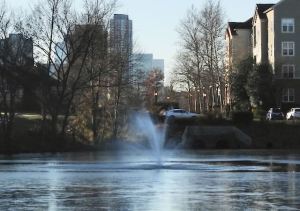
Our fountain in the frozen lake, view toward downtown, December 23

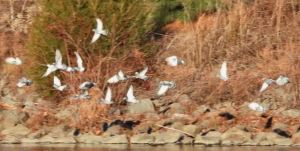
Our resident flock of Rock Doves takes off from north shore, December 23

European Starling, brightly lit by the sunrise, scans from the dead Oak, east bank, December 23

Carolina Wren alights on a branch above me, calls friends, and feels the flurries on a snowy morning, December 20

Robins in late December! Wow! These cavort in a sugarberry tree in the north end woods, December 23

This Robin calls in the Sugarberry that same cold morning, December 23

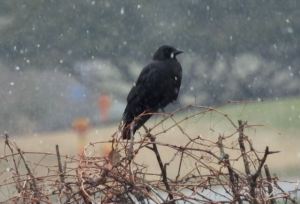
American Crow, amid flurries, perches atop a Bradford Pear and Blackberry canes below the north end dam, December 20

Four Canada Geese swim mid-lake in the December 20 morning snowshower

Tufted Titmouse perches along the southeast path on a cloudy December 1

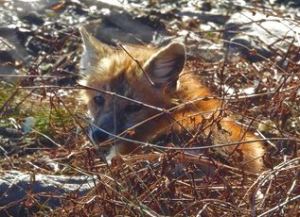
Red Fox, not often seen, watches me from the brush beside the north shore rocks, December 8

Mallard pair along the northeast shore in the rain, December 9

Rare visitor, male Hooded Merganser, swims in mid-lake, cold, windy December 6

Three Hooded Mergansers, 2 female and young male, along the east lake bank late afternoon, December 6

The Red Fox, ill with mange, explores the north shore rocks, then drinks from the lake, December 8

Blue Heron flies from north shore to west bank and through community, December 17

And so, weakened as we are, may we take wing and fly into 2025 in hope of a more just and thoughtful world.

November 2024: In a Sad Month, So Much To Be Thankful For

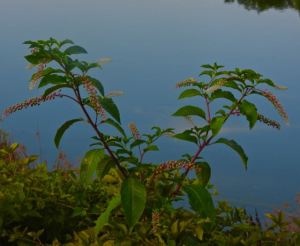
Mockingbird on dry Pokeberry bush, north shore of lake, Nov. 17

In this month’s entry:

Thanksgiving Gifts from Our Family
Wildlife Around Our Lake Disappear in the Ongoing Drought
Election Gives Narrow, But Still Decisive Win to Climate Change Deniers
Keeping Up the Good Fight: Visiting the Virginia State Arboretum
The November 2024 Photo Gallery: Pretty Landscapes, Growing Silence

At nearby Lake Newport, we walk on crispy, fallen leaves amid skyscraping trees and brilliant autumn colors.

Thanksgiving Gifts from Our Family

How fortunate and thankful we are to be able to share our joys with family who have come to join us from New York, Virginia, and Georgia. Our Thanksgiving embraces a week of holiday outings, imaginative meals, and raucous, witty (of course!) conversations among three generations from age 4 to 80. Even those family members we can’t be with in person, we will be with via phone, text, and FaceTime.

What did we do to be so blessed? And, wouldn’t you know it, we’ve even gotten an inch of rain this week to begin, we hope, to make a dent in the drought.

************************************************************************

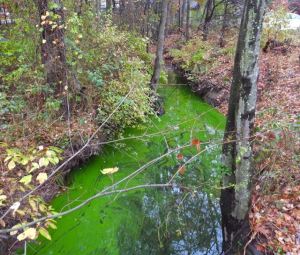
Green algae thick in the inlet stream into our lake, Nov. 18, as significant rain has not fallen since September

Ongoing Drought and the Fast Spread of Bird Flu: Birds Disappear Here, While Wildfires Plague the Northeast

Exactly one year ago (see November 2023 entry), this blog celebrated in story, video, and photos a profusion of wildlife around our small lake. The stars of the entry were several pairs of amorous mallards happily building their relationships, while the videos featured a varied soundtrack of the many songbirds and waterfowl calling to their fellows in an often rainy setting.

The only ducks we’ve seen in our lake since the spring are these four Buffleheads, who visited last week for one day, and then flew off. Even our frequent cormorants have not visited. Only our resident flock of Canada geese visit this water, and even their visits have declined.

Oh, what a difference a year makes! The drought brought on by record high average temperatures across the country (and much of the entire world) this year has been intensifying in our multi-state region since early in 2024. The drought has continued through this November (October was completely rainless), and this November is the hottest on record in our area (as reported in the Washington Post, Dec. 3). Last month’s entry focused on how quickly the lakeshore’s plants were drying out and leaves were beginning to fall. The music of the birds had almost ceased as birds migrated toward wherever they might find fresh water.

The Next Pandemic? Perhaps Bird Flu.  A secondary cause of the bird decline is the H5N1 bird flu, which has spread rapidly across the country, causing the decimation of many millions of chickens in commercial flocks, and now also infecting some 685 cattle herds in 15 states, as reported in the Los Angeles Times (“Business as Usual Despite H5N1,” Nov. 30) and in National Geographic (Fred Guteri, Dec. 18). Unfortunately, like the widespread drought, scant attention is being paid to the spread of this disease in our environmentally-oblivious U.S. of 2024.

Photo: NatGeo/Reuters

No one wants to hear this, because there is clearly no appetite in this country for even thinking about  precautions for a new health crisis. But, as Zeynep Tufekci writes in the Dec. 9 New York Times, more and more human cases of H5N1 are arising, and the time is now to take the threat seriously (“A Bird Flu Pandemic Would Be One of the Most Foreseeable Catastrophes in History”). In 2019, there were health experts in the first Trump administration who could push back strongly on the President’s fantasies about COVID-19 (remember the bleach cure and hydroxychloroquine?). But now he has surrounded himself with vaccine deniers like Robert F.Kennedy, Jr., and there will be no medical leaders like Anthony Fauci, Deborah Birx, and Francis Collins to mobilize an effective national/international response, so wishful thinking, studied ignorance, and quack remedies will abound, more like the Middle Ages than the 21st century.

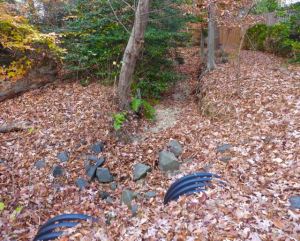
At nearby Lake Newport, the bone-dry inlet stream from surrounding hills and neighborhoods, as the drought goes on, Nov. 20

Wildfires in New York, New Jersey, and Massachusetts

5000-acre Jennings Creek Fire on New York-New Jersey border (USA Today photo, Nov. 18)

Last month’s blog also displayed the map of the U.S. (created by Drought Monitor), which showed almost the entire nation (except for hurricane-pounded Florida and western North Carolina) in a moderate to severe drought. Wildfires were in lethal bloom in many Western states. Weather Service maps showed “red flag warnings” across much of the central and eastern states, including New York State and even New England.

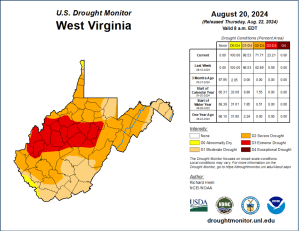
Well, sure enough, in November as many as 500 fires of various sizes have transformed the usually wet and cooling Northeast states into a California-like wildfire season–experiencing such change for the first time in memory. The largest of these blazes so far has been the Jennings Creek fire (shown above): 5000 acres and growing along the New York-New Jersey border, with smoke from all these fires fouling the air in East Coast cities. Meanwhile, in many other states, such as Oklahoma and Texas, drought has caused the massive loss of crops, which this blog catalogued in August as having occurred here in Virginia’s usually lush Shenandoah Valley. Neighboring West Virginia’s governor–a staunch climate-change denier–declared a statewide drought emergency across its 55 counties:

***************************************************************************

Election Gives Narrow, But Still Decisive Win to Climate Change Deniers

To make matters even worse, this November’s closely-contested elections gave a thin, but nevertheless sufficient victory to former President Donald Trump and to just enough climate-change denying Republican candidates to give that party razor-thin majority control in the Senate and the House of Representatives. Trump, who is a strident spokesperson for the fossil-fuel cartel, made “Drill, baby drill!” for gas and oil one of the emphatic slogans of his campaign.

As if that weren’t destructive enough, the rival candidate, Democrat Kamala Harris, never during the campaign spoke out in favor of renewable energy sources, and indeed promised voters in the closely-contested state of Pennsylvania that she supported the destructive, water-wasting practice of hydraulic fracturing (“fracking”) for natural gas, which has become in recent years a favored process of gas extraction in that state and many others. Why she and her party turned their backs on climate is not clear, but surely indicates that they did not trust voters to understand the dangers and their importance. This is puzzling, because, as this blog detailed in July, polls show that a healthy majority of Americans see climate change as a solvable major problem. But at this point, possible solutions don’t even get on the ballot.

So, with no candidates in either party having the courage to speak the truth about climate destruction, the results were inevitable. As the world and our nation become steadily hotter, more polluted, drier, less fertile, and with more extreme storms, we humans are getting what none of us want, but what too many of us prefer to ignore, or deny, or feel powerless to prevent.  Too bad that our fellow creatures don’t have a say about our actions, but just suffer–and disappear–through our cowardice.

***********************************************************

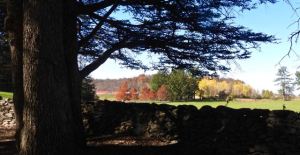
Panorama of the Virginia State Arboretum: Cedar of Lebanon foreground, and Bald Cypress grove and famous yellow Ginkgo grove in distance, Nov. 8

Fighting the Good Fight: Visiting the Virginia State Arboretum

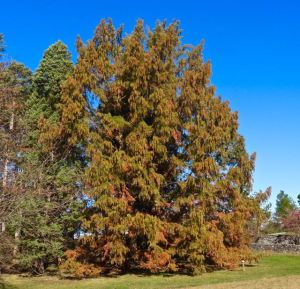
The magnificent Dawn Redwood, native to China, 80 feet tall, part of the international display at the Arboretum, Nov. 8

We had read about the Virginia State Arboretum, part of the Blandy Experimental Farm operated by the University of Virginia. We finally visited on November 8, a warm, sunny day just perfect for walking and viewing. Located 80 miles west of us, north of Shenandoah National Park, and just beyond the Shenandoah River near the village of Boyce, the Arboretum is an out-of-the-way miracle that is one of Virginia’s best kept secrets. With trees from around the world and across the U.S., as well as representative trees from throughout the state, the Arboretum’s several miles of trails offer stunning sights, good exercise, and a pleasant education in arboreal beauty.

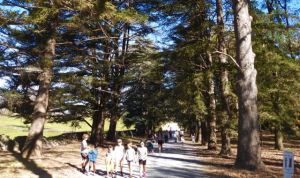
Visitors to the Arboretum walk the Alley of Cedars of Lebanon toward the Ginkgo Grove, Nov. 8

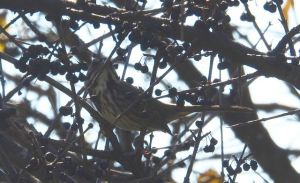
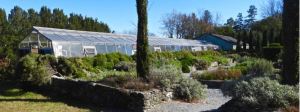
Our visit came during the Arboretum’s Ginkgo Festival, so about a hundred visitors of all ages had come especially to see the famous grove of Asian Ginkgos (pictured above). Our leisurely two-hour visit also included a walk along the Cedars of Lebanon Alley,  a stroll among the many labelled and fragrant plants in the garden of herbs from around the world, and a talk with one of the helpful members of the staff–who answered our questions about the effects of the drought on the trees. She told us that often drought effects on trees are not seen until two years or so into the event, because of the trees’ resilience and stores of nutrients. However, she said, one evident effect already had been the drying up of the ponds and lakes on the property, as well as the decline in the bird population. Nevertheless, the broad lawns were still remarkably green and the trees glowed with fall colors, so the sights were lush and I even was able to get one bird photo, of the Brown Thrasher (below).

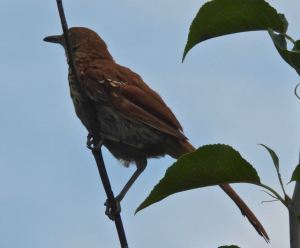
Brown Thrasher silhouetted in a berry-covered Buckthorn tree between the Cedars of Lebanon Alley and the Ginkgo Grove, Nov. 8

Greenhouse and outdoor international herb garden, State Arboretum of Virginia, Nov. 8. Ah, the fragrances!

 *************************************************************************

Sunrise panorama toward colorful north end woods, with west side dock in middle distance, Nov. 15

November 2024 Photo Gallery: Finding Beauty in the Drought

This month’s Gallery features scenic photos from around our little Lake Cameron, from nearby Lake Newport, and from other local sites. The birds are much fewer in number, so the music of their calls has all but disappeared, though the number of species is still considerable, as the photos here demonstrate.  Happily, some still make their presence known visually, and we highlight them here. We give them thanks for sharing their delicate beauty.

Eighteen Canada Geese adorn our lake before the north end, Nov, 23. They’re visiting frequently now, but no longer daily.


White-throated Sparrow, first sighting here of this species after two years of listening to the call, north end path, morning after rain, Nov. 28


Inlet stream to our lake, water clear after night of rain and colder temps, Nov. 28


Flock of Rock Doves on stanchion west of lake, morning after rain, Nov. 28


Burning Bush and gazebo, west shore of our lake, with view toward downtown, morning after rain, Nov. 28


American Crow atop Tulip Tree, north end woods, Nov. 28


Three Turkey Vultures glide above the east bank of our lake, the most we’ve seen here at one time, Nov. 18


Chipping Sparrow in dried Cutleaf Teazel, at the northeast corner of our lake, on a warm, dry morning, Nov. 8


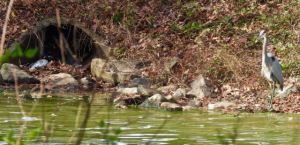
Great Blue Heron, our regular visitor, beside the inlet culvert on the southwest shore, warm Nov. 18


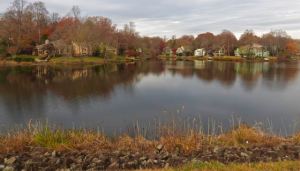
At nearby Lake Newport, homes and fall colors are reflected as we look from the dam on a cold morning, Nov. 20


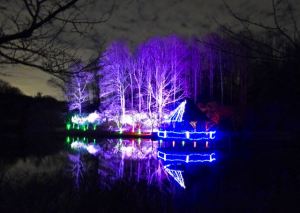
Meadowlark Botanical Gardens, holiday light show, trees and gazebo illuminated across lake, Nov. 25


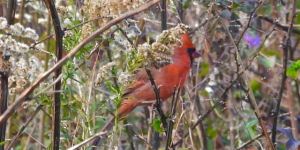
Male Cardinal, amid Asters, Boneset, and Blackberry Canes, northeast corner of our lake, Nov. 7

This male House Finch lands atop a Tulip Tree in the north end woods by our lake, on a cool morning, Nov. 18


Bluejay near feeder, east side, Nov. 8


A newly arrived Yellow Warbler perches in the Willow Oak on the east bank of our lake, Nov. 8


Carolina Wren on branch, southeast shore of our lake, windy morning, Nov. 11


Just after sunrise on a cold Nov. 24, Cherry Laurel, red Oakleaf Hydrangea, and the northern panorama of our lake


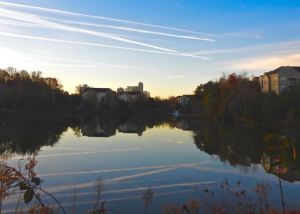
Panorama toward the south end of our lake and downtown, with contrails, early morning,Nov. 17


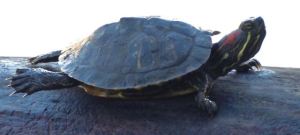
One of our Red-bellied Cooter Turtles, on log at the southeast shore, warm morning, Nov. 15

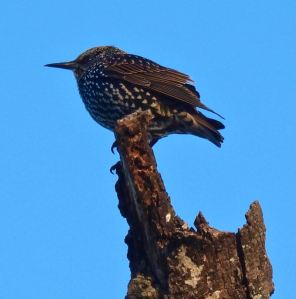
European Starling scans from atop the dead Oak on the east bank of our lake, on a cold dry morning, Nov. 23


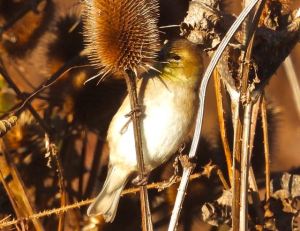
Yellow Warbler feeds on dry Cutleaf Teazel in field west of our lake, Nov. 23


Song Sparrow, amid dry blackberry canes, northeast shore of our lake; warm, windy morning, Nov. 17


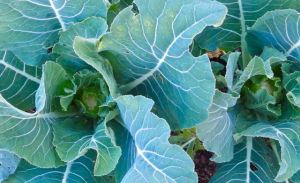
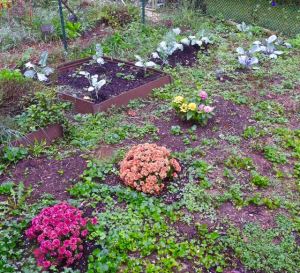
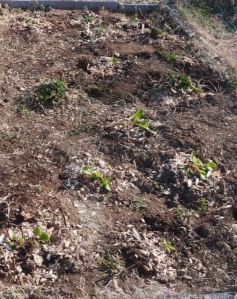
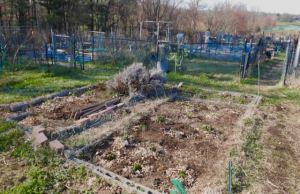
In our new garden plot in the public gardens in our town, tiny heads emerge in two of our cauliflower plants, warm morning, Nov. 24

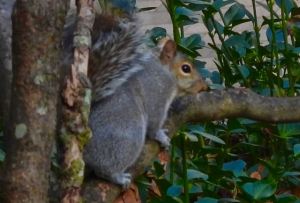
A Grey Squirrel pauses on a branch near the west side path along our lake, on a cold morning, Nov. 24

 Mist rising at sunrise, beside the north end outlet stream below dam, Nov. 17


Fall colors, including Scarlet Oak along the west side path, warm morning, Nov. 18

Here’s to a happy, fruitful December, which is bound to be interesting!

October 2024: Way More Than Our Senses Can Handle

A feast of fall colors: from Oakleaf Hydrangea to the trees surrounding our lake, October 28

In this month’s blog:

Way More Than Our Senses Can Handle: So Much Beauty, So Many Extremes
Bounty from Our October Kitchen
More Exploration in Amish Country
Celebration of Dia de Los Muertos
The October 2024 Photo/Video Gallery: Fall Beauty Amid Deepening Drought

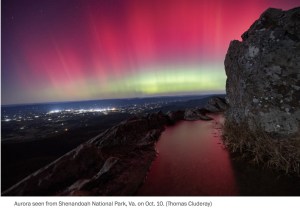
The Northern Lights, as seen from Shenandoah National Park, Virginia, Oct. 10 (Washington Post photo)

*******************************

Photo of Bat Cave, North Carolina, after Helene, from USA Today, October 10

A Month of Extremes: So Much Beauty, So Much Suffering

Chris:

I struggled to find a theme for this month’s blog entry, because so many conflicting emotions have been inspired this October. On the one hand, there is the astounding visual beauty of the fall colors–more intense than we’ve seen in years–and the astonishing surprise of seeing the Aurora borealis this far south; on the other, there is the utter devastation resulting from the unprecedented back-to-back hurricanes Helene and Milton, as well as the ongoing destruction taking place daily in Gaza, Lebanon, and Ukraine.

Bringing us daily joy is the love of our family members, our pride in their achievements, and our opportunities to make and enjoy good food and to make visits to new and familiar places. But tempering our joy is our anxiety over the upcoming elections, with so much at stake for our democracy. And even our pleasure in the fall colors is muted by seeing from day to day how intensifying drought across almost the entire U.S.  has hastened the loss of greenness, the stunting of crops, the dropping of the colorful leaves, and the early migration of local bird species. (Here in Northern Virginia it has not rained for more than month, a new record.)

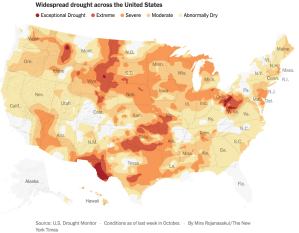
Intensity of drought across the U.S., end of October. Source: U.S. Drought Monitor

So, as this entry proclaims in its photography and stories, we take immense pleasure in all the beauty we are so blessed to see, hear, taste, feel, and imagine. We want our entries to share some of that joy. But our joy is not unreflective. It is not a joy that ignores the suffering that goes on in the world, or that fails to ask how life can be made better for other humans and for all the species that are harmed by human actions. When we show photos and videos of the animals and plants where we live, that is  pure and beautiful joy, but it is beauty that we know is fragile, under threat, and so needing our attention and respect in order to keep it beautiful.

In particular, readers of this blog know that we call out the day-by-day degradation of our environment, as Mother Earth steadily heats up through the carbon pollution produced by the selfish greed of the fossil fuel cartels and of the politicians who promote them through their lies, crude insults, disinformation, and fear mongering. 

But we do not call out these harmful actions in order to rob people of joy. Indeed, one of the joys we try to express in these entries is that the fate of the Earth is not hopeless, but hopeful. Indeed, any person is capable of doing small things, day by day, to heal their own tiny bit of the environment. It is joyful to say that the degradation of the Earth is reversible, and so we celebrate acts and arts, large and small, through which people try to lead more nurturing lives and build a healthier future for our children and our fellow creatures. These small actions are beauty in themselves.

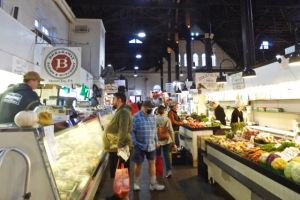
Produce stalls in the Central Market, Lancaster, PA, October 25

So this month’s entry relates three stories that show people trying to make life better in environmentally responsible ways: Jean’s description of her delicious pumpkin dessert, farmers in Pennsylvania living simply and producing nutritious foods of many kinds, and indigenous performers in Mexico creating art that honors the lives of their forebears who struggled against oppression.

*********************************

A Pumpkin Treat from Our October Kitchen

Jean’s Crustless Pumpkin Streusel Pie, just from the oven, October 15

Jean:

It’s pumpkin time of year.  Time to get a big pumpkin for your porch and maybe carve it for Halloween.  Time for a pumpkin drink from your favorite coffee shop.  And time for pumpkin pie–my favorite dessert other than tiramisu.  I need to work on a way to combine those, but I can’t figure out what the mashup name for the dish should be.

Meanwhile, because I was not yet seeing pumpkin pie in my favorite grocery store(s), but I really wanted to eat one, I thought it would be a good time to try out some other variations on the traditional recipe.  For years I have made it from the recipe on the Libby’s pumpkin puree can, with a can of sweetened condensed milk and a homemade pie crust from a simple Crisco recipe.  I thought all that was perfect.

But this week I didn’t feel like making pie crust.  I have always disliked rolling it out.  I’m not strong enough, I guess.  It just wants to sit there in a cold clump, resisting my efforts to move it far enough in any direction to get it rolled out as thin as it should be.  The most successful technique I have come up with is to put the right amount of dough for one crust on a 10-inch plate and press down on it with a similar plate.  When the dough is room temperature, this works to give me a round of the right size, which I can then cover and chill until ready to invert it onto the pie pan, fill, and bake. But sometimes I don’t even feel like struggling with that.  Of course I could have bought a frozen, pre-shaped crust, but I find those break very easily while I am trying to get them into the pan.

So I looked for crustless pumpkin pie recipes, and sure enough, they exist.  You’re essentially making a pumpkin custard or mousse.  Easy enough.  Who needs pie crust unless you really want to be able to cut out picture perfect pieces that stand up properly?  I just want to scoop the filling into my mouth, with loads of whipped cream.

Bowl, beaters, and some of the ingredients for whipped cream on Jean’s Crustless Pumpkin Pie, October 15

One other wrinkle.  I didn’t have a can of condensed milk and just wanted to get started on my pie in the morning because the baking, cooling, and chilling all take hours.  I didn’t want to go to the store for canned milk any more than for a frozen pie crust.  I wondered if I could make a pumpkin pie with either buttermilk or coconut milk, both of which I happened to have.  Take a look at these great examples I found:

https://www.southernliving.com/recipes/easy-pumpkin-pie

https://www.foodnetwork.com/recipes/food-network-kitchen/buttermilk-pumpkin-pie-3363760

https://www.dishbydish.net/crustless-pumpkin-pie-gluten-free-dairy-free/

The last recipe above touts the benefit of a dairy-free, gluten-free pumpkin pie!

I’m not going to tell you what to do.  This is the sort of thing I love; look over the recipes and decide on the combination you want to try.  You probably can’t go wrong.

One other point, though. In place of the contrasting texture provided by a pie crust, I decided to try this streusel topping from ZoeBakes, since I also happened to have pepitas and a little buckwheat flour:

https://zoebakes.com/2018/10/21/buttermilk-pumpkin-streusel-pie/

I like a more pronounced ginger flavor, so I also crumbled some Trader Joes’ Triple Ginger Cookie Thins on top.  I belatedly realized I could also have used these to make a cookie crumb crust underneath, easier than dealing with pie dough.  Maybe next time.

You could also make this taste something like a pecan pie by using chopped pecans instead of pumpkin seeds in the streusel.

I’m not into making caramel sauce as Zoe does here, but I’m sure it would be great, especially if you want more of the pecan pie taste.  All I needed to do after cooling the pie was whip up some heavy cream with sugar (or sugar substitute), a little bourbon and vanilla and then garnish with a nice pecan half.  Enjoy!  We certainly are.

Serving of the crustless pie with whipped cream and pecan garnish

********************************

Our Latest Exploration in Amish Country

Horses and buggies at AAA Buggy Rides in Ronks, PA, October 23

Chris:

Following our June visit to rural New York and Pennsylvania, as recorded in our June entry, we wanted to go back to Amish country in southeast Pennsylvania, because we enjoyed our two days there so much.  This time we visited the towns of Ronks, Lititz, and Ephrata and the city of Lancaster. Our 3 days total left us wanting still more.

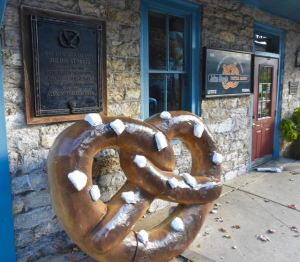
Lititz, PA: the Sturgis Pretzel Bakery, oldest in the Americas, begun 1861 (photo October 24)

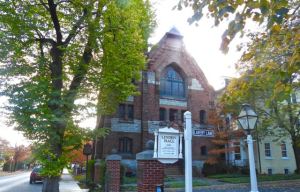
Lititz, PA: Chapel of the Linden Hall School, the oldest college prep school for women in the U.S., founded in 1746 (photo, October 24)

One of our objectives was to actually ride in one of the horse-drawn buggies that move at leisurely pace along the highways and byways through Amish country; buggies and teams that brave the roar and fumes of the cars and monstrous trucks that sweep by just a few feet away.  This we did on our first afternoon, in Ronks, on a two-horse buggy driven by our patient guide, Henry, and accompanied by a young couple visiting the U.S. from Holland. We’d actually been hoping that our trip would only be on the quiet back-country roads, far from the traffic, but both getting to farm country and then getting back required us to be buffeted and shaken by the speeding vehicles.
It was as if we were in two worlds at once: Henry, our horses, and we visitors were clopping slowly in the 18th century, while the traffic just an arms-length to our left had their own 21st century gas-powered agendas. Clearly, Henry and the team were calmly at home in their world and we picked up their vibe.

Short video of the start of our horses-and-buggy ride on Rt. 340 in Ronks, PA, October 23 

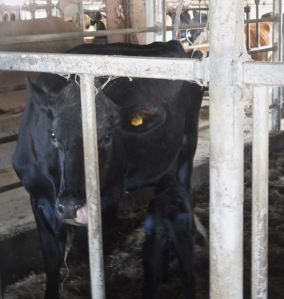
Our destination on the buggy tour was the Organic Valley Dairy Farm owned by the Esh family. Here are a few pics and videos of our hour-long visit with the residents.

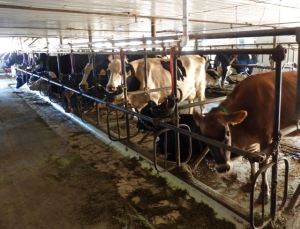
One of two rows of cattle in the barn for feeding after being all day in the fields

A day-old calf feeds on Mom in the barn

The huge Belgian horses who work on the farm eat their afternoon meal in the barn

Equipment and baled hay at the Esh farm

Bald Eagle soars above the Organic Valley Farm

On our trip back, we pass a multi-generational home community not far from the Esh farm

The 7 of us clop down the road with the traffic back to our starting point in Ronks.

The Ephrata Cloister. A spur-of-the-moment destination for us was the historic Ephrata Cloister, founded in 1732 by Conrad Beissel, one of many religious fugitives from Europe who came, like the Amish, to the Pennsylvania colony because of its toleration of many religions. Very different from the Amish religion, Ephrata was a monastic community of men and women who practiced a celibate lifestyle, and who eagerly anticipated the second coming of Christ predicted in the Christian Bible. Though the last monastic resident died in 1813, the impressive and unique buildings remained and were restored beginning in the 1940s–a project that continues today.

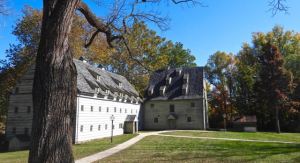
Restored buildings of the Cloister, as designed by Beissel

Known for both the composition and performing of religious music, with over 1000 hymns, the Cloister men and women also became famous for their calligraphy and printing.

The restored room where hymns were written down for printing in the Cloister’s renowned German script

The well-maintained graveyard at the Ephrata Cloister, including the 1768 grave of founder Conrad Beissel

Lancaster’s Central Market, thriving today. Our final destination of the three days was the Central Market in Downtown Lancaster. Founded in 1730, the Market is the longest-running truly public market–not privately owned–in the U.S.  It’s 64 standholders come from throughout Lancaster County, and offer a wide variety of produce, dairy, meats and fish, ready-to-eat foods, baked goods, specialty food items, health and wellness products, and flowers.

Begun as just an open piece of ground in colonial Lancaster, the market’s growing number of vendors took more and more space on local streets as the Market’s fame spread. To house them, the beautiful building it now occupies was built in 1889. Open 3 days each week, it is truly a mecca for the region, and we gathered fresh produce and breads to carry home with us to Virginia, as well as the intention to visit again.

Front of the Lancaster Central Market, built 1889 (photo, October 25)

********************************

Dia de Los Muertos at the NMAI, Washington, DC

Main altar for the Dia de Los Muertos celebration at the National Museum of the American indian, October 26

We traveled to nearby Washington for the first of two days of celebration of the Dia de Los Muertos (Day of the Dead) at the Smithsonian Institution’s NMAI on Saturday, October 26, just after our return from Pennsylvania. The National Museum, both here in DC and in its branch in New York City, honors the indigenous cultures of the Americas with exhibits and performances throughout the year. The annual Dia exhibition is one of its largest.

Through dance, music, and visual arts, the performances show how, unlike our Halloween’s fixation on scaring people, particularly children, through terrifying costumes and stories, the Day of the Dead celebrates those who have gone before us and the community’s mutual bravery in facing mortality and the ongoing threats to the community’s existence.

The following video excerpts record the first performances of the day, as described on the program’s website:

“Dance Performances by Grupo los Tecuanes: The name of the Danza de los Tecuanes (Dance of the Jaguar) is rooted in the Mixtec understanding of the duality of life and death and the fight of good against evil. The Danza de los Viejitos (Dance of the Old Men) is a humorous dance featuring dancers colorfully dressed as old men.”

Part of the Dance of the Old Men (Danza de los Viejitos) performed by Grupo los Tecuanes at the NMAI Washington, October 26

Part of the Dance of the Jaguar (Tecuanes) at the NMAI, October 26

*************************************************************

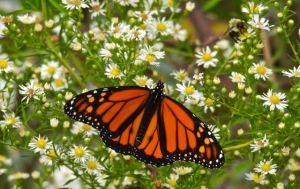
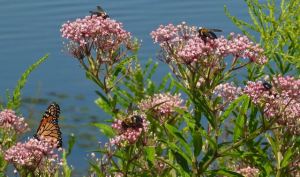
The last Monarch Butterfly of the year, with Bumblebee, relish the Asters on the south shore of our lake, October 4

The October Photo/Video Gallery: Missing the Music

As every month, the gallery features the residents and visitors to our small lake community in Northern Virginia, with perhaps a few pics and videos from other places. Overall, we are aware that the number of birds in the community this month is down significantly from one year ago, because of the drought. We miss the variety of waterfowl we had last year, and the sheer numbers of birds, who create a tuneful, harmonic chorus each day. We miss the music, and we hope the drought does not linger and that our residents return soon.

But still we have an amazing, colorful, creative, varied, enterprising community, well represented here in these photos and videos.

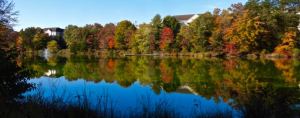
Fall colors show off the west bank of our mirror lake on the morning of October 28

Blue Heron on the west shore of the green lake, warm morning, October 28

Eight Red-bellied Cooters enjoy the sun on a log amid Greenbriar on the south shore of the lake, October 22

Ruby-crowned Kinglet–our first sighting here!–on the east bank of the lake, on a warm morning, Oct. 28

A new fall visitor, Eastern Bluebird, on a branch west of the lake, October 28; they came in profusion last year


Three House Sparrows in Willow Oak on the east bank of the lake, October 28

Six dozen Rock Doves and European Starlings on the stanchion to the west of the lake, warm morning, October 28

I stalk the Blue Heron, who is stalking along the west shore of the lake, October 28. Watch patiently

Turkey Vulture soars over the north shore of our lake on a sunny noon, October 20

On a visit to nearby Lake Newport, we listen to Carolina Wren calling, October 19

West side path, colors, shadows, fallen leaves, morning, October 28

Tufted Titmouse, always good at hiding, in Pokeberry bush, northeast corner of the lake, windy October 16

Winged Sumac, splendid in red, gold, and green, by the southeast cove, October 13

Immature Swamp Sparrow (rare sighting) on the porch by our feeder, east side, October 29

A newly arrived Dark Eyed Junco (welcome!) in Chinese Holly, east side, October 29

One of our Grey Squirrels enjoys munching our pumpkin on our east side Halloween display, October 26

Our last Orange Sulphur Butterfly of the year feeds on Carolina Horsenettle along the north end path on the morning of October 6

Our last Monarch of the year feeds on Asters, accompanied by Bees, as a jet flies overhead, south shore, afternoon, October 4

On to November in joy and hope! Happy Halloween, Happy Dia de Los Muertos, and Happy Diwali!

September 2024: We Return to the Eastern Shore and We Start a New Garden

If you’re new to this blog, start with the About page, then come to Home.

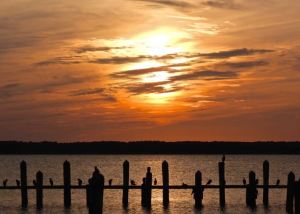
Double-crested Cormorants celebrate sunset on the Tred Avon River, Oxford, MD, September 15

In this month’s entry:

Return to the Eastern Shore: Heroes, Horses, Survivors
Our Newly-Started Garden!
Another Potomac Valley Exploration
The September 2024 Photo/Video Gallery

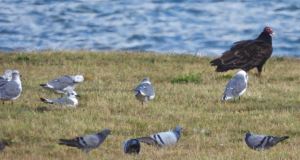
On the Long Wharf in Cambridge, MD, Herring Gulls, Rock Doves, and a Turkey Vulture commune, September 14

Return to the Eastern Shore: Heroes, Horses, and Survivors

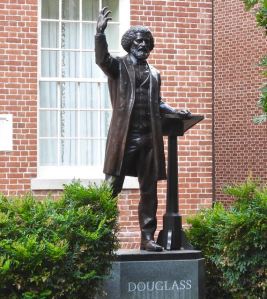
Frederick Douglass statue at County Courthouse, Easton, MD, September 13

One year ago, we took our first trip to the Eastern Shore of Maryland since we’d left California in 2022. On that trip, we focused on the quiet village of St. Michael’s, the even tinier Tilghman’s Island just across the Chesapeake Bay from Virginia, and the Blackwater National Wildlife Refuge. On this year’s two-days-longer trip, we focused on the historic towns of Easton, Cambridge, Vienna, and Oxford–as well as windswept Assateague Island all the way east at the Atlantic Ocean.

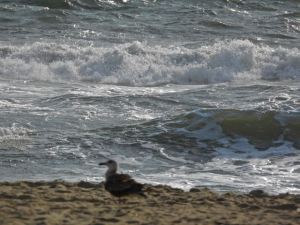
Early morning scan along a small beach at the western edge of the town of Oxford, toward the Choptank River, September 16

Heroes

The town of Easton thrives today near where Frederick Douglass grew up enslaved and from which he escaped as a young man. His life and struggles are immortalized in his 1845 autobiography, Narrative Life of Frederick Douglass. Easton reveres its local hero through a powerfully-wrought statue in the town center and an annual Frederick Douglass Day celebration, to be held this year on September 28.

Douglass Day poster, Easton, Maryland (photo, September 13)

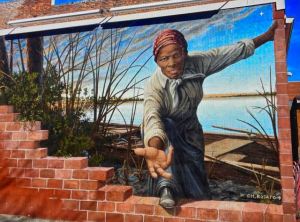
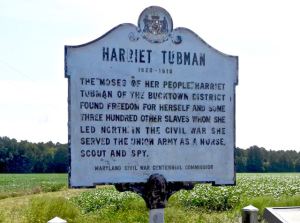
A second Eastern Shore hero, Harriet Tubman, the courageous, tireless leader of the Underground Railroad, is commemorated in nearby Cambridge, Maryland, through the Harriet Tubman Memorial Garden, and the Harriet Tubman Underground Railroad National Historical Center, which includes the Museum of the Underground Railroad. On this Veteran’s Day, November 11, Tubman was honored, 160 years after her military service to the U.S. during the Civil War, by being named a one-star general in the Maryland National Guard. Over her lifetime of service, she liberated many hundreds of enslaved persons in Maryland and other slave states.

Mural of Harriet Tubman in downtown Cambridge, MD

Harriet Tubman grew up enslaved on the Brodess Farm eight miles south of Cambridge, and from there not only escaped herself, but led others from the farm to freedom. The peaceful fields and forest of this land today, marked by two plaques, are a quiet tribute to the lifetime of heroic service by this American hero.

Historic marker to Harriet Tubman at the site of the Brodess Farm, south of Cambridge, Maryland (photo, September 15)

Horses

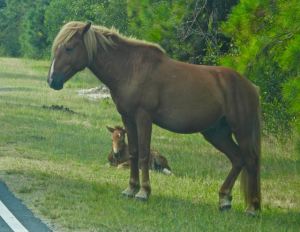
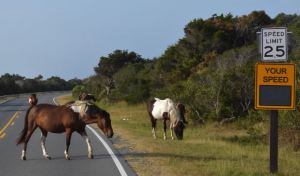
According to legend, a shipwreck late in the 17th century left a small herd of horses stranded on long, narrow, sandy Assateague Island just off the Maryland coast. These horses survived on the salt marsh grass, and their descendants became over time the darlings of the human community that grew up near them, and were instrumental to the humans’ own success. In the 20th century, Assateague Island became the Assateague Island National Seashore, the land and horses protected by the national and state Park Services.  On September 15, we visited the island for the first time in many years, and were enchanted once again by the natural setting and its equine inhabitants.

One of the Assateague horses welcomes us to the National Seashore. We stopped and let the horse pass by to join friends. (September 15)

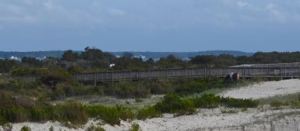
Not only were we and the other human visitors greeted by several of the approximately 75 horses on the island, but we were able to visit the very quiet, early morning beach, surrounding marshes, and woods. As one would expect, the island is being constantly reshaped by wind, currents, and climate change; so a second large responsibility of the Park Services is to revitalize the beaches and protect the native plant species.

Panorama of the Assateague shoreline, morning, September 15 

View from the beach across the marsh to the intracoastal bay and the mainland beyond (September 15)

Assateague mare and her foal, along the roadside, September 15

Survivors

Life on the Eastern Shore is about survivors, not only the enslaved humans who managed to escape, or the horses on Assateague, or the native plants and animals challenged by modern agriculture and overfishing, but all those over centuries whose descendants have endured and often thrived in an environment with arable land and plentiful sea life. Perhaps among the most challenged have been the Native American humans of this unique region, who made a living from this land and its waters over many centuries through responsible use of the natural resources–and then were decimated by Anglo tobacco growers, farmers, and fishermen from the 17th through 19th centuries. Descendants of those who survived still call this region home.

We actually came on this visit because we wanted to take part in the 32nd Annual Festival of the Nause-Waiwash Band of Indians, celebrated in Vienna, Maryland, 25 miles east of Cambridge on the banks of the Nanticoke River.

Consisting of displays of foods and crafts, exhibits, demonstrations, ceremonies, and native dances, the annual festival draws members from several tribes and other visitors from the Eastern Shore and well beyond (like us).

Drew Shuptar-Rayvis, Cultural Ambassador of the Pocomoke Nation, exhibiter at the festival, September 14

Parks Docent describes habits of the Red Tail Hawk, at the Native American Festival, Vienna, MD, September 14

The Nanticoke River, looking toward south, Vienna, MD, September 14

**************************************************************

We Start a New Garden!

Our first plantings: Broccoli, Cauliflower, Red Cabbage, Mums, Daisies, 3 weeks old, in the rain, September 24

Shortly after we moved into our Northern Virginia community in 2022, I put our name on a waiting list for a 200-square-foot garden plot in one of our suburban city’s array of four areas open to residents for their gardens. Each of the four area clusters includes about 50 plots: the clusters are all fenced in and require a code to enter.  These four areas are closely supervised by the community, with each area governed by rules (organic gardening is required, for example), with the rules enforced by managers. Water is provided in each area, and mulch and compost are also available. Each plot holder pays a reasonable seasonal fee.

These plots are so popular that I waited almost two years for our name to come up. In that time, we learned as much as we could about growing vegetables and flowers in the rainier Northern Virginia climate–so different from the year-round, irrigated gardening I did in California for 17 years, and which is captured month to month in this blog from 2016 to June 2022. (Check out some of our entries!)

Here, we are starting very small, to get a feel for the climate and because winter is fast approaching. We planted 6 seedlings each of broccoli, cauliflower, and red cabbage, plus a few hardy fall flowers (chrysanthemums and gerbera daisies), just to see how they will do in the weather and how they are impacted by the squirrels, chipmunks, and cabbage leaf butterflies. We are learning so much from the other garden plots we look at–and we are mightily impressed by the variety and productivity of our new neighbors’ gardens. See the video below.

Keep watching this blog for monthly updates.

Pano-track of plots in the area in which we have our small new garden, in the rain, September 24

*************************************************************************

Another New Potomac Valley Exploration: Rock Creek

Marsh on Rock Creek tributary above Jones Mill, Rockville, Maryland, September 3

Rock Creek begins in Montgomery County, north of Washington, DC, and flows through the District and into the Potomac at Georgetown. On September 3, we visited the northern-most part of Rock Creek, where the Jones Mill stood in the 18th century. As with the Conococheague Creek region 60 miles to the northwest, some of Jean’s ancestors settled in this Jones Mill area at that time. So visiting this area  and observing the waterways and flora helps us begin to imagine what those ancestors might have experienced, though the land has been greatly changed since those times. Fortunately, small parts of this densely-developed area have been preserved as parkland and even as nature refuge, rather than adapted and re-adapted decade upon decade as commercial, residential, and roadway construction.

Indeed, even to preserve this few-acre streambed as a wetland has meant substantial redesign and replanting, plus the addition of paths and bridges for visitors, as seen in the above photo.

Black Swallowtail Butterflies on Blue Lobelia, Rock Creek marsh, Jones Mill area,  September 3

Oxeye Sunflowers, Rock Creek marsh, Jones Mill area, September 3

Magnificent Black Walnut Tree, Rock Creek park, Jones Mill area, September 3

***********************************************************

The September 2024 Photo/Video Gallery

More from around our community lake, from our new garden, and from our travels this month

Maybe twice a year, we’ll be privileged to witness a beaver swimming in our lake. On September 26, in the rain just before sunrise, I watched as this beaver explored the swollen shoreline. This is our most extended view of this resident in two years.

A pair of Blue Jays atop an oak east of our lake, misty morning, September 25

Spiderweb view of the lake, southeast cove, misty morning, September 25

Ripe raspberries from a bush left in our new garden by the previous plot holder, September 24

Red-bellied Woodpecker in a neighbor’s plot in the community garden in the rain, September 24

Cocks-comb (Celosia) on porch beside our lake, September 24

Cauliflower plants thrive in pot on porch beside our lake, September 24

Wildflower montage below the lake’s north end dam: Goldenrod, Late Boneset, Cutleaf Teazle, Purple Thistle, Porcelain Berry, drizzly morning, September 22

Rock Doves by dozens fly on to and perch on stanchion west of the lake, drizzly morning, September 22

Exceptionally rare in the Eastern U.S.: Clark’s Nutcracker feeds on dried Evening Primrose on the Northeast bank of the lake, September 22

Mockingbird on Pokeberry bush at the north end shore of the lake, misty morning, September 25

Ferry trip: from Oxford, MD, to Bellevue, MD, across the Tred Avon River, September 16

The Robert Morris Inn, built 1710, where we stayed in Oxford, MD, September 15-16

Eastern Shore trip: Passing by a typical Easton area farm with the ubiquitous soybeans that we saw growing in the region, Sept. 13

By the Dorchester County History Museum, Cambridge, MD: Tracking the flora and Mallards in the marsh, September 14

On the Choptank River bridge, September 13: a paddle wheeler heads toward the pier in Cambridge

Assateague Island: Herd crosses the road where traffic has stopped, September 15

Assateague Island: A Herrring Gull at the ocean’s edge, early morning, September 15

Surprise Zucchini blooms and vine on the north end path by our lake, September 10

Community garden: male Cardinal perches in a neighbor’s plot in the rain, September 24

Red Wasp feeds on Porcelain Berry west of our lake, late afternoon, September 9

Snapping Turtle swims across the middle of our lake, always on the lookout, afternoon, September 22

Another patient watcher: Blue Heron amid Late Boneset and Bushclover, northwest corner of the lake, misty morning, September 25

And my camera is always on the lookout, too, as I hope to see, hear, and hold on to more memories. Still a few days of September left, then on to October in our colorful, exciting, fragile world.

August 2024: Passing the Torch

If you’re new to this blog, start with the About page, then come to Home. Otherwise, you may feel a bit lost.

Rarely seen Monarch Butterfly feeds and flits among Swamp Milkweed along the east shore of our lake, on warm and breezy August 15

In this month’s blog:

Passing the Torch–Are We Ready for the Future?
Of Trees and Battlefields: More Potomac Valley Exploration
August 2024 Photo/Video Gallery: Serendipity

The same Monarch and 4 Bumblebees on Swamp Milkweed, same afternoon, Aug. 15

***********************************

Passing the Torch: Ready for the Future?

The Paris Olympics ended on August 11, with Los Angeles mayor Karen Bass accepting the Olympic flag and with ageless celebrity Tom Cruise taking the Olympic flame, zipping on a motorbike through the streets of Paris, and then “magically” landing by parachute at the Hollywood sign–signalling the 4-year buildup to the 2028 LA Olympics. The Paris Olympics, showcased for the world’s viewers against the classic backdrops of the Eiffel Tower, Sacre Coeur, Versailles, and the Seine, were a marvelous tribute to the work of the 45,000 people of a countless range of skills who made it an athletic and artistic success.

Now that the torch has literally been passed to Los Angeles, iconic in the world for its own, very different, works of imagination, the world will be watching as LA tries to equal the success of the Paris extravaganza. LA leaders swear that they are ready for the challenge. We will be paying attention.

Logo for the LA Olympics 2028 Plan

Meanwhile, the world witnessed in late July another dramatic passing of the torch, this time symbolic, but even more powerful. U.S. President Joseph Biden, reluctantly accepting that his age-related decline in powers was making him a liability to his Party’s chances of winning the Presidential election, withdrew from the race. He endorsed his Vice-President, Kamala Harris, 22 years his junior, as his successor in the competition. With truly remarkable speed, almost as if the many, highly-diverse millions of their fellow Party members had been psychologically practicing for this moment, delegates from every state–every one–rallied around Harris. Campaign contributions sky-rocketed (for once this overworked metaphor really exploded!), and volunteers in the many thousands shouted their desire to help. Harris herself, Constitutionally-muted for 3-plus years in the always silent role of VP, bloomed overnight, it seemed, into the charismatic, photogenic, bold, compassionate standard-bearer that the Party had been hoping for.

Kamala Harris at Democratic National Convention (Photo: Chip Somodevilla, Getty Images, Aug. 22)

This week, the torch flamed especially bright, as the Party nominating convention shook the walls of the Chicago convention center with an oratorical, rainbow-colored, music-filled, and choreographic love-fest different from any political convention seen before in the U.S. This Party really knows how to throw one!

Ready for the future? Now, this remains to be seen. The election happens on Nov. 5, and lots can happen between now and then. As with LA’s plans for the next Olympics, we’ll be watching, even more intently.

A third passing of the torch? It wouldn’t be this blog if it didn’t turn to a third torch, a much more emphatic and aggressive one, that is spreading its flames across the Western U.S. With extreme heat still smothering the West, the Plains States, and the South (especially Texas), it’s no wonder that, according to the New York Times Daily Fire Tracker, there are at least 39 major wildfires in the U.S. as of August 22. Though the largest of these, the 430,000-acre Park Fire, is in a state the media always cover, California, the state with the greatest number of large fires is Idaho, about which the news media are always silent.

New York Times Wildfire Map, August 22

Will we be watching how the fire map changes as the heat lingers and the Western drought intensifies? So far I’d say no. As remarkable as is the cross-party vitriol that spews forth daily in the 2024 election campaigns, almost no one in the Republican and Democratic camps is even mentioning climate change and the ever-growing damage it sparks.

As this blog explored most recently last month, there are touchy reasons for this taboo. Put most bluntly, even though everyone knows what needs to be done to reverse climate change, the economic web woven by the fossil fuel cartel so controls everyday life in most of the world that few politicians have the courage to suggest changing policy. And no matter how people are suffering from the effects of a changing climate, even many great sufferers would prefer to pay the ever-rising costs of inaction rather than change how daily life plods on.

I guess we could say that this torch is just too hot to handle.

*********************************************************

The restored Poffenberger Farm, at the north edge of the battlefield at Antietam National Military Park, Aug. 17

Of Trees and Battlefields: More Potomac Valley Explorations

Exploration I. We return to Antietam

Before last weekend, we last visited the Antietam National Battlefield Park in December 2022. Despite, but also perhaps because this bucolic setting witnessed the most costly, gruesome day in U.S. history, we keep being drawn back to traverse the fields on which so many–23,000–soldiers were killed or wounded on that September 17, 1862. We come to grieve for the loss of so many young lives, for families ripped apart; but also to honor the sacrifices made by these men in the name of clashing causes that led over three centuries to inevitable civil war. And also to wonder at the dire, seemingly intractable, enmities of our own time, that lead year upon year to the deaths of thousands, even millions, of soldiers and civilians, men, women, and children; enmities that we humans seem unable to resolve peaceably, generously.

The Sunken Road, or “Bloody Lane,” Antietam Battlefield (photo August 17)

We came this past weekend, specifically, because the Park Rangers were honoring an incredible technological development that changed forever how people far from a battlefield could understand the horrors that happened there: photography.

In fact, through the chemical genius of 18th century and early 19th century experimenters with the capture of images on metal and glass, the art and science had so developed that by 1861, when the Civil War began, two photographers in the U.S., Mathew Brady and Alexander Gardner, were called on by the  U.S. Army to make a photographic record of the war, mainly pictures of generals and other important figures. But Brady and Gardner wanted to photograph the war itself. They built a mobile studio–a fully-outfitted horse-drawn wagon with the great amount of equipment and chemicals needed to re-create studio conditions on a battlefield. The first battle so recorded in all its grim horror? Antietam.

Two historians were at the Visitors Center giving us insight into the evolution of the photographic process and allowing us to see through cameras like those Gardner used. We gained a much better appreciation of the intense, complex effort it would have required to bring the 1862 studio, as it were, to the battlefield.

Corpse-strewn Field by Dunker Church, Antietam, taken by Alexander Gardner, September 19, 1862

A mere two days after the battle, as surviving Union soldiers began carrying out the somber work of burying corpses of their fallen comrades in shallow graves on the battlefield, Gardner’s team was at its own grim task of recording the carnage. Before Gardner’s team brought stark images like this one (above) to newspaper readers and museum visitors in Washington and New York, the only images of war that those far from battlefields had seen were drawings by artists: reconstructions, often fanciful, well after the fact. Moreover, the quality of these grim photographs was so clear that sometimes the families of those slain or missing in battle would do the bitter work of trying to identify their fallen loved ones from the photos. Any illusions about the glory of war, or even just its impersonal statistics, were quickly dispelled by the photographic record.

Panorama of Antietam battlefield from the woods and cornfield at top to the sunken road, foreground. As many as 18,000 soldiers fell on this ground from morning to early afternoon, Sept 17, 1862 (photo taken Aug. 17, 2024)

Today, as we walk and scan the quiet Maryland countryside, the Gardner photos remain in our consciousness. We realize that we are walking on haunted ground. Corn is still planted every year on what was then Miller’s cornfield, where thousands of Union marchers, unable even to see their attackers, fell in a hail of iron balls. Each day, tourists like us stroll the peaceful “Bloody Lane,” where so many Confederate soldiers were mowed down in an hour that bodies were stacked five deep.

Having just munched on a grey squirrel, this Black Vulture stands beside our car, as we read a plaque at Miller’s Cornfield. Vultures are at home here, Aug. 17.

We give thanks to all those who have preserved this place as a park: as a kind of sanctuary for over 150 years, and to scientists like Gardner and his predecessors, so that we can have this double consciousness and explore its contradictions of peace and war.

Exploration II. Remembering John Brown

The Gibson-Todd House, Charles Town, West Virginia, Aug. 18

The day after our pensive visit to Antietam, we returned to a spot that we had visited many years before in nearby Charles Town, West Virginia, across the Potomac from Maryland. Here, on the grounds of what is now the Victorian-era Gibson-Todd House, was the scaffold on which the great abolitionist hero John Brown was hanged in December 1859. Again, it is hard to reconcile the quiet, beautiful, tree-lined neighborhood of stately homes in which we now walked with the rabid furor and fear that gripped the town, indeed the entire South, at the time of this violent event.

The Execution of John Brown, December 2, 1859, detail | House Divided

Drawing of the hanging of John Brown, Dec. 2, 1859

But Brown’s attempted raid on the arsenal at Harper’s Ferry, just up the road from Charles Town, had reignited in the slave-holding states their latent fear of a widespread rebellion by enslaved people. It is hard for us today to understand that slavery was still permitted in the U.S. before the Emancipation Proclamation of 1863, and so when Brown and his fellow insurrectionists were captured in 1859, they were tried for treason against the U.S. Only two years later, the Southern States seceded from the U.S. and so the Civil War, which had been threatened for many years, began.

While Brown had been feared for years in the South as a result of the attacks he led against slave holders in the Kansas Territory in 1856, so his capture after Harper’s Ferry was cheered across the South. In contrast, his capture and subsequent hanging made him a martyr to the cause of abolition in the North, and helped stoke the flames that led to war.

Text and image of the Civil War Trails historical marker at the hanging site of John Brown in Charles Town, West Virginia

Exploration III: Remarkable Trees in the Shenandoah Valley

As part of the weekend trip we took to the drought-stricken Shenandoah Valley just at the start of August, we were able to find two more of the “remarkable trees” from the book of that name, which we have been seeking out across the state for the past seven months.  On this sojourn, the two we added to our list were  the massive Chinquapin Oak, the largest of its kind in the state, in downtown Luray:

Virginia Champion Chinquapin Oak in downtown Luray, August 2

with its impressively gnarled trunk:

Trunk of the Champion Chinquapin Oak in Luray, VA, 15 feet in diameter, Aug. 2

…and the wide-spreading (132 feet in diameter) Bur Oak thirty miles south in downtown Elkton, the largest of four Bur Oaks that surround the historic Jennings House:

The historic Jennings House in Elkton, VA, is surrounded by four massive Bur Oaks, of which this is the largest, Aug. 2

In coming months we plan to seek out more of these remarkable Virginia trees in the Tidewater part of the state southeast of our home in Northern Virginia.

**********************************************

Five Canada Geese in flight across our lake on a muggy afternoon, Aug. 25

The August 2024 Photo/Video Gallery:

Birds, butterflies, bees, wildflowers, and other surprises from around our little lake community.

These sightings are never planned, but serendipitous. I go out to walk, camera at the ready, and then there they are–and then gone. Oh, yes, of course, there are patterns one can grow to expect, and even hope for. But even when I know that we have goldfinches in August, I never know when I’ll see one, and I’m just lucky this one time to witness one munching on a bunch of teazle seed puffs! As the weather and seasons change, new wildflowers keep appearing, too, making the landscape ever surprising. I grow to expect surprise and am rarely disappointed. I just try to be ready to capture it, but if I don’t, I’m confident there will always be more opportunities–as long as our little refuge stays a refuge within our bustling, motorized, semi-urban region.

Tiny Red Bellied Cooter and Thistle puff on the log in the southeast cove, Aug. 22, as Cicadas call

August wildflower: Grandfather’s Whiskers, along the north shore of the lake, Aug. 22

Bumblebee in Evening Primrose and Pokeberry bush, on the north shore, Aug. 22

Panorama toward downtown with Pokeberry and Porcelain Berry, warm afternoon, Aug. 15

Goldfinch feeds on flying Teazle seed puffs on a muggy north shore afternoon, as children play across the lake, Aug. 25

Orange Sachem Butterfly on Multiflora Rose leaves, north end path, warm afternoon, Aug. 15

Chinese Clematis blooming along the south shore, Aug. 20

Orange Cattails along the outlet stream below the dam, Aug. 20

Honeybees swarm over Porcelain Berry vines on the northeast shore, warm afternoon, Aug. 12

Mourning Dove perches on a light pole along the highway west of the lake, Aug. 20

Carolina Horsenettle in the unmowed field below the dam, Aug. 20

One of our Double-crested Cormorants perches on a log in the lake on a cool morning, Aug. 20

Three young fisherfolk angle on the west shore dock on a cool morning, Aug. 20

Rare visitor: Osprey lands high in Virginia Pine along the west shore, scans, then takes off, morning of Aug. 22. Such sightings are always serendipitous, then fleeting

Crape Myrtle blooms in all its pinkness east of the lake, cool morning, Aug. 20

Snapping Turtle, first sighting of summer, glides in mid lake, muggy afternoon, Aug. 12

The Mockingbirds seem to be everywhere this month. Here two scuffle in their favorite Bradford Pear by the northeast corner path, Aug. 20

Summer Azure Butterfly feeds on new blooming Indian Hemp by the east side path, muggy morning, Aug. 7

I spy a Cottontail along the north end path. Then, lo and behold, there are 2!
Aug. 8

First tiny Blue Mistflowers appear along the southwest path, Aug. 20

Purple Skipper Dragonfly amid Bushclover on the east shore, muggy afternoon, Aug. 12

On my morning walk, Aug. 22., the Canada Goose flock flies in, covers the southeast cove, and puts on its show of honking and wing flapping. Yes, we know you are here.

Let us march on, passing torches when we can, continue to explore, and expect serendipity. On into September!

July 2024: Feeling the Heat

If you’re new to this blog, start with the About page, then come to Home. Otherwise, you may feel a bit lost.

Great Blue Heron soars over the lake toward the south end just after sunrise, July 15

In the blog this month:

Feeling and Dealing with the Heat
Someone Loves It: Pollinators Galore in the Humid Heat
Did Someone Say “Drought”? In Virginia?
Climate Log: The Truth That Dares Not Speak Its Name
July 2024 Photo/Video Gallery

Yellow Tiger Swallowtail, Bumblebees, and Honeybees Swarm in Cutleaf Teazel and Porcelain Berry in the north end below the dam on a hot afternoon, July 23

Feeling and Dealing with the Heat

“The less you use it, the easier it is to live without it.” (Stan Cox, author of Losing Our Cool: Uncomfortable Truths about Our Air-Conditioned World)

In early July, the extreme heat that has smothered the U.S. hit Northern Virginia with a vengeance, as air temps for most of a week exceeded 100–and the heat index (the combo of heat and humidity) reached 110–before the air temp simmered back to the high 80s/low 90s. From mid-month on, clouds, bits of rain, and the forecast of more rain have tantalized us with a promise of normal summer weather in this part of the country.

Still, what separates this summer from 2022 and 2023 so far has been the humidity, the overall heaviness of the water-vapor-loaded air, which makes breathing slightly more difficult and sweating more intense. Fatigue hits us more quickly.

Those of us who can luckily spend most of our time indoors in chemically-cooled air can combat these effects. But most people in the world, including millions in this country, are not so fortunate. And even those of us with the luxury of cooled air pay the environmental price of further pollution of the air by the very machines we use to cool the air. In addition, all that hot air spewed outside by the air con just makes the outside hotter! So there’s really no escaping the costs of extreme heat brought on by our fossil-fuel addiction. Not to mention the big hit our utility bills take by all that air con!

With all that negativity in mind, even the fortunate can take a few simple steps to minimize their reliance on chemical/mechanical cooling; and you’ll save $$$, too!

  • Learn to live with higher temps than you’d prefer: when it’s 100 outside, set your air conditioner at 80 or higher (I set mine at 78, but by following the suggestions below, the aircon rarely comes on)
  • Keep shades or blinds closed to keep out sunlight–live with a little bit of darkness
  • Strip down to your preferred level of modesty
  • When coming in out of the muggy heat, wipe face and neck (and any other area you feel needs it) with a wet washcloth
  • Stay hydrated–keep drinking water handy
  • Avoid using heat-producing machinery to the extent possible in the kitchen or workroom

Anything you can do to stay cooler without the air-conditioning running is a plus for everyone.

**********************************************

Butterflies, Moths, Bees, and Dragonflies–Pollinators Galore in the Humid Heat

Silver-Spotted Skipper Butterfly feeds on the ubiquitous Cutleaf Teazel by the outlet stream below the dam, hot afternoon, July 23

Taking a daily stroll around the lake this month in the humid air may not be the most pleasant experience, especially from 11 AM on, when the air is at its hottest. But if you do, you’ll be treated to a festival of pollinators gorging on the lush July wildflowers, from Queen Anne’s Lace and Swamp Milkweed to Cutleaf Teazel, Porcelain Berry, and Purple Thistle–and even the last remaining Allegheny Blackberries. In my two summers here so far, I’ve not seen such profusion of Butterfly, Moth, and Dragonfly species, as well as the numbers of Bumblebees, Honeybees, and smaller bees flitting from flower to flower.

The difference is the level of heat and humidity. What makes life uncomfortable for us fragile humans seems to bring out the best in the small pollinators, at least to this point in the month. So I’ll enjoy the photographic cornucopia while I can, and keep track over the coming weeks. Here are some of the results, with more in this month’s Photo/Video Gallery later in the entry.

Black Dragonfly amid Cattails and Reeds by the outlet stream below the dam, July 23

Orange Sulphur Butterfly, with Bees, and Beetles, on Cutleaf Teazel on a breezy July 13

Bumblebee and two Honeybees feed on Cutleaf Teazel at the northwest corner of the lake, at sunrise, July 15

Closeup of a Common Buckeye Moth on the path below the north end dam, July 23

Pipevine Swallowtail–first sighting–feeding on Cutleaf Teazel on the northwest corner of the lake, on a hot afternoon, July 23

Three Bumblebees feast on Swamp Milkweed, east bank of the lake, July 23

If you are interested in identifying Butterfly and Moth species, may I suggest the website Butterflies and Moths of North America.

If you are interested in identification of insects of all kinds, go to insectidentification. org.

If you want to get kids involved in the looking and enjoying, try the Children’s Butterfly Site, with quizzes and games to add to the fun.

***********************************************

“Drought,” Did Someone Say? In Northern Virginia?

Severe (orange) and extreme (red) drought conditions in Virginia, July 23 (source: Fairfax County Government)

Update, July 31: According to the Washington Post  (July 30), the Washington-area Council of Governments has issued a “drought watch” to the region, and has urged residents to “voluntarily” conserve water by such actions as taking 5-minute showers, turning off water while brushing teeth, and only using dishwashers for full loads. At the same time, they are assuring residents that the area reservoirs are full and the region is well-prepared for drought. Commenters to the article disagree with this rosy assessment.

July 28: Since moving here from California two years ago, I’ve occasionally written in this blog about how shocked, but not surprised, I’ve been by how ignorant and complacent this region is about water or the lack of it. Whereas Californians obsess about water, because they have always been forced by drought to be aware of every drop, what happens to it, and how to conserve, Northern Virginians take water for granted. In California, most people know whether local water comes from the aquifer, from a far-away reservoir, or from annual river runoff from the Sierra snowpack. Here, it’s just assumed that rain will provide–and in the past it did. But no longer.

Water-hungry toilets, multi-acre-sized carpets of pollinator-empty grass, and thirsty beds of annual flowers are everywhere in the DC suburbs and exurbs. Mowers are out weekly to make sure that lawns look like artificial turf–rather than like actual plantings, which if allowed to grow would have roots that can reach the water table. Local governments never ask residents to conserve water. (Note: See the July 31 update, above.)

Last year’s drought conditions in Central Virginia (see the map above) and even a few brief wildfires near us in August drew hardly a mention here. Equally critical, the lack of snowfall in the disappearing winter (see my January 2024 entry) is only considered significant because of lack of a nostalgic White Christmas, not because it portends trouble to come. Indeed, most Northern Virginians are happy not to have the snow, because it just clogs traffic–everyone’s number one preoccupation. (I’m trying not to be too cynical!)

A rare rain shower wets the burned-out blackberry canes along the north end of the lake, July 11

Finally, the Washington Post published an article by Ian Livingston on July 11 that proclaimed the “severe drought” plaguing the DC region. It noted the 4.5 inch deficit in average rainfall, and showed a picture of browned-out grass in one neighborhood. But the overall message was that a few nice rainstorms and maybe even a helpful hurricane would come by to bring us all back to our usual contentment.

Typical rain-dependent, regularly mowed “lawn” space in suburban Northern Virginia, not hospitable to pollinators, July 26

However, one of the many commenters to the bland article emotionally described an actual consequence of what the “severe drought” is doing to the region:

I live in the Valley and let me tell you it is really bad. I realize that many sit inside in A/C and never even think about what is happening. The farmers are selling their cows because they cannot feed them. Normally the fields are lush and green now with plenty of grass. There is no hay. We normally get three crops of hay. There was one very small crop this year. So there is no hay to feed animals this winter. Even if we got a lot of rain now, there will be no more hay. I don’t know what the farmers will do. The trees are dying. Wells are running dry.

We had a similar scenario last year but the drought started last year in late August so at least there was a decent hay crop.

If this is the new normal and I am starting to think that it is, then it will be impossible to raise cows for beef and for milk at least here in VA. Prices are going to go way up in any event (please don’t blame this on Biden, he cannot control the weather).

And I have never seen it so hot for so long. Weeks on end of mid 80’s to upper 90’s temperatures. And I fear now for forest fires. One lightning strike is all it will take.

Note, however, that this impassioned commenter “lives in the Valley” (presumably the Shenandoah Valley 90 miles west of here), so it’s unlikely that the average DC area urbanite/suburbanite will pay any attention to “hay” and “cows,” when they have much more pressing concerns–like this morning’s (or any days’) traffic on the beltway (“I know! Isn’t it a nightmare?!”)

Update, August 3: Photos from the Drought-Stricken Shenandoah Valley

To see for ourselves what commentators to the Post articles were writing about the extreme drought conditions in Western Central Virginia, we spent August 2 and 3 in the Shenandoah Valley. Once we crossed the Blue Ridge Mountains and drove down into the Valley in the high 90s heat, the fields were much browner than east of the mountains, and corn fields were stunted and sometimes bare. The South Fork of the Shenandoah River was very low, though the river still flowed. The forecast on the 2nd was for thunderstorms, but, as usual, storm clouds did appear, but no more than a few drops fell.

Dried out field, stunted corn crop, at farm in Shenandoah, VA, August 3

Burned out farm field, New Market, VA, Aug. 2

Families are still out tubing on the shallow, much-narrowed South Fork of the Shenandoah River, Elkton, VA, August 2

*************************************************

Climate Log: The Truth That Dares Not Speak Its Name

What now looks like desert was not long ago a thriving pasture in Leonforte, Sicily (photo by Gianni Cipriano, June 24). See Postcards from “A World on Fire” for more such examples of drought around the world.

In the intense political atmosphere of this critical election year, I am again dismayed, but not surprised, by the lack of any mention of climate change by U.S. candidates, particularly in relation to the daily, dramatic heat extremes of this most unique of summers. This last week of July is feeling Earth’s hottest day on record in 88 years of recording–or really a succession of hottest days ever–not to mention report after report of heat-related deaths, crop burnout, and devastating effects of drought. The Washington Post article by Sarah Kaplan, July 23, reviews the research and statistics from the European Union’s Copernicus Project. The  shocking photo from Sicily (above) is just one of many examples of climate degradation around the world in just the most recent year, and far from the most terrible in terms of human cost in lives and livelihoods.

Here in the U.S., research by the National Oceanographic and Atmospheric Administration (NOAA) reveals the intensity and spread of one climate change consequence–extreme drought–as illustrated by this map of Texas south through Mexico to Guatemala (June 2024), as part of its Global Drought Narrative for the current year:

But for one of our two U.S. political parties, climate-change denial is perhaps its most important commandment. Why? Because the Party is deeply committed to the fossil-fuel cartel. The Party’s Presidential nominee openly promised the cartel special favors in exchange for a one-billion dollar donation to his campaign.

Even though a solid majority of Americans continue to say to pollsters that climate change is an important issue that needs to be addressed (78%), the cartel and its supporting politicians have so far managed to convince many Americans that climate change may not be primarily human-caused (46% of respondents to the polls sponsored by the EPIC project at the University of Chicago). This viewpoint translates into a clear majority of respondents to the same polls who would not be willing to pay even 1 dollar more in taxes to reduce fossil fuel emissions! However, if, as the pollsters asked, corporations could be induced to pay for the transformation of the energy system to renewable energy, the popular opinion becomes strongly positive (65%). 

So most Americans do think that something needs to be done to combat climate change–as long as someone else pays for it.

As might be expected, people who align themselves Republican (the party of denial) are way more skeptical of the need to address climate change. But even many of them (42%) would support regulations to limit emissions from power plants and vehicles. Support by Democrats (the party for positive action on climate change) is, understandably, higher, with 78% favoring regulation of emissions.

What about people who have suffered first-hand from extreme effects? The brightest number in the EPIC stats for those favoring action comes from respondents–across party lines–who say that they had suffered the extreme effects of climate change in their own lives. 68% of these sufferers consider it an important issue in this election year, and 53% want the newly-elected President to take action. Even more telling is that up to 22% of sufferers in four states who are among the most affected (Texas, Louisiana, Oklahoma, and Arkansas) would consider moving out of those states–becoming migrants themselves–if conditions don’t improve (see map below).

Percentages of those already affected by extreme heat and storms willing to move (EPIC Project, U. of Chicago, 2024)

Since the extreme effects of heat, drought, floods, sea level rise, etc., will only intensify, the deteriorating climate itself promises to keep moving the public-opinion dial toward government action and corporate change. But how many more tragedies must occur in the meantime?

For the present, even the Democrats, nervously looking at the ambiguous numbers, are afraid to come out too strongly for positive action on climate change. Listen to and read their speeches, their policy statements, their incessant funding pleas. Do they even mention how people and places are suffering from a changing climate? Or will the extreme effects of heat, drought, floods, wildfires, and eroding shorelines remain a terrible truth that dares not speak its name? How many more places across the world, including the U.S., must become virtually unlivable before politicians have the courage to speak out with bold plans to save lives, livelihoods, and our fellow creatures?

Park Fire, now the 6th largest in California history. Sacramento Bee article by Rosalio Ahumada, July 29

***********************************

The July 2024 Photo/Video Gallery

This month’s gallery features more scenes of the variety of pollinators (birds, butterflies, bees, dragonflies) around the lake, including species not seen here before, as well as the flowering plants with which they collaborate. That our fragile little ecosystem remains so wildlife friendly is a tribute to all, including humans, who care for it by not polluting, by letting plants grow, and by not scaring the wildlife away.

Red-winged Blackbird male perches on a Persimmon Tree at the northwest corner on a hot afternoon, July 21

Orange Skimmer dragonfly rests on a branch on the southwest shore, July 31

Green Heron listens to Cicadas on a branch under the bridge on the southeast cove on a humid afternoon, July 23

Ripe Elderberries along the path by the southeast bridge, July 15

Some of the last Allegheny Blackberries at the north end, before the canes burned out in the heat, July 5. We harvested some for snacks and baking, but left almost all for the birds!

Silver Spotted Skipper Butterfly–a first sighting here–amid Cutleaf Teazel below the dam, hot July 23

Red-winged Blackbird female in Porcelain Berry at the north end below the dam on July 23

Chipmunk eyes me from the grass beside the southeast cove bridge on the hot, humid July 23

Our ubiquitous Red-bellied Cooters don’t like coming above water on really hot days, but this one showed up on the log in the southeast cove in the heat of the afternoon, July 23

Another July regular, Pokeberry, appears in graceful glory on the north end shore, July 4

I surprise an unfazed Mockingbird on the north end path, on a drizzly morning, July 22

Cottontails are plentiful this July, like this one, munching calmly on the grass beside the northwest path on a hot afternoon, July 23

Tiny Summer Azure Butterfly on Porcelain Berry leaf below the north end dam in heavy rain, July 11

Two Goldfinches amid Purple Thistle on a drizzly morning in the northwest corner, July 22

Blue Widow Skimmer Dragonfly on Porcelain Berry below the north end just after sunrise, July 7

Brown Thrasher, first sighting here, in Bradford Pear by the northeast corner path, July 23

Sachem and Fritillary Butterflies feed on a Cutleaf Teazel bloom in the northwest corner, July 13

As the abnormally high heat and humidity continue, we hope the resilience of our pollinators and of our human Virginia neighbors continue to set an example for all of us. On to August!

June 2024: Going to the Source

Making a connection with wildlife: Our youngest granddaughter cradles a Painted Lady butterfly, June 13 

In this month’s entry:

Going to the Source: Susquehanna Journey
Williamsport to Cooperstown: Baseball, but Not Only
Ithaca and Serendipity: The Call of Birds
Amish Country: A Living Past, a Model for the Future?
The June 2024 Gallery: Potpourri

A pair of Grackles at the Susquehanna source, Cooperstown, NY, June 10

The Great River of the East: Susquehanna Journey

On a bridge above the tiny Susquehanna, we look toward its source, Otsego Lake, June 10

For many years, I had been tantalized by the Great River of the East Coast, the Susquehanna. The longest river east of the Mississippi, this queen of East Coast waterways winds 444 miles from tiny Lake Otsego in Cooperstown, New York, through majestic mountain gaps in Pennsylvania, and past the towns and cities that have thrived along its banks. Finally, at Havre de Grace, Maryland, the Susquehanna flows into mammoth Chesapeake Bay–which is in fact just the final extension of the River, being the Susquehanna’s drowned estuary. Since 2022, this blog has celebrated the mighty Chesapeake as the goal of the Potomac River, but I’ve kept in mind this other goal of traveling the source of the Chesapeake, the Susquehanna, whose stream-fed fresh waters mix with the salt of the Atlantic in the 200-mile-long bay. 

The Susquehanna watershed, from Cooperstown (top right corner) to the Chesapeake (bottom right corner) (Open Street Map, 2024, and Wikipedia)

susquehanna river - susquehanna river harrisburg stock pictures, royalty-free photos & images

The Susquehanna at Harrisburg, state capital of Pennsylvania (Getty Images); the river here is a mile wide and fast flowing

Part of my plan had been to drive along the Susquehanna for as far as I could. On June 8, part of this plan was finally realized as Jean and I drove right beside the river on U.S. Route 15 for 100 miles from Harrisburg, PA to Williamsport, PA. There were almost no buildings between us and the Susquehanna, because the floodplain, which has been frequently flooded over the years, has made building a hazardous venture. So we were able to see the broad and often rock-strewn riverbed and fast-flowing waters through gaps in the abundant woods for most of that distance. A dream come true for me.

But only Part One of our June journey to the source.

***********************************************

Just across the Susquehanna in downtown Williamsport, PA, a 360-degree panorama shows a four-corners bronze tribute to the city, the home of Little League Baseball (June 9).

Williamsport to Cooperstown: Baseball? Yes, But More

Lamade Field, Williamsport, with Pennsylvania mountain ridges beyond (June 9). Every August, the city and stadium are packed with visitors for the international Little League World Series. 

Baseball has been a love of mine for almost my entire life, and continues to be a binding force for our far-flung family. The children and now their children have played the game and rooted for their favorite teams. The two Susquehanna towns of Williamsport, PA, and Cooperstown, NY, have been iconic–and ironic–centers for the sport, as neither is close to the urban centers where professional major league teams play. But these two Susquehanna country towns are home to the most revered shrines of those who have played the game over the close to 300 years of its existence in different forms.

In 1939, a local Williamsport baseball enthusiast, Carl Stotz, gathered community support to outfit local boys, ages 8 to 12, with uniforms and equipment, and create teams into a local league, so that these kids could have an organized experience like that of the major league heroes they listened to on the radio but rarely got to see in person. The idea spread to other towns, then other states–then other countries–and Little League Baseball became an international phenomenon, with its headquarters in tiny Williamsport.

Trading Team Pins:  When teams from around the world come to Williamsport for the World Series, players exchange their official team pins with one another. This display in the Little League Museum shows an assortment of pins from many years (June 9).

Each August, Williamsport hosts the international Little League World Series, and the usually quiet small city is packed with visiting teams and fans from all over the world. On the day we visited, Lamade Stadium (shown above), where the championship finals are played each year, was hosting a transnational girls all-star team visiting the area.

On to Cooperstown: Source of the Susquehanna and Home of the Baseball Hall of Fame

An aerial photo (no date) showing Doubleday Field, the Village of Cooperstown, and Lake Otsego, source of the Susquehanna

This was Jean’s first visit to Cooperstown, which I’d been privileged to visit three times over the years, and we made the most of the opportunity. We had two main goals:

  • to visit the Baseball Hall of Fame, with its three floors of exhibits, which follow the history of the game and show in low- and hi-tech detail the teams, the greatest players, the controversies, the advancements, and all the ways that the sport and culture interweave through the history–and look toward the future

View of the Village main street toward the red-brick Hall of Fame two blocks away, and the hills beyond, June 10, morning

  • to walk the Village, sample its shops and eateries, and especially reach the spot where Lake Otsego feeds its water into the quiet stream that miles later becomes the mighty Susquehanna–with my camera at the ready to grasp tiny sightings of the place and its inhabitants.

Just below the lake, a Mallard female herds her 7 ducklings in the Susquehanna stream, as cars pass on the bridge, June 10, afternoon

A small selection of photos, with captions, of our Cooperstown day:

In the Hall of Fame, a plate from 1860 shows a baseball game. Vintage teams around the U.S. still don uniforms from that time and play by ancient rules.

Hall of Fame: Mixed-media poster of Jackie Robinson, who in 1947  became the first African-American player admitted to the major leagues–and so changed the game of baseball and contributed to the necessary advance of American culture. Every year, all teams celebrate April 15, the day he made his Major League debut; on that day, all players wear his Brooklyn Dodgers number, 42.

Hall of Fame: Display honoring the Midwest women’s baseball league during World War II (memorialized in the film “A League of Their Own”)

The most hallowed place in the Hall of Fame displays the plaques of all those players who have been voted into the Hall. Here is the plaque of Christy Mathewson, one of the greatest pitchers of all time and honored posthumously as one of the first five inducted into the Hall in 1936.


Life-size basswood sculptures of legendary batters Babe Ruth and Ted Williams in the hall of plaques


At the joining of Lake Otsego and the Susquehanna, a plaque commemorates the Haudenosaunee peoples, who settled these lands and waterways thousands of years ago. An army of Haudenosaunee fought for the colonists during the Revolution against England–but then were massacred in 1779 by the troops for whom they were fighting. Yet another shameful event in U.S. history.

*********************************************

Ithaca and Serendipity: The Call of Birds

Fall Creek sings beside the Cornell Wildflower Garden, Ithaca, NY, June 11

Just to the north of the Susquehanna watershed and 100 miles west of Cooperstown is Ithaca, NY, home of Cornell University and of the internationally-revered Cornell Lab of Ornithology, which I’ve written about in this blog concerning the annual Great Backyard Bird Count, in which I’ve participated for years, and the Lab’s creation of the Merlin and E-Bird electronic Bird Identifiers–invaluable tools for birders. Needless to say, the Lab was on our must-do list for this PA-NY trip, as I’ve not been there in person before.

African, Australian, and Asian parts of the Birds of the World wall art at the Cornell Lab Visitors Center, June 11

In planning the trip, we’d not known what to expect before we got there, as the website kept saying that the Visitors Center was still being renovated and would be reopened “sometime in the spring.” Here it was June, and no announcement of reopening. “Oh well,” I thought, “there’s still plenty to explore, with the Arboretum, the Botanical Gardens, and the miles of trails.” 

But when we reached the Botanical Gardens, I mentioned the Lab to one of the docents, and she fairly shouted, “Guess what! It’s open! Today it’s reopened. Can you believe it?” Talk about serendipity. “Your timing is perfect! ” she said. 

A Red-bellied Woodpecker and a Downy Woodpecker at the Visitors Center feeders, Cornell Lab of Ornithology, June 11

So the remainder of our morning was spent at the Botanical Gardens, especially in the magnificent Herb Garden, where volunteers and staff were hard at work. Then, after lunch in Ithaca, we explored the Wildflower Garden and the Arboretum, before heading over to the Lab and the newly-renovated Visitors Center later in the afternoon. A great day, even better than we’d expected!

Panorama of the Cornell Herb Garden, June 11

Red-winged Blackbird in the Cornell Arboretum, June 11

Woodchuck eats and scans the woods along the roadway at the Cornell Arboretum, June 11

Marsh with Water Lilies in the Cornell Arboretum, June 11

Interactive displays engage visitors at the newly-reopened Cornell Lab Visitors Center, June 11

**********************************************************

Amish Country: A Living Past, A Model for the Future?

On the highways through Intercourse, PA, horse-drawn buggies and wagons share the roadway with trucks and cars, including ours, from which I took this photo (June 12)

On the final two days of our journey, June 12-13, we stayed in Intercourse, PA, in the southern part of the Susquehanna watershed. We wanted to stay longer, because the famous Amish culture of this unique region offers such a stark–and pleasant–contrast to the fast, loud, and pollution-intense culture that dominates most of the U.S. 

Amish culture dates from 17th century Germany and Switzerland, with adherents to this form of Christian religion first coming to colonial North America in the early 18th century and settling in the  Pennsylvania colony because of its reputation for religious toleration. The Amish in the U.S. were almost an exclusively agrarian society, and they continue to be best known for their farms, their closeness to the land, their care of plants and animals, and their rejection of technologies such as electricity, fossil-fueled cars and trucks, and mass communication. 

Pony, cart, and driver at a main commercial intersection in the town, June 12

However, as their population has steadily grown (more than 250,000 over 25 states and Canadian provinces) and as available farmland has grown scarcer and much more expensive, today only about 10% of Amish are mainly farmers. Most adults, male and female, find work either in Amish craft businesses or non-Amish service industries–often requiring their communities to make limited technological accommodations, such as work with computers. 

But even communities with more such economic accommodations retain their core anti-technological values and practices, as well as their intense loyalty to a community-focused service ethic and plain lifestyles. The signature symbols of the horse and buggy, the communal barn-raising, and the traditional, simple, home-made clothing persist across communities.

In front of the Bird-in-Hand Bakery in the town of the same name, I look across the quiet road to fields with crops ripening, June 13

In our brief two days in the region we were impressed again and again by the beauty, exquisite care, and quietness of the farms we passed and the businesses we visited, at which Amish employees were working. In sharp, jarring contrast was the frequent roar of trucks, from pickups to 18-wheelers, pounding along the highway (PA route 340) that traversed the center of town and links York and Lancaster in the west to Philadelphia and points east. Nothing makes the contrast between cultural visions sharper than when a horse and buggy clip-clops along the highway at 10 MPH and a huge truck, engine snuffling and brakes grinding, slows down then tries to pass (as in the photo at the top of this section). 

On PA route 340 in Intercourse, a horse and buggy clips along before a field of cows, and cars approach, June 12.

One is a vision of the present we know all too well in most of the U.S. The other is a vision out of a past that seems stunningly out of place in our present. But must the present vision of ceaseless competition, exhaust fumes, and brain-shaking sound be that of our future? Or can we make more room in our future for a quieter, more nature-respectful, more community-loving vision?  A vision that has already been resilient over centuries? 

Vision of the future or only of the past? A Cabbage Leaf Butterfly and a farm scene in Intercourse, June 13

*********************************************

The June 2024 Photo/Video Gallery: Potpourri from our Little Lake Community

Jean’s French Gruyere Souffle for Father’s Day, June 16

Fruit breakfast and basil plant, already hot morning, June 23

Ripening fast in the high 90’s heat: Allegheny blackberries, north end path, June 22


Tufted Titmouse–usually hiding–perches in the Willow Oak, east bank, June 2

Baby Cottontail feeds on grass and clover, beside the Northwest path, hot evening, June 22

Blue Heron on dam structure, north end of lake, with playground in the background, June 15

Spotted sandpiper–first sighting this far inland!–walks and pecks on the log in the southeast cove, June 2

Like the sandpiper above, another visitor from the coast, an adult Osprey, June 22, on the dead white oak, east bank of the lake

Bumblebee in the air between two Swamp Milkweed, south end shore, June 15

Three baby Green Herons play/fight near the nest, southeast shore, June 15; first sighting in these numbers

Tree Swallow–first sighting here-in the dead Willow Oak, east bank, June 16

Male Cardinal calls and scans on a branch on the southeast bank after sunrise, June 15

View toward downtown with our Goose flock in the lake just after sunrise, June 15


Natural bouquet: Crown Vetch and Daisy Fleabane, new blooms, near the northwest corner of the lake, June 16

Aphrodite Fritillary butterfly as frogs trill and jet sounds overhead, below dam, June 3

Barn Swallow on dam structure, north end, June 3


Blue Heron lands in pine, north end woods, June 2

Bumblebee feeds in Purple Thistle, first bloom of the year, north end, as birds call, June 3

Green heron walks, scans, and preens on log, southwest shore, morning, June 3: perhaps the parent of the 3 babies videoed on June 15?

So many wonderful moments this month, here and in Pennsylvania and New York! Now the heat of summer is upon us, as we head into July. Here’s to more beautiful scenes…

May 2024: The Bird We Heard, the Tree We See

Calls of Tufted Titmouse, Downy Woodpecker, American Robin, and Great Crested Flycatcher in panorama along the leafy greens of the west lakeshore in steady rain, May 18

Calls of Song and House Sparrows, European Starlings, Cardinals, and Fish Crows as we walk along the westside shore on a foggy morning, May 20

In this month’s entry:

Birdsongs in Deep Greens: Our Cool Early Summer
Chapter III: Glorious Central Virginia Trees
Climate Log: The Texas Storm-Bourne Plague, and Florida Bans “Climate Change” as Insurers Flee
The May 2024 Photo/Video Gallery: Cool Cookin’ This Month, in So Many Ways

A pair of Bumblebees feed in Blackberry Blossoms, southeast shore, on a sunny May 13

**********************************************

Birdsongs in Deep Greens: Our Cool Early Summer

Elderberry in full bloom along the southeast shore, foggy morning, May 20

May has become the first month of summer in our warmer Northern Virginia, with the springy blossoms of March and April having fallen and the marvelous leafy varieties of green now dominating the glorious landscape of our fragile, yet robust, lake community.  To be sure, new blooms keep appearing, as they will through summer, like the creamy elderberry (above) and the Arrowwood Viburnum near it on the southeast shoreline (below). But for those of us always on the look-out for birds, the luxurious green canopy means lots of hiding spots for the clever avians, whose melodious calls announce the sunrise each morning and tempt us to keep looking all day until the night.

Arrowwood Viburnum along the shore, May 9

Better off are we to immerse ourselves in the concert, and just be happy when a bird or two or three show themselves on a tree top or nearby branch, or swoop across the lake (below) so that we can try to grab a snap or video clip. The more I come to recognize their calls, the more I can visualize the birds in my imagination, without needing always to scrutinize the greenness for an actual sighting, not to mention suffering the exquisite torture of setting up a clear shot! I receive plenty of visual gifts as it is.

A favorite friend, Blue Heron, glides above the lake in the heavy rain of May 18.

We have yet to have a 90-degree day in this early summer, and most days have given us more clouds than sun. Rains, mostly gentle, have fed the trees, the wildflowers, and the animals. So much green energy, so many sparkling drops on the leaves, so much freshness in the cool air.

If you read the Climate Log below, you’ll understand why I feel that a month like our May here in Northern Virginia in 2024 is a moment to be celebrated, recorded, and cherished. We are very, very fortunate.

Three goldfinches flit within a young persimmon tree on a foggy May 6 at the north end of the lake

**********************************************

Chapter III: Remarkable Trees of Central Virginia

A majestic Willow Oak atop a hillside at the Boar’s Head Resort in Charlottesville, May 15

Chapter III of our tree-hunting adventure took us a hundred miles southwest to Charlottesville and environs, famous for Thomas Jefferson’s Monticello, the University of Virginia (which Jefferson designed in the 18-teens), excellent wineries, and breathtaking scenery in the foothills of the Blue Ridge Mountains. Three of the majestic trees from Remarkable Trees of Virginia were among our goals for the two-day trip. Not only did we find these long-lived, well-cared-for beauties, but we found once again that when we begin looking closely at tall, spreading trees, we stop taking their grandeur for granted, and really begin appreciating. In short, we found many more remarkable trees than we intended to.

Graceful Eastern White Pine dances beside the lake at the Boar’s Head Resort, May 15.

The Grounds of the University of Virginia are home to many imposing trees, perhaps none moreso than one of the trees on our list: the largest Ginkgo we have ever seen, which stands beside the iconic, domed Rotunda that epitomizes Jefferson’s architecture.

Over a hundred feet tall and spreading 120 feet, the remarkable Ginkgo, resplendent in May greens, stands beside Jefferson’s Rotunda on the UVA Grounds, May 15


Perhaps most unique about the Ginkgo is its many-columned trunk, 12 feet in diameter, a stunning natural model for the Parthenon-like columns for which the Grounds are famous.

Fifteen miles west of the University and approaching the Blue Ridge resides an amazing collection of 30 carefully-tended Oaks at the Emmanuel Episcopal Churchyard near the town of Crozet. These trees are so remarkable for their height and health that we could not pick out the one that had been chosen for the book–which actually grows down the hill from the church parsonage and near the highway. All the more impressive for the setting is that the gravestones of the old and well-cared for cemetery are among most of the trees themselves.

The White Oak honored by the book, on the grounds of Emmanuel Episcopal Church, near Crozet, May 16


Magnificent White Oaks among the old, well-tended gravestones at Emmanuel Episcopal Church, near Crozet, May 16

The final of our three destination trees on this trip to Central Virginia has perhaps the most unique setting of all. While the other trees we sought are within groves of other majestic colleagues, this White Oak stands alone and so dominates the vista. That this tree has survived and thrives is testament to the extraordinary efforts of workers who made sure to preserve it in the midst of a construction site at the Charlottesville Municipal Airport in Earlysville, a site where many other trees had been taken down, and where this tree would have been a casualty also, save for the perseverance of those who appreciated its value and fought for it. Today it stands alone in a broad green field and draws the eyes of all who pass by.

Consider for a moment, if you will, all the broad lawns, fields, so called “developments,” and wastelands we pass by that used to be stands of equally magnificent trees, but which were all clear cut, with no monuments left.

We viewed this remarkable White Oak through a high chain-link fence that surrounds it from along a 200- hundred-yard perimeter just outside the Charlottesville Municipal Airport in Earlysville, May 16.

*********************************************************

The Climate Log for May:

The Texas Storm-Bourne Plague, and Insurance Rates in Florida Through the Roof

Across Houston, high rise windows were blown out by 120 MPH winds, May 16

The Texas Gulf Coast seems now to be suffering storm upon storm, the latest coming just last week, as hurricane-like winds of up to 125 MPH rocked skyscrapers and neighborhoods, while torrential rain caused even more flooding in this flood-prone region. As Gulf temps are setting heat records, the air above the Gulf becomes what meteorologists call “heat domes,” which in turn create conditions for the massive storms.

The north edge of a heat dome (in orange), along the Gulf Coast, produced the intensely violent storms that rocked the Houston region, May 16-17 (as reported in the Washington Post)

These heat domes are becoming more common as the Earth warms through fossil-fuel pollution, so storms of this magnitude are likely to increase, as high temps in the dome collide with cooler air from the north. Meanwhile, the same heat dome, as the map shows, has caused record high temps across Florida. More violent weather to come? The 2024 hurricane season has not yet even begun.

Temp chart for South Florida, May 19 (Miami Herald, weather.gov)

Mosquito Plague in the Wake of Record Texas Gulf Coast Storms

Another gift of the violent, soaking weather has been a plague of Mosquitoes, who thrive in the warming climate and germinate in the hundreds of pools of standing water throughout the area. Residents are saying that they’ve never seen anything like it:

“Before Linda Adams begins her morning walk with her dog, Tater Tot, she makes sure to douse herself in bug spray. ‘It has to be at least 40 percent DEET,’ Adams said. ‘It’s the only way I can get through the day.’” (Matt Keyser and Dino Grandoni, Washington Post, May 18)

Home Insurance in Florida? Good Luck with That!

President Biden visiting a Florida town, Live Oak, devastated by Hurricane Idalia in September 2023.

The Florida legislature last week passed a bill, signed by Governor Ron DeSantis, to ban the term “climate change”  from official documents. But banning two words does not make the reality disappear. Some 30 home insurance companies have already fled the state. Those companies that remain charge Floridians rates that are by far the highest in the country. The average rate by state is less than $2400 per year. Florida’s is almost $12,000. (Louisiana’s, also on the Gulf Coast, is over $6000.)

Pretending that climate change does not exist just makes everyone more vulnerable to its effects–and to its costs.

Oh, and by the way, here’s the latest from the Washington Post about another term, sea level rise, that DeSantis and friends don’t want to hear in connection to threats to Floridians from (shh!) climate change (there, I said it). This time the article concerns contamination of water by overflows from flooded septic tanks, not only in Florida, but also in other Gulf Coast and Atlantic Coast states, as far north as Maryland.

Miami neighborhood flooding during high tide (Washington Post, May 22, 2024)

**********************************************************

The May 2024 Photo/Video Gallery: Cool Cookin’ This Month, in So Many Ways

Two families of Canada Geese, including eight month-old goslings, enjoy feeding and resting in the southeast side picnic area, May 23

Two yellow swallowtails fly along northeast shore as jet roars overhead, hot muggy morning, May 8

Blue Heron flies toward camera from east bank to north end, foggy May 6

Colorful tulip on tree waves in breeze on the west bank, May 11

Baltimore Oriole, first sighting, calls in willow oak, east bank, foggy morning, May 6

Blue Jay in Oak at Emmanual Episcopal Church, near Crozet, VA, May 16


Chipmunk near 18th century Michie Tavern, Charlottesville, May 16


View from Michie Tavern toward Charlottesville and Blue Ridge, May 16


Sweet William Dianthus at Michie Tavern, Charlottesville, May 16


Jean’s Huevos rancheros divorciados (both red and green chilis on separate eggs), May 9


Jean’s Greek lamb potpourri, May 8


Family brunch celebration: Mother’s Day pistachio cake, May 12


Carolina Wren in dense fog, northeast shore of Lake Cameron, May 20

Room for another? Sixteen red-bellied cooters share log at the southeast shore, sunny PM, May 11

Chinese privet on the east bank, sunny May 21


Blue Heron looks down from atop dead oak on the east bank, foggy May 19

Female Cardinal in pine tree shakes off rain in the southeast cove, May 18

In the field below the north end dam, Eastern Kingbird carries nest material, sunny May 21

Female Purple Finch lights on the picnic area east of the lake, May 21


Newly blooming Northern Catalpa tree in the north end woods, May 21


Grey Squirrel scampers near watchful Goose chick on the southeast path, May 20

Mulberry and birdsong in rain along the southeast shore, May 18

Red-winged Blackbird parks beside me on No Parking sign at the south end, May 20

Red-winged Blackbird, on dead willow oak 200 yards away, calls, foggy May 20

On to June…but watch for updates with a week left in this aMayzing month!