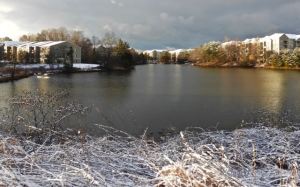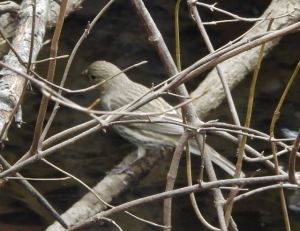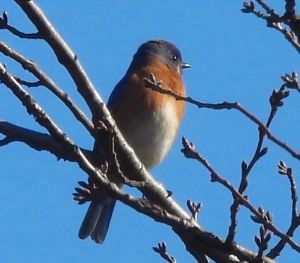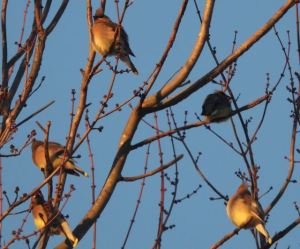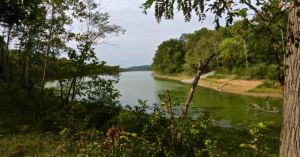
April 2024: Early Spring in Full Bloom–Catch It While It Lasts

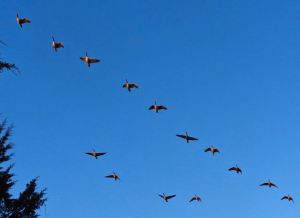
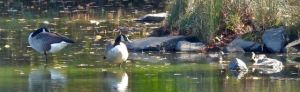
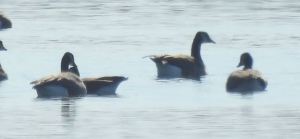
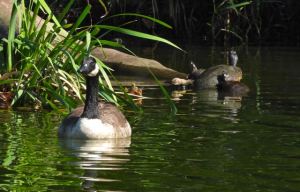
Canada geese sing duet: an invitation that leads to acceptance, then courting in the rain, April 1

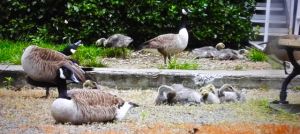
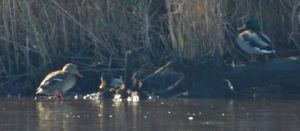
On Earth Day! First sighting of new Canada Goose chicks on the northeast side path! Congratulations! (April 22, 2024)

Day 3 sighting: Two Geese families and friends on the southwest side of the lake, 10 chicks in all! April 24

In this month’s blog:

Early Spring in Full Bloom in the Potomac Valley 
Climate Log: Serving Our Addiction vs. Saving Our Future
Climate Log 2: Floods in Dubai? What’s Next in Extreme Weather?
More Remarkable Virginia Trees: Survivors of Bondage and War
April 2024 Photo/Video Gallery: Birds, Bees, Blooms–and Even Cows?

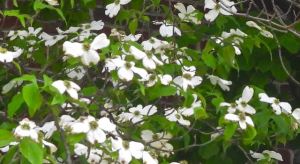
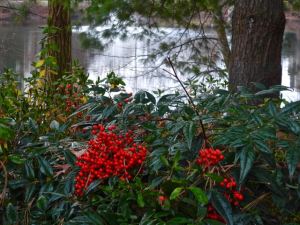
White Azalea in full bloom with Heavenly Bamboo berries beside the west side gazebo, April 16

Early Spring in Full Bloom in our Potomac Valley Town

You know the old saying, “April showers bring May flowers.” Here’s the updated version: “Winter showers bring April flowers.” Or March flowers, as this blog showed last month after our visit to the Tidal Basin in Washington.

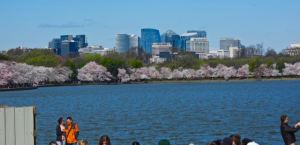
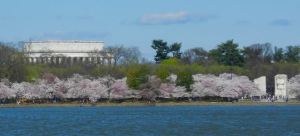
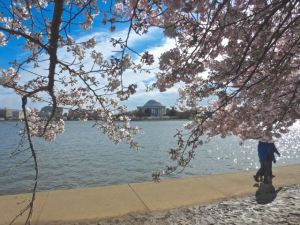
Potomac Tidal Basin, March 17: Japanese Cherry trees in bloom, Virginia skyline, and visitors to the Jefferson Memorial

This month’s Gallery will show lots of colorful views along the small lakes that provide suitable habitat in our otherwise mechanized suburban town. We are thankful for those lakes, the flowering trees, and the animals, plants, and people that care for the environment. April has become the month of fullest new blooms. Catch the blooms now before summer arrives in May, which will have its own verdant discoveries.

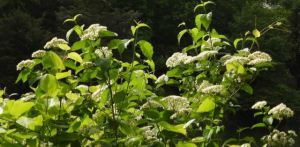
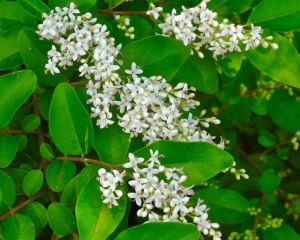
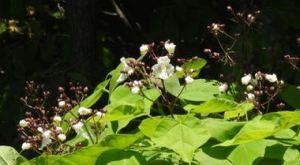
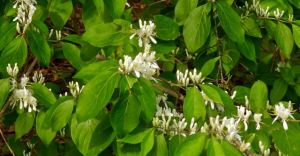
Amur Honeysuckle, new blooming, along the east side bank of Lake Cameron, April 20

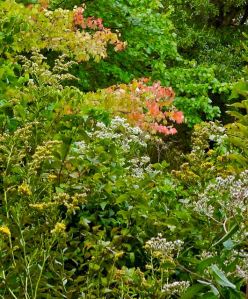
Don’t delay: the Cherry blossoms came in March and have now given way to the leaves, as have the blooms from the Bradford Pears and the Red Maples. Even the Redbuds, who bloomed out early this month, have turned to leaf making. Now it’s Dogwood time–Virginia’s state flower!–and Azalea time in an array of colors!  Look also closer to the ground for wildflowers and flowering bushes that manage to show their colors where the ground isn’t mowed.

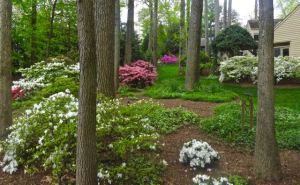
Multi-color Azaleas in Lake Newport garden, April 18

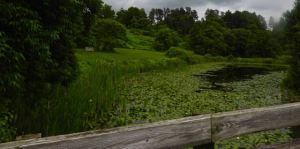
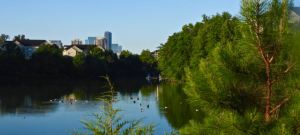
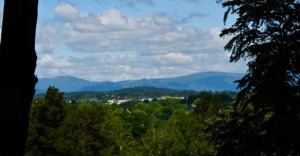
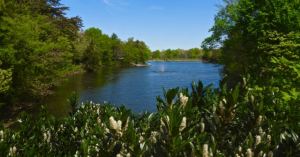
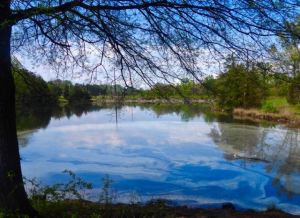
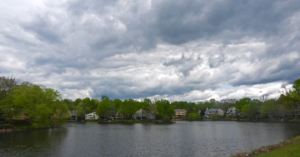
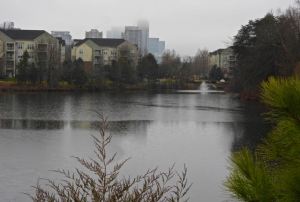
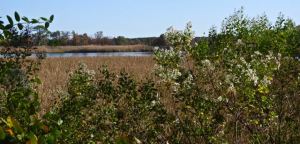
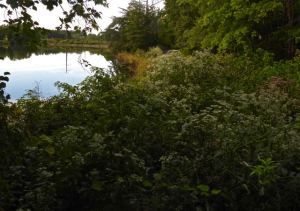
Panorama of Lake Cameron toward north, with Cherry Laurel in foreground, April 20

Dogwood in bloom in our community, south end, April 21

The last of the redbuds still blooming, southeast side of the lake, April 21


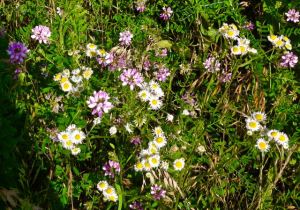
Yellow Woodsorrel and Purple Deadnettles in bloom at the north end, April 18

****************************************************

Climate Log: Serving Our Addiction vs. Doing the Hard Work of Saving the Future

While fully enjoying all the beauty and genius of the plants and animals (including humans) who make Earth so wonderful a place to live, I’m saddened by the slowness of U.S. governments, corporations, and individuals to give up our addiction to fossil fuels–even as each month sets a new record for high temperatures, and as extreme weather events occur more rapidly. (See the section below on the floods in Dubai).  We seem to be more willing to pay the ever-increasing billions upon billions for flood-and-fire damage repairs than to address the actual problem.

Politicians also deliberately ignore, to satisfy the fossil fuel cartel, the causal link between worldwide spreading drought and the alarming increase of human migrations, which are stressing national borders here and in other countries. These politicians would rather blame other governments and even the victims themselves, rather than placing the blame on the fossil fuel cartels.

But addictions, including ours to fossil fuels, are really hard to break, sometimes almost impossible, especially when they give us familiar pleasures, and especially when very powerful and relentless forces (such as oil companies, plastics industries, automakers, public utilities, and a whole political party) convince us that we have to build our entire lives around that addiction. In our community, the association directors frequently remind us that ours is a “smoke-free community,” which means that tobacco (or marijuana) smoking is not allowed either inside buildings or on the grounds, including the lake and its surrounding woods. Still, we frequently find cigarette butts on the paths and in the greenery, though most residents happily adhere to the policy and love the freedom from second-hand smoke. 

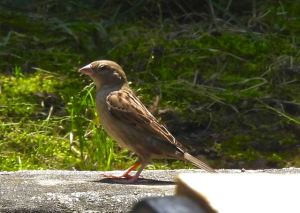
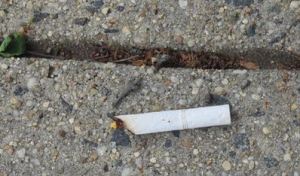
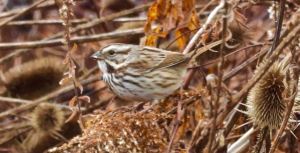
Song Sparrow near a cigarette butt on the north end path, Earth Day, April 22

But the “smoke-free community” idea, as laudable as it is, does not include the smoke that invisibly and relatively odorlessly pours from the exhaust pipes of most of the cars in the parking lots and from the exhaust chimneys on top of the buildings, all of which are gas heated and all of which feature gas stovetops and ovens. So acculturated are most of us to gas-fueled lives that we never think of emissions as smoke.  Yet, the latest annual research by the American Lung Association shows that 40% of Americans, the highest rate since the 70s, when the Clean Air Act was passed,  live in dangerously bad air, contaminated by gas-generated particulate matter, wildfire smoke, and vehicle emissions.

Despite these dangers, we really can’t imagine living differently. That’s especially true here in Virginia, where almost no houses have solar panels and renewable energy is rarely mentioned.

Oh sure, some of us, when we have money enough, peck at the edges of our addiction, like maybe buying a hybrid or even an EV, perhaps installing a heat pump and electric stove, or cutting back on plastics use and methane-belching beef. But with most elected officials dead set against incentivizing these pro-climate actions, the great majority of folks are caught in the web of the oil-gas cartels and are addicted even if they wish they weren’t.   

Chimneys on every building of our community emitting exhaust from gas appliances, Earth Day, April 22

We’re also completely acculturated to the noise of internal combustion engines, which you will hear on many of the videos of birds and scenery in this blog, as cars and trucks pass by on the surrounding highways, and as jets fly to and from Dulles Airport. As pretty as the lake looks, the birds, squirrels, and turtles have to adjust to the noise of all the surrounding engines, if they can.  The birds often have to work hard for their calls to reach above the steady din; if they can’t, they die trying.

And for the many species that hunt for their food by sound, the “white noise” of constant vehicle traffic makes their hunting harder, if not impossible. The habitat destruction that has caused the 30% decline of bird populations in North America since 1970 includes destruction by noise, not just the incessant killing of wilderness and wetlands being turned into farms, housing tracts, mines, and commerce.

Will we ever be willing to change our ways, or will our addiction win out? When will the costs of climate catastrophes grow so great that we will say “Enough!”? 

Red-shouldered Hawk atop Tulip Tree north of the dam hears and watches the traffic roar past on the neighboring highway, Feb. 1

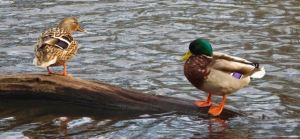
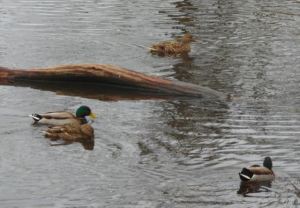
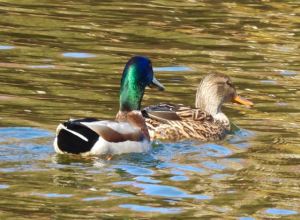
Mallard pair swims toward south on snowy day as a jet roars overhead, Feb. 16

********************************************

Climate Log 2: Floods in the Dubai Desert? What’s Next in Extreme Weather? 

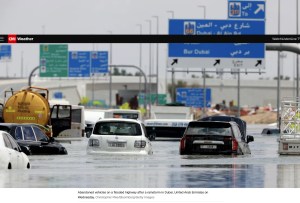
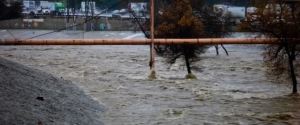
Abandoned cars in deep water on Dubai freeway after unprecedented storm, April 17 (Photo: Christopher Pike, Bloomberg, Getty Images)

Can you imagine the tallest building in the world, the Burj Khalifa (3000 feet high), being without power to run the elevators and cooling system? Can you imagine a home food supply system based mainly on app-ordered deliveries totally shut down? Can you imagine some of the most traffic-clogged highways in the world suddenly inundated with water rising waist high, and cars just abandoned for days?  Can you imagine all of this happening in a desert country that has no infrastructure to deal with rain? A country where there has not been a storm like this on record? 

Well, no need to have to just imagine such a place any more. It’s real in Dubai, in the United Arab Emirates (UAE), right now, because of a rainstorm of from 4 to 12 inches in 12-24 hours on April 16-17.

A year or 2 years of rain there is about 4 inches. Dubai’s infrastructure has been all about how to deal with relentless heat, drought, and the need to manufacture water via desalinization in order to support a robustly technological culture with U.S.-like skyscrapers, shopping malls more upscale than in almost any other place in the world, and an international workforce of low-wage immigrants, who perform the endless construction these ambitions demand. 

During the storm, those shopping malls became waist-deep in water, with rain pouring through roofs onto the high-end merch. These roofs were never meant for anything but sun screening and keeping the cool inside. Damage estimates are in the billions throughout the small emirate.

Dubai residents move from inundated dwellings after the storm, April 18 (Photo: Amr Alfiky, Reuters)

Will events like this happen again? Probably. But how soon? Who knows? Now we live in the chemical-emissions-caused world of very erratic, often extreme weather, where communities have to be prepared for drastic variations in temperature and precipitation. In this blog in February, I reported on ways that California is preparing for erratic variations in precipitation that that state had not seen before 2022, even though there had always been much slower variations from wet to very dry over longer periods of time. California is used to having to build infrastructure to handle different extremes, and Californians know that the costs are often prohibitive, causing ongoing conflicts between competing interest groups.

But how should a nation like the UAE proceed, when an event like this storm had not happened in memory? Given Dubai’s highly sophisticated, world-class economic goals, what would appropriate preparation look like? Intractable questions like these will become much more common everywhere as climate change intensifies.

********************************************

More of Virginia’s Remarkable Trees: Living through War

Ancient Catalpa lives on at Chatham Plantation, Falmouth, Virginia, April 9

Remarkable trees are not only those that are huge, stately, and symmetrically spreading. Some remarkable trees have just lived for many years, suffered damage, and yet survived through times of great disruption and tragedy. Often they have survived only with the concerned care of generous people.

One such tree is the Catalpa that grows just beside the historic main house of Chatham Plantation, across the Rappahannock River from the town of Fredericksburg, Virginia. Now maintained by the National Park Service, Chatham was built in 1771 as a multi-crop plantation by the Fitzhugh family, whose success came through the forced labor and dedicated industry of at least a hundred enslaved people.

By the time that the Civil War to free the slaves in the Southern states began in 1861, the then owners of Chatham abandoned the property, which was soon taken over by the Union Army of the Potomac. The Army turned it into a headquarters in late 1862 as they prepared for an attack against the Confederate Army, whose divisions were arrayed in the hills above Fredericksburg across the Rappahannock. This attack was one of the great tragic blunders of the war, as the Union troops were decimated. Chatham’s role changed once again, becoming an emergency hospital for thousands of the dying and wounded, whose cries still seem to echo there. 

Today, the gnarled and shriveled Catalpa seems a still living symbol of the horrors that occurred at Chatham, which has been restored by the Park Service as a museum of the events of over two and a half centuries. Besides the Catalpa, the Chatham grounds nurture a splendid array of magnificent old trees that honor the memory of those who were in bondage there or who gave their lives in war. 

For an excellent summary history of Chatham, I recommend this article and video from the National Park Service.

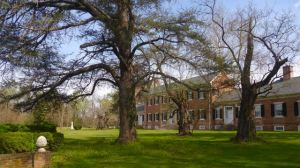
Chatham Manor and the venerable Deodar Cedar, Black Locust, and Catalpa trees. We visited there on April 9, the 159th anniversary of the surrender of the Confederate Army at Appomattox, Virginia, two years beyond the tragic events in Fredericksburg.

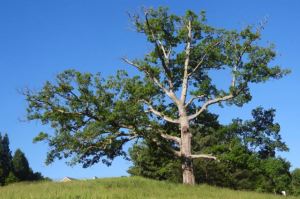
The Brompton Oak across the River in the Heights above the Town

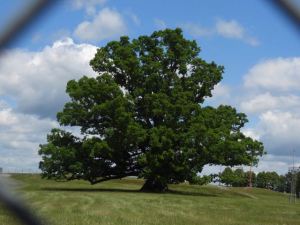
Hundreds of years old, the Brompton Oak stands beside the manor of the same name, which witnessed the horrific fighting in 1862 in the Civil War.

Across the Rappahannock and far up the heights above the town of Fredericksburg lies Brompton Manor, built in 1838. When the Union troops tried their ill-fated, catastrophic attack up those heights in December 1862 against the firmly entrenched Confederate Army, Brompton Manor stood about 200 yards above the smoke and cries of battle. The headquarters of Confederate general James Longstreet during the battle, the manor house–and the massive, long-lived oak beside it, now known as the Brompton oak–were unscathed by the fighting.

But Brompton, too, became a hospital during this battle, and indeed through battles over the next two years of the War. So many of the battles from 1862 to 1865 occurred here in Northern and Central Virginia, the fighting and disease taking the lives of hundreds of thousands and disabling many thousands more. The manor house and the oak today, majestic and peaceful, with bright tulips and flowering trees all around in the April breezes, obscure the horrors of the conflict, as they do the bondage of the enslaved people who labored here.

Brompton oak and manor house, as seen from the Sunken Road, from which the entrenched Southern army mowed down the Northern troops advancing in December 1862 from the river far below.

As at Chatham Manor, perhaps only a mile from Brompton but playing a similar role during the battle, many long-lived trees have survived and still grace the grounds. Besides the historic Brompton Oak, another majestic tree that captured our attention was a 100-foot tall sycamore down the steep hill from the manor grounds and beside the Sunken Road, where some of the bitterest fighting took place. High up in the sycamore perched another combatant always ready for battle, a Red-shouldered Hawk, calmly waiting for the next action. 

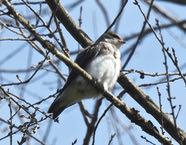
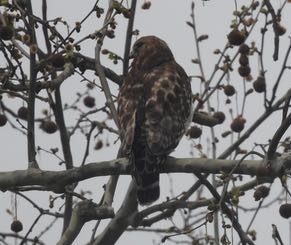
Red-shouldered Hawk observes the one-time battlefield from the top of a huge sycamore beside the Sunken Road in front of Brompton Manor, April 9.

***************************************

The April 2024 Photo/Video Gallery: Birds, Bees, Blooms, and Even a Cow or Two (and a Snake!)

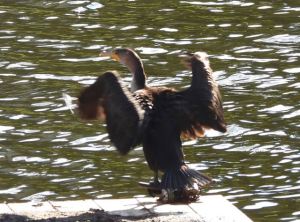
Cormorant pair on and beside the foot-powered boats that take residents silently over the waters, Earth Day, April 22

Huge old Red-bellied Cooter and baby, on log along the southeast shore, Lake Cameron, April 24

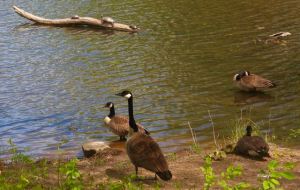
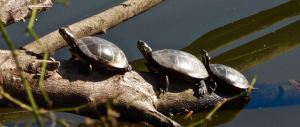
Four Canada geese and three Red-bellied Cooters enjoy the southeast cove on a cool afternoon, April 20

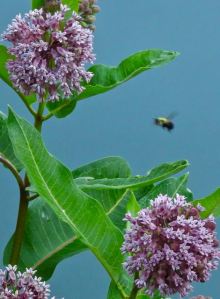
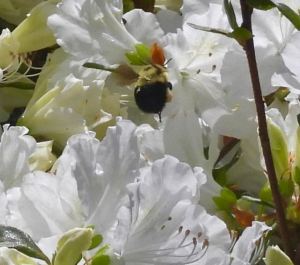
One of our first bumblebees feeds on the nectar of the newly-blooming White Azaleas beside the gazebo on the west shore, April 20

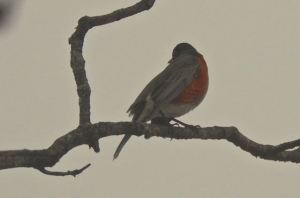
American Robin calls from atop a Walnut tree in the east woods, April 15

Japanese Pieris in bloom on east side of the community, April 14

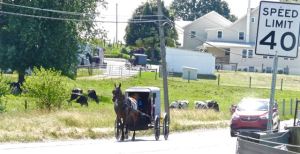
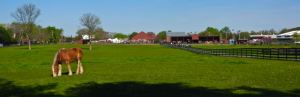
This Clydesdale welcomes us to a visit to nearby Frying Pan Farm Park, one of the few farms still left in our suburban county, April 16

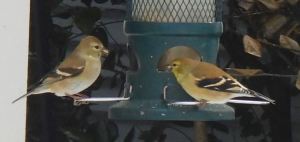
American Goldfinch in morning sun calls from atop a Willow Oak on the east bank of the lake, April 16, while Blue Jay also calls and walkers comment

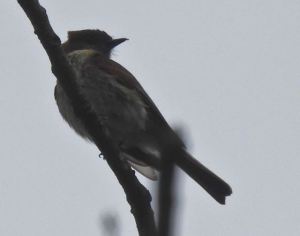
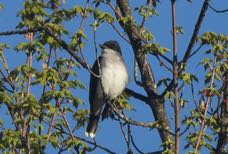
Our first sighting of an Eastern Kingbird, in Red Maple in the north end woods, April 16


Another view from Frying Pan Farm Park: Rhode Island Red cock and colorfully varied hens, April 16

Under water and just after sunrise: 2 large Red-bellied Cooters swim to the northwest shore, April 16

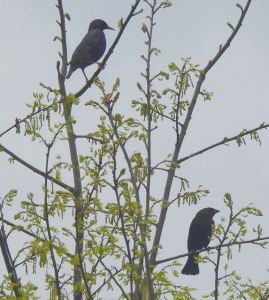
European Starling and Brown-headed Cowbird in Pin Oak on the east side, April 17


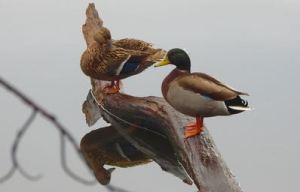
At nearby Lake Newport, five Mallards, four of them males, on the dam outlet structure, April 18

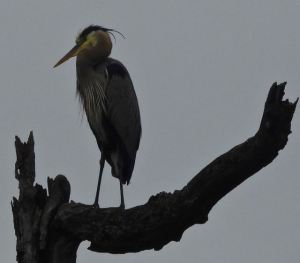
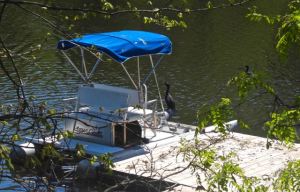
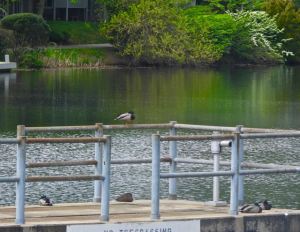
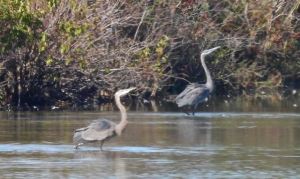
At Lake Newport, Blue Heron and Canada Goose by the dock. Heron takes off and House Sparrows chatter in a nearby nest, April 18

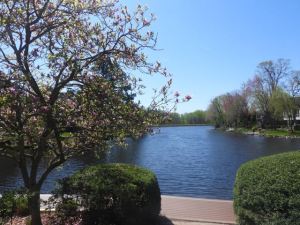
Lake Newport: Magnolias in bloom and panoramic view across the lake toward east, April 14


Lake Cameron: Male Mallard guards the nest on the east shore after a storm, April 15

Lake Newport: as seen from lakeside path, Red-shouldered Hawk moves up and down chimney after having captured 6-foot snake, apr. 18

Lake Newport: fellow walker had alerted us to the hawk having captured the snake. This blurry photo is from her smartphone. Amazing. April 18


The pollen-filled Lake Cameron after the storm on April 15, southeast cove

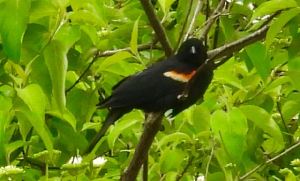
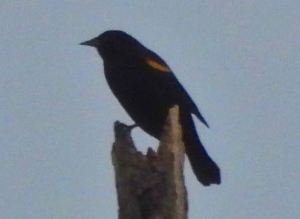
Lake Newport: Red-winged Blackbird calls in Willow tree on sunny morning, April 14

Lake Newport panorama toward north, with angry clouds, April 18

Lake Cameron: Bumblebee flies and feeds among the pillowy White Azaleas, west side, April 20

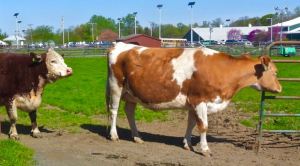
Oh, yes, the Cows: a Hereford and a Guernsey at Frying Pan Farm Park, April 16

And on to May, with more adventures in store…

March 2024: Springing Early and in Song

From the north end of the lake, I spied two large waterfowl on a submerged branch halfway toward the south end, about 250 yards away. Zooming in, I recognized a favorite mallard pair–then saw three smaller waterfowl swimming around them! Who were they? Ducklings? No, they were too large, and it would usually be too early in the year for newborns. To my surprise, they were three hooded mergansers, very rare visitors to our lake and no doubt just stopping on their way north. I had already passed this quintet on my walk, but the thick foliage had made them invisible to me until I’d gotten to the north end and had a clear view.

In the March blog:

Hearing More Than Seeing: Playing the Soundtrack of Spring
Visiting Remarkable Virginia Trees
Climate Log: We Return to the Tidal Basin Cherries
The March 2024 Photo/Video Gallery

When the high temp gets consistently above 60F, the Red-Bellied Cooters, including these 3 on the west shore, rise from their winter home in the lakebed, March 14

Hearing More Than Seeing: Playing the Soundtrack of an Early Spring

Amid a chorus of other birds and human traffic, this Male Cardinal calls other Cardinals from atop a tree in the north end woods, early morning, March 1

“Birdwatching” is a misnomer. Sure, bird students spend a lot of time trying to see birds, and even more time trying to take clear pictures of them. But most of the information we get from these friends is through listening. Birds always make their presence known by their calls, much less by letting us see them. For good reason. If we see them, so do their more-than human predators. It’s much safer to work  inside a bush or thicket of vines or leaves and call out, than to perch on an exposed branch so a paparazzo like me can snap pics, or a hungry hawk can draw a bead.

“Birds may prattle and rant with feathers and body poses, but far and away the most common, the most extreme, and the most complicated kind of bird babble is vocal.” Jennifer Ackerman, The Bird Way (2021), p. 28

Fortunately for us bird students, artificial intelligence (AI)–in the form of the e-Bird/Merlin and BirdNet bird identifying apps–clues us in to who’s calling in our neighborhoods whenever we turn on the record feature. So on a warm morning in this new early spring, March 14, I could identify the various instrumentalists in this video of one of our favorite Mallard pairs, as they fed along the shore of the southeast cove:

During two one-minute recordings, as I paid visual attention to the ducks, I heard the following–

Song sparrow….Northern Cardinal….American Goldfinch….Carolina Wren…Red-bellied Woodpecker….House Sparrow….American Crow….Brown-headed Cowbird….Red-winged Blackbird….Yellow-rumped Warbler….Blue Jay….Tufted Titmouse….Canada goose

A few of these species, such as the woodpecker, the cowbird, and the titmouse, I see very infrequently, so the app is a needed tool. Another, the red-winged blackbird, is one I look for this time of year as a harbinger of warm weather, so when I heard its call on this recording, I knew to look–and listen–for it. In addition, the woods directly across from the lake cove are thick and tall, so seeing birds there is always a challenge for me. The oral cues let me know who is visiting or at home in a way that watching can’t.

On the day following the recording, March 15, I saw this Red-winged Blackbird from about 200 yards away atop a dead oak on the east bank.

I heard this Red-bellied Woodpecker calling and tapping high on a hundred-foot tall white oak in the thick woods beside the southeast cove, and finally spotted it, on a sunny morning, March 3

***************************

Visiting Remarkable Virginia Trees (New Feature)

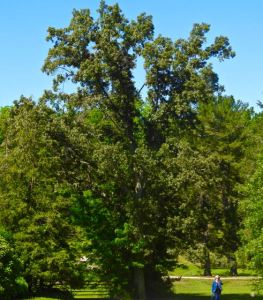
This 6-foot thick Chestnut Oak crowns a knoll in a townhouse subdivision in Centreville, VA. We visited on March 19.

To help us re-acclimate to our new home in Northern Virginia, we have been visiting and re-visiting places in the region–and reading as much as we can about their history and natural features. Hence the many entries in this blog since 2022 about our regional travels, especially within the broad and long Potomac River watershed. One recent focus of our travels has been “remarkable trees,” the title term of the beautiful photo book Remarkable Trees of Virginia, by Nancy Ross Hugo, Jeff Kirwan, and Robert Llewellyn (Univ. of Virginia Press, 2008). The text of the book recounts the history of each of the more than 90 trees, plus exquisite photos. So far, our visits have been local only, but our plan is to traverse the state and seek out more of these venerable trees, then include our own photos in the blog.

Here are our photos of the first five trees we’ve visited. One of the most refreshing aspects of these visits is that the trees are not marked with signs or plaques, and thrive as living creatures within their neighborhoods. Most people pass them by without noticing, but, thanks to the authors of the book, we were able to find them and give them a bit more honor and attention.

This venerable American Holly is protected in Christ Church graveyard in Old Town Alexandria. We visited on February 20.

We especially thank the people in those neighborhoods who have cared for these very old trees and, in some cases, have gone to great lengths to keep them standing and healthy–while so many trees, more each month, disappear en masse in the ongoing rush to build more houses, shopping strips, roads, warehouses, and other testaments to suburban sprawl.

This massive American Beech is protected on the grounds of the United Methodist Church in Annandale. We visited on February 20.

This 130-year-old Sugar Maple adorns the main intersection in the town of Sperryville. We visited on February 4, but we’ll be back in the fall to glory in its color display.

This is the Oakton Oak, for which the town was named. We visited on January 30. It has been carefully protected, and even nurtured back from serious damage, even as roads and shopping have been built all around it.

***********************************

Climate Log: We Return to the Endangered Tidal Basin Cherries

The Tidal Basin Yoshino Cherry Trees, planted 1912, with the Lincoln Memorial and the Martin Luther King, Jr., Memorial beyond the waterside, March 18

One year ago, we made our first visit in many years to the Tidal Basin in Washington, DC, to view the iconic cherry blossoms in their white-pink splendor. More visitors come to DC for this event than at any other time of the year. In 2024’s even earlier spring, we chose a warm, breezy day, March 18, with the trees in full bloom. The Festival used to be celebrated in April, but now it’s March, and the trees are spectacular–but threatened.

Blooming cherries surround the Jefferson Memorial across the Tidal Basin, March 18

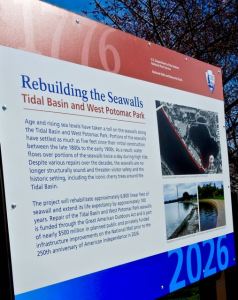
In last year’s report of our visit, which told the history of the Tidal Basin, I noted that we’d seen a small sign announcing that the Basin shoreline walls would begin being renovated because of the increasing damage from tidal water level rise. Well, not only has that renovation now begun, but we could see increasing evidence of overflows beyond the sidewalks and, more disturbing, that many dying trees near the Jefferson Memorial had already been uprooted and removed. Permanent signs (see photo below) describing the 2-year renovation plan gave the figure as 150 trees to be removed. The Washington Post vividly described the plan with amazing photos, videos, and infographics.

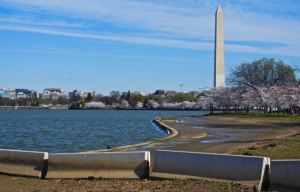
Jersey walls indicate closed off areas of the path just west of the Jefferson Memorial, with evidence of tree removal and tidal overflows. Shoreline walls used to be as much as ten feet above the water.

The goal is to have the renovation completed by 2026, in time for the 250th anniversary of the U.S. Declaration of Independence

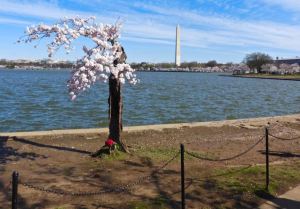
One tree scheduled for removal is a particular focus for camera-wielding visitors: the oldest tree along the shore, nicknamed “Old Stumpy,” still blooming and already grieved.

“Old Stumpy’s” lonely vigil: still blooming, March 18

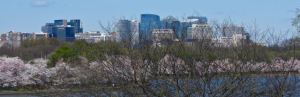
Meanwhile, the broad, deep Potomac River, whose tidal waters fill (and daily overfill) the Basin, rolls on, with the Virginia high-rise city of Roslyn on its west bank. Because much of Washington city, including the Tidal Basin, is built on land reclaimed in the 19th century from Potomac River mudflats, high-rise buildings like those in Roslyn are not allowed east of the river.

The city of Roslyn, Virginia, across the Potomac, where modern buildings rise much higher than is allowed in DC, March 18

*********************************

The March 2024 Photo/Video Gallery

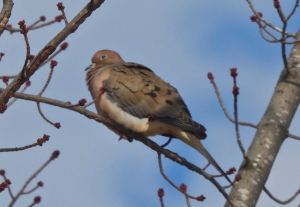
Mourning Dove plucks seeds along the southeast path on a brisk sunny morning, March 24

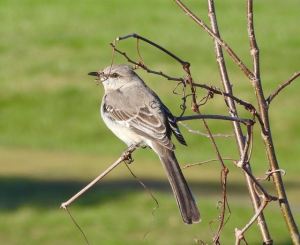
From a young branch at the north end, Mockingbird listens for calls, March 24

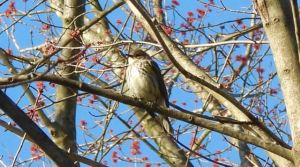
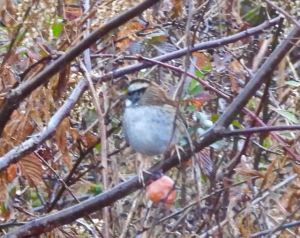
First sighting: Hermit Thrush on a branch along the southeast bank on a cool late afternoon, March 21

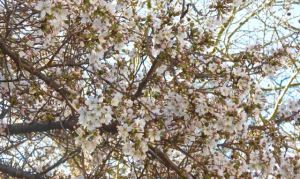
Japanese Cherry in full bloom in our community, east side of lake, March 16

Red-shouldered Hawk soars above the west shore on a windy morning, March 19

The outlet stream below the north end dam burbles, accompanied by the call of a Red-winged Blackbird, March 16

Jean’s fresh-baked soda bread for St. Paddy’s Day, March 17

Song Sparrow’s short call as traffic whizzes past on nearby highway, March 16

Two Double-crested Cormorants swim mid-lake in the rain, March 2

Mallard pair in flight toward the northeast shore in the rain, March 2

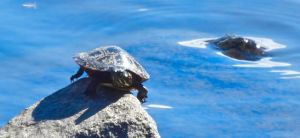
Red-bellied cooter balances on a rock while another peeks from the water, northwest shore, March 20

View toward the south end and downtown as 2 Canada geese swim near the west side dock, March 19

Four starlings converse atop a willow oak, east bank, early morning, March 1

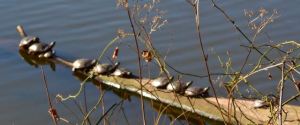
Ten Red-bellied Cooters lined up on a log on the southwest shore, warm day, March 12

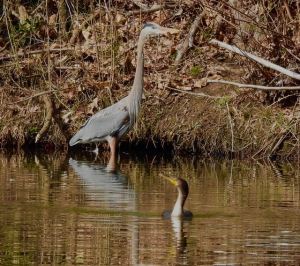
Great Blue Heron and swimming Cormorant at the west shore, March 3

Carolina Wren’s songful calls in the south end community, brisk morning, March 24

Camera captures this Eastern Phoebe–a first sighting here for me–in a treetop 300 yards east of the lake, on a rainy March 27

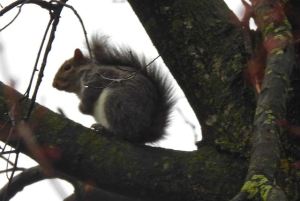
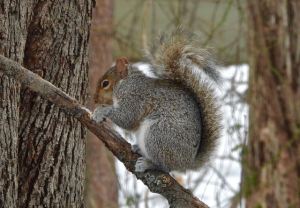
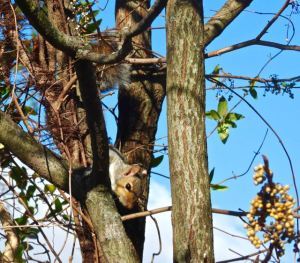
This Grey Squirrel ponders high up in an oak in the southeast woods, rainy March 27

This American Robin lands on the southeast path just in front of me, then skitters, while listening to the sparrows in the lakeshore thicket, on the rainy March 27

Now on to April, with more birdsongs, more blooms, and more daily surprises to inspire us all!

February 2024: A Month of Valentines, and Hopes for More

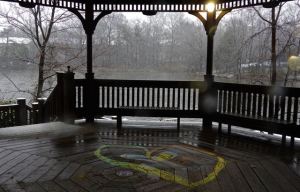
A chalk Valentine adorns the gazebo on the west bank during a brief morning snowshower, Feb. 13

First sighting since August: Beaver swims from cove toward west bank and dives, Jan. 27. Watch videos by researcher Emily Fairfax about ways that beavers, whose populations are steadily declining because of human intervention, create wetlands that restrict wildfires and increase water supply.

In this month’s blog:

Valentine’s Weekend for Birders: The Great Backyard Bird Count
Climate Log: Saving the Rain Forest by Saving Stingless Bees
Climate Log 2: Oh Those California Rivers in the Sky
February 2024 Photo/Video Gallery: One More Beautiful Snow Day (and More Avian Moments)

Two Crows bathe in the northeast corner of the lake on the final day of the Great Backyard Bird Count, Feb. 19

Two snow-covered Geese and teazle plants in the northwest corner during a brief morning snowfall, Feb. 13

Happy Valentine’s Weekend! The Great Backyard Bird Count

The video of the beaver we sighted on Jan. 27 was a Valentine to us before February even began, because beaver sightings are so rare in our lake. But an equally beautiful gift for Valentine’s Day is the annual four-day weekend of birding searches known as the Great Backyard Bird Count. Each February, the National Audubon Society, the Cornell Lab of Ornithology, and Birds Canada/Oiseaux Canada sponsor this multinational birding extravaganza, when enthusiasts from more than 200 countries post their pics and sound files to the site of their choice. This year, more than 600,000 of us feathery fanatics (AKA citizen scientists) from 209 countries posted sightings of over 7800 species. I was out there each of the four days, February 16-19, contributing my pics. Here are a few:

Two Canada Geese exclaim, then preen along the southeast shore, Feb. 19

American Goldfinch on the southeast bank, Feb. 16

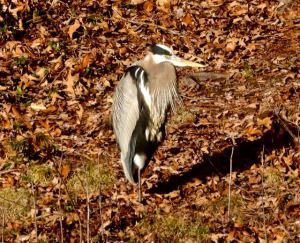
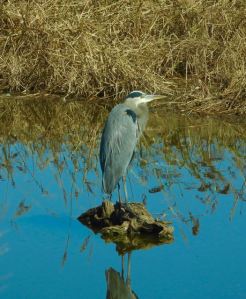
Great Blue Heron watches from the west bank on a sunny Feb. 18

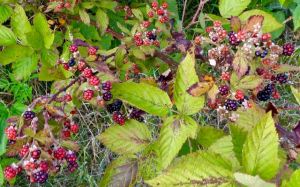
Chipping Sparrow in blackberry canes at the northeast corner, Feb. 16

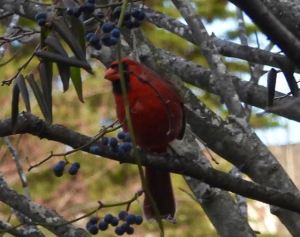
Male Cardinal in greenbrier berries, southeast bank, Feb. 16

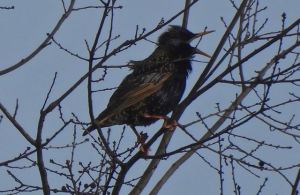
European Starling in mid call from the east bank, Feb. 16

Pair of Red-shouldered Hawks in separate trees north of the dam. Feb. 19

Of course, I get gifts like these from my feathery friends every time I walk around the lake.  So February for me is a month of Valentines.

**************************************

Climate Log: Saving the Rain Forest by Saving Stingless Bees

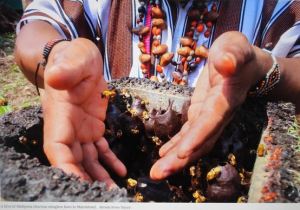
Finding a hive of stingless bees in Peru’s Amazon rain forest (NY Times, Jan. 30; photo by Brenda Rivas Tacury)

The Amazon rainforest in Peru is home to many species of stingless bees, who produce a honey that has been used for generations by Indigenous peoples of the region, such as the Asháninka, as a natural medicine. These stingless species have thrived as pollinators of native plants, who have in turn thrived because of these plants.  But as deforestation and mass agriculture have overtaken more and more of the rainforest, and as pesticides used by farmers have threatened species including the stingless bees, both the native plants and the bees are in danger of disappearing.

An article in the New York Times by Katrina Miller and Rosa Chávez Yacila (Jan. 30) describes how Indigenous beekeepers are attempting to keep the species thriving by creating artificial hives out of range of the pesticides, and then by creating a commercial market for the distinctive beneficial honey. Their hope is that the success of the honey sales will incentivize more Indigenous beekeepers and spur more efforts to maintain large areas of undisturbed forest, so that both the bees and the forests in which they mutually thrive can continue their vital work.

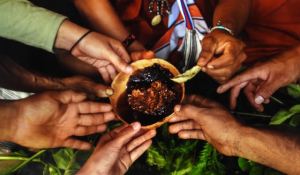
Asháninka community members and Peruvian scientists examine stingless-bee honey in traditional container (New York Times, 1/30/24; Brenda Rivas Tacury photo)

Help for these efforts has come from word of mouth during the pandemic of the medicinal value of the honey, as well as from scientists such as Drs. César Delgado and Rosa Vásquez Espinoza, whose study in the journal Food and Humanity reported this honey’s  “anti-inflammatory, antimicrobial, and other health-promoting properties.” The popularity of the product is slowly growing, with half-liters now selling for upwards of $20.

Key to the success of the venture is the expertise of the beekeepers, whose knowledge and skill have come from generations of practice. So, if the economic endeavor succeeds, not only will the bees and the forest be saved, but so will a vital part of the culture of the people for whom the practice is central to their lives.

Melipona Eburnea soldier bee at the door of the hive (Photo by Luis Garcia Solsoi)

**************************************

Climate Log 2: Oh Those California Rivers in the Sky!

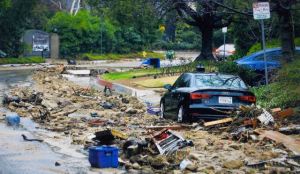
California’s second “water year” in a row of way above average precipitation has again filled the state’s reservoirs, brought deep snows into the Sierra–and this year caused massive flooding and landslides in the LA region as rain poured down on soil still soaked in many places from last year’s “atmospheric rivers” (or, as I like to call them, “rivers in the sky”).

Studio City street swarmed with landslide debris (LA Times photo by Carlin Stiehl, Feb. 6)

Last year at this time, one of the big stories was the re-emergence of historic Lake Tulare, which had covered for centuries parts of several counties in the Central Valley before farmers and ranchers in the late 1800s had made the lake disappear (as well as Indigenous communities reliant on the lake) by diverting its inflows for their own purposes. Last year’s rains were so intense that the lake had come back, but now was contaminated by farm and ranch runoff. The reborn lake now also endangered farm communities that had grown up in the intervening century.

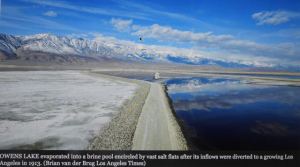
One of the big stories from this season’s storms, besides the floods and landslides in LA County, has been their impact all the way across the Sierra in another historic California locale. As Louis Sahagún reported in the LA Times on Feb. 19, the rains have “been good for LA’s water supply, but have caused costly damage to the aqueduct and dust control systems in the Owens Valley.” These recent storms have just intensified damage that began last year. If you don’t know the Owens Valley, then you don’t know the iconic California story (as loosely depicted in the great movie Chinatown in 1974) of how the city of Los Angeles in 1913 secretly bought up land in the quiet farming valley east of the Sierra so it could divert by aqueduct the region’s water 230 miles south to the burgeoning metropolis.

The Owens Lake brinepool and runoff from the 2024 storms (LA Times photo by Brian van der Brug)

After the city had to pay compensation to Owens Valley residents decades after the city’s duplicity was discovered, it also had to create complex systems to monitor and control every year the toxic dust that resulted from the dry lakebed. Sahagún’s article states a cost of $2.5 billion so far (and counting) for this year-by-year environmental disaster mitigation. Now, the deluge of returning water has damaged both the aqueduct and the state-of-the art dust control systems, at a repair cost estimated to be $100 million, which will no doubt be passed on to LA’s 4 million water system ratepayers.

So, climate change is the gift that just keeps on giving. Scientists are predicting that these new cycles of more intense rainfall will alternate with years of ever-warmer drought, creating the need for drastically different, perhaps conflicting, types of infrastructure. (Think systems to capture precious water into deep-below-ground aquifers in the rainy years to prepare for droughts, but also systems to divert excess water away from already soaked land.) California is working on it, as always. And, as always, the rest of the nation will keep looking toward California, as more and more states, like my own Virginia, must adapt to the new normal.

Unless political will actually strengthens around the world to really confront and eliminate the causes of climate change, we Earth humans will have no choice but to pay the ever larger costs, in money, famine, and millions more refugees, that a more extremely erratic climate will bring to all creatures, including the human kind. Sorry, no Valentines.

Flood surge in Atwater Village, Los Angeles, Feb. 5 (photo by Dania Maxwell, LA Times)

*************************************

The February 2024 Photo/Video Gallery: One More Beautiful Snowy Morning (and More Avian Moments)

Meanwhile, we enjoy heartily the gifts we receive each day from the birds and other folks who make our fragile lake sanctuary one of their homes. Enjoy these Valentines with us.

Mallard pair in glorious full color on the log in the southeast cove, Feb. 16

Snowy morning, Feb. 17: Northwest corner path and trees of the north end woods

Male Cardinal on the snowy morning, southeast bank, Feb. 17

Snowy morning, Feb. 17: From the southeast cove along the west bank

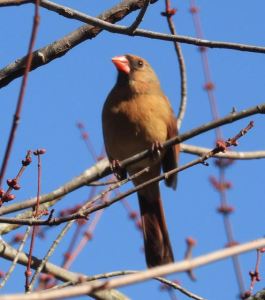
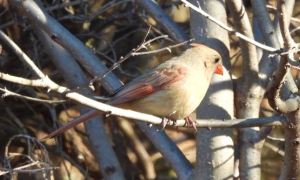
Golden Female Cardinal in a red maple, east bank, Feb. 21

Carolina Wren in slippery elm along the east bank, Feb. 1

Mourning Dove in red maple, southeast bank, Feb. 17

American Goldfinch feeds and sings at feeder on the east side, Feb. 12

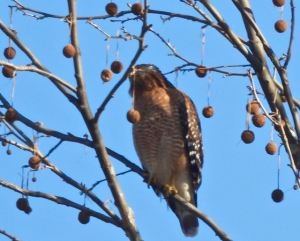
Red-shouldered Hawk in budding sycamore below the north end dam, Feb. 21

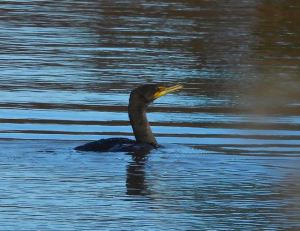
Double-crested Cormorant in mid lake, Feb. 16

On the snowy morning of Feb. 17, winds growl along the northwest path as storm clouds gather

Rare White Female Cardinal perches in the northeast corner, Feb. 21

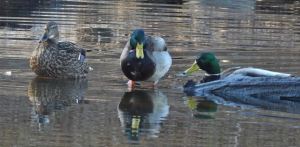
Two Male and one Female Mallard in the southeast cove, Feb. 21

Goose flock ambles toward southeast lake shore, and one flies toward front, Feb. 16

Watch camera move to reveal a pair of Red-shouldered Hawks on the fence along the highway west of the lake, Feb. 16

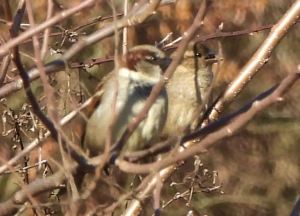
Mating pair of House Sparrows in sumac branches, northeast woods, Feb. 19

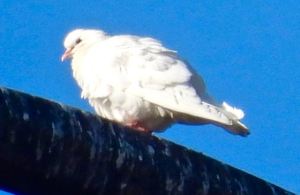
Uncommon White Rock Dove on stanchion high above the lake, Feb. 18

Panorama toward south end from snowy reeds, on the morning of Feb. 17

Yellow-rumped Warbler sings a short song on the snowy morning on the southeast bank, Feb. 17

Female House Finch studies the inlet stream by the bridge, Feb. 27

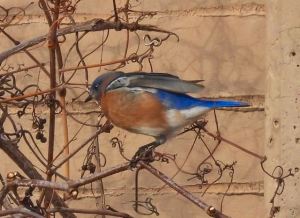
Eastern Bluebird in aspen on the east side, Feb. 25

A rare White-crowned Sparrow on the southeast path by the inlet bridge, Feb. 15

Dramatic scene of Great Blue Heron confronting a Cormorant in mid lake, then flying to west shore, Feb. 6. We were amazed.

So many Valentines this February! On to March!

January 2024: Winter Actually Arrived! And Stayed for Ten Days

Our second snowfall of the week, a total of about 7 inches, Jan. 19. Our first real snow since our move from California in 2022.

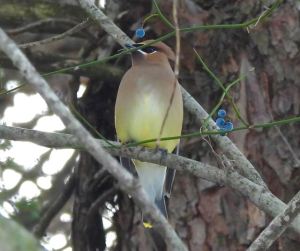
Five Cedar Waxwings lit by sunrise in a red maple along the east side path, Jan. 17

In this month’s blog:

Beautiful Surprise: Snow to Start the New Year
Climate Log: As Bird Populations Plummet, How Can we Change Minds?
Potomac Valley Exploring: Great Falls Adventure
The January 2024 Photo/Video Gallery

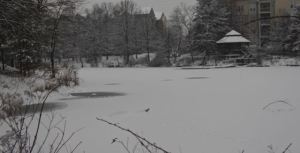
Across the lake from the southeast cove to the dock and gazebo, during the latest snowfall, Jan. 19

“It’s so beautiful”–Snow comes to us in mid January

I didn’t realize how much I had missed snow until it arrived last week. In the almost 2 years since we returned from our 17-year sojourn in California, I thought I’d come to terms with the year-on-year lack of snow in Northern Virginia, a far cry from the sometimes deep snows of my youth and middle age in this Potomac region. But when the first wave of tiny crystals began sticking to the grass and pavement here on the 14th, I realized the old exhilaration of the icy wind and the soft prickle of ice on my face and hands. It was with glee that I donned my snug coat and hood, pulled the wooly hat over my ears and the gloves over my hands. I couldn’t wait to walk around the lake and witness the changes in light and color, the crackle of branches, the loud languages of intensity–“it has come!”–in the songbirds and waterfowl.

A male Cardinal amid greenbriar on the southeast bank of the lake confronts the blowing snow, Jan. 14

There of course had been the many years of my life when a forecast of snowfall had brought the fear of pipes bursting, power outages, traffic snarls during my incessant commutes to work, careening on black ice, hours of digging out from snowdrifts, my old car battery dying in the cold, and all the other hazards of carrying on what most Americans thought of as “normal” existence while Mother Nature was just being her cantankerous, always creative self.

But now, in my semi-retired old age, when driving is not a daily demand, I can glory in sharing a child’s joy in the white blanketing of gossamer fluff that makes the whole outside world different and new. Many of our neighbors shared this joy with me. When I met them this week on their own lake walks, most of these folks being walked by their dogs (!), they greeted me with “It’s so beautiful!” or at least with smiling eyes as they scanned the scenery.

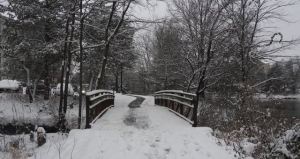
First snowfall: bridge over the inlet stream, Jan. 16, 7 AM

I was even looking forward to the remembered exertion of cleaning the snow off my car, digging the stubborn ice-crust off the windshield, and taking tiny steps to avoid falling on the ice. The task was now a welcome challenge and a tasty bite of nostalgia, no longer a resented imposition on the carefully-timed daily work schedule that had governed most of my life.

Waterfowl Retreat and Songbird “Mega-Bird” Day. But most of all, as I looked out on how the white blanket changed the world of every day, I wondered how the snow and intense cold would change life for the animals I had come to know as my friends along the lake. Who and what would I see? Would what I was used to seeing now be hidden from me?

In new snow, a single waterfowl, a Cormorant, negotiates the lonely lake, Jan. 16

The Cormorant I videoed (above) on Jan. 16, after the first snowfall, was the last waterfowl I saw on the lake before it froze on the 17th, when temps fell to 11 degrees. The water was frozen solid in many places, but elsewhere it became a kind of hard slush that makes swimming impossible, while still allowing some animals, like squirrels, to walk or leap in the shallowest areas. The Mallards, who I saw most recently on the 15th, after the first snowfall, and who starred in this blog in December, are now off somewhere else. I await their return.

My favorite Mallard pair swim in a strong wind in the southeast cove on Jan. 13, just before the first snowfall.

Other waterfowl citizens, such as the usually exhibitionist Canada Geese and the usually steadfast Great Blue Herons, lasted until the hard freeze and second snowfall occurred, but they have now left (though I hear the Geese flock overhead most days late in the afternoon, and I spotted a Heron swooping overhead just at sunset on the 22nd).

The Blue Heron withstands the sharp wind of Jan. 13, the day before the first snowfall, but has not landed here since, as the lake has frozen.

In contrast, an array of songbirds–including an amazing flock of Cedar Waxwings and some very early American Robins–arrived here just before the first snowfall, and some have stayed around. In fact, Jan. 18, the day before the second snowfall, saw so many songbirds out flying, eating seeds, and singing that I called it in my notes “mega-bird day.” More sightings from that day are part of this month’s Photo/Video Gallery.

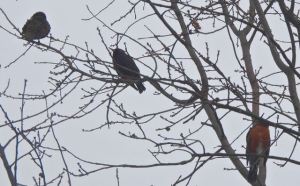
On a bitterly cold day, 2 European Starlings and an early visitor, an American Robin, atop a tree on the east bank, Jan. 18–“mega-bird day”

***********************************************************

Climate Log: As Birds Decline, How Can Changing Climate Change Minds?

Of course, not everyone enjoyed the snowfalls last week. Another neighbor cheerfully told me on the morning of the 22nd, “I’m glad the snow will be gone soon. Time for a change of scene.” For some outside our area, the cold snap and heavy snow were tragic. The blizzards across much of the country and temps as low as -40F, were a shocking surprise that became terrible because of the dozens of deaths across the continental U.S. caused by the sudden, extreme shift in the weather from an almost snowless December and early January. The sudden cold anomaly is also tragic because it reinforces the delusion of people who still remain unconvinced that the climate is dangerously warming through human causes. 

Yes, as the science predicts, our snow holiday was fleeting. For the 25th, the temperature forecast is 60F and we’ll have rain, not snow, from the 24th onward for 5 days–both signs of the “new normal” that is way warmer than the normal that used to be January. A dangerous “new normal” that is much more typical now for the entire world, including the U.S.  

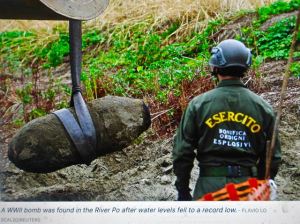
Italy’s River Po is at a historic low amid drought (Photo by Flavio Lo)

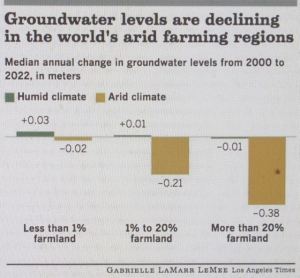
Dramatic worldwide depletion of groundwater since 2000 (LA Times, Jan. 26)

Indeed, it would surprise no one if 2024 were at least as warm month-to-month as the record-setting 2023. But it remains difficult for many folks who live in the remaining parts of the U.S. still relatively unaffected by drought, groundwater depletion, chronic flooding, sea level rise, extreme heat and humidity, sudden extreme cold snaps, etc., to credit the overwhelming amount of scientific data that sounds the alarm for the need to move away from the fossil fuels that have steadily, even if gradually, endangered many forms of life on Earth, including humans. Climate change skepticism, and even outright denial, continue to plague the effort to save species, this denial fueled relentlessly by the fossil fuel industry’s evermore frantic efforts to maintain its obscenely vast revenues by deluding the public into believing that all is right with the status quo. That this industry bankrolls politicians and media outlets to keep spreading the soothing lie that everything is OK just makes the tragedy worse.

“New normal” quickly asserts itself. Steam rises from the thawing lake on Jan. 25, as all snow has already vanished

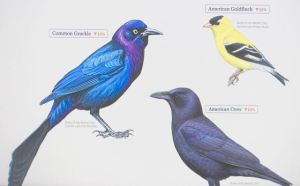
Bird Populations in Alarming Decline. Since most U.S. people are not enthusiasts, close observers, or feeders of birds, and so don’t pay close attention to our feathered friends except when they see bird poop on their cars, they don’t know that most bird species are in serious decline, and, like the proverbial “canary in the coal mine,” this is bad news for humans’ own survival. The Washington Post published last week a beautifully graphic map of how this decline is affecting all parts of the U.S.

3-bird drawings from the Washington Post infographic/video on bird decline, January 17; text by Harry Stevens

Will colorful graphics such as the birds map have any positive effect on the skeptics? Will the heart-rending stories from “Postcards from a World on Fire” ever reach viewers who have been so indoctrinated to hate/fear refugees from other countries that it is impossible for them to empathize with their suffering fellow humans?  No doubt some positive effect can occur, if people actually see these sites.  But it’s so easy nowadays to stay within your own partisan media bubble, so that crossover among viewpoints is minimal.

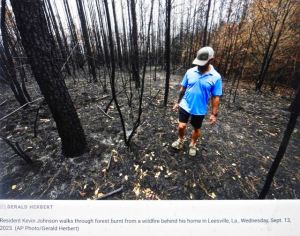
Sadly, the best chance to sway opinions may come from climate-caused damage itself.  The many U.S. communities and states now experiencing chronic flooding or the effects from drought and wildfires are realizing that the trend must be stopped. The Republican-voting fisherman who has seen his catch get smaller every year in a warming ocean may have a better chance to sway other Republicans than any graphic from the Washington Post. The same goes for residents of flood-prone and now wildfire-prone states like Louisiana (below). But will any climate-denying outlet like Fox News ever allow such a person to have a voice? Maybe yes, but only if enough people want their voices heard.

Wildfires covered much of usually flood-prone Louisiana this summer and fall, Sept. 2023. (AP photo by Gerald Herbert)

Fortunately, there are more and more politicians, local leaders, journalists, bloggers, and creative, determined companies that are fighting the good fight and showing people how we can still save a future for all creatures, including us humans. 

Logo from the New York Times infographic/video Postcards from a World on Fire, December 2023

***********************************

Potomac Valley Exploring: A Great Falls Park Adventure

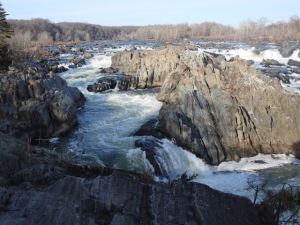
On January 3, we visited Great Falls National Park, just 10 miles from our community, and on our list for visiting since we moved here. We were with one of our visiting daughters from California, and it was a beautiful afternoon, crisp and sunny. The park features stunning views of the roaring, tumbling rapids over a series of drops and between massive boulders through a narrow gorge. It also features the ruins of an early attempt, begun in 1784 by a consortium headed by George Washington, to build a canal around the falls on the Virginia side of the Potomac.

The Great Falls of the Potomac, as seen from the Virginia side of the river, Jan. 3

This bypass of the river was successful in transporting agricultural goods until 1802, when plans for a new canal on the Maryland side of the Potomac were created. A second part of the Park is on the Maryland side, where the much more successful canal was built early in the 1800s and flourished until the early 20th century.  Earlier blog entries have captured our visits to more upstream parts of the Chesapeake and Ohio Canal, in Williamsport, Maryland; Shepherdstown, West Virginia; and beside Fort Frederick near Clear Spring, Maryland. 

Great Falls provides thrilling views for visitors of all ages. A brisk, sunny day for our visit, Jan. 3

The Sheer Drama of Great Falls. No place on the Potomac provides more excitement for visitors. The overlooks high above the gorge give viewers a panoramic vantage point on the many torturous, dangerous passes amid the rocks, while the constant roar of the rushing waters warns onlookers of the danger threatening anyone who might want to attempt the passage. Nevertheless, on the day we visited, two intrepid kayakers took the plunge, and we had clifftop viewing, along with the many people of all ages also watching and cheering them on:

A pair of kayakers attempt the Falls, Jan. 3 

As the kayakers bravely made their way down the drops, we enjoyed the added thrill of seeing Park Rangers monitor the adventurers’ progress. 

Needless to say, Great Falls will stay on our list of Potomac sites to visit. Maybe next time, we’ll add the Visitors Center. We’ll probably not be planning our own plunge over the Falls.

*******************************************

The January 2024 Photo/Video Gallery

This month’s Gallery highlights snow, hawks, mega-bird day, and more.

A Mourning Dove rests high in a red maple above the south end of the lake, Jan. 22

A Blue Jay struggles in a windy, sunny, snowy day, Jan. 21

Mega-bird Day! 27 Rock Doves crowd their favorite perch, the power stanchion high above the west side of the lake, Jan. 18


After the second snowfall, the inlet stream by the bridge, southeast cove, Jan. 19


On Mega-Bird Day, grey squirrels like this one in a pignut hickory, southeast side, join the party on this very cold afternoon, Jan. 18

This young Cooper’s Hawk flew past me as I began my lake walk in the deep snow of Jan. 20 and landed in a tree outside our building. This young friend was remarkably patient as I took this video.

These brilliant American Goldfinches safely shared this feeder not long after the Cooper’s Hawk had flown off from this spot into the woods, Jan. 20.


This early arriving American Robin chose this very cold Mega-Bird Day for a first appearance, east bank dead tree, Jan. 18


Change of pace: This Mediterranean super-veggy omelet (with a bit of prosciutto) warmed us at breakfast on a very cold and snowy Jan. 19.


This wonderfully-colored Cedar Waxwing shone brightly in the greenbrier thicket at the northwest corner of the lake, Jan. 23


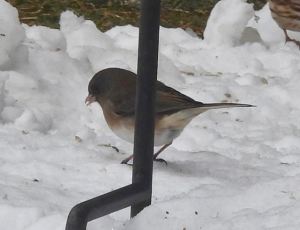
A Dark-Eyed Junco looks for seeds beneath the feeder on the east side, Mega-Bird Day, Jan. 18


A Downy Woodpecker at an east side feeder, 7 AM, Jan. 16. A hungry time.


Looking north across the lake at sunrise, 7 AM, 11 degrees F, Jan. 17


View across the frozen lake toward downtown at sunset, Jan. 22

In mid-walk, we spied this Red-Shouldered Hawk watching us from a small elm on the north end path, no more than twenty feet from us. This friend was patient for 10 seconds of my video before hopping down…

…stood magnificently in profile on the ground by the path, then launched past us and gone, Jan. 23. What an unforgettable gift to us!

Such a remarkable first month of 2024. On to Valentine’s Month!

December 2023: Bluebirds, Loving Ducks, and a New Kind of Christmas

Our first and only snowfall thus far, a brief one inch on Dec. 11

Looking north in first snowfall, Dec. 11, 3:30 AM

In this month’s blog:

Bluebirds, Loving Mallards, and a New Kind of Christmas
 A Joyous Christmas Week With Family
The December 2023 Photo/Video Gallery

Heavenly bamboo on the west bank of the lake, Christmas Eve. In California, these resilient, colorful plants serve as symbols of Christmas.

Bluebirds, a Closed Bethlehem, and Other Signs of a New Kind of Christmas

Two bluebirds in a budding red maple, southeast side of the lake, Dec. 23

Oh little town of Bethlehem / How still we see thee lie…

And so the beloved Christian hymn begins. It imagines a peaceful small town in the Palestine of 2000 years ago, a town as yet unaware that the birth of Jesus is about to take place in the humble stable where the poor pilgrims Mary and Joseph have stopped for the night. As the tune of the song, which I’ve sung many times, plays in my mind, I find it hard to comprehend that the Bethlehem of 2023 is also still this year, many places shuttered because of the killing and devastation a mere 50 miles away that have torn apart this Holy Land sacred to three great world religions.

The Church of the Nativity in Bethlehem, silent because of the war in Gaza (photo from “God Is Under the Rubble of Gaza,” the New York Times, Dec. 24)

Usually on Christmas, many thousands flock to a joyous, music-filled, brightly lit Bethlehem to celebrate Jesus’ birth. But this year the tone is mournful, many streets quiet. The few who have still come to honor the Birth will do so in silent reverence. Said New York Times journalists Yara Bayoumy and Samar Hasboun:

“A Lutheran church put up its crèche, but with a sad and symbolic twist. The baby Jesus — wrapped in a keffiyeh, the black-and-white checkered scarf that has become a badge of Palestinian identity — is lying not in a makeshift cradle of hay and wood. Instead, he lies among the rubble of broken bricks, stones and tiles that represent so much of Gaza’s destruction.”

The church’s pastor, Rev. Munther Isaac, who created the crèche, said, “The horror of war cannot be allowed to bury the spirit of Jesus… Despite the circumstances, we must still show that Jesus is the source of happiness and peace in the church. God is under the rubble in Gaza, this is where we find God right now.” (See also the article in the Washington Post, Dec. 26.)

The Signs of a New Christmas in Northern Virginia

Looking toward downtown across the lake on a cool, rainy day after Christmas

Perhaps paling in significance compared to the Israel-Gaza War are the quiet signs of a psychological change in how we define Christmas here in this little corner of Virginia, USA. Of course, some things are the same: the calendar still says it’s late December, and so people have been flocking to stores since November and shopping online for the dazzling array of goods that we will give as colorfully-wrapped presents to family members.

But we in the U.S. (even those of us on California and Florida beaches) used to define Christmas as occurring within a deep winter setting of chill winds and blizzardy falls of white snow. Santa Claus, the primary spirit that kept us warm and happy in forbidding weather, we pictured flying from home to home on the magical sleigh led by reindeer from the bitterly cold far north. That picture still made a kind of sense when most parts of the US still had snow cover in December. But now, when even the polar ice caps are melting, it’s just nostalgia–and maybe fear of the future–that keeps us clinging to the White Christmas fantasy.

A typical Christmas scene as imagined by Blue Mountain e-cards, Dec. 20

On Christmas this year, the high temperature here was a calm 58. What would Santa in his fur coat do in a climate like ours? Of what use is a sleigh without snow? And the poor reindeer, what of their chances in our warmth? The fleeting inch of snow we had on Dec. 11 is a gone memory, and it’s been many years since there was snow here on Christmas.  Oh, you might point out that last Christmas Eve, 2022, the low temp was a biting 7 degrees F., but that was an anomaly, as was the dusting of snow we had on Jan. 31 last winter, the only snow of the season.

A rare December bluebird along the highway sound barrier west of the lake, Dec. 23.

A Bluebird Surprise

There is no shock to the mind from a mild day in December; indeed, the change from the possible bite of a freezing wind is soothingly pleasant. As I walked around the lake on Dec. 23, I delighted in the warmth, and then in the brilliant orange and blue of a small flock of bluebirds, who I was surprised to see and I luckily photographed. But part of me registered a disturbing discord, like a slight seismic tremor. “I’m happy to see you, friend bluebird, but why are you here so early?” Then the disquieting thought: “Were things not so nice where you’d usually be this time of year? Too warm perhaps? Is this just a temporary visit, or will you try to make a home in our community long term? Have you discussed this with the house sparrows?”

Eastern bluebirds are known as “partial migrants.” A particular flock may go as far north as Canada in summer and as far south as Florida in winter–but that flock might also stay year-round wherever they find the right conditions. Maybe in New England, maybe in Georgia, maybe right here. Some flocks might stay year-round where it’s cooler; others where it’s warmer. Another group might switch locations during the year. Like humans, bluebirds aren’t all alike in their preferences. Maybe these bluebirds I conversed with were gonna stay a while because of the warmth, or the relative coolness; maybe they’d move on. Still, I’d never seen bluebirds here this early.

Another bluebird by the sound barrier west of the lake, Dec. 23, morning

What we know for sure is that the changing climate is gradually warming, with 2023 the hottest year on record around the world. Winters have been getting shorter most places, and aren’t as cold. In our region, the fall leaves stay on the trees longer; the buds appear earlier. Was that red maple in the photograph above really budding already, when just last month it still had bright red leaves on its branches? How long can it still exist here with no real winter?

These bluebirds wouldn’t be here if it were actually an icy white Christmas. They can’t be fooled by nostalgia. Unlike us, but very much like the human climate refugees increasing everywhere, bluebirds have to live 24/7 in the real world. We who are not yet climate refugees are lucky that our imaginations can still enable us to live in a fantasy world, at least for a while yet. We can still sing “let it snow, let it snow, let it snow, ” when it’s 58 outside. But sooner or later, we’ll have to live in the real world, too.

The Romantic Mallards: Definitely Early Birds

Mallard pair communicate on the log in the southeast cove, Christmas Eve

Last month’s blog entry ends with a 2-minute video of a pair of mallards clearly engaged in mating, or at least pre-mating, behavior. Take a look.  It’s amazing how they communicate and how one bird observes and imitates the other. This month, the mallards, particularly one pair, are the stars of the lake, sometimes even being the lone waterfowl on a rainy morning. I find them on the lake almost every day, often in shore places where I’ve not seen them before. Just the day after Christmas, Dec. 26, I spotted them in the inlet stream beneath the bridge over the southeast portion of the lakeside path. It’s gotten so that I’m not surprised when they show up anywhere along the lakeshore. Here’s that video:

The mallard pair makes their relationship pretty obvious in the inlet stream on the southeast portion of the lake, Dec. 26

Mating season for mallards is the spring, not fall or winter. But this pair began mating behavior in November and it’s only intensified this month. If the warm weather and the birds’ activities keep up as they have, we’ll be seeing ducklings in February, well before the official start of spring. Just more evidence of the new kind of Christmas we’ll have to get used to.

Here are a few more mallard photos from December:

Two mallard pairs after sunset in the southeast cove, Dec. 23

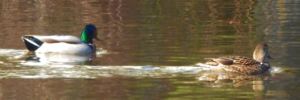
I love to see their synchronized trails in the water, Dec. 20

Mallard pair and their reflections on a misty day, Dec. 17

*******************************************************

Celebrating Christmas Week with Family from Far and Near

Two of our grandchildren have become regular observers of the wildlife at the lake (Dec. 21).

How fortunate we are this year to live very close to some members of our extended family, and to have been able to visit and be visited by more family who live farther away, even across the country in California. I recall fondly the weekly hour-long Zoom visits we maintained during the pandemic in 2020 and 2021. These were actually a cherished substitute for in-person relationships, but not the same as what we have now since we moved back to Virginia.

Not only do we live very near three families, but we’ve had in-person get-togethers at least twice this year with all our families from Virginia, New York, Georgia, and even California, most recently with some of them just last month.

Christmas Day with two of our local families

And now this Christmas week. We spent Christmas Day with two of our nearby families, and later this week with some of our children and grandchildren from Georgia and California.

One precious aspect of these visits, which the pandemic precluded, has been sharing meals. There is no substitute for cooking for those dear to you or being hosted by them for meals and conversation.

Sharing food and conversation at the Christmas Day party

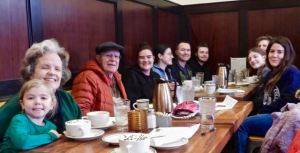
Sharing breakfast with families from three states at a local restaurant, Dec. 29

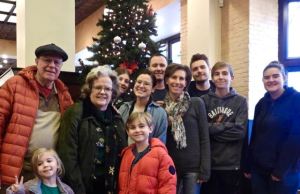
Another scene from breakfast, with the Christmas tree, Dec. 29

Flashback! Many of the same folks at a holiday meal, but in 2014. Isn’t it great how we’ve grown up since then!

***********************************************

The December 2023 Photo/Video Gallery: Citizens and Visitors in a Cool, Rainy Month

A Red-Shouldered Hawk scans the lake from atop a budding tulip tree in the north end woods, Dec. 15

One of our loyal Great Blue Herons searching for a meal on a rainy day, north end of lake, Dec. 26

A Song Sparrow amid dry teazle northwest of the lake, Dec. 26

A male Cardinal in a budding tulip tree in the mist below the north end dam, Dec. 24

A Carolina Wren singing and listening in a tree of heaven on the east bank, early morning, Dec. 24

Across the lake, our community and some downtown buildings at sunset, Dec. 23

On the west bank, a pair of grey Squirrels romp in maple leaves on a rainy afternoon, Dec. 26

Below the north end dam, a Crow wades through an icy patch in the Sugarland Run Branch outlet stream, Dec. 23

One of our visiting Bluebirds is lit by the early morning sun in a red maple, Dec. 23

A Great Blue Heron watches from atop a dead tree on the east bank, grey morning, Dec. 24

An impressionist rendering of a pair of House Sparrows on a branch along the southeast bank, Dec. 21

A mallard pair swims from mid lake to below the west bank, early morning, Dec. 23

A female Cardinal rests on a branch above the east bank, Dec. 23

A male Cardinal and a Carolina Wren in a bradford pear below the north end dam, Dec. 24

The Sugarland Run outlet branch burbles below the north end dam, Dec. 24

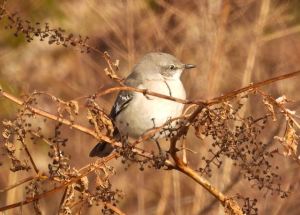
A Northern Mockingbird in dry pokeberry, north end, morning, Dec. 23

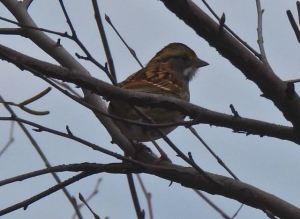
Another visitor: a Savannah Sparrow rests on a branch on the west bank, grey morning, Dec. 30

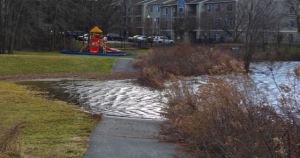
The flooded path on the east bank after an overnight storm inundates the lake, Dec. 18

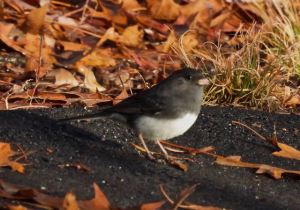
A Dark-eyed Junco on the southwest path amid fallen leaves, Dec. 11, after morning snow has melted

Canada Geese, lit by the setting sun, take their daily sunset flight from our small lake, Dec. 18

Finally, wherever your travels might take you, here’s to a joyful, adventurous New Year!

November 2023: Let’s Call It Thanksgiving Month

A mallard couple, who arrived two days ago, have the lake to themselves on a cold, breezy day, Nov. 11

In this month’s blog entry:

A Month for Giving Thanks
The Frustrating Joys of Birding
California Odyssey: Visiting Family, Friends, and the Bolsa Chica Wetlands
On the Day Itself: Family and a Bit of Cookery
The November 2023 Photo/Video Gallery: Fall Colors Persist, New Visitors Arrive, and the Mallards Return

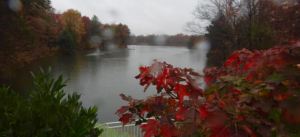
An early morning panorama of the still lake toward the northwest, with red maple in foreground, Nov. 15

*************************************

A Month for Giving Thanks

“Can we all just go to a leaf and thank Mama Willow?” (Pandora Thomas, founder of EARTHseed Farm, Sebastopol, CA (in the LA Times, Nov. 21)

Every store and online advertiser has been telling us all month that Thanksgiving is coming, and so we should get out there and buy stuff for the ones we love. I think the advertisers are on to something, even if it isn’t exactly what they intend. Instead of just on Thanksgiving Day, let’s give thanking its due and dedicate this whole month to giving thanks, whether that means spending money or not.  Thanksgiving Month has a nice ring to it. And we certainly have enough people, other creatures, and day-to-day happenings to be thankful for.

Sure, there’s also lots going on that we wish weren’t happening, things that make us afraid and give us difficulty sleeping at night. I don’t need to name those things: you know what they are in your own life. But if every day we also gave a little time to focusing on the so-much in our world that is kind and beautiful and generous, we’d certainly have enough to fill an entire month, and maybe each day in the year. And this grateful focus might, if we give enough thanks, help us sleep better at night.

We’ve been getting together with family and friends this month, including some members that we don’t see too often, and those opportunities are to be cherished. And every day, as this blog records, I am privileged to walk in a place that brings me into the presence of fellow creatures who give me joy and who give of themselves without considering how I might reward them. Now those are gifts that truly deserve my thanks, including whatever gifts I might be able to give in return.

The sunlit, translucent, and generous oakleaf hydrangea just outside the window of the room where I write. (Thank you!)

***********************************************

 Joyful Frustration and Frustrating Joys: The Daily Adventures of Birding

For every serendipitous photo like this one I took on Nov. 21, there are thirty or more that are either too blurred, too dark, too cluttered, or too bright to decipher; are otherwise disastrous; or are set up, and then not taken at all. The frustrations just go with birding, and if it weren’t a challenge, birding wouldn’t be fun. 

When I list all the things I do for which I am thankful, birding is high up on my list. On the 21st it was raining steadily and getting heavier, so of course it was ideal birding weather for me. I wanted to see who the other obsessives were (avian ones, not just me) who’d be out in the stormy November cold going about their important business or just socializing. How was my photographic jaunt? Well, when I met my neighbor, who was going out for his walk as I was coming in soaked, he asked me, laughing, “Did you get any good shots today?”, I said, “Oh yeah, I got some great shots!” And I had, though he was just shaking his head.

My tally was 61 shots, probably another 50 set up but not taken, and a whopping 12 saved, of which 6 were of birds and 6 of landscapes. It was a great shooting day, because, of the 6 bird photos I saved, one was of a white-crowned sparrow, a variety I haven’t seen here before (though we had them often in California) and another was of a yellow-rumped warbler, a species that I hear often but see rarely; and a third was the one shown above, with 3 house sparrows scuffling at our feeder while a female cardinal leisurely munched on a seed in the foreground.

A rare sighting here of a white-crowned sparrow, Nov. 21; they were regular visitors to our home in California

A yellow-rumped warbler brightens this rainy day, Nov. 21, in a willow oak by the east bank of the lake

The daily frustrations of the shots gone awry or the shots not taken (as the little folks hide or fly away just as the shutter is about to click) are more than made up for by the successful snaps and videos. And even if I never got a clear, well-focused, and well-lit picture, the ever-present joy is the opportunity I have every day to listen closely, watch closely, study closely, and so learn more and more about the many fellow creatures who share their lives with me.

For birding is composed of so much more than the myriad birds themselves. Without the insects there would be no birds, so they, too, must be studied. And for so many birds, they would not exist without the water animals and the mammals and reptiles of the land. The plant life in which all the creatures live and which feeds them and houses them have also become my study, for the plants and the animals are a continuum with the humans like me, as are the air we all breathe and to which we contribute, and as is the soil which the plants need and to which they contribute; as is the water which feeds us all and which itself is made up of the atoms of the air and of all the creatures.

Yes, we are all one. It is when humans forget this, as we have so often, that the Earth gets into trouble, as it surely is now. Somehow we humans think we are separate from, even superior to, the rest of the Earth, even though we are younger, mere children compared to other creatures who have been on our planet for millions, even billions, of years.

A grey squirrel, another of our essential citizens, alert in a chinaberry tree on the east side

One frustrating, joyful event. On Nov. 20, I was thinking about this idea of joyful frustration when I was on my walk. Sure enough, my revery was broken by a bird sound I didn’t think I’d heard before.  A kind of melodious click, then another, and another, and another. It was nearby, so I did as I so often do: I began to scan with my old eyes the trees beside and above me. I always look for movement, though often I see none, no matter how long I look, even as the songs and calls continue. But this time, I saw something appear and then disappear on the trunk of the white oak just to my right. There it was again, slightly farther down the trunk. It was much too small to be one of our grey squirrels, but it sort of moved around the trunk the way that squirrels do.

So I trained my camera–a much inferior tool compared with the senses of any other forest animal–and saw a tiny head–was it a head?–pop around the trunk, then disappear again. Then there it was again, and this time I snapped a picture, and then another and another as the animal, most likely a small bird, appeared at other spots down the trunk. What did I have? I wouldn’t know until I could get my camera home after the walk and enlarge the images I had captured, such is my old human’s sensory incompetence.

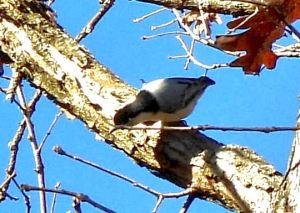
Well, after my cumbersome procedure of many minutes later, I discovered that what I had snapped was a white-breasted nuthatch, a type of bird that I had snapped serendipitously last fall, but with much less effort.

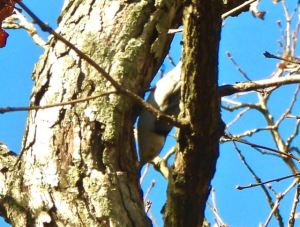
White-breasted nuthatch between trunk and branch of white oak, Nov. 20, west of the lake

So what did I feel? Yes, a kind of satisfaction, sure. But not a satisfaction that might come from a victory in some kind of competition–me against the little bird, if such a thing could be imagined. Rather, it was the sense of a link between me and that little bird, a magnificent being who had allowed me to share a tiny moment of life.

And that is pretty much how I always feel when I take a successful picture, or even when I just am allowed by the bird to see this fellow for a moment before she or he moves on to the next objective. Oh they move so quickly, so often silently, and they hide so mysteriously, and they sing so gloriously. And when they stop just for a moment in my presence, I breathe a “thank you” that I can only hope they somehow feel.

White-breasted nuthatch on the trunk of a white oak, west side of the lake, Nov. 20. Can you see him or her?

White-breasted nuthatch on a branch of the white oak, clearer view, Nov. 20, west of the lake

*********************************************

California Odyssey: Sharing Time with Family, Friends, and Wildlife

Sea lions in La Jolla Cove, La Jolla, California, Nov. 3

Our first trip back to California since our move to Virginia last year took place in early November. The trip was a celebration in several respects: it was a milestone wedding anniversary for Jean and me, and an opportunity to visit with our two West Coast daughters and share meals with them and their partners.  It also meant our taking part in the wedding of two good friends in La Jolla, as well as reconnecting with other old friends there. So the trip became a weeklong odyssey along the California coast between San Diego and Los Angeles.

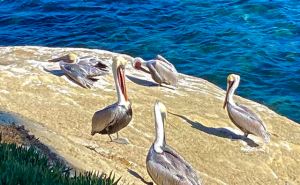
Brown pelicans on the cliffs at La Jolla Cove, California, Nov. 3

Visiting the Bolsa Chica Wetlands

Besides our planned visits with our daughters and their partners in Seal Beach and Long Beach, and the wedding in La Jolla, our short odyssey featured touristy time in San Diego and Los Angeles, as well as beach views along the Pacific Coast Highway.

Panorama of Sunset Beach, California, early morning, Nov. 6, with shearwater gulls and morning walkers

An unexpected treat was visiting the Bolsa Chica Ecological Reserve in coastal Orange County. The Bolsa Chica Wetlands, next to what is now Sunset Beach in Huntington Beach, California, were an extensive tidal marsh beside the Pacific Ocean, with hospitable use for over 9000 years by native tribes such as the Acjachemen and later the Tongva. Then, extensive coastal destruction by developers came in the later 19th and early 20th centuries. The marsh still existed in part, but without any protection. Then property purchasers wanted to drain it completely and build beachfront houses in the 1970s.

A marina in Sunset Beach abuts the northwest edge of the Bolsa Chica Ecological Reserve, November 6

A concerted effort by local, state, and finally national organizations soon arose, which after several years convinced the courts to halt the destruction plan and establish the remaining marsh as a nature preserve.  Today the Bolsa Chica that remains is open to the public to visit and take photos from miles of wooden walkways. Though the rushing traffic on the adjoining Pacific Coast Highway and a large adjacent marina limit the marsh, it continues to provide a home for native plants and the animal life that the plants and water sustain.

A sparrow rests in a Chamiso Saltbush at the Bolsa Chica Ecological Reserve in Huntington Beach, California, November 6

It takes less than a minute for speedy drivers on the PCH to pass by the Bolsa Chica, so it’s easy for people to not even know it is there. But for the wildlife that depends on it, and for the humans who stop and stay to admire it, Bolsa Chica provides a life-giving break from the commercial development along the Orange County coast.

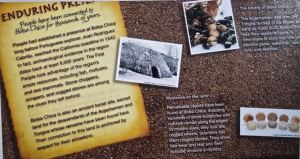
Infographic of history of human presence at Bolsa Chica Wetlands Reserve in California

********************************************

On the Day Itself: Family and a Bit of Cookery

Three generations of family at our Thanksgiving meal

We spent the official Thanksgiving Day with local family members, three generations of us, at their home. We enjoyed a wonderful array of foods, with some contributions by all. Jean and I made two dishes, three sisters stew and corn  casserole. Last December, I described in this blog the Native American history of the “three sisters” dish and my adaptations. This year, as I made the stew, I videoed its cooking, with a bit of background music:

Jean’s corn casserole, with milk, eggs, and corn meal creating a dreamy creamy texture with the sweet whole kernel corn, cooked for four hours in the crockpot and came out a perfect addition to our communal meal:

Then, on the day after Thanksgiving, which for some reason the commercial world calls Black Friday, we continued the family thanks-sharing. First, my sister and brother-in law, who had traveled from downstate Virginia, and my niece and her husband joined us for a celebratory breakfast. And to top off all the festivities, one of our New York sons, our daughter-in-law, and their spunky, energy-filled kids, ages five and three, joined us for a picnic lunch on a crisp, bright afternoon at a nearby park and for hot beverages at a nearby Starbucks:

One day is just not enough for all the thankfulness. Here’s to Thanksgiving Month!

The November 2023 Photo/Video Gallery: Fall Colors Persist, Visitors Arrive, and the Mallards Return

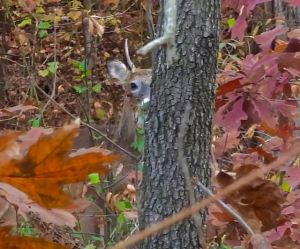
A young deer peeks at me from behind a white oak in the east side woods, far from the north end where we usually see them, and no more than forty feet from where I stand in the path, Nov. 15. A truly serendipitous photo.

A Blue Jay, resplendent in various blues, calls from atop a red oak on the southeast bank just after sunrise, Nov. 25

In the cold rain of Nov. 21, the brilliant oakleaf hydrangea contrasts with the misty north end of the lake

The great blue heron, who usually haunts the shoreline, hides in this Virginia pine in the north end woods, Nov. 19

This great blue follows bird calls while alert on the west bank, Nov. 27

Three pairs of mallards, newly returned, adorn the southeast cove, Nov. 12

And on Nov. 22, another returnee, a cormorant, with bold wingspread, on the west side dock

Sunlit late fall colors along the west side path, early morning, Nov. 13

In this short video, a male mallard flies in to join (impress?) a female friend, then takes off down the lake, Nov. 15

Raindrop circles in the inlet stream beside the bridge, with late fall colors, Nov. 21, in the steady downpour 

A male cardinal atop a berry-clustered red cedar in the northwest corner by the lake, Nov. 15

First time sighting of a male bufflehead duck in our lake, Nov. 10, on a rainy morning

And now, on Nov. 22, the bufflehead returns–and has been joined by another! 

Three rock doves look down on the lake from the power lines to the northwest, Nov. 15

Panorama, with a young red maple , as I look toward downtown in the rain of Nov. 21

Short video of rock dove flock performing aerobatics west of the lake, Nov. 19

A mallard pair in the southeast cove silhouetted against the late fall colors of the west bank on the mirror lake, Nov. 19

A pair of Canada geese eye a mallard pair in the southeast cove, Nov. 9

In this 2-minute video, watch how this mallard couple builds their relationship in the quiet southeast cove, Nov. 11.

Thank you for reading, viewing, and listening. On to December!

October 2023: On Indigenous Peoples’ Morning, Walking to Remember and Learn

A rarely visiting Cooper’s Hawk, early morning, east bank of lake, Oct. 9 (Indigenous Peoples Morning)

In this month’s entry:

Walking the Lakeshore on Indigenous Peoples Morning
Keeping Alive the Landscape History of the LA Region
From the Renaissance Festival to Maryland’s Eastern Shore
October 2023 Photo/Video Gallery: Fall Colors, Citizens, Visitors

A Bald Eagle, one of many noble citizens of the Blackwater National Wildlife Refuge on Maryland’s Eastern Shore, Oct. 24. See the section on our trip there later in the entry.

Walking Our Lakeshore on Indigenous Peoples Morning, Oct. 9

Walking the lakeshore mindfully seems particularly appropriate on Indigenous Peoples Day, since the indigenous of North America practiced a way of living that appreciates plants, animals, water, air, and the land in ways that our mass culture of unlimited consumption ignores, with the destruction of life on our planet as the inevitable consequence.

Indigenous Peoples Day, the 2nd Monday in October, and Native American Heritage Day, the day after Thanksgiving in November, were established by Congress so citizens of the U.S. would both keep in mind the essential contributions of our indigenous peoples to sustaining our great country and honor the continuing contributions of their descendants today and into the future. These days of commemoration are one very small effort to counteract the centuries of erasure of Native Americans that began with the first settlers from Europe in 1607 in Virginia and that continues today with state laws like that passed in 2021 in Oklahoma to ban children from learning in school about the decimation of the Osage people in the early 1900s (and the massacre of Black Oklahomans in Tulsa in 1921).

“Perhaps someday we’ll begin teaching our children the full, demythologized truth about ourselves,  but I doubt it.” Rinker Buck, The Oregon Trail: A New American Journey (Thorndike Press, 2015, p. 720)

The erasure of Native peoples and their cultures is equalled by the ongoing–and closely related– erasure of the land and its plant and animal citizens that has been going on since 1607 by what we call “progress” and “development.” These two pretty words mask the wholesale destruction of true wilderness and its creatures, such as the extinction and near-extinction of thousands of species–and the ever-increasing fouling of air, water, and soil by mining, the burning of fossil fuels, and irresponsible hunting and farming methods that have continued throughout the expanding U.S. over four centuries.

Early fall color palette: white boneset, goldenrod, red maple, and willow oak, at the southeast cove, Oct. 9

A Reciprocal Relationship with the Earth. As I explored in the blog a year ago, part of that erasure meant our never learning–or our forgetting–the native peoples’ brilliant understanding of what Robin Wall Kimmerer calls (in Braiding Sweetgrass) a “reciprocal” relationship with Mother Earth. This relationship requires that what we take from Earth and her creatures must be equalled by what we give back.  So, for example, if we feed ourselves fish from the rivers or birds from the air, we never take so much that the species can’t reproduce an equal number or greater. And we never plant so much of the soil to feed or clothe ourselves–especially with a single crop–that the soil becomes so depleted of nutrients that the land cannot easily recover. And so on for all human actions.

An Earth-Saving Lifestyle. So what can I as an aging human in 2023 in the “progress'”-deformed  North America do to practice a reciprocal relationship with Mother Earth? I explored this question in the blog for April 2023. There I described my efforts to lead an “Earth-saving Lifestyle,” which included in my list of actions something I do every day toward not forgetting the “more than human” citizens of my world: “I can walk around the lake and glory in the birdsong, the change of seasons, the constant creative work of local animals and plants to survive and share beauty.” In other words, I try to pay attention and learn more and more about my environment, despite all the lures of over-consumption that distract me and most others.

Another writer who tries to live an “earth-saving lifestyle” is Margaret Renkl . Read what she has to say in this essay from October 9 about nurturing the endangered citizens of her Tennessee garden.

So on Indigenous Peoples Day 2023, I walked with my camera slowly around the lake, watching, listening, smelling and tasting the air, and being alert for what I might learn about this place where I live. I was rewarded, as I am in each day’s walk, by bounty that my camera can only capture a tiny part of. Bounty that it is my responsibility to help protect.

Besides the Cooper’s Hawk pictured at the start of this entry, here are a few of those rewards:

Six red-bellied cooters in formation on a log behind dotted smartweed at the north end of the lake, Oct. 9

A great blue heron landed near me on the northeast bank and then stalked for a meal, Oct. 9

A Cardinal in red cedar on the northwest bank in early morning sun, Oct. 9

Northern flicker after sunrise in the southeast cove, Oct. 9

Bumblebee on wild asters and blackberry leaves, north end, Oct. 9

***********************

Keeping Alive the Landscape History of the LA Region

Cover map of the new report on the Indigenous Landscape of the LA region

Often, not forgetting means taking extraordinary efforts to remember. A case in point is the Los Angeles Landscape History Project, begun in 2018 with foundation funding and involving the work of a team of representatives from three tribes (Chumash, Tataviam, Gabrieleño) and geographers, historians, and biologists from four LA region universities (CSU Long Beach, CSU Northridge, CSU Los Angeles, and the University of Southern California). According to the Executive Summary of the brand-new, freely available report–released on Indigenous Peoples Day–the project blended “different approaches to understanding and describing the landscape to produce a set of parallel products that describe…six village sites in detail and provide detailed maps of the natural environment, its flora and fauna, and tools to understand its influence into the modern era for the region.”

The Summary concludes as follows:

“This project is unique because a commonly shared, detailed map of the historical ecology—the flora, fauna, hydrology, and landforms, that evolved within Southern California’s Mediterranean climate over millennia and supported human populations for 9,000 years, has never been developed. Individually and cumulatively, the results of this research are vital resources to all regional and local planning efforts involving sustainability, habitat restoration, and preparing for climate change. This project is unique also because four of its co-Principal Investigators are members of the Indigenous peoples of the Los Angeles Basin (Gabrieleño, Tataviam, and Chumash).”

Fig. 0-4 of the Executive Summary. “Indigenous roads and pathways compared with contemporary road network.”

*******************************

More Exploring: The Renaissance Festival and Maryland’s Eastern Shore

Canada geese flock in flight over the Blackwater National Wildlife Refuge, Oct. 24

Since we moved to Virginia from California last year, we’ve been exploring historic places in the watershed of the nearby Potomac River in Virginia, West Virginia, Maryland, and southern Pennsylvania. Well, last week and this we spent a couple days on the other side of Chesapeake Bay, along part of Maryland’s iconic Eastern Shore. Whereas the western shore of Chesapeake Bay features long, broad rivers like the Potomac and the James, the Eastern Shore (as the map below shows) presents marshes, narrow peninsulas, and many small inlets and creeks, as well as a few broader, winding rivers such as the Choptank, beside which the small, historic city of Cambridge sits.

Map of the Choptank region of Maryland’s Eastern Shore (from the Maritime Museum in St. Michael’s)

For thousands of years, the Eastern Shore has had a maritime, riverine human culture, with native tribes like the Nanticoke and Choptanks thriving on the crabs, oysters, and fish for which the region continues to be famous. Many of the English settlers who arrived beginning in the 17th century also took on this water-focused life, although the broad, flat, fertile lands east of the peninsulas and marshes became tobacco fields and plantations, just like their famous counterparts west of the Bay. As the lucrative trade with England in tobacco took over more and more of the land, the tribes of the region, who had thrived on a diversified agriculture and aquaculture, were forced out and decimated, with murder of natives encouraged by a colonial Maryland decree in 1652. (A later treaty gave the remaining Choptanks a reservation that they held until 1822.)

The working boatyard at the Chesapeake Bay Maritime Museum in St. Michael’s, MD, where boats of the historic water culture are restored.

Visiting the Maryland Renaissance Festival

Our short trip to the Eastern Shore began this past Sunday with a visit by us and other family members (three generations of us!) to the annual Renaissance Festival in Crownsville, just north of Annapolis, the state capital. The festival, which draws thousands from across the region, is a different kind of remembering, and features events, food, and costumed staff and visitors recalling the England of the Middle Ages and of the days of King Henry the Eighth and Queen Elizabeth I.

Costumed revelers at the Maryland Renaissance Festival, Oct. 22.

Music and Dancers at the Renaissance Festival, Oct. 22

One of the most anticipated events each year is the medieval jousting tournament, at which each section of the crowd cheers for their favorite competitor.

The royal court of King Henry the Eighth, presiding at the jousting tournament

Moments of the third competition of the jousting tournament, Renaissance Festival

Best of all for us was the time we spent with our family members, including two of our grandchildren, ages 6 and 8, all suitably garbed for the celebration!

Members of our family creatively, even spookily, dressed for the Festival!

Visiting St. Michael’s, Remembering the History of the Waterfolk

Our visit to the Eastern Shore focused on two quite different locales in the region. The first was the village of St. Michael’s, founded in the 1600s, and the narrow peninsula nearby (as shown on the map above) that winds down to tiny Tilghman Island. Water culture is alive and well in this area and is honored in the Chesapeake Bay Maritime Museum, which vividly displays both the history and present of a changing environment. Spread over 20 acres, the Museum includes

  • a working boatyard, where historic craft are restored
  • an art gallery, which this month focuses on climate change and the depletion of the shellfish
  • a historic lighthouse (that you can climb!)
  • an interactive display of the most famous water craft, the skipjack,

as well as three history museums. It even includes a cabin once lived in by the sister of Frederick Douglass, who was born in nearby Easton. Set on the Miles River waterfront, the Museum campus offers magnificent views of the river and marshland.

Viewing the Miles River, marsh, and buildings of the Maritime Museum

The historic collection of restored rivercraft at the Maritime Museum, Oct. 23

Douglass cabin and garden at the Maritime Museum

Panorama of the Miles River waterfront and Museum buildings from the top of the old Lighthouse, Oct. 23

Nearby Tilghman Island. Twelve miles from St. Michael’s the peninsula ends with tiny Tilghman Island, with much of the sparse land a nature preserve. Here the Choptank River flows into the Bay. A marvelous setting for photography!

Black Walnut Point on Tilghman Island is a mere 12 miles across the Bay from Virginia, seen in the background beyond the sailboats

A song sparrow in the Tilghman Island marsh, Oct. 23

Herring gulls on the wharf, Choptank estuary, Tilghman Island, Oct. 23

Watching from the reeds toward the Choptank estuary, Tilghman Island, Oct. 23

Day Two: The Blackwater National Wildlife Refuge

Since we’d moved back to Virginia, I’d had this wonderful place, south of the Choptank, on my radar. It includes forest and marshes, with a setting beside the broad Blackwater River which draws varied waterfowl, migrating and year-round, and other marsh folk. It has miles of trails and a great 3.6 mile drive that takes visitors to all parts of the refuge. If you have a good camera, you’re in reach of subjects well away from your car. Here are a few of the folks I snapped.  (One caution: bring repellant. The skeeters can be ferocious.)

Cackling geese

Devil’s Walking Stick beside a trail

Three mallards in reeds

Female Northern Pintail duck

Marsh Wren in hair-awn muhly reeds

Grounseltree or salt bush at marsh edge

A Pair of Great Blue Herons advance in the river

Rare sighting of a Wilson’s Phalarope in the marsh

A Savannah Sparrow on a shed roof

A lone Great Blue Heron on gnarled wood

Panorama of the quiet Blackwater River on a sunny, breezy morning, Oct. 24

******************************

The October 2023 Photo/Video Gallery: Fall Colors, Citizens, and Visitors

Late October is the peak of the autumn color display where we live. Not only do the trees always amaze, but the other lake citizens–and a few migrating visitors–also put on a pre-winter show.

A Blue Jay and Mockingbird scuffle in the elderberry, east bank, Oct. 25

Full fall colors in the north end woods, Oct. 29

Two European Starlings enjoy the view atop a dead tree on the east side bank of the lake, Oct. 29

Fall display from the southeast cove to the west side, Oct. 25

A Mockingbird in mid-scuffle with a Blue Jay stares amid Virginia creeper and red cedar on the east bank, Oct. 25

A Great Blue Heron walks, turns, and stalks along the south end of the lake, early morning, Oct. 29

A Warbling Vireo enjoys Poison Ivy berries above the inlet bridge, Oct. 25

Sugar maples show off on the west side path, Oct. 25

A male Cardinal is always showy, and certainly always in the fall displays, southeast bank, Oct. 25

Surprise visitors–4 Northern Pintails–glide along the west bank, Oct. 18

A flock of Canada geese enjoy the southeast cove amid fall colors and the gazebo on the west side, Oct. 29

Sugar maple in full color south of the lake, Oct. 21

What begins as a short video of one of our Great Blue Herons with the Pintails and Geese becomes a melee of Heron and Geese that ends with Heron soaring across the lake, Oct. 18. Watch and listen.

Quiet Lake Cameron fall display toward the north end, Oct. 25

Panorama of our lake refuge toward busy downtown, with fall colors and yellow evening primrose, Oct. 29

All joy from our colorful October toward a thankful November in hope and mindfulness.

September 2023: Celebrating Our Bees, Butterflies, and Wildflowers

Our first sighting of a monarch, in shadows amid the boneset flowers on the northwest bank, Sept. 15 (see story, below)

In this month’s blog entry:

A Bee, Butterfly, and Wildflower Celebration
More Potomac Valley Discoveries in Maryland and Pennsylvania
The September 2023 Photo/Video Gallery

Two Virginia skipper butterflies in boneset flowers on the east bank, Sept. 14

Celebrating Our Bees, Butterflies, and Wildflowers

I had not yet seen an adult monarch butterfly by our lake in the year and a half I’d been walking the lakeside. Last fall I saw a monarch caterpillar in one of our swamp milkweeds, but not the adult. So I almost couldn’t believe my eyes when I glimpsed a flash of red-orange more than 100 feet away as I scanned the north end of the lake. So I snapped a photo of the deep shadows where I hoped the butterfly had landed. I zoomed into the shady foliage as closely as I could. Then, back home, when I could enlarge and brighten the photo, lo and behold, there was a  monarch!

The plant that the monarch in the opening photo is feasting on is the favorite host plant for the pollinators this month: the prolific late boneset, which thrives around the lakeshore this time of year.

This September, boneset dominates much of the lakeshore, including the southeast cove (Sept. 21)

The second favorite for the past three months has been the brilliant lavender-purple bull thistle, which is now past its bloom time, but still helps to provide a safe home for birds, bunnies, and insects. The blog galleries in July and August featured butterflies, especially the yellow tiger swallowtails, and bumblebees on the bull thistle.

Close-in view of a bumblebee on boneset on the southwest bank, Sept. 19.

Though few butterfly species inhabit our lakeshore, the yellow tiger swallowtails are prominent (Aug. 24). The purple bull thistles draw them and other pollinators.

Learning wildflowers: every day is different and a reason to celebrate. My daily lakeshore discovery walks, as I call them, have made me ever more aware of the great diversity of wild and domesticated plants and wildflowers along the lake and in the surrounding fields and woods. My walks, with my Nikon P950 camera, help me focus on what I’m seeing, and make me curious to identify the different plants and animals I encounter. Two apps, PictureThis (V3.51) and Merlin Bird ID (from the Cornell Lab of Ornithology), allow me to snap iPhone photos of any plant or bird and immediately get much information about what I’m seeing.  I’ve become much more observant not only of the diverse plants, but also of the changes that occur from day to day and month to month throughout this sanctuary.

In this month’s gallery, check out more photos and videos of plants, birds, insects, and a few of our other citizens this September.

A display of yellow foxtail bristlegrass appears this month along the north end path, Sept. 21

More Potomac Valley Discoveries in Pennsylvania and Maryland

18th century log houses and cornpatch, Conococheague Institute, Welsh Run, PA, Sept. 8

In exploring the Potomac and its tributaries, one of our favorite regions to visit is about 60 miles west and north of our Virginia home. In southern Pennsylvania, just north of Hagerstown, Maryland, is the Conococheague Institute, near tiny Welsh Run, PA. The Institute is a restored 18th century farm, museum, and library dedicated to the study of early settler history and to preserving the natural environment that surrounds the farm. Nearby Conococheague Creek provided water and transportation for the indigenous people who lived in the area for thousands of years before the arrival of the settlers, who were mainly of German origin. The creek is a tributary of the Potomac, into which the creek flows about 30 miles south at Williamsport, MD, as I described in the February 2023 entry.

Fritillary butterfly at Conococheague Institute farm, Sept. 8

The work of the Institute is particularly important to us, because a small cemetery only about a half mile from the farm holds the graves of some of Jean’s immigrant ancestors, who first came to the area in the 1730s. The Institute provides information to support family research, and the researchers in turn help to support the work of the Institute.

This small cemetery, amid cornfields, is overgrown now with bristlegrass. The cemetery holds graves of German immigrants from the 18th century (Sept. 8)

Fort Frederick State Park. A site we’d been wanting to visit, but had not explored before this month, is Fort Frederick State Park, MD, about 30 miles west and south from Welsh Run, PA, near the town of Clear Spring. Fort Frederick is both an historical site and, through its Friends of Fort Frederick, a center for cultural activities for children and adults, including an annual Market Fair, held in April.

Fort Frederick, built 1756-57, main gate and southside walls, Sept. 8

This imposing edifice, built to hold thousands of troops and withstand a prolonged attack, was testament to the dedication of the British, their North American colonies, and tribes of indigenous peoples allied with them, to defeat the alliance of the French and several other indigenous peoples in what became known as the French and Indian War, 1755-1763. Ironically, the fort never saw a battle in that war, as the armies moved 160 miles west, to contest for control of  the Monongahela, Allegheny, and Ohio rivers at the French Fort Duquesne, now the location of the city of Pittsburgh. The British and their allies captured Duquesne from the French in 1759, renamed it Fort Pitt, and the war moved farther north into Canada.

Aerial view of the restored Fort Frederick of today.

As a further irony, Fort Frederick was used in a later war, the War of Independence waged by the colonies against Great Britain, from 1775 to 1783. Instead of being manned by British soldiers, however, the fort was used by the colonists as a prison–to hold the 2000 or more British soldiers captured in 1777 at the Battle of Saratoga in New York! The prisoners from Saratoga and from other battles were held there until the end of hostilities in 1781, whereupon some of those who survived returned to Europe and others chose to stay in the now independent United States.

Barracks at restored Fort Frederick made to resemble prison housing for British soldiers in the US war for independence, 1777-81

As for the indigenous peoples who had fought in the 1755-63 war, many of them on the side of the victorious British and the colonists, they fared tragically over the following 60 years of warfare with the settlers and the new United States. The treaties that the natives had agreed to in order to fight were like all the subsequent treaties between the settlers and the natives: thoroughly disregarded by those who had made promises to the indigenous. Those native soldiers and their families who survived the wars, the burning of their villages, starvation,  and settler diseases such as smallpox were steadily forced off their homelands and pushed farther and farther west.

Late 19th and early 2Oth century: the Williams family. Another irony is that as Fort Frederick began to crumble because of disuse, it and the land were sold to an emancipated Black family headed by Nathan Williams, who farmed it successfully for many years. In the 1920s, the state of Maryland re-purchased the fort and land, and in the 1930s, in the midst of the Great Depression, the Civilian Conservation Corps, which had been created by Congress to give jobs to poor youth, restored the fort to the original massive grandeur that visitors witness today.

Panorama of the west side of Fort Frederick, restored in the 1930s by the Civilian Conservation Corps during the Great Depression

Fort Frederick: the nearby Chesapeake & Ohio “Big Pool,” the beaver pond, and the Potomac itself. Another reason we wanted to visit Fort Frederick is its nearness to the Potomac itself and to the early 19th century Chesapeake & Ohio Canal. Strategically, the fort was built on high ground only half a mile from the river. But the hilly acres between the fort and the river are mostly marshland, which means that today the great value of the location is its biodiversity of animal and plant life. As part of the state park, this means that this large wetland will be protected.

The “Big Pool” wetland just downhill from Fort Frederick, part of the Chesapeake & Ohio Canal built in the early 19th century

As one walks down toward the river, the first part of the wetland one encounters is the “Big Pool,” actually a small lake that was incorporated into the Chesapeake & Ohio Canal in the 1820s. As the photo above shows, the pool is surrounded by dense woods. Then, as one proceeds down toward the river, one next encounters the Beaver Pond, a dense swamp whose composition varies with the water level. Beavers are just one of many species who thrive in the marsh.

The Beaver Pond, thick with white water crowfoot, below the Big Pool and above the Potomac, all down the hill from Fort Frederick (Sept. 8)

Finally, as one winds forward on the downward trail, the Potomac River itself comes into view. On the hot, cloudy day we visited, the water level was lower than normal, but the crisp, steady flow of the river contrasted with the thick stillness of the Beaver Pond and so sustains its own very different ecosystem.

The Potomac River, down the hill from Big Pool and the Beaver Pond, viewed toward the west, Sept. 8

How amazing that in such a short walk, less than half a mile, I could encounter such different ecological worlds.

As you watch the video above, listen for the call of the Belted Kingfisher toward the end.

The September 2023 Photo/Video Gallery

Our gallery celebrates more wildflowers and animals this month, as well as an unexpected tropical storm that lashed our quiet refuge from September 22 to 24.

A bumblebee luxuriates in an evening primrose on the east side, Sept. 22

A rarely seen Eastern wood pewee atop a dead tree on the east bank, very hot day, Sept. 4

A downy woodpecker on the trunk of the same tree, Sept. 4

Profuse ripe berries on amur honeysuckle on the east bank, Sept. 15

A bumblebee samples a patch of mile-a-minute vines and berries, east bank, Sept. 19

 A cardinal couple in a berry-rich juniper tree, southeast bank, Sept. 19

One of our cottontails munches grass along the northeast side path, Sept. 22

A female red-winged blackbird enjoys one of the elderberry trees on the east bank, Sept. 19

A mockingbird observes in a persimmon tree on the northeast lakeside, Sept. 22

A Canada goose and 3 red-bellied cooters converse in the southeast cove, Sept. 20

A rare female morph tiger swallowtail and several bumblebees engage the wind as they enjoy purple bull thistles on the north end bank, Sept. 5

Female blue grosbeak is alert in American burnweed at the north end, Sept. 22

Our newly returned flock of 50 Canada geese fly and call across the lake, Sept. 14

Amazing sunset heralds the Tropical Storm Ophelia, as seen across the lake from the east side, Sept. 22

Rainwater rushes into the lake from the southeast inlet stream during Tropical Storm Ophelia, Sept. 23

Winds and rain from Tropical Storm Ophelia churn the lake and raise its level more than a foot over 3 days, Sept. 22-24 

A week of September remains to be explored, with more rain in the forecast. And then on to October with joy and great expectations!

August 2023: Who’s Missing as I Walk Around the Lake?

Green heron stalks in red maple, east bank, August 27

In this month’s blog entry:

Who’s Missing as I Walk around the Lake?
A Northern Virginia Climate Impasse
Venerable Lahaina, Rest in Peace
If Not Fires, Then Floods in Cali
More Somber Potomac Valley History
The August 2023 Photo/Video Gallery

A welcome returning citizen: an American Goldfinch in bull thistles on the northeast bank, August 10

Who’s Missing as I Walk Around the Lake?

I haven’t seen a hawk here since March, when I snapped a red shoulder well below the north end dam.

None of our other hunters here stun the songbirds into silence and camouflage like the red shoulders, redtails, cooper’s, sharp-shinned, and goshawks do. Their visits are always infrequent, only rarely lasting more than a day, but the songbirds always know. These five months have been the longest interval without hawks since I’ve lived here. When will they return?

Red-shouldered hawk launches above Lake Cameron in January 2023

I’m not predicting anything dire for our little bit of sanctuary, but North America has three billion fewer  birds than it had in 1970, according to a review of surveys published in Science in September 2019. Habitat loss and climate change have been the main culprits. The loss has been about 30% of all birds in North America in those five decades. The steep decline has been pretty much across most species, with shorebirds, songbirds, and prairie species hardest hit. Outside North America, think, for example, of the massive loss of Emperor penguin chicks in the Antarctic this year as the sea ice retreats from their breeding grounds.

Surprisingly, after plummeting before 1970, raptors actually increased after 1970, largely because of the banning of DDT in the 1960s. So there might be some hope left for our hawks. The DDT story, the Science authors say, shows the good that can happen if enough people and organizations unite in an environmental cause to defeat powerful, entrenched corporate interests.

Preserving more and more wild land from destruction is key. Keeping tiny wetland refuges (like ours) safe from ever-encroaching development will also be vital in most communities. We have to start thinking of a “healthy economy” as requiring us to be creative and respectful in adapting already developed space–even “rewilding” some of it–not crunching more precious native land and erasing the species it nurtures.

Typical weekday noon: a tree-lined parking lot in our community, August 25

A Northern Virginia Climate Impasse

I apologize for the intrusion of a parking lot into my photo montage of the lake, but throughout our lakeside community are some 350 or more spaces for our residents, at least 90% of which are filled most evenings by gas-burning sedans and mid-size SUVS that are not hybrids. The number of EVs is small and slowly growing, as is the number of hybrids. However, at this rate, the dominance of conventional gas burners will go on for years. And this is the sobering fact that all us climate idealists must always keep in mind.

The photo above is taken at noon on a weekday. Typically, at least 40% of the spaces are empty at noon, about 150 cars, whose drivers commute each morning to work, etc., and return by 6 PM, when the lot is full. Quite a predictable in-and-out-flow. Which means all those conventional tailpipe emissions, year upon year, until any meaningful change occurs.

How many years? Well, if the growth of hybrids and EVs continues at the current rate, about 8% per year at best, then let’s say 12 years or more will pass until the guzzlers are pretty much replaced, the big factors being availability and affordability.  Unfortunately, I think 12 years is way too optimistic, given the unparalleled negative power of the fossil fuel lobby and of the governments, like Russia’s and those of a chunk of US states, devoted to the old, poisonous ways, like our neighbor just one county beyond, West Virginia.

Now if auto manufacturers were fully committed to EVs (only some are even partly committed), I’d revise the guess, but where’s the evidence for such commitment?  Most automakers are still advertising the heck out of their guzzlers, even if they also push their EVs.  And it’s noteworthy that the guzzlers have a lower sticker price, though there’s no real reason for that beyond automaker choice. So where do automakers’ hearts (if hearts they have) really lie?

Venerable Lahaina, Rest in Peace

Lahaina old town and marina before the August fire that wiped it out (Getty image)

Lahaina: cars abandoned as people tried to leave amid the flames, August 10 (Paula Ramon, AFP, Getty)

These pictures seem a world away from my tiny lake, don’t they?  I recall thinking that the Northwest Territories of Canada were a world away, too, and then our own skies here were grayish orange in June from the fires that still burn there today.

When we lived in California in 2020, we were shocked that storms coming from another faraway world, up the coast of South America, were spawning lightning strikes that started the wildfire that came within a few miles of our home in the Sacramento Valley that August.

The fire that caused the most deaths in California, the Camp Fire of 2018, was ignited by a faulty electric transmission tower. The larger cause, of course, is the high-pressure drought that plagues Maui and California alike in a warming climate. That 2018 fire trapped cars trying to leave the fire zone. The town that was destroyed was named Paradise, a name often given to Maui, where the fire that destroyed Lahaina last week had similar cause and a similar spark. But California may have seemed a world away and maybe not relevant enough to warn the public safety officials in Maui, where cars were similarly trapped, and where many, many more dead are still unrecovered.

We visited Maui and the venerable old city of Lahaina in 2008. Our memories of that remarkable trip are as fresh today as if they were being formed–today. Now we have even more reason never to forget. We didn’t know we’d be grieving such loss. We certainly didn’t suspect that when we did grieve for the people, fellow creatures, and land that is Maui, the grief would feel like our own in a world that keeps growing smaller.

Donations in Lahaina after the fires were out, August 12 (Yuki Iwamura, AFP, Getty)

If Not Fires, Then Floods in Cali

Five inches of rain in the Coachella Valley leaves scenes like this in Cathedral City on Aug. 20 (KTLA News photo)

While Maui was still in the midst of its horrors, California and the Mexican states bordering it were facing their own unprecedented climate event, an August hurricane and tropical storm, named Hilary. Used to withering heat, drought, and wildfires this time of year, Southern Californians were bracing for possibly torrential rains and devastating summer floods, for which they have no infrastructure.  Ironically, however, the record atmospheric rivers and mountains of snow last winter east of the LA basin at least had LA and communities east somewhat psychologically prepared for continuing extreme events.

To everyone’s relief, the storm, when it hit, brought the LA region some heavy, but not torrential rain and little flooding. In contrast, toward the desert mountains, including Death Valley, which only a few weeks earlier had almost set a new world record for heat (it did reach 129 degrees F), rain totals were record setting: 2.2 inches in one day in the Valley, with extensive flood damage and closed roads.

Farther south, however, in the Coachella Valley resorts of Palm Springs, Cathedral City, and Palm Desert, as many as 5 inches came down over a day and a half, leaving streets and homes inundated. Fortunately, there was no reported loss of life.

Alex Hall, director of the Center for Climate Change at UCLA, spoke with Ailsa Chang of NPR on Aug. 23. Chang asked the question that was on every Californian’s mind after this unprecedented winter and now summer of record precipitation: “Where does California exactly stand now in terms of drought after all of these different storms, all the rain and snow last winter?”

Here’s Hall’s answer: “California is the land of extremes. It always has been. We have always had big, wet years and deep droughts. That’s a hallmark of the hydroclimate in California. So we expect drought to return to the state. The challenge going forward is really to capture the water that does come in the wet years, especially in a changing climate where we expect there to be more precipitation in storms. We need to be in a better position to capture that extra water to get us through the inevitable droughts, which, by the way, will also intensify in a warming climate – probably already have intensified somewhat. We know that we will have dry years coming up, and we have to prepare for those.”

Bristow Station: More Somber Potomac Valley History

Tragic events at this little-known site of Civil War conflict are memorialized at this beautiful creekside park near Manassas

I’d heard about the 1863 battle at tiny Bristoe Station, but knew almost nothing about it. So we spent an early August morning tracking down the small battlefield park south of the much more famous Manassas, expecting to find a plaque or two somewhere along the two creeks, Kettle Run and Broad Run, that I could see from the map flowed through that area on their way to the Occoquan River, which then wound its way into the broad Potomac.  Learning more about the Potomac Valley is always on my agenda.

Well, as ever in our travels, we were surprised and impressed by what we found. The marker above was by a substantial parking lot and led to several paths, one of which climbs a hill to a broad battlefield from 1863. It has a commanding view miles into the distance. One can easily imagine seeing regiments marching in formation and being confronted by opposing infantry and artillery.

The other main path, broad and well marked, we discovered to be very different. It led into a dark, fragrant forest of wildflowers, tall trees, and some marshland. It revealed itself to be both a nature preserve and a sanctuary to commemorate the many poor souls who had died and were buried there, mostly in the first year of the war, 1861.

Indeed, if you read the plaque above, you will learn much of the tragic story.

Bristoe memorial park and wildflower sanctuary, August 1

That more Civil War dead succumbed to illness or infections than to wounds received in battle is well known.  Just last month, this blog noted deaths of Confederate prisoners and Union soldiers at the Point Lookout prison camp late in the war. But this relatively neglected Bristoe Station battlefield park commemorates soldiers from several Southern states who were new to the war, in its very first year, and who died in unstoppable epidemics from the mere fact of their being camped together with their friends, neighbors, and fellow recruits. I’m imagining surviving officers, sick themselves, writing letters to parents and wives, and these relatives reading them in utter disbelief.  I’m imagining the Union troops, a year later, coming suddenly upon these burial grounds, one state after another, in dark woods, and perhaps hurrying on from this morbidly unlucky place.

Alabama burial ground in the Bristow Station forest, renovated after the war to honor the fallen youth of 1861.

Walking through the forest today honors the memory of the fallen by devoting the ground to the growth of wildflowers and native trees. Silence and the echo of soft birdsong reign. Three signs in the woods, each saying “Do Not Mow,” reinforce the spirit.

Wild sweet potato morning glory in Bristoe Station sanctuary

Whole leaf rosinweed in Bristoe Station sanctuary, August 1

The August 2023 Photo/Video Gallery

New and returning wildflowers, birds, and other creatures greet us each month. See and hear this month’s bounty.

Purple ironweed, south end of the lake, Aug. 23

Northern mockingbird poses for the camera, with returning geese in the lake beyond, Aug. 23

False waterpepper and bumblebee brighten the west side, Aug. 23

A great blue heron preens on the southeast bank, and listens to the late August choir of cicadas, locusts, and crickets

Storm in our community, Aug. 10 (same day as wildfire in Maui)

Wild evening primroses and bull thistles beautify the north end of the lake, Aug. 23

A rare visitor: an osprey from Chesapeake Bay, like those we saw in St.Mary’s, Aug. 10

The lakeshore teems with late boneset and bumblebees in August (Aug. 24)

Though few butterfly species inhabit our lakeshore, the yellow swallowtails are prominent (Aug. 24). The purple bull thistles draw them and other pollinators.

Grey catbirds are regular residents. This one shows off the berry in its mouth, while perching on a rail at the south end, Aug. 12.

Unlike bumblebees, honeybees are not common on our lakeshore. Here, one feeds on the plentiful swamp milkweed, Aug. 12.

One of our young green herons calls and flutters from the southeast bank early in the month (Aug. 4).

Through most of hot August, the snapping turtles were missing from the lake. But here one glides just below the surface in the middle of the lake this week, August 27

Two more wildflower species coming into their own in August: prickly lettuce and pokeweed, Aug. 23

Another rare visitor, a northern flicker on a dead tree,north end, that it will explore for an insect meal, Aug. 10

Some citizens, like our ubiquitous house sparrows at the south end, think that signs don’t apply to them (Aug. 10)

Looking more ominous than they are, one of our young green herons stalks along the southeast bank, August 23

Contrasting moods in August: lake panorama toward north on a misty early morning early in the month, Aug. 5

Lush Evening primrose display north end, August 27

Another rare visitor, a Black-crowned night heron honors the south end, Aug. 12

Equally rare for our lakeside, a sunflower and honeybee perform along the southeast path, Aug. 7

Saying thanks once again to our glorious lake community and with wishes for hopefulness and resilience in an increasingly challenged planet, on we go to September…
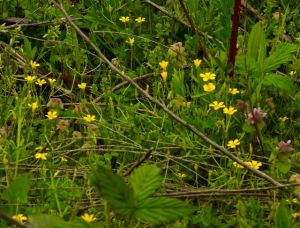
July 2023: Coexisting? Really?

A Yellow Swallowtail butterfly and a bee feed on bull thistles at the north end of the lake, as highway traffic roars past.

In this month’s entry:

Can a Lake’s Lives and the Machinery of the City Coexist? 
Record Heat and the Unstoppable Wildfires
St. Clement’s Island: More Potomac History
The July Gallery: More New Sightings of Birds, Dragonflies, Wildflowers, and More

Doe and two fawns in pasture near Columbia Gas substation, below the north end dam, July 20

Can a Lake’s Lives and the Machinery of the City Coexist?

The answer is a clear–but qualified–yes. After all, the swallowtail butterfly in the top video and the deer in the photo above appear to be successfully going about their business of survival in our little lake environment, despite the roar of traffic on the Fairfax County Parkway next door and the petroleum and gas pipelines that run under the lush grass fields beside the lake. Indeed, one could argue that the presence of the pipelines below the lakeside makes it more likely that the lake and its bountiful shorelines will remain a refuge for plants and animals of many kinds. Why? Because safety regulations won’t permit housing or commercial development directly above the pipelines. So, as this line of thinking goes, it’s lucky for Mother Nature and all her beautiful offspring that the fossil fuel pipes are there, as strange as that might sound.

Similarly, zoning also allows the concentration of cell towers and high tension electrical transmission lines along the highway a hundred yards west of the lake, but not above the housing that surrounds much of the lake. So there’s a buffer zone for a few hundred feet that allows the lush greenery and its myriad inhabitants to function relatively unencumbered.

Cell towers and electrical transmission lines west of the lake


Rock doves in daily perch on electrical towers west of lake

But I did say a qualified yes. Qualified, because the notion that the thousands of creaturely lives in and around our small lake could ever really thrive in the presence of the ever more intrusive forces of human housing, transport, commerce, and pollution, is at best a temporary respite, and at worst, a cruel joke. In every entry of this blog, I use terms like “refuge,” “idyllic,” and “fruitful” to describe this place that Jean and I have come to call home. And it does live up to those terms, but only because of (1) the amazing adaptability of the plants and animals in a changing and challenging environment and (2) the efforts and money of the many humans who built–and every day maintain!– the complex infrastructure that enables this little lake to be a refuge from the surrounding sprawl. 

To keep a small reservoir in the midst of a thriving city relatively clean is a feat in itself. To maintain a green and diverse boundary around that lake, from at least 15 feet wide to as many as 100–and to keep it all accessible to every resident–goes against conventional thinking in the US about waterfronts, which are mostly available only to homeowners who pay heavily for access, with no one else allowed. But an open arrangement like that we enjoy also calls on the residents of our community to keep those areas clean and refuse-free, and most of the residents do just that. 

Trash at water’s edge, west bank, after a strong rain and inflow the previous day, July 19.

But as one scientific study after another is reporting, our environment is changing because of fossil fuel emissions even more rapidly than prior forecasts predicted, and so the prognosis for a small water-based habitat like ours is dire. Last month’s smoky skies, from the unchecked Canada wildfires, is one dramatic indication of what is to come more frequently. This summer’s record temperatures in much of the world are equally dangerous, not only because of the heat itself, but also because of the effect that warming waters have on ecosystems, coral reefs, currents, and rain patterns.

Our little lake is thick with green algae most of the year now, as you can see in many of my photos, and this will only get worse as waters continue to warm. With air quality continuing to degrade, with fossil fuel burning continuing with little let up, and with species of every kind of creature in decline, how much time can a fragile mini-ecosystem like ours have left?

Inlet stream, southeast lakeside, thick with algae, July 14

All that said, I’m trying hard to maintain a positive, hopeful attitude about our idyllic little refuge, and the many, many places like it across the planet. All the happy things I write and show about this amazing place are still true, and will be true for some time to come. The spirit that enables the birds, bees, turtles, rabbits, and deer to keep on doing what they do will live on, even as they must continue to adapt. The spirit will continue that empowers us who live here and work here to do what’s needed to keep this a beautiful place so full of lives that inspire and teach us.

We know what needs to be done by us as individuals and by local and national policymakers. All we need is the willingness and courage to keep up our efforts despite the determined opposition of those who just won’t give up their addictions to fossil fuels, waste, and over-consumption. Every little bit we can do to lead a healthier lifestyle helps both each of us and the Earth.

Bee on porcelain berry, east side of lake, July 27


Two more pollinators visiting the bull thistles, July 27

Record Heat and the Unstoppable Wildfires

One thing that the Potomac and Sacramento valleys have in common this month is extreme heat. As the NOAA heat tracker (above) shows, we in Virginia are in the most intense heat wave of the summer so far, with heat indexes well over 100 today (July 28) and tomorrow, while Northern California is just coming out of sustained temps over 100 last week and the week before. Of course, July temps over 100 are not strange for the Sacramento Valley–we expect them. Similarly, temps in the 90s are common in July in Virginia.

But what is unprecedented have been the sustained temps over 110 across the Southwest this year. Phoenix, no stranger to temps over 110, has now gone a solid month with daytime highs over 110 (19 in a row was the previous record), with no end predicted. Globally, climate scientists are forecasting 2023 to be the hottest year on record.

Firefighters battle brush fire in extreme heat in Santa Clarita, CA, July 27 (LA Times)

National Public Radio quoted one of the scientists who conducted the most recent global heat research: 

“”Without climate change we wouldn’t see this at all or it would be so rare that it would basically be not happening,” said Friederike Otto, a climate scientist at Imperial College London who helped lead the new research as part of a collaborative group called World Weather Attribution.

“El Niño, a natural weather pattern, is likely contributing to some of the heat, the researchers said, “but the burning of fossil fuels is the main reason the heatwaves are so severe.””

What is also unprecedented have been the remarkable number of wildfires across the northern tier of Canada since the spring and ongoing through the summer. As in California’s increasingly devastating experience with wildfires over the past few years, most of these fires rage in remote mountainous areas that are extremely difficult for firefighters to reach. As a result, most of these fires rage on uncontained.

Wildfire in far northern Canada, July (Google images)

We in the US, including here in Virginia, where we never thought we’d have to deal with these climate disasters, have contended with hazy, smoky skies since June whenever the wind blows from the north. More northern states , like those along the Great Lakes, experience these days much more often. But the smoky skies have affected states as far south as Georgia. As the fires rage on, we will have more such days coming.

St. Clement’s Island: More Potomac History

St. Clement’s Island, where the 1634 refugees first landed


Osprey in nest at Port Tobacco on our way to St. Clement’s, July 24

We took another one-day overnight trip to Southern Maryland this week, back to St. Mary’s City and to the tiny Potomac island, St. Clement’s, where the English refugees temporarily landed before settling in the larger cove downriver. Unlike the smoky grey skies that we encountered on June 6 in St. Mary’s, owing to the Canadian wildfires, we had blue skies and scudding white clouds on this short trip.

At the excellent small museum on the mainland adjacent to the island, we learned that it was the native Yaocomico  on St. Clement’s who advised the crew and passengers to go to the safer mooring of the protected cove a few miles distant.  The choppy waves we saw around St. Clement’s showed the wisdom of this advice.

Among its other treasures, the museum contains a 19th century wall-size rendering of the landing of the English refugees at St. Clement’s, plus a list of the settlers, including Jean’s ancestor, John Nevill.

19th century painting of arrival of English refugees at St. Clement’s Island, 1634

The July 2023 Gallery: More New Sightings of Birds, Wildflowers, Dragonflies, and More

First sighting of a barn swallow, on dam outlet structure, north end of the lake, July 20


Eleven Canada geese in formation swimming toward southeast cove of the lake


Bumblebee on porcelain berry, west bank of the lake, July 20


Bumblebee on yellow prickly lettuce bloom, north end of lake, July 26


First downy woodpecker of the year, on dead tree at north end of lake, July 22


Giant goldenrod, east side of lake, July 26


Green heron in willow oak, north end of lake, July 22


Late ripe blackberries, north end of lake, July 26: the latest are the sweetest.


A rock dove prepares to land at the north end rocks, July 26


Pokeweed starting to bloom with bull thistle on the east bank, July 20


Wild teazel flowers and yellow swallowtail butterfly at north end below the dam, July 20

American red squirrel, first sighting, in dead tree in north end woods, July 18

Bee in swamp milkweed, southeast bank, July 14

Cat-o-nine-tails, first sighting, on east bank of lake, July 16

Great blue skimmer dragonfly over the lake, first sighting, east bank, July 15

Halloween pennant dragonfly, first sighting, north end of lake, July 15

Male cardinal, berry in beak, in sweet viburnum nannyberry tree, east bank of lake, July 18

On to August, with hope for all our lake citizens…