If you’re new to this blog, start with the About page, then come to Home. Otherwise, you may feel a bit lost.
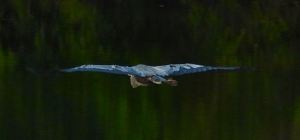
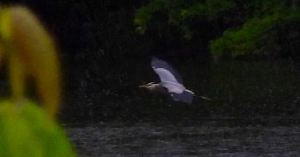
Great Blue Heron soars over the lake toward the south end just after sunrise, July 15
In the blog this month:
Feeling and Dealing with the Heat
Someone Loves It: Pollinators Galore in the Humid Heat
Did Someone Say “Drought”? In Virginia?
Climate Log: The Truth That Dares Not Speak Its Name
July 2024 Photo/Video Gallery
Yellow Tiger Swallowtail, Bumblebees, and Honeybees Swarm in Cutleaf Teazel and Porcelain Berry in the north end below the dam on a hot afternoon, July 23
Feeling and Dealing with the Heat
“The less you use it, the easier it is to live without it.” (Stan Cox, author of Losing Our Cool: Uncomfortable Truths about Our Air-Conditioned World)
In early July, the extreme heat that has smothered the U.S. hit Northern Virginia with a vengeance, as air temps for most of a week exceeded 100–and the heat index (the combo of heat and humidity) reached 110–before the air temp simmered back to the high 80s/low 90s. From mid-month on, clouds, bits of rain, and the forecast of more rain have tantalized us with a promise of normal summer weather in this part of the country.
Still, what separates this summer from 2022 and 2023 so far has been the humidity, the overall heaviness of the water-vapor-loaded air, which makes breathing slightly more difficult and sweating more intense. Fatigue hits us more quickly.
Those of us who can luckily spend most of our time indoors in chemically-cooled air can combat these effects. But most people in the world, including millions in this country, are not so fortunate. And even those of us with the luxury of cooled air pay the environmental price of further pollution of the air by the very machines we use to cool the air. In addition, all that hot air spewed outside by the air con just makes the outside hotter! So there’s really no escaping the costs of extreme heat brought on by our fossil-fuel addiction. Not to mention the big hit our utility bills take by all that air con!
With all that negativity in mind, even the fortunate can take a few simple steps to minimize their reliance on chemical/mechanical cooling; and you’ll save $$$, too!
- Learn to live with higher temps than you’d prefer: when it’s 100 outside, set your air conditioner at 80 or higher (I set mine at 78, but by following the suggestions below, the aircon rarely comes on)
- Keep shades or blinds closed to keep out sunlight–live with a little bit of darkness
- Strip down to your preferred level of modesty
- When coming in out of the muggy heat, wipe face and neck (and any other area you feel needs it) with a wet washcloth
- Stay hydrated–keep drinking water handy
- Avoid using heat-producing machinery to the extent possible in the kitchen or workroom
Anything you can do to stay cooler without the air-conditioning running is a plus for everyone.
**********************************************
Butterflies, Moths, Bees, and Dragonflies–Pollinators Galore in the Humid Heat
Silver-Spotted Skipper Butterfly feeds on the ubiquitous Cutleaf Teazel by the outlet stream below the dam, hot afternoon, July 23
Taking a daily stroll around the lake this month in the humid air may not be the most pleasant experience, especially from 11 AM on, when the air is at its hottest. But if you do, you’ll be treated to a festival of pollinators gorging on the lush July wildflowers, from Queen Anne’s Lace and Swamp Milkweed to Cutleaf Teazel, Porcelain Berry, and Purple Thistle–and even the last remaining Allegheny Blackberries. In my two summers here so far, I’ve not seen such profusion of Butterfly, Moth, and Dragonfly species, as well as the numbers of Bumblebees, Honeybees, and smaller bees flitting from flower to flower.
The difference is the level of heat and humidity. What makes life uncomfortable for us fragile humans seems to bring out the best in the small pollinators, at least to this point in the month. So I’ll enjoy the photographic cornucopia while I can, and keep track over the coming weeks. Here are some of the results, with more in this month’s Photo/Video Gallery later in the entry.
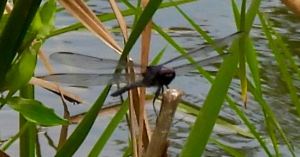
Black Dragonfly amid Cattails and Reeds by the outlet stream below the dam, July 23
Orange Sulphur Butterfly, with Bees, and Beetles, on Cutleaf Teazel on a breezy July 13
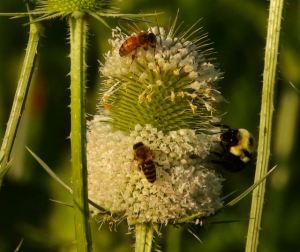
Bumblebee and two Honeybees feed on Cutleaf Teazel at the northwest corner of the lake, at sunrise, July 15

Closeup of a Common Buckeye Moth on the path below the north end dam, July 23
Pipevine Swallowtail–first sighting–feeding on Cutleaf Teazel on the northwest corner of the lake, on a hot afternoon, July 23
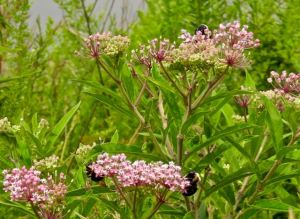
Three Bumblebees feast on Swamp Milkweed, east bank of the lake, July 23
If you are interested in identifying Butterfly and Moth species, may I suggest the website Butterflies and Moths of North America.
If you are interested in identification of insects of all kinds, go to insectidentification. org.
If you want to get kids involved in the looking and enjoying, try the Children’s Butterfly Site, with quizzes and games to add to the fun.
***********************************************
“Drought,” Did Someone Say? In Northern Virginia?
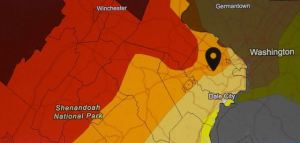
Severe (orange) and extreme (red) drought conditions in Virginia, July 23 (source: Fairfax County Government)
Update, July 31: According to the Washington Post (July 30), the Washington-area Council of Governments has issued a “drought watch” to the region, and has urged residents to “voluntarily” conserve water by such actions as taking 5-minute showers, turning off water while brushing teeth, and only using dishwashers for full loads. At the same time, they are assuring residents that the area reservoirs are full and the region is well-prepared for drought. Commenters to the article disagree with this rosy assessment.
July 28: Since moving here from California two years ago, I’ve occasionally written in this blog about how shocked, but not surprised, I’ve been by how ignorant and complacent this region is about water or the lack of it. Whereas Californians obsess about water, because they have always been forced by drought to be aware of every drop, what happens to it, and how to conserve, Northern Virginians take water for granted. In California, most people know whether local water comes from the aquifer, from a far-away reservoir, or from annual river runoff from the Sierra snowpack. Here, it’s just assumed that rain will provide–and in the past it did. But no longer.
Water-hungry toilets, multi-acre-sized carpets of pollinator-empty grass, and thirsty beds of annual flowers are everywhere in the DC suburbs and exurbs. Mowers are out weekly to make sure that lawns look like artificial turf–rather than like actual plantings, which if allowed to grow would have roots that can reach the water table. Local governments never ask residents to conserve water. (Note: See the July 31 update, above.)
Last year’s drought conditions in Central Virginia (see the map above) and even a few brief wildfires near us in August drew hardly a mention here. Equally critical, the lack of snowfall in the disappearing winter (see my January 2024 entry) is only considered significant because of lack of a nostalgic White Christmas, not because it portends trouble to come. Indeed, most Northern Virginians are happy not to have the snow, because it just clogs traffic–everyone’s number one preoccupation. (I’m trying not to be too cynical!)
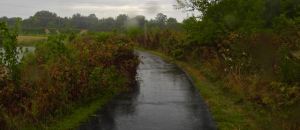
A rare rain shower wets the burned-out blackberry canes along the north end of the lake, July 11
Finally, the Washington Post published an article by Ian Livingston on July 11 that proclaimed the “severe drought” plaguing the DC region. It noted the 4.5 inch deficit in average rainfall, and showed a picture of browned-out grass in one neighborhood. But the overall message was that a few nice rainstorms and maybe even a helpful hurricane would come by to bring us all back to our usual contentment.
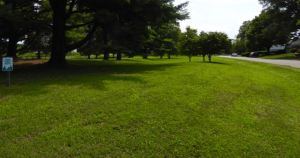
Typical rain-dependent, regularly mowed “lawn” space in suburban Northern Virginia, not hospitable to pollinators, July 26
However, one of the many commenters to the bland article emotionally described an actual consequence of what the “severe drought” is doing to the region:
I live in the Valley and let me tell you it is really bad. I realize that many sit inside in A/C and never even think about what is happening. The farmers are selling their cows because they cannot feed them. Normally the fields are lush and green now with plenty of grass. There is no hay. We normally get three crops of hay. There was one very small crop this year. So there is no hay to feed animals this winter. Even if we got a lot of rain now, there will be no more hay. I don’t know what the farmers will do. The trees are dying. Wells are running dry.
We had a similar scenario last year but the drought started last year in late August so at least there was a decent hay crop.
If this is the new normal and I am starting to think that it is, then it will be impossible to raise cows for beef and for milk at least here in VA. Prices are going to go way up in any event (please don’t blame this on Biden, he cannot control the weather).
And I have never seen it so hot for so long. Weeks on end of mid 80’s to upper 90’s temperatures. And I fear now for forest fires. One lightning strike is all it will take.
Note, however, that this impassioned commenter “lives in the Valley” (presumably the Shenandoah Valley 90 miles west of here), so it’s unlikely that the average DC area urbanite/suburbanite will pay any attention to “hay” and “cows,” when they have much more pressing concerns–like this morning’s (or any days’) traffic on the beltway (“I know! Isn’t it a nightmare?!”)
Update, August 3: Photos from the Drought-Stricken Shenandoah Valley
To see for ourselves what commentators to the Post articles were writing about the extreme drought conditions in Western Central Virginia, we spent August 2 and 3 in the Shenandoah Valley. Once we crossed the Blue Ridge Mountains and drove down into the Valley in the high 90s heat, the fields were much browner than east of the mountains, and corn fields were stunted and sometimes bare. The South Fork of the Shenandoah River was very low, though the river still flowed. The forecast on the 2nd was for thunderstorms, but, as usual, storm clouds did appear, but no more than a few drops fell.
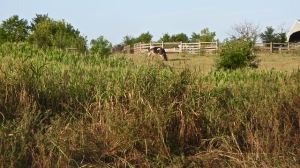
Dried out field, stunted corn crop, at farm in Shenandoah, VA, August 3
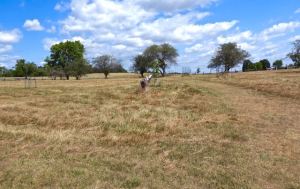
Burned out farm field, New Market, VA, Aug. 2
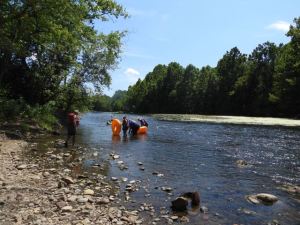
Families are still out tubing on the shallow, much-narrowed South Fork of the Shenandoah River, Elkton, VA, August 2
*************************************************
Climate Log: The Truth That Dares Not Speak Its Name

What now looks like desert was not long ago a thriving pasture in Leonforte, Sicily (photo by Gianni Cipriano, June 24). See Postcards from “A World on Fire” for more such examples of drought around the world.
In the intense political atmosphere of this critical election year, I am again dismayed, but not surprised, by the lack of any mention of climate change by U.S. candidates, particularly in relation to the daily, dramatic heat extremes of this most unique of summers. This last week of July is feeling Earth’s hottest day on record in 88 years of recording–or really a succession of hottest days ever–not to mention report after report of heat-related deaths, crop burnout, and devastating effects of drought. The Washington Post article by Sarah Kaplan, July 23, reviews the research and statistics from the European Union’s Copernicus Project. The shocking photo from Sicily (above) is just one of many examples of climate degradation around the world in just the most recent year, and far from the most terrible in terms of human cost in lives and livelihoods.
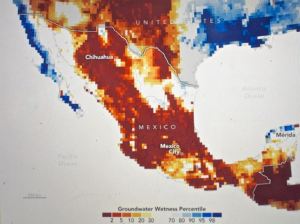
Here in the U.S., research by the National Oceanographic and Atmospheric Administration (NOAA) reveals the intensity and spread of one climate change consequence–extreme drought–as illustrated by this map of Texas south through Mexico to Guatemala (June 2024), as part of its Global Drought Narrative for the current year:
But for one of our two U.S. political parties, climate-change denial is perhaps its most important commandment. Why? Because the Party is deeply committed to the fossil-fuel cartel. The Party’s Presidential nominee openly promised the cartel special favors in exchange for a one-billion dollar donation to his campaign.
Even though a solid majority of Americans continue to say to pollsters that climate change is an important issue that needs to be addressed (78%), the cartel and its supporting politicians have so far managed to convince many Americans that climate change may not be primarily human-caused (46% of respondents to the polls sponsored by the EPIC project at the University of Chicago). This viewpoint translates into a clear majority of respondents to the same polls who would not be willing to pay even 1 dollar more in taxes to reduce fossil fuel emissions! However, if, as the pollsters asked, corporations could be induced to pay for the transformation of the energy system to renewable energy, the popular opinion becomes strongly positive (65%).
So most Americans do think that something needs to be done to combat climate change–as long as someone else pays for it.
As might be expected, people who align themselves Republican (the party of denial) are way more skeptical of the need to address climate change. But even many of them (42%) would support regulations to limit emissions from power plants and vehicles. Support by Democrats (the party for positive action on climate change) is, understandably, higher, with 78% favoring regulation of emissions.
What about people who have suffered first-hand from extreme effects? The brightest number in the EPIC stats for those favoring action comes from respondents–across party lines–who say that they had suffered the extreme effects of climate change in their own lives. 68% of these sufferers consider it an important issue in this election year, and 53% want the newly-elected President to take action. Even more telling is that up to 22% of sufferers in four states who are among the most affected (Texas, Louisiana, Oklahoma, and Arkansas) would consider moving out of those states–becoming migrants themselves–if conditions don’t improve (see map below).
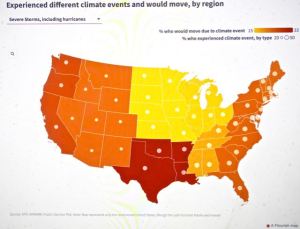
Percentages of those already affected by extreme heat and storms willing to move (EPIC Project, U. of Chicago, 2024)
Since the extreme effects of heat, drought, floods, sea level rise, etc., will only intensify, the deteriorating climate itself promises to keep moving the public-opinion dial toward government action and corporate change. But how many more tragedies must occur in the meantime?
For the present, even the Democrats, nervously looking at the ambiguous numbers, are afraid to come out too strongly for positive action on climate change. Listen to and read their speeches, their policy statements, their incessant funding pleas. Do they even mention how people and places are suffering from a changing climate? Or will the extreme effects of heat, drought, floods, wildfires, and eroding shorelines remain a terrible truth that dares not speak its name? How many more places across the world, including the U.S., must become virtually unlivable before politicians have the courage to speak out with bold plans to save lives, livelihoods, and our fellow creatures?
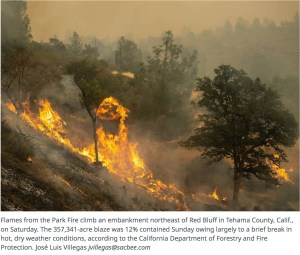
Park Fire, now the 6th largest in California history. Sacramento Bee article by Rosalio Ahumada, July 29
***********************************
The July 2024 Photo/Video Gallery
This month’s gallery features more scenes of the variety of pollinators (birds, butterflies, bees, dragonflies) around the lake, including species not seen here before, as well as the flowering plants with which they collaborate. That our fragile little ecosystem remains so wildlife friendly is a tribute to all, including humans, who care for it by not polluting, by letting plants grow, and by not scaring the wildlife away.

Red-winged Blackbird male perches on a Persimmon Tree at the northwest corner on a hot afternoon, July 21
Orange Skimmer dragonfly rests on a branch on the southwest shore, July 31
Green Heron listens to Cicadas on a branch under the bridge on the southeast cove on a humid afternoon, July 23
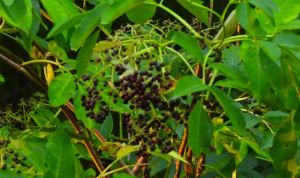
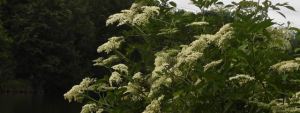
Ripe Elderberries along the path by the southeast bridge, July 15
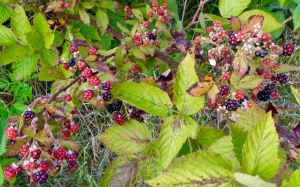
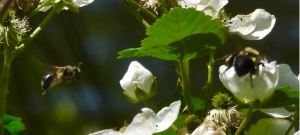
Some of the last Allegheny Blackberries at the north end, before the canes burned out in the heat, July 5. We harvested some for snacks and baking, but left almost all for the birds!
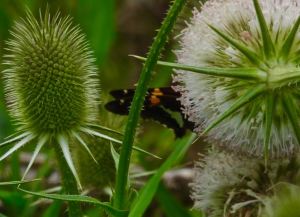
Silver Spotted Skipper Butterfly–a first sighting here–amid Cutleaf Teazel below the dam, hot July 23
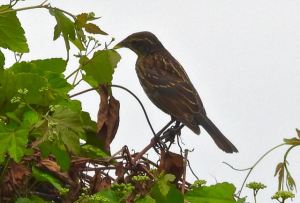
Red-winged Blackbird female in Porcelain Berry at the north end below the dam on July 23
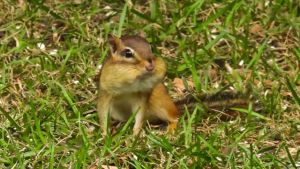
Chipmunk eyes me from the grass beside the southeast cove bridge on the hot, humid July 23

Our ubiquitous Red-bellied Cooters don’t like coming above water on really hot days, but this one showed up on the log in the southeast cove in the heat of the afternoon, July 23
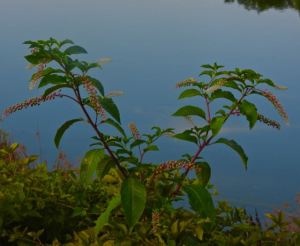
Another July regular, Pokeberry, appears in graceful glory on the north end shore, July 4

I surprise an unfazed Mockingbird on the north end path, on a drizzly morning, July 22
Cottontails are plentiful this July, like this one, munching calmly on the grass beside the northwest path on a hot afternoon, July 23
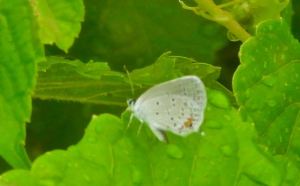
Tiny Summer Azure Butterfly on Porcelain Berry leaf below the north end dam in heavy rain, July 11
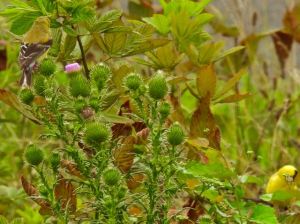
Two Goldfinches amid Purple Thistle on a drizzly morning in the northwest corner, July 22
Blue Widow Skimmer Dragonfly on Porcelain Berry below the north end just after sunrise, July 7
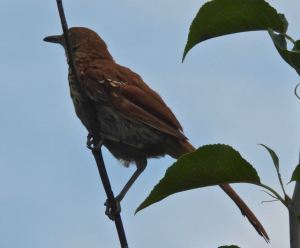
Brown Thrasher, first sighting here, in Bradford Pear by the northeast corner path, July 23
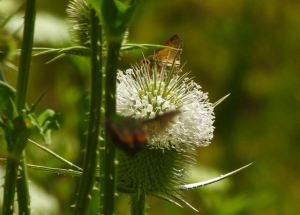
Sachem and Fritillary Butterflies feed on a Cutleaf Teazel bloom in the northwest corner, July 13
As the abnormally high heat and humidity continue, we hope the resilience of our pollinators and of our human Virginia neighbors continue to set an example for all of us. On to August!













 From Sacramento to Potomac: Tales of Two Valleys