December 2025: Holiday Gifts for the Environment

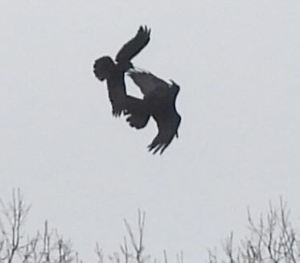
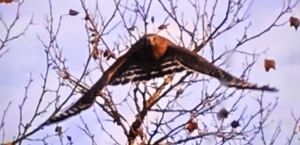
Jean’s amazing photo of a Red-Shouldered Hawk flying toward her from a Maple southeast of the lake, on a very cold morning, December 7. This visitor, who had been pestered by a few of our enraged resident crows, flew past her and landed in a nearby tree.

In this month’s blog:

Climate Log: Holiday Gifts to the Environment–and to Us Humans!
Climate Log 2: The “Unstoppable Worldwide Rise of Renewables”
Garden Update: Fresh in the Freezer
Presents through Presence: Visiting with Family
The December 2025 Photo/Video Gallery: Gifts from our Lakeside Community
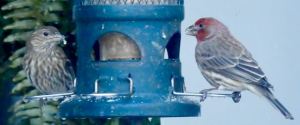
Pair of House Finches, Female and Male, at Southeast side feeder, December 14

***********************************************************************************
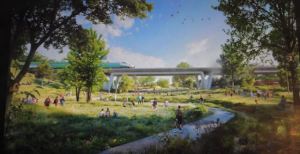
Parks, wetlands, and light rail: three features of the plans in Toronto for redevelopment of an outdated airport (see below)

Climate Log: Holiday Gifts to the Environment–and to Us Humans!

The current U.S. federal administration (now a year old) keeps doubling down on the fossil fuels that are steadily killing us. But Americans across the country are inventing ways to make or remake our fragile environment to be more resilient. Below, we link to 3 of these many gifts to us. We also note a 4th gift, from our friends in Canada, who have large plans to repurpose developed land to achieve life-friendly goals of health, beauty, and love for all creatures.

Gifts One and Two: “Fifty States, Fifty Fixes”–We’ve cited in past entries a few of the many climate-friendly projects from this ongoing NY Times series, and here are two more, both from so-called “red states” (which, as polls keep showing, are picking up more tints of blue).
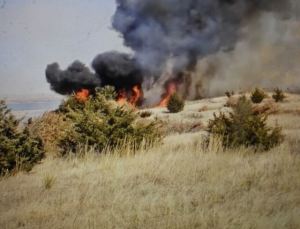
“South Dakota Ranchers Burning the Prairie to Save It” (New York Times photo) December 11 https://www.nytimes.com/2025/12/09/climate/prescribed-burns-wildfire-south-dakota.html

In South Dakota, an organization of cattle ranchers is teaching others how to use Native American methods of “controlled burns” to remove invasive species, such as the Eastern Red Cedar, so that native grasses and their pollinators can return.
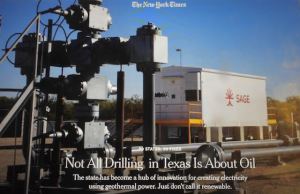
“Not All Drilling in Texas Is About Oil” (New York Times photo, December 11  http://www.nytimes.com/2025/12/09/climate/not-all-drilling-in-texas-is-about-oil.html

As new companies in Texas are demonstrating, the many skills needed to dig for oil and gas are being adapted to make the state a hub of innovation in the production of clean geothermal power.

Gift Three: Big Plans in Toronto to Make an Outdated Airport an Environmental Miracle

Toronto Downsville airport to be redeveloped as housing and parks, current view (CNN photo), Dec. 11  https://edition.cnn.com/travel/toronto-downsview-airport-yzd-c2e-spc

CNN’s “Inside the Abandoned Airport Being Transformed into a $30 Billion Sustainable City” (by Nell Lewis, December 11) describes in glowing detail the history of this early airport and Toronto’s ambitious plans to redevelop the land over 30 years into one of the largest and most innovative sustainable sites in North America.  
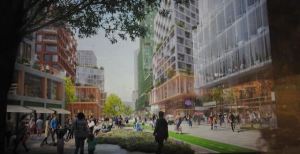
Toronto plan for former airport: sustainably-designed high rises and pedestrian mall as two of its features (CNN photo), added Dec. 11 

 Gift Four: The Data Rescue Project  https://www.datarescueproject.org/
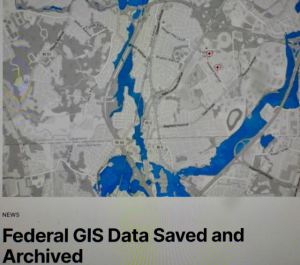
One recent successful data rescue project, Dec. 16

Even as the EPA and other branches of the current administration race to hide vital information from scientists, from the economic and financial communities, and from the entire voting population, the Data Rescue Project (among other similar organizations) is working tirelessly to save information and make it available to us. While this rescue effort began during the first Trump administration, when scientific research data, especially about climate change, began disappearing, the erasure has ramped up exponentially this year across all government departments. So the Data Rescue Project has also intensified.

The specific data saving initiative pictured above, regarding erasure of the GIS (Geographic Information System) in September and October, is reported on by Frank Donnelly, Head of the GIS and Data Services of the Brown University Library. The saved data are available at https://www.datalumos.org. Of course, even more rescuers are needed by the Data Rescue Project.

******************************************************************************
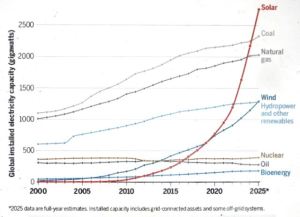
Comparative growth of solar and wind vs. other forms of energy worldwide since 2000 (Science, 12/19/25)

Climate Log 2: The Best Gift to Us and the Environment?  The “Unstoppable Rise of Renewables” Worldwide

Solar Farm in Wisconsin (Getty Images)

Once we in the U.S. look beyond the choking fog of fossil-fuel hype in the current administration, we can see that the best gift to the worldwide environment is the phenomenal growth of solar (and wind) power since 2000. In its lead article this week, “Good Morning, Sunshine,” the journal Science announced its “Breakthrough of the Year”: the “seemingly unstoppable growth of renewable energy.”

Led by China’s truly astonishing build-out, an example being steadily adopted by nations around the world, solar and wind energy are far out-stripping fossil fuels in installation since 2000. Why? Because of solar and wind’s cost effectiveness and clean simplicity. Indeed, says Science, “Wind and solar have become the cheapest energy in much of the world.”

Of China’s dominance in these new technologies, Science writes:

“China’s solar power generation grew more than 20-fold over the past decade, and its solar and wind farms now have enough capacity to power the entire United States.”

Perhaps it’s no wonder, then, that the current U.S. administration–given its marriage to 19th century forms of enegy–has done its utmost to prohibit new solar and wind projects in this nation. Just this week (Dec. 22) the President “paused” 5 wind projects off the East Coast, 3 of these already under construction. The five would have reduced power costs for millions of people, provided clean energy, and created 10,000 jobs:

“Trump Halts Five Wind Farms Off the East Coast”
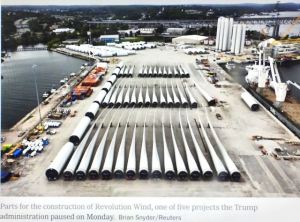
“The decision imperils billions of dollars of investments,” as Maxine Joselow and Lisa Friedman reported in the New York Times.

Too bad that we the people don’t have a say about such capricious, harmful decisions. Nevertheless, Americans will keep on trying to make the environment cleaner, greener, and more healthy in ways that this blog and the free press will celebrate.

******************************************************************************

First snowfall of the new winter: looking across the lake to the west side gazebo, December 5

Garden Update: Fresh in the Freezer
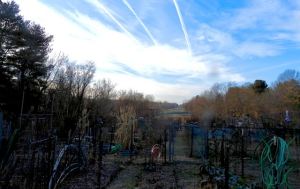
In the midst of many days of freezing temps, our garden community, except for some hearty plants, has quieted, too. Some birdsong persists, but even that is muted on a cold, cold morning, December 13 

Our November garden update gloried in the rapid growth of the six broccoli and six cauliflower we’d planted in October. Since the calendar turned to December, however, we’ve experienced an inch of snow on the 5th and almost two weeks of freezing temps, getting as low as 16 on a couple days.  Fed by a polar vortex which has kept much of North America in the deep freeze since late November, our weather is much colder now than at any time over the 3.5 years since we’ve been back from California. 
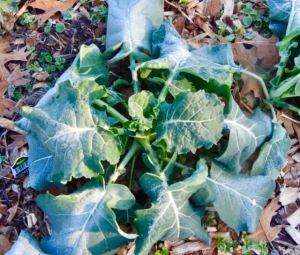
Broccoli plant still holding on to its green suppleness despite the cold, December 18

So it’s fun to visit the frosty garden every few days to see how the plants above ground are doing. We know, of course, that underground nature is taking its course, and, almost before we know it, it’ll be driving toward spring and shoots will poke through the soil: species that we will take joy in identifying, some of which people may call weeds, but which we will enjoy watching grow into their curious individuality.
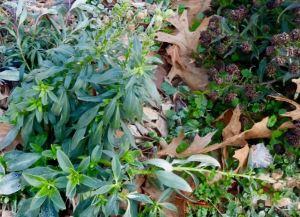
Snapdragons, planted in October, acting all green and sprightly, as if it weren’t winter around them, December 18.
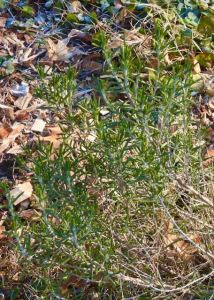
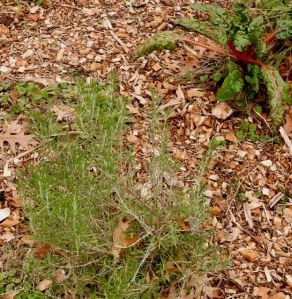
Rosemary, a perennial, green as ever, and just as pungently fragrant as in August, December 18
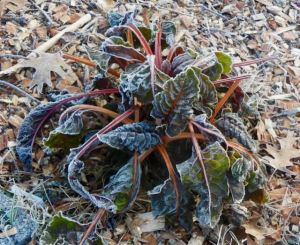
Swiss Chard, wilting in the frost but still with some of its orange vigor, December 7
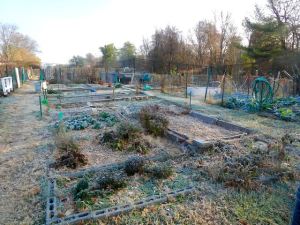
Garden panorama toward Northeast, with our plot in foreground, cold morning, December 7

Blue Jay in Green Ash in the woods beside our community garden, cold morning, December 7

************************************************************
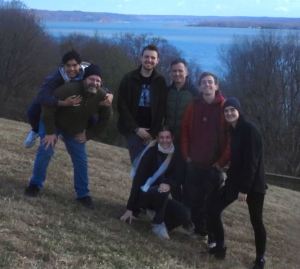
Visiting family members before Potomac River vista at Mt. Vernon, sunny, windy December 29

Presents Through Presence: The Gift of Family

In the season of giving, there is no greater gift for us than the opportunity to be with members of our far-flung family, who have traveled to Northern Virginia from Georgia and California to share meals, conversation, ideas, and lots of laughter. We are joyful, of course, to revel anew in how the younger ones have grown in learning and wisdom, and how their parents’ strengths have surpassed ours when we were their age.

And what is true of our visiting family is equally true of the family who live near us, and who welcome us into their homes. And it is also true of those family who live far away and whom we visit this holiday season via phone, text, email, or video. Is it not amazing how their wisdom, care, humor, and love come through to us regardless of the media? Truly blessed and fortunate are we.

Family welcome us into their home on Christmas Day for food, games, and conversation.
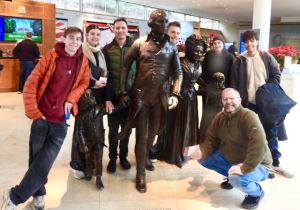
Our visiting family share the holiday spirit at Mt. Vernon with George, Martha, and their kids, December 29

Even Lulu, the family Yorkie, shares in the festivities on Christmas Day

************************************************************
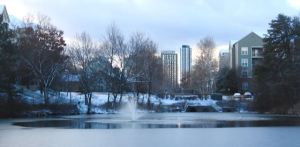
Across the ice-covered lake to the fountain, our community, and on to downtown, December 14

The December 2025 Photo/Video Gallery: Snow, Ice, and the Serendipity of Wild Life

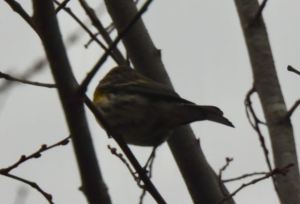
Almost every trip around our lake presents surprises, like the Hawks, the Bluebird, the White-Throated Sparrow, and the Northern Flicker pictured this month, or the Bald Eagle and the friendly White-Tailed Deer I wrote about last month. Their allowing us to see them–they are so good at hiding!–is a real gift. I like to think that they feel somewhat safe in our presence, despite the risks they run by being visible. I hope that safety is not just our illusion.
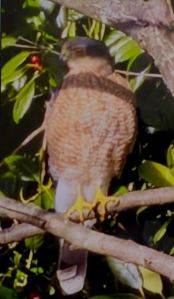
Cooper’s Hawk alights in Laurel, southeast side, sunny afternoon, December 20 (photo by Pat Welch)
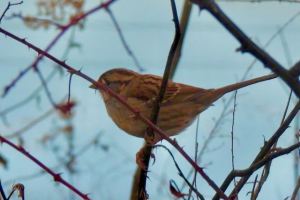
White-throated Sparrow among Blackberry canes, northeast corner of lake, at sunrise, December 21
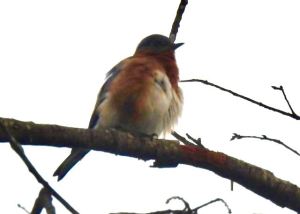
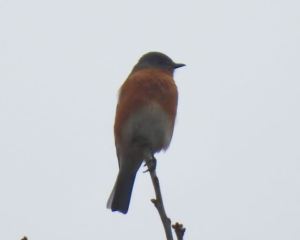
Eastern Bluebird on dead Willow Oak, east bank, at sunrise, December 21
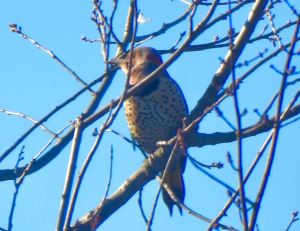
 

Northern Flicker–a rarely visiting type of woodpecker–perches in a Red Maple in the north end woods on a crisp morning, December 22

Male Cardinal perches, chirps, and munches in Sweet Cherry tree, southeast bank, crisp 

December 22
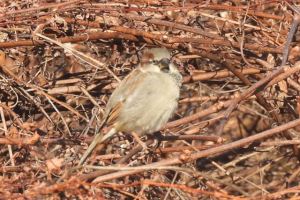
House Sparrow rests in Oriental Bittersweet vines along the north shore of the lake, December 22
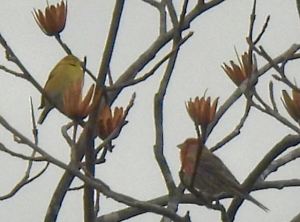
American Goldfinch and House Finch perch in a budding Tulip Tree, north of dam, cloudy December 23
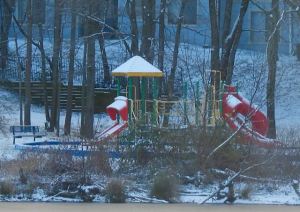
Playground on the Northeast bank, snowy December 14
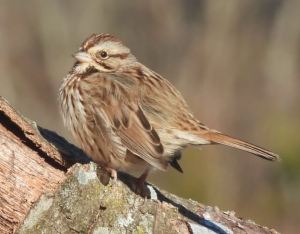
Song Sparrow on dead Willow Oak, east shore of lake, December 16
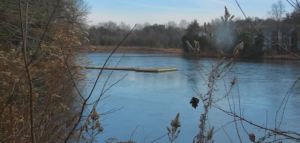
Panorama of the frozen lake toward the dock and the northeast corner, December 13
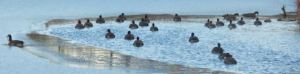
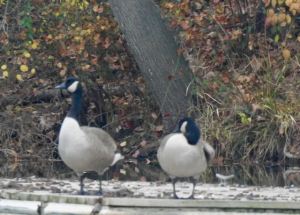
Large flock of Canada Geese in a corner of the east shore, looking to north, Dec. 14
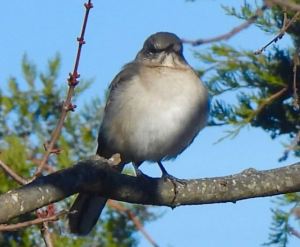
Mockingbird perches in Red Maple along the southeast path, sunny, cold December 16
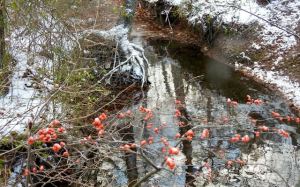
Winterberry bush glows above the inlet stream by the bridge, southeast corner, snowy December 14

Song Sparrow in Japanese Honeysuckle, southwest shore, calls to fellow across the lake on a sunny December 16
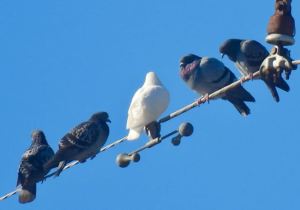
Five Rock Doves bask in the morning sun atop the power tower west of the lake, December 16
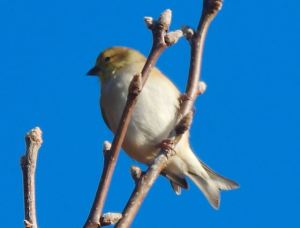
American Goldfinch in winter feathers perches in Bradford Pear along the northeast path, December 16

From the gazebo across the lake, I scan goose by goose the line spread out along the southeast cove, December 14
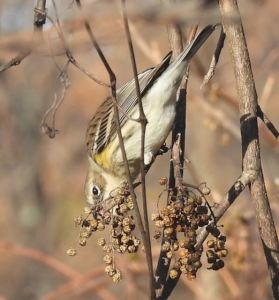
Acrobatic Yellow-Rumped Warbler feeds on Poison Ivy berries in the southeast cove, December 1

Turkey Vulture scans from high above the lake on a misty December 9
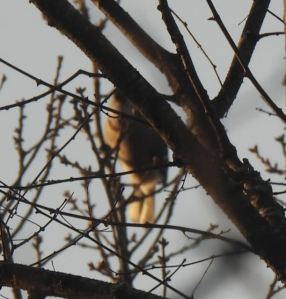
Tufted Titmouse hides in Maple on the west side just after sunrise, December 7
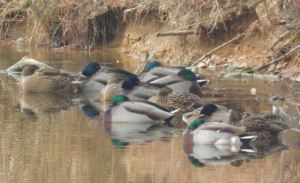
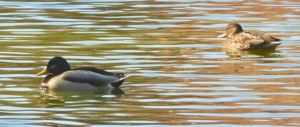
Mallard pairs stay warm along the southeast shore on a very cold morning, December 9

Mallard pair flies north toward woods from southeast cove, then west into trees, cold morning, December 9
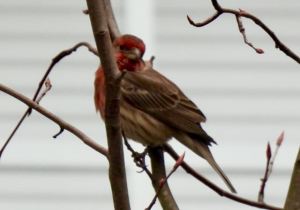
House Finch male in Downy Serviceberry, southeast side, December 9
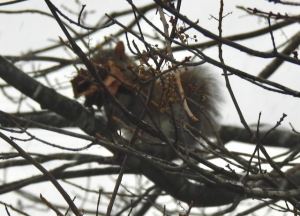
Grey Squirrel with mouthful of leaves walks along branch of Red Maple, southeast path, snowy December 5

First snowfall of the winter: five Mallards swim along the east shore as flakes fall, December 5

European Starling lit by sunrise along the southeast shore, December 7
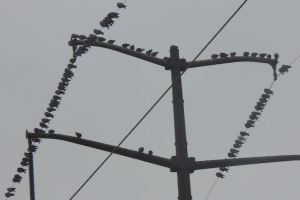
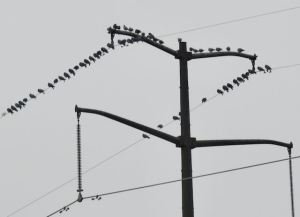
80 Rock Doves–a record?–atop the power tower west of the lake on the very cold December 9

And so we move into the last week of this challenging 2025, as always with hope for a Happy New Year…


November 2025: “Call to Earth Day” and Ways to Thank Wildlife

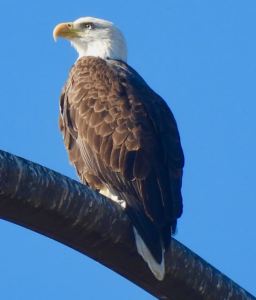
Bald Eagle–a rare sighting here!–scans our community from atop the power tower west of the lake, bright morning, November 3

Two Rock Doves, the usual inhabitants of the top of the power tower, claim their space–and keep their distance–from the visiting Bald Eagle, crisp morning, November 3

In this month’s blog:

“Call to Earth Day”–Saying Thanks to Wildlife by “Guarding Our Green Space”

Climate Log: Just the Most Recent Outrages from Washington
Climate Log 2: California Act Saves Water, Wildlife, and the Eastern Sierra
Garden Update: Winter Is Coming, but Growth Continues
Our November Kitchen: Thanksgiving, with a Difference
The November 2025 Photo/Video Gallery: Surprises

****************************************************

Children in the Czech Republic turn trash into art (CNN Photo, Nov. 6)

Call to Earth Day 2026: Preserving and Increasing Our Precious Green Space

Chris: While more anti-environment outrages occur in the secret halls of US power, we focus this month on celebrating the fifth annual Call to Earth Day (http:// cnn.com/calltoearthday) sponsored by CNN, program donors, and life-affirming thinkers and doers from around the world. “Yes, we can!” say these  dedicated children and adults, whose ideas and hard work help inspire nations to protect and save all of us, our fellow creatures, and our land, air, and water.

From Kenya, to Nigeria, to Hong Kong, to England, to the Czech Republic, and, yes, to places around the US, CNN reported on life-building and nature-saving projects that give us hope for a greener, less poisonous world. In so many of these places, children–assisted by dedicated adults–are leading the way.

In California this fall, one such event, the 2nd annual Green New Leaders Summit, was held in San Bernardino: https://socalren.org/futuregreenleaders , with workshops for hundreds of middle school students on energy systems, wildlife, career pathways, and other topics in green technologies and environmental protection.

Three attendees at the Green New Leaders Summit in San Bernardino in November try out some of the energy apparatus.

Here in Virginia, the best recent news for “guarding our green space” is the election, by an emphatic margin, of Democrats Abigail Spanberger (Governor), Ghazala Hashmi (Lieutenant Governor), Jay Jones (Attorney General), and 13 new House of Delegates members on November 4. Although it remains to be seen what the new state administration can and will do to advance such green issues as energy efficiency and pollution reduction, part of Spanberger’s mandate is to reduce the cost of power for Virginia citizens, which certainly can be accomplished through more solar and wind. When we moved here from California 3 years ago, we were dismayed to see how few homes had solar panels, when we knew from our own experience how much we saved through our panels (for example, we paid 0 dollars for power every summer after installation in 2017 in comparison to $300 per month in the brutal summers before we went solar).

At the very least, Spanberger will be another thorn in the side against the Trump administration’s ongoing rollbacks of endangered species protections and its rollbacks of clean air and water protections (see the next section). Her promises to improve public education will no doubt include greater emphasis on science, including environmental science, which the Trump administration has deliberately weakened and defunded out of his deference to the fossil fuel cartel’s campaign for public ignorance.

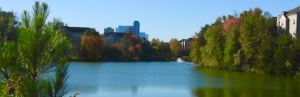
Looking toward downtown across our lake, October 17. Our tiny, precious refuge in a bustling city

Meanwhile, we anticipate that our pro-green political leaders here in our community in Northern Virginia will continue to fund our parks, trails, and public gardens for the benefit of our splendidly diverse population, and encourage both public transportation and our driving of EVs and hybrids. We also hope they’d join the state government in advocating for more rooftop solar.

The AI Monster. Still, by far the largest environmental issue facing our state and region is the explosion in the past 3 years of data centers for generative artificial intelligence. Indeed, our region of the state has the largest concentration of these data centers in the entire world! 

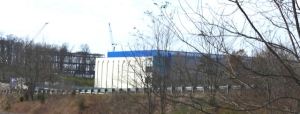
Two new data centers for AI processing, out of already over 200 such centers in Northern Virginia, November 6

The number one question for our leaders in the coming years is how the state and region, already in drought conditions, will handle the prodigious use of water to cool the machinery, as well as the burden on the electrical grid and on land use. Just before we took this photo, we had to drive on a makeshift gravel road almost impassable because of new ditches for the thick cables leading from the centers.

******************************************************************

Climate Log: Just the Most Recent Climate Disasters Coming out of Washington

US map of how home insurance rates have skyrocketed in various states, November 20

  1. Home insurance skyrockets in tandem with climate-change denial

The map above (National Bureau of Economic Research, 2025)) shows that those states who have suffered the most from the extreme heat and intense storms as a result of human-caused climate change now also suffer from extreme rises in home insurance rates. Florida and Louisiana have the nation’s highest rates by far, but those Plains states hardest hit by record hail storms suffer almost as much. These are also states whose leaders most emphatically deny climate science.

       2. “This law helped save the bald eagle. Trump officials want to weaken it.”

Our visiting Bald Eagle, threatened by new Trump order, scans our lake from perch on the power tower, November 3

“Trump Plan to Rollback Protections of Endangered Species, including the Bald Eagle” (Dino Grandoni, Washington Post, Nov. 20)

https://www.washingtonpost.com/climate-environment/2025/11/19/trump-endangered-species-act/?utm_campaign=wp_post_local&utm_medium=email&utm_source=newsletter&carta-url=https%3A%2F%2Fs2.washingtonpost.com%2Fcar-ln-tr%2F45d8021%2F691f030b1d64392bc2d69296%2F62cf3bc956064350197e865a%2F39%2F86%2F691f030b1d64392bc2d69296

As the article describes, rolling back protections of endangered species follows the Trump administration’s mission of opening millions more acres in the US to drilling, mining, and commercial “development” (AKA environmental destruction), a topic also covered in last month’s blog in relation to the Arctic National Refuge.

          3. Trump administration opens 85% of all US wetlands to “developers”

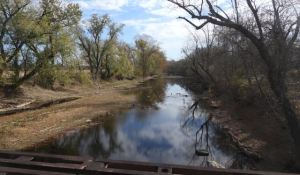
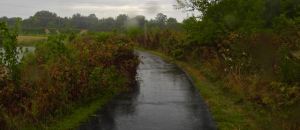
An intermittently-filled side channel of the Potomac River along the Potomac National Trail in Ashburn, Virginia, Nov. 17

Maxine Joselow of the New York Times (“E.P.A. Rule Would Drastically Curb Protections for Wetlands,” Nov. 17) describes the ruling this week that would put into jeopardy 85% of all US wetlands–prime sources of drinking water for millions of voters and their families, as well as habitat for countless species that depend on these waters. The new rule will allow “developers” and landowners to use as they wish 55 million acres of “intermittent” streams, ponds, and marshlands that had been protected– until a disastrous Supreme Court ruling in 2023 that was based on ignorance of how water and land interact on an annual basis. As this blog described in April, “To Save All Life, Don’t ‘Drain the Swamp,'” the wetlands, ponds, mires, bogs, swamps, and marshes of the world are responsible for creating much of the world’s fresh water and for nurturing all species. But ignorant, willful, greedy humans just see wetlands as “wasted,” “messy” land that they would damage by draining and disruption for other purposes.

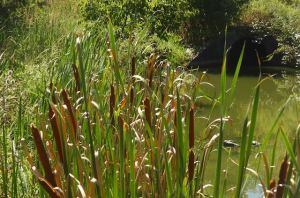
The marshy outlet pool of our lake, below the north end dam, with a Cattail festival, August 27

******************************************************************

Climate Log 2: California Act Saves Water, Wildlife, and the Eastern Sierra

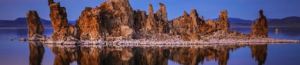
Mono Lake, east of the Sierra Nevada Mountains, long depleted by its use as a source of drinking water for Los Angeles (California Parks photo, Nov. 22)

In a massive victory for environmentalists and for the environment of California east of the Sierra, the city and county of Los Angeles is constructing a water recycling facility in Van Nuys that will meet the water needs of 500,000 residents. Even more important, using the recycled water for drinking will at long last enable Los Angeles to stop drawing water from Mono Lake and the Sierra streams feeding it–some 250 miles from LA. For well over a century, LA’s use of this imported water has sparked enmity, sometimes violent, with inland California residents. Even worse, it has made Mono Lake almost dry and destroyed habitat for many species.

Drinking water will come from this recycling facility being built in Van Nuys, CA (photo Eric Thayer, LA Times, Oct. 31

Ian James’s article in the LA Times (“Los Angeles Will Nearly Double Recycled Water for 500,000 Residents,” October 31) recounts the troubled history. But his main emphasis is on what this move means for the even larger possible use of recycled water for drinking. For 20 years, the safety of recycled water for drinking has been debated, and this move is the first in the West to follow through in a massive way on the water science that guarantees this safety. As the Western US becomes ever hotter and drier through climate change, successful recycling will help mitigate at least one of the fears that the ongoing drought and over-pumping of well water have intensified throughout the region. 

Still, unless governments can agree to shift to renewable forms of energy and away from the burning of fossil fuels, even recycling plans as large as this one will be just a drop in the bucket. 

**********************************************************************

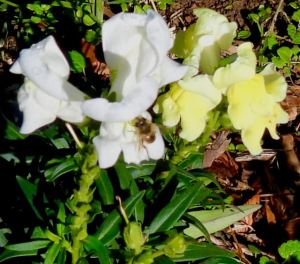
Honeybee on the White and Yellow Snapdragons in our garden plot, November 8

Garden Update: Winter Is Coming, But Growth Goes On

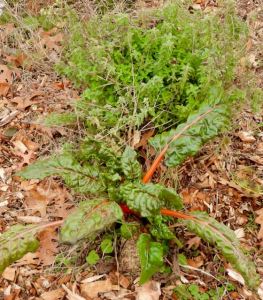
Swiss Chard and Oregano stay green and lush despite a few freezing nights, November 20

High temps now are mostly in the forties to low fifties, and we’ve had four freezing nights as low as 27. But the two veggies we’ve planted–6 Broccoli and 6 Cauliflower–plus the Snapgragons, Mums, and Asters we put in last month are hearty and green, with the Snappies still blooming. The surprises among the summer holdovers are 4 of our Swiss Chards and the Oregano, while we knew that the Rosemary would stay lush.  Our most beautiful October performer, the Wild Blue Aster, has now lost its blooms, but is still thriving.

Rosemary and Swiss Chard, November 20

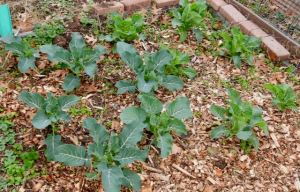
Our 6 Broccoli and 6 Cauliflower have handled the freezing nights well and continue swelling and developing toward producing heads, November 20

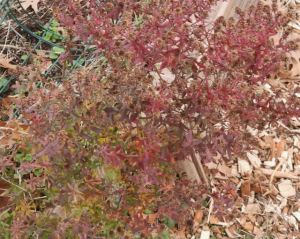
Our Wild Blue Aster may no longer be in spectacular blue bloom, but it has turned on its deep red leaves for winter, November 25

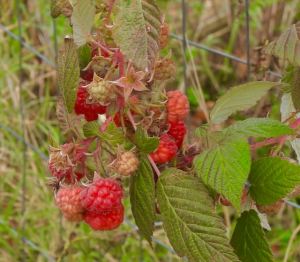
And here is a cluster of ripe red raspberries on the bush in our former neighbor’s now untended plot. We’ve been invited to pluck these and we can’t resist, November 25

What will come? Forecasters are predicting a freeze (25-29 degrees) for Thanksgiving weekend because of a strong polar vortex, but no snow in the forecast as yet. Will the plants keep thriving? We have had about an inch of rain in the past 2 weeks, so that’s a good sign. We’ll keep checking our garden plot in the community gardens every few days, because we just can’t stay away.

******************************************************************************

Our November Kitchen: Thanksgiving, of course, with a Difference

Jean’s Spicy Veggie Curry on the stove

Jean: This Thanksgiving season, we’re thankful to have a number of occasions to get together with family and friends. The traditional turkey, stuffing, and potatoes will be part of one of these meals, but our community of many cultures also gives us opportunities to indulge our varied palates and cooking styles.

Have I mentioned that curry is probably my favorite flavor and dish?  At least on the savory side.  Tiramisu is my favorite sweet, but that’s for another day. 

I think I first learned to make curry from my Japanese mother-in-law in the 1970s.  Japanese curry is based on Indian, and it is mellower than types I didn’t try until later, like Thai curry.  I love making curry because it can be a vegetarian dish for when you feel like or need that, or it can be a very good meat dish, particularly with chicken. For protein in your vegetarian version, tofu is great!
 
Furthermore, curry is the kind of dish I like best to make; you can throw in all sorts of things from your vegetable drawer, your pantry, your garden, or the “leftover” shelf in your refrigerator. 
 
My mother-in-law started with a simple base of chopped onions, potatoes, and carrots. For a little sweetness, she would also add some chopped apple. 
 
However, I like to add more Indian ingredients as well, like butternut squash, cauliflower, eggplant, spinach, chard, lentils, and/or chickpeasSweet or hot peppers add color and flavor as well.
 
Also for color, you might want to add in green peas or edamame as an alternative to spinach.
 
The order in which you add all of these, as well as the cooking time, depends on the ingredient, but half an hour in total should take care of most of these.
 
For spices, I love to play with all those warm “c” spices in my spice cabinet–cardamon, cinnamon, coriander, and cumin.  You can use a premixed curry spice, or try the Japanese curry paste I learned to use early on.  If you choose the paste, you just need to dissolve it first in hot water or broth so it does not clump onto the vegetables.  Add as much spicy broth as needed to cover all the veg.  
 
 
Optional add-ins include either coconut milk or diced tomatoes to dilute and cool the spicy sauce as desired.  (My Japanese version does not use either of those, so suit your own tastes.)

PS. Curry is obviously nutritious as well as delicious, given the number of vegetables and legumes you can include. Once you get your family hooked on the flavors, you may be able to slide in vegetables they wouldn’t eat otherwise. The “C” spices mentioned above have various health benefits. Turmeric, another of my favorites, adds yellow color and anti-inflammatory properties.

Eat more curry! 

A serving of Jean’s Spicy Veggie Curry

 
Here are two more of Jean’s November treats:
 

Jean’s Jumbo Pumpkin Oatmeal Cookies, with Pumpkin Butter Icing

Jean’s Blueberry Muffins, with Jumbo Blueberries

***************************************************************************************

One of our ubiquitous House Sparrows chatters with us and friends along the north shore, November 21

The November 2025 Photo-Video Gallery: Communing with Our Neighbors in Our Green Space

Chris: Surprises always happen as we walk around our little lake, but several were especially memorable this month. The Bald Eagle I saw on the power tower west of the lake on Nov. 6 was a first for me here, as was the Yellow-Bellied Sapsucker pictured just below. On the 20th, I got one of my biggest surprises in the 3 years we’ve lived here, when I turned from watching the lake’s northeast shore and was startled by a young White-Tail Deer watching me–from no more than 10 feet away! Remarkably patient and inquisitive, this new friend moved slowly away, but kept eyes on me while munching on leaves and “hiding” visibly in the saplings and reeds. Three videos captured the conversation, two of which I show here.  Though deer are always present in the nearby woods, I only see one every few months or so, and never before so close. How thankful I am for these moments when I can mutually treasure our green space with one or more of these neighbors.

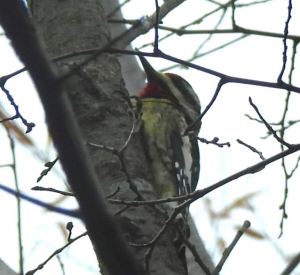
Yellow-Bellied Sapsucker–a rare visitor here on Nov. 21–perches on Willow Oak, southeast shore of the lake. A new study in Experimental Biology (Nov. 2025) shows how these woodpecking birds put full-body power into every strike, about 13 per second.

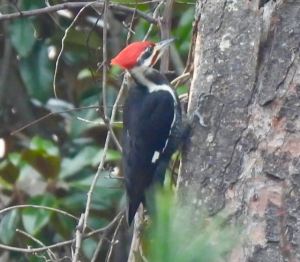
Talk about woodpeckers: here’s a large pileated one in the woods next to our garden plot, cloudy November 25

From ten feet away, White-Tail Deer watches me, then walks into cover, as a siren wails from the highway, cloudy morning, November 21

From 20 feet away, the deer continues to watch me, and feeds a bit, then watches some more, as I zoom in for a closer view. A siren blares from the highway, machinery grates in the community, and geese honk from the lake. Typical sounds. Cloudy November 21

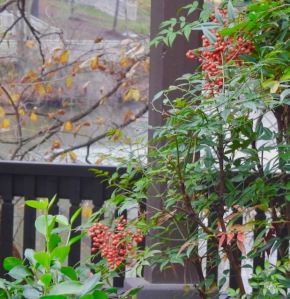
Heavenly Bamboo were prominent at our home in Northern California, and we’re happy to see them here, too, by the gazebo on the west shore of the lake, Nov. 20

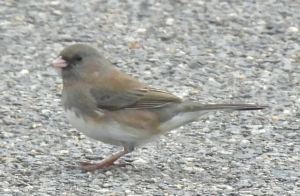
An uncommon Slate-Colored Junco stops for a moment on the path at the Northwest corner of the lake, November 21

Tiny Ruby-Crowned Kinglet rests in shadows on the Willow Oak, Southeast shore, November 20

All summer the hillside down to the outlet stream below the dam was left unmowed, and the wildflowers and faunal inhabitants exulted. Now it has been mowed, revealing the signs for the petro line that runs below the surface, and the solar-powered gas substation near the outlet stream. Our Green Space shares its home. Note also the busy highway to the left, from which come the car and truck sounds and the sirens that are a steady chorus in our refuge. November 20

Cardinal male stops to rest in the North end woods, November 21

Eastern Bluebird scans atop Maple in the North end woods, cloudy November 21

Song Sparrow feeds along the gravel path on the hillside below the dam, as cars sound from the highway, November 21

Yellow-Rumped Warbler in shadows amid branches along the Southeast bank, November 20

I capture a Common Raven in battle with American Crow above the treetops in the North woods, November 21

Burning Bush along the West shore, cloudy November 20

60 Rock Doves in their accustomed perch atop the power tower, November 21. No Bald Eagles around!

Sun through leaves on the West shore, sunny morning, November 3

Mockingbird scans from Catalpa along the East shore, November 3

Canada Goose pair on the dock along the West shore, November 20

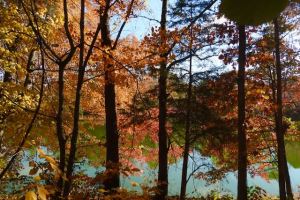
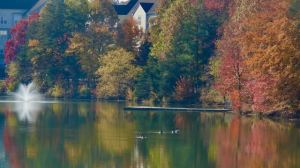
Late fall colors: Looking southwest on the lake with Geese and fountain, morning, November 3

Salt Marsh Goldenrod, Northwest corner of the lake, cloudy November 21


Grey Squirrel amid leaves, southeast path, sunny November 23


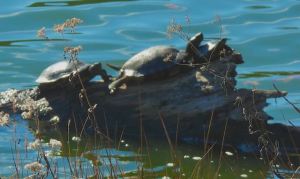
Too cold for turtles? Not for these 3 Red-Bellied Cooters on a log at the North shore, sunny November 23


Here they are! The first Mallard pair of the new breeding season, Southeast cove, sunny November 23

Happy Thanksgiving! Hopes for the last week in November and a celebratory December…

June 2025: ICE, No Ice, and Bounty in the Garden

Double-crested Cormorant preens and scans atop dead Oak, east bank of our lake, at sunset, June 8, while visiting Osprey looks on doubtfully

In this month’s blog:

ICE vs. Worker Shortages: More News from a Bizarro 2025
Climate Log: “No Ice” in Alaska; Here Comes the “Heat Dome”
Our Garden: Produce Galore in a Rainy Month
The June 2025 Photo/Video Gallery: Virginia Travel and Local Color

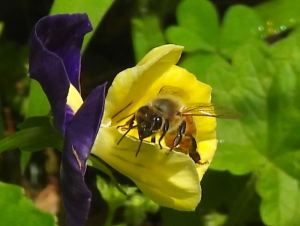
Honeybee sips from a yellow-purple Pansy in our garden plot, warm morning, June 18

*********************************************

ICE vs. Worker Shortages: More News from Bizarro 2025

ICE agents warn onlookers as agents handcuff one protester in Los Angeles (LA Times photo). From Jenny Jarvie and Grace Toohey, “Raids by ICE are stunning, but no surprise,” June 16

As I look at photos of Donald Trump’s Immigration and Customs Enforcement (ICE) agents surging unannounced into workplaces (Home Depot, clothing factories, etc.) then handcuffing people in Los Angeles last week and this, I have to remind myself that this is the strange, new US in 2025, not scenes of Darth Vader stormtroopers from Star Wars (see below). The likeness is uncanny, though: the masks, the armor, the heavy weapons, the lack of identification of any kind, the immediate violence. I’ve certainly not in my lifetime seen so-called “US law enforcement” acting as a federal government secret police force. Russian KGB and East German Stasi during the Cold War, yes, but not US law enforcement, which over recent years (and especially since 2021) has been trying to become more people-friendly and transparent in their tactics.

The five-month-old federal administration keeps trying to convince us that undocumented immigrants are an ongoing threat to US citizens and to our economy. But where’s the evidence? The claim is that these brown-skinned, admirably bi-lingual (English/Spanish) families are “taking our jobs,” as if there were a glut of workers in the US, and as if US citizens cannot find open jobs.

At last look, however (June 3), the US Bureau of Labor Statistics reported that there were “7.4 million job openings” in the US. That’s 7.4 million. Shortages of workers–not a glut–continue to be reported in many fields, including manufacturing positions, first responders, air traffic controllers, teachers, nurses, child-and-elder-care workers, hotel and restaurant staff, retail sales, construction workers, agriculture workers, etc., etc., as well as in the agencies that Elon Musk’s DOGE (Dept. of Government Efficiency) rampage of firings left understaffed.

To take just the first of those many categories, the New York Times (June24) analyzed data from the Business Roundtable (“Why Factories Are Having Trouble Filling Nearly 400,000 Open Jobs”) that pointed to severe lack of qualified applicants and the falling rate of community college enrollment.

Meanwhile, the workforce gets steadily older, as the percentage of over 65s keeps increasing and the US birthrate keeps declining.

Bottom line: this country needs more workers, not fewer.

So it’s extremely puzzling why the administration wants to deport all these workers–and why the President’s advisors want to terrify US communities into shunning places of business where ICE might attack next. What does this administration have against the people of the US and the businesses that fuel the economy? The ICE assaults in LA, for example, have left many prosperous economic hubs deserted (“LA Neighborhoods Clear Out, As Immigration Raids Send People Underground,” LA Times, June 21). Onlookers have seen adults and children grabbed off the street, no questions asked, and pulled into vans. People across these neighborhoods don’t want it happening to them or their loved ones. Would you?

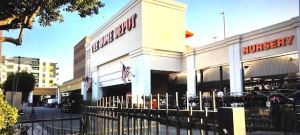
Home Depot on Sunset Blvd. in Hollywood, where ICE arrested dozens on June 19 (LA Times photo)

To make matters worse, Trump chief advisor Steven Miller earlier this month ordered the Dept. of Homeland Security (which controls ICE) to increase the daily toll of captures and detainments to 3000 per day! What can possibly be the goal of this frenzy? Why would Trump and Miller want to weaken the US economy and hamstring businesses by creating much greater worker shortages than those that already exist? What do they have against small and large businesses, who need more workers, and against us consumers–who will have to pay even higher prices as supplies dwindle because of a shrinking workforce?

According to the Business Roundtable (New York Times, June 24), a path to citizenship and aid to education for the undocumented could help ease the shortages of qualified workers (NYT photo)

******************************************************************

Climate Log: No Ice in Alaska–Here Comes the “Heat Dome”

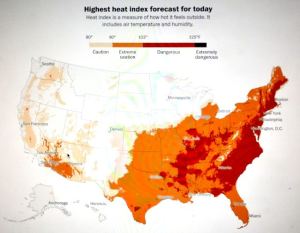
Heat Index in US, June 24 (Washington Post ) as the “heat dome” has arrived

As described in last month’s blog, Americans keep dying and being made homeless through record flooding in the US heartland, but with never a word of sympathy or even awareness from the current President. To add insult to injury, he’s gutted the Federal Emergency Management Agency (FEMA), which we had always depended on to offer emergency supplies and funds for rebuilding after such disasters. Instead, he wants the states (most often red states who voted for him in the 2024 election!) to foot their own bills for their stricken citizens. Because he and his appointees claim that climate change doesn’t exist–and all facts to the contrary don’t matter–obviously those record floods didn’t happen (or so their actions and inactions claim) and those stricken people and communities are on their own.

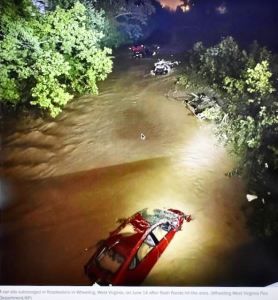
This month, the floods continued, and the administration again took no notice. The story (by Dana Hedgepeth, Washington Post, June 16) reported that 4 people died in flash floods in West Virginia on June 15. One state official said, “I’ve never seen anything like it,” but cries for attention like that fell on the deaf ears less than 200 miles east in DC.  Moreover, as one of the nation’s poorest states, West Virginia is in no position to deal with the destruction without federal help.

West Virginia flash flood damage, June 15 (photo by Wheeling, WVA, Fire Department/AP)

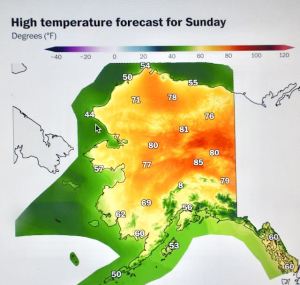
At the same time that the heartland floods were still occurring, the Post was also reporting (Ian Livingston, June 16) that “Part of Alaska is Under a Heat Advisory: That’s a First.” https://www.washingtonpost.com/weather/2025/06/13/alaska-first-heat-advisory/

Temps across Alaska for Sunday, June 22 (National Digital Forecast Database and Washington Post)

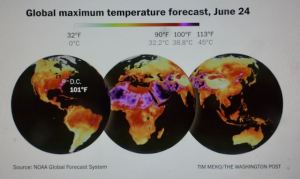
If you are among the great majority of US residents who acknowledge the climate change that our President says doesn’t exist, you will take note that these unprecedented June forecasts are part of the “heat dome” pattern that is becoming more frequent worldwide (“June is the New July: Why Intense Summer Heat Is Arriving Earlier,” Washington Post, June 25) https://www.washingtonpost.com/climate-environment/2025/06/25/global-heatwave-climate-change/

Worldwide heat map from NOAA, June 24, in Washington Post, “June Is the New July”

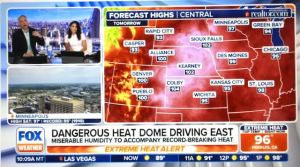
According to even Fox Weather (almost always a mouthpiece for the President), “heat domes” are especially powerful high-pressure systems that can be 1000 or more miles wide and long. The domes can

  • move steadily eastward in the US,
  • last for days until a stronger system erodes the dome, and
  • produce record-setting temps and humidity.

Now, this week,the “dome”–with temps close to and perhaps over 100 in the Northeast US–will have affected during its run three quarters of the US population.

And it’s only June. But please, if you accept the President’s Bizarro version of things, don’t believe what the weather people–who know what they’re talking about–are telling us. If you want to stay completely Bizarro, just nod your head at whatever the administration tells us.

Fox Weather infographic on the current “heat dome,” June 20

**************************************************************

Our Garden: Produce Galore in a Rainy Month

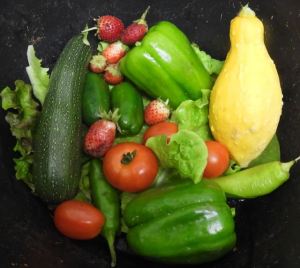
On a rainy morning, June 16, we collected this produce from our small patch in the community garden

The “heat dome” described above has just reached us in Virginia, but until this point in June we’ve had substantial rain (3-4 inches!) and moderate temps–so our 225-squ.-ft.garden has been producing magnificently.

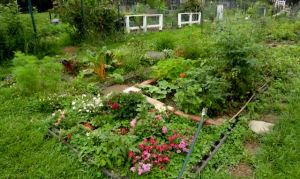
Our 15′ by 15′ garden of diverse flowers and veggies has filled fruitfully over 2.5 months, as have the gardens of our hard-working neighbors (June 16)

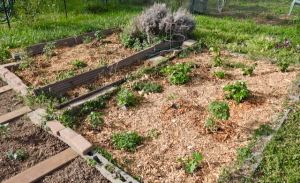
Here, by contrast, was our garden just two months ago:

On April 25, here was our garden, with all plants in ground, newly mulched, and with veggies and flowers beginning to thrive in the steadily warming temps.

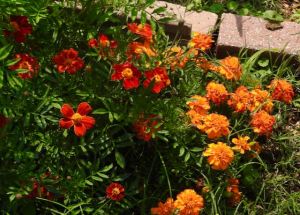
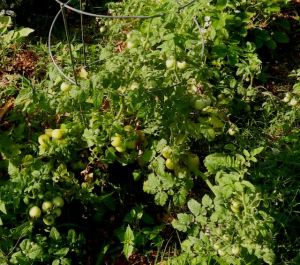
Three types of tomatoes, four types of peppers, two blueberry bushes, zucchini, crookneck squash, strawberries, Swiss chard, thyme, oregano, mint, rosemary, and sage have grown steadily since late April–and now daily produce delicious edibles. Meanwhile, ebullient flowers–dahlias, dianthus, coneflowers, buttercups, vinca, snapdragons, cosmos, pansies, petunias, zinnias, salvia, the flowering herbs, and three types of marigolds bring pollinators to the garden and a rainbow of colors.

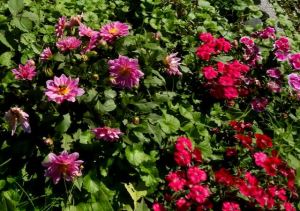
Magenta Dahlias and red and white Snapdragons, morning, June 20

We have gradually been getting to know our neighbor gardeners, most of whom have been growing in Virginia much longer than we have, and not only do they answer our questions readily, but they offer us some of their produce, as we offer ours.

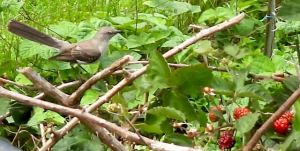
Mockingbird in a neighbor’s Berry patch, morning, June 18

Weeding, of course, is an ever-present chore in this humid climate–the productivity of our garden includes lots of productive weeds! Because we are all organic gardeners, we’d rather weed than subject our plants, the pollinators, and our bodies to herbicides. Crab grass is torturous, but blue speedwell (AKA “creeping charley”), while prolific, comes up easily–and then comes back for more fun!

Multi-color Marigold display, all grown from seed, brings pollinators and dominates the crab grass that we pull from the garden, June 11

Conversely, we’ve always looked upon “volunteers”–plants that just show up uninvited–as opportunities to learn about new species. In our garden, for example, one volunteer was the Buttercups that have brought pops of yellow that complement the reds, pinks, purples, whites, oranges, and blues of our plantings.

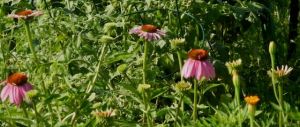
Our “volunteer” Coneflower plant, in full bloom and with more buds coming, morning, July 23

The majestic pink coneflower that emerged in late March as a “weed” is now a tall, multi-stemmed beauty that stands next to our “sweet millions” tomatoes. So what if it competes with two of our pepper plants? They all have enough room, even if crowded. And our two perennial strawberry plants? They also emerged in March to surprise us, and they produce better than any strawberries we ever planted in California.

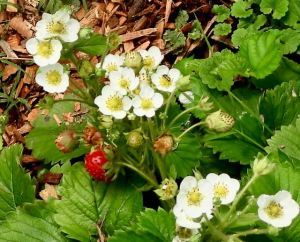
Tiny Bee in one of our two Strawberry plants, with many blossoms, morning, June 18

But here comes the heat dome. Now we get to see how our plants do in the hottest heat of summer. Bring on the “heat dome”! We’ll meet the challenge as best we can. We have experienced neighbors to help advise us.

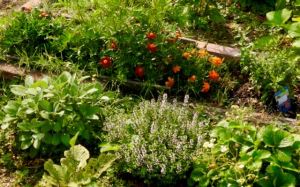
Sage, Thyme, Strawberries, Marigolds, Blue Aster in bloom, June 6

*******************************************************************

The June 2025 Photo/Video Gallery: Virginia Travel and Local Color

This month’s gallery includes, among a range of artifacts from our lake community and garden, photos from our trip early in the month to Tidewater Virginia and the historic towns of Williamsburg, Yorktown, Jamestown, and Gloucester along the York and James Rivers, where refugees from England encountered the indigenous Powhatan people for the first time in 1607, and where the English built their first settlements in North America. Professional historians, including four of our Virginia relatives, whom we visited on the trip, have done an amazing job of keeping alive this tumultuous 425-year history of immigration, conflict, rebellion, slavery, and warfare–but also the steady, progressive development of the democratic principles that have made the US great and that still, we hope, will continue to guide the future of the nation.

As we walk around our lake, Green Heron flies into the dead Willow Oak on the east bank of our lake, then preens and scans. Such serendipity!

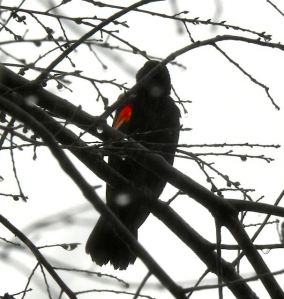
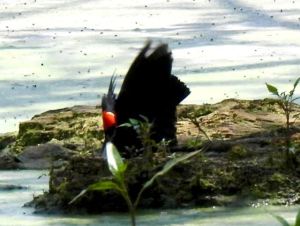
Red-winged Blackbird in the same Willow Oak, but on a rainy morning, June 16

Bumblebee in Juliet Tomato flower in our garden, morning, June 18

On our Tidewater travels, we toured Jamestown Island, where the first English settlement was built. Here I snap a Red-bellied Cooter in the marsh at the island’s edge, June 1

This simple cross commemorates at Yorktown the French soldiers and sailors who died in this final battle, 1781, of the American Revolution. Without the French aid and sacrifice, the Revolution would not have succeeded.

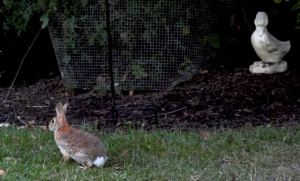
Cottontail beside duck statue, east side of our community, morning, June 20

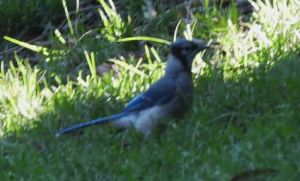
Bluejay in morning shadows along the southside path in our community, June 20

A pair of Cormorants scan along the lake from the west shore dock, rainy morning, June 16

Grey Catbird pair sips from puddles on north end path, rainy June 16

In our garden, Pink Dahlias with Honeybee and Red Dianthus, June 20

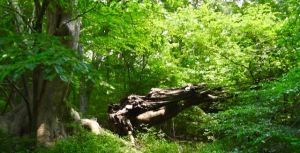
The majestic fallen trunk of one of 4 Yellow Poplar trees that still grow at historic Zion Poplars Baptist Church in Gloucester, VA, May 31. These poplars are honored as a Remarkable Tree of Virginia for their historical significance.

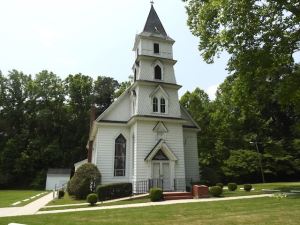
Zion Poplars Baptist Church, Gloucester, VA, May 31. This church was the first Black Church in Virginia established (1866) after the end of the Civil War. Early services at the church were held under the seven Poplars, of which four remain and which are pictured above.

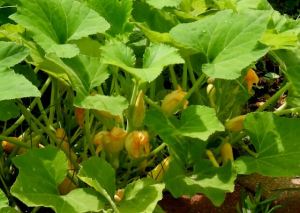
Crookneck Squash blooming and fruiting in our garden, June 18

Husky Cherry Red Tomato plant in our garden, loaded down with fruit, early morning, June 23

Snapping Turtle, first sighting of the year in our lake, pokes head above water, lurks, then dives, June 20

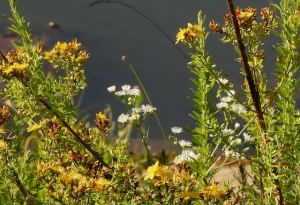
Oxeye Daisies, St. John’s Wort, and Daisy Fleabane among June wildflowers beside the north shore of our lake, June 20

Common Moorhen male, my first sighting, in marshland at the Yorktown battle site, May 31

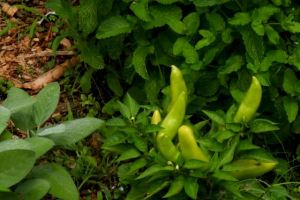
In our garden, Hot Burrito Peppers, Sage, and Mint plants, morning, June 18

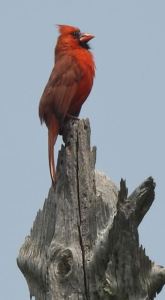
Cardinal male atop dead tree in the Jamestown Island marsh, June 1

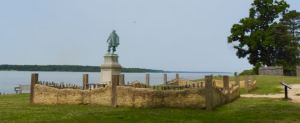
Foundation of the original meeting house of the Jamestown settlement, 1607, and statue of explorer, writer, and founder John Smith, by the James River, June 1

Song Sparrow calls singingly from atop a young Willow Oak on the north shore of the lake, June 12

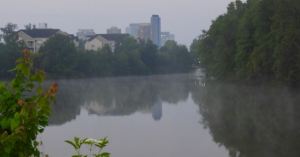
Before sunrise, June 11, mist rises from the lake, with Red Maple and Elderberry in foreground and downtown buildings in the distance

Mourning Dove on wire west of the lake, morning, June 12

Five House Sparrows try out the new yellow feeder on our porch, morning, June 17

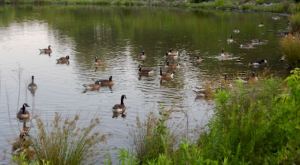
In two months, like our garden plants, the young ones of our Canada Geese families have matured from two throngs of fuzzy goslings to almost fully-grown adults. See the flotilla of 30 here in the Northeast corner of the lake, early morning, June 23

What adventures await us in the last week of June and into July?

July 2024: Feeling the Heat

If you’re new to this blog, start with the About page, then come to Home. Otherwise, you may feel a bit lost.

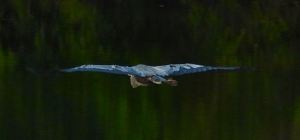
Great Blue Heron soars over the lake toward the south end just after sunrise, July 15

In the blog this month:

Feeling and Dealing with the Heat
Someone Loves It: Pollinators Galore in the Humid Heat
Did Someone Say “Drought”? In Virginia?
Climate Log: The Truth That Dares Not Speak Its Name
July 2024 Photo/Video Gallery

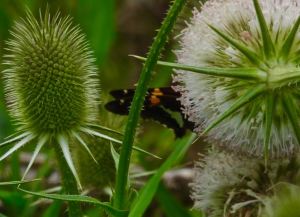
Yellow Tiger Swallowtail, Bumblebees, and Honeybees Swarm in Cutleaf Teazel and Porcelain Berry in the north end below the dam on a hot afternoon, July 23

Feeling and Dealing with the Heat

“The less you use it, the easier it is to live without it.” (Stan Cox, author of Losing Our Cool: Uncomfortable Truths about Our Air-Conditioned World)

In early July, the extreme heat that has smothered the U.S. hit Northern Virginia with a vengeance, as air temps for most of a week exceeded 100–and the heat index (the combo of heat and humidity) reached 110–before the air temp simmered back to the high 80s/low 90s. From mid-month on, clouds, bits of rain, and the forecast of more rain have tantalized us with a promise of normal summer weather in this part of the country.

Still, what separates this summer from 2022 and 2023 so far has been the humidity, the overall heaviness of the water-vapor-loaded air, which makes breathing slightly more difficult and sweating more intense. Fatigue hits us more quickly.

Those of us who can luckily spend most of our time indoors in chemically-cooled air can combat these effects. But most people in the world, including millions in this country, are not so fortunate. And even those of us with the luxury of cooled air pay the environmental price of further pollution of the air by the very machines we use to cool the air. In addition, all that hot air spewed outside by the air con just makes the outside hotter! So there’s really no escaping the costs of extreme heat brought on by our fossil-fuel addiction. Not to mention the big hit our utility bills take by all that air con!

With all that negativity in mind, even the fortunate can take a few simple steps to minimize their reliance on chemical/mechanical cooling; and you’ll save $$$, too!

  • Learn to live with higher temps than you’d prefer: when it’s 100 outside, set your air conditioner at 80 or higher (I set mine at 78, but by following the suggestions below, the aircon rarely comes on)
  • Keep shades or blinds closed to keep out sunlight–live with a little bit of darkness
  • Strip down to your preferred level of modesty
  • When coming in out of the muggy heat, wipe face and neck (and any other area you feel needs it) with a wet washcloth
  • Stay hydrated–keep drinking water handy
  • Avoid using heat-producing machinery to the extent possible in the kitchen or workroom

Anything you can do to stay cooler without the air-conditioning running is a plus for everyone.

**********************************************

Butterflies, Moths, Bees, and Dragonflies–Pollinators Galore in the Humid Heat

Silver-Spotted Skipper Butterfly feeds on the ubiquitous Cutleaf Teazel by the outlet stream below the dam, hot afternoon, July 23

Taking a daily stroll around the lake this month in the humid air may not be the most pleasant experience, especially from 11 AM on, when the air is at its hottest. But if you do, you’ll be treated to a festival of pollinators gorging on the lush July wildflowers, from Queen Anne’s Lace and Swamp Milkweed to Cutleaf Teazel, Porcelain Berry, and Purple Thistle–and even the last remaining Allegheny Blackberries. In my two summers here so far, I’ve not seen such profusion of Butterfly, Moth, and Dragonfly species, as well as the numbers of Bumblebees, Honeybees, and smaller bees flitting from flower to flower.

The difference is the level of heat and humidity. What makes life uncomfortable for us fragile humans seems to bring out the best in the small pollinators, at least to this point in the month. So I’ll enjoy the photographic cornucopia while I can, and keep track over the coming weeks. Here are some of the results, with more in this month’s Photo/Video Gallery later in the entry.

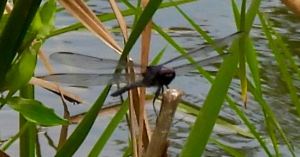
Black Dragonfly amid Cattails and Reeds by the outlet stream below the dam, July 23

Orange Sulphur Butterfly, with Bees, and Beetles, on Cutleaf Teazel on a breezy July 13

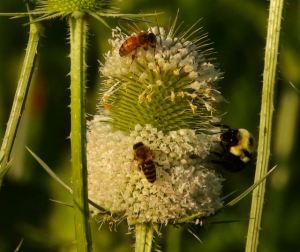
Bumblebee and two Honeybees feed on Cutleaf Teazel at the northwest corner of the lake, at sunrise, July 15

Closeup of a Common Buckeye Moth on the path below the north end dam, July 23

Pipevine Swallowtail–first sighting–feeding on Cutleaf Teazel on the northwest corner of the lake, on a hot afternoon, July 23

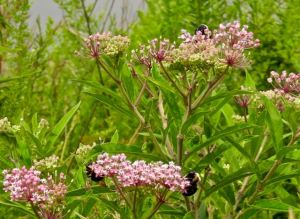
Three Bumblebees feast on Swamp Milkweed, east bank of the lake, July 23

If you are interested in identifying Butterfly and Moth species, may I suggest the website Butterflies and Moths of North America.

If you are interested in identification of insects of all kinds, go to insectidentification. org.

If you want to get kids involved in the looking and enjoying, try the Children’s Butterfly Site, with quizzes and games to add to the fun.

***********************************************

“Drought,” Did Someone Say? In Northern Virginia?

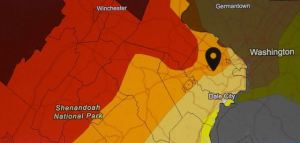
Severe (orange) and extreme (red) drought conditions in Virginia, July 23 (source: Fairfax County Government)

Update, July 31: According to the Washington Post  (July 30), the Washington-area Council of Governments has issued a “drought watch” to the region, and has urged residents to “voluntarily” conserve water by such actions as taking 5-minute showers, turning off water while brushing teeth, and only using dishwashers for full loads. At the same time, they are assuring residents that the area reservoirs are full and the region is well-prepared for drought. Commenters to the article disagree with this rosy assessment.

July 28: Since moving here from California two years ago, I’ve occasionally written in this blog about how shocked, but not surprised, I’ve been by how ignorant and complacent this region is about water or the lack of it. Whereas Californians obsess about water, because they have always been forced by drought to be aware of every drop, what happens to it, and how to conserve, Northern Virginians take water for granted. In California, most people know whether local water comes from the aquifer, from a far-away reservoir, or from annual river runoff from the Sierra snowpack. Here, it’s just assumed that rain will provide–and in the past it did. But no longer.

Water-hungry toilets, multi-acre-sized carpets of pollinator-empty grass, and thirsty beds of annual flowers are everywhere in the DC suburbs and exurbs. Mowers are out weekly to make sure that lawns look like artificial turf–rather than like actual plantings, which if allowed to grow would have roots that can reach the water table. Local governments never ask residents to conserve water. (Note: See the July 31 update, above.)

Last year’s drought conditions in Central Virginia (see the map above) and even a few brief wildfires near us in August drew hardly a mention here. Equally critical, the lack of snowfall in the disappearing winter (see my January 2024 entry) is only considered significant because of lack of a nostalgic White Christmas, not because it portends trouble to come. Indeed, most Northern Virginians are happy not to have the snow, because it just clogs traffic–everyone’s number one preoccupation. (I’m trying not to be too cynical!)

A rare rain shower wets the burned-out blackberry canes along the north end of the lake, July 11

Finally, the Washington Post published an article by Ian Livingston on July 11 that proclaimed the “severe drought” plaguing the DC region. It noted the 4.5 inch deficit in average rainfall, and showed a picture of browned-out grass in one neighborhood. But the overall message was that a few nice rainstorms and maybe even a helpful hurricane would come by to bring us all back to our usual contentment.

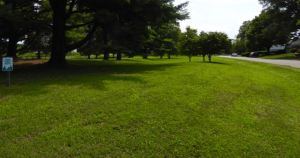
Typical rain-dependent, regularly mowed “lawn” space in suburban Northern Virginia, not hospitable to pollinators, July 26

However, one of the many commenters to the bland article emotionally described an actual consequence of what the “severe drought” is doing to the region:

I live in the Valley and let me tell you it is really bad. I realize that many sit inside in A/C and never even think about what is happening. The farmers are selling their cows because they cannot feed them. Normally the fields are lush and green now with plenty of grass. There is no hay. We normally get three crops of hay. There was one very small crop this year. So there is no hay to feed animals this winter. Even if we got a lot of rain now, there will be no more hay. I don’t know what the farmers will do. The trees are dying. Wells are running dry.

We had a similar scenario last year but the drought started last year in late August so at least there was a decent hay crop.

If this is the new normal and I am starting to think that it is, then it will be impossible to raise cows for beef and for milk at least here in VA. Prices are going to go way up in any event (please don’t blame this on Biden, he cannot control the weather).

And I have never seen it so hot for so long. Weeks on end of mid 80’s to upper 90’s temperatures. And I fear now for forest fires. One lightning strike is all it will take.

Note, however, that this impassioned commenter “lives in the Valley” (presumably the Shenandoah Valley 90 miles west of here), so it’s unlikely that the average DC area urbanite/suburbanite will pay any attention to “hay” and “cows,” when they have much more pressing concerns–like this morning’s (or any days’) traffic on the beltway (“I know! Isn’t it a nightmare?!”)

Update, August 3: Photos from the Drought-Stricken Shenandoah Valley

To see for ourselves what commentators to the Post articles were writing about the extreme drought conditions in Western Central Virginia, we spent August 2 and 3 in the Shenandoah Valley. Once we crossed the Blue Ridge Mountains and drove down into the Valley in the high 90s heat, the fields were much browner than east of the mountains, and corn fields were stunted and sometimes bare. The South Fork of the Shenandoah River was very low, though the river still flowed. The forecast on the 2nd was for thunderstorms, but, as usual, storm clouds did appear, but no more than a few drops fell.

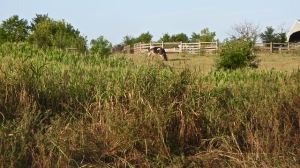
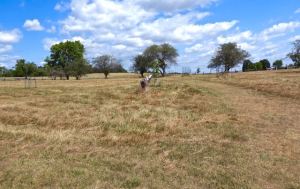
Dried out field, stunted corn crop, at farm in Shenandoah, VA, August 3

Burned out farm field, New Market, VA, Aug. 2

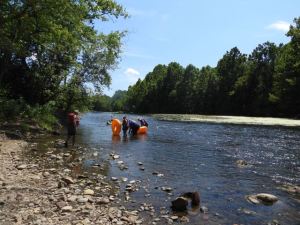
Families are still out tubing on the shallow, much-narrowed South Fork of the Shenandoah River, Elkton, VA, August 2

*************************************************

Climate Log: The Truth That Dares Not Speak Its Name

What now looks like desert was not long ago a thriving pasture in Leonforte, Sicily (photo by Gianni Cipriano, June 24). See Postcards from “A World on Fire” for more such examples of drought around the world.

In the intense political atmosphere of this critical election year, I am again dismayed, but not surprised, by the lack of any mention of climate change by U.S. candidates, particularly in relation to the daily, dramatic heat extremes of this most unique of summers. This last week of July is feeling Earth’s hottest day on record in 88 years of recording–or really a succession of hottest days ever–not to mention report after report of heat-related deaths, crop burnout, and devastating effects of drought. The Washington Post article by Sarah Kaplan, July 23, reviews the research and statistics from the European Union’s Copernicus Project. The  shocking photo from Sicily (above) is just one of many examples of climate degradation around the world in just the most recent year, and far from the most terrible in terms of human cost in lives and livelihoods.

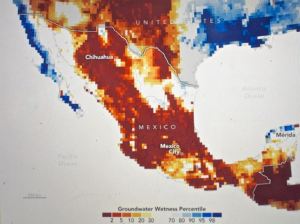
Here in the U.S., research by the National Oceanographic and Atmospheric Administration (NOAA) reveals the intensity and spread of one climate change consequence–extreme drought–as illustrated by this map of Texas south through Mexico to Guatemala (June 2024), as part of its Global Drought Narrative for the current year:

But for one of our two U.S. political parties, climate-change denial is perhaps its most important commandment. Why? Because the Party is deeply committed to the fossil-fuel cartel. The Party’s Presidential nominee openly promised the cartel special favors in exchange for a one-billion dollar donation to his campaign.

Even though a solid majority of Americans continue to say to pollsters that climate change is an important issue that needs to be addressed (78%), the cartel and its supporting politicians have so far managed to convince many Americans that climate change may not be primarily human-caused (46% of respondents to the polls sponsored by the EPIC project at the University of Chicago). This viewpoint translates into a clear majority of respondents to the same polls who would not be willing to pay even 1 dollar more in taxes to reduce fossil fuel emissions! However, if, as the pollsters asked, corporations could be induced to pay for the transformation of the energy system to renewable energy, the popular opinion becomes strongly positive (65%). 

So most Americans do think that something needs to be done to combat climate change–as long as someone else pays for it.

As might be expected, people who align themselves Republican (the party of denial) are way more skeptical of the need to address climate change. But even many of them (42%) would support regulations to limit emissions from power plants and vehicles. Support by Democrats (the party for positive action on climate change) is, understandably, higher, with 78% favoring regulation of emissions.

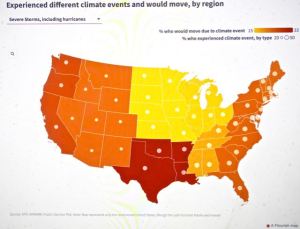
What about people who have suffered first-hand from extreme effects? The brightest number in the EPIC stats for those favoring action comes from respondents–across party lines–who say that they had suffered the extreme effects of climate change in their own lives. 68% of these sufferers consider it an important issue in this election year, and 53% want the newly-elected President to take action. Even more telling is that up to 22% of sufferers in four states who are among the most affected (Texas, Louisiana, Oklahoma, and Arkansas) would consider moving out of those states–becoming migrants themselves–if conditions don’t improve (see map below).

Percentages of those already affected by extreme heat and storms willing to move (EPIC Project, U. of Chicago, 2024)

Since the extreme effects of heat, drought, floods, sea level rise, etc., will only intensify, the deteriorating climate itself promises to keep moving the public-opinion dial toward government action and corporate change. But how many more tragedies must occur in the meantime?

For the present, even the Democrats, nervously looking at the ambiguous numbers, are afraid to come out too strongly for positive action on climate change. Listen to and read their speeches, their policy statements, their incessant funding pleas. Do they even mention how people and places are suffering from a changing climate? Or will the extreme effects of heat, drought, floods, wildfires, and eroding shorelines remain a terrible truth that dares not speak its name? How many more places across the world, including the U.S., must become virtually unlivable before politicians have the courage to speak out with bold plans to save lives, livelihoods, and our fellow creatures?

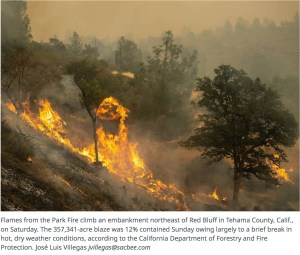
Park Fire, now the 6th largest in California history. Sacramento Bee article by Rosalio Ahumada, July 29

***********************************

The July 2024 Photo/Video Gallery

This month’s gallery features more scenes of the variety of pollinators (birds, butterflies, bees, dragonflies) around the lake, including species not seen here before, as well as the flowering plants with which they collaborate. That our fragile little ecosystem remains so wildlife friendly is a tribute to all, including humans, who care for it by not polluting, by letting plants grow, and by not scaring the wildlife away.

Red-winged Blackbird male perches on a Persimmon Tree at the northwest corner on a hot afternoon, July 21

Orange Skimmer dragonfly rests on a branch on the southwest shore, July 31

Green Heron listens to Cicadas on a branch under the bridge on the southeast cove on a humid afternoon, July 23

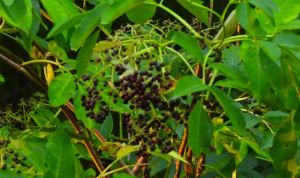
Ripe Elderberries along the path by the southeast bridge, July 15

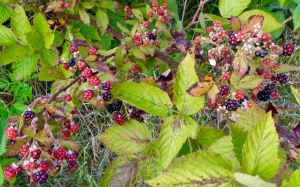
Some of the last Allegheny Blackberries at the north end, before the canes burned out in the heat, July 5. We harvested some for snacks and baking, but left almost all for the birds!

Silver Spotted Skipper Butterfly–a first sighting here–amid Cutleaf Teazel below the dam, hot July 23

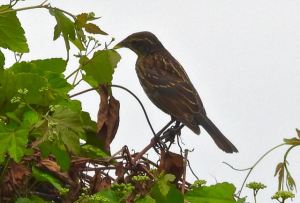
Red-winged Blackbird female in Porcelain Berry at the north end below the dam on July 23

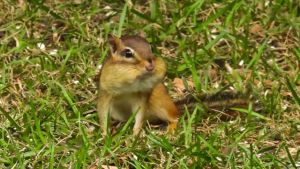
Chipmunk eyes me from the grass beside the southeast cove bridge on the hot, humid July 23

Our ubiquitous Red-bellied Cooters don’t like coming above water on really hot days, but this one showed up on the log in the southeast cove in the heat of the afternoon, July 23

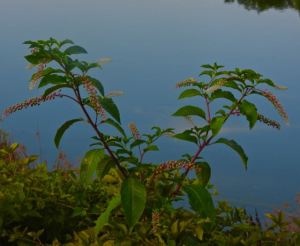
Another July regular, Pokeberry, appears in graceful glory on the north end shore, July 4

I surprise an unfazed Mockingbird on the north end path, on a drizzly morning, July 22

Cottontails are plentiful this July, like this one, munching calmly on the grass beside the northwest path on a hot afternoon, July 23

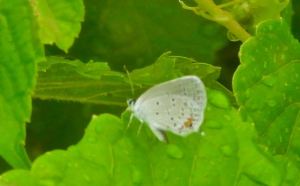
Tiny Summer Azure Butterfly on Porcelain Berry leaf below the north end dam in heavy rain, July 11

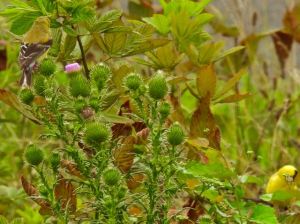
Two Goldfinches amid Purple Thistle on a drizzly morning in the northwest corner, July 22

Blue Widow Skimmer Dragonfly on Porcelain Berry below the north end just after sunrise, July 7

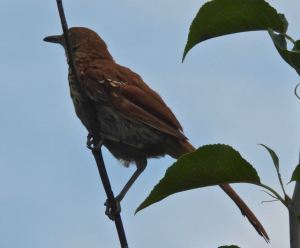
Brown Thrasher, first sighting here, in Bradford Pear by the northeast corner path, July 23

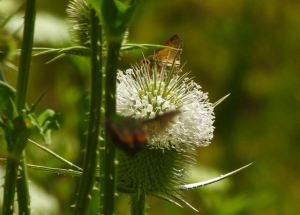
Sachem and Fritillary Butterflies feed on a Cutleaf Teazel bloom in the northwest corner, July 13

As the abnormally high heat and humidity continue, we hope the resilience of our pollinators and of our human Virginia neighbors continue to set an example for all of us. On to August!