Farm workers who create and nurture this beautiful, productive California field (Getty images)
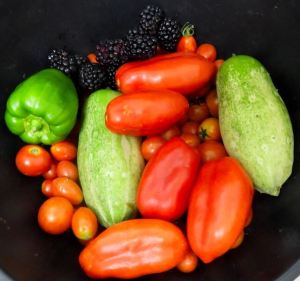
One day’s harvest from our garden plot, July 19
In this month’s blog:
Being One with the Land: At Least Trying to Be
Climate Log: Flash Flood Horror in Texas and Iceland’s Dilemma
July Kitchen: Homemade Pies and Garden Produce Dishes
The July 2025 Photo/Video Gallery
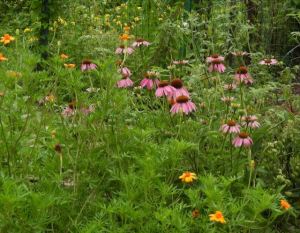
Marigolds and Coneflowers, our garden plot, July 2
Being One with the Land: At Least Trying to Be

Farmworkers plant jalapeño pepper seedlings in Camarillo, CA (LA Times photo)
“A fresh peach still requires a pair of hands to pick that off a tree. Table grapes still require the sensitive hands of an employee to remove them from the vine.” Ryan Jacobsen, director, Fresno County Farm Bureau (From LA Times: “For State’s Farmers, Migrant Workers Are ‘Irreplaceable,'” July 10, Andrea Castillo, Sulauna Hussain, Jessica Garrison)
Chris:
It may be ridiculous to think that amateur gardeners like us have anything in common with the skilled farmworkers, like those pictured in two photos above, who spend their lives in the fruit and vegetable fields of California and other states. After all, they have the experience, perseverance, knowledge, patience, and toughness to grow the crops that feed the United States and much of the world, while we just experiment semi-blindly on our little plot with tiny seeds and cute seedlings we’ve picked up from Home Depot, and then marvel at how the sun, soil, and water turn those infants into delicious (we hope) tomatoes, cucumbers, squash, berries, herbs and gloriously beautiful flowers–with precious little work on our part. While those farmworkers bear the heavy responsibility to keep all of us alive through their skilled, talented work in the harshest of conditions.
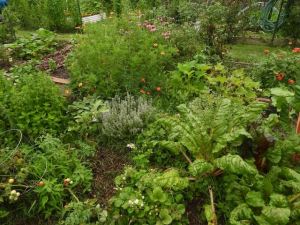
Swiss Chard, Tomatoes, Strawberries, Thyme, Oregano, Squash in our garden plot, July 2
If we fail in our little garden playpen, so what? We can just go to the store and stock up on the fruits of the farmworkers’ incessant, highly skilled labor.
The Price of Being One with the Land. Now one would think that people who bear all that responsibility and who display every day all that skill and perseverance, would be honored by the rest of us and treated like the heroes they are. But, instead, their work and knowledge are, at best, taken for granted by us. And, even worse, the people who we voters have elected most recently to lead us treat those indispensable workers with fear and contempt. These leaders just take and enjoy the fruits of these essential workers’ labors–and then, if you can believe it–do nothing to grant these workers citizenship in our nation. In fact, by not granting them citizenship, these leaders pretend that the workers are criminals because we have not granted them citizenship!
And even worse, these leaders send in masked marauders to capture them, often in workplaces like the Home Depots we visit, and send them out of the country. Can anyone make sense of this? Where, pray tell, will our food come from if these workers are deported? Does anybody gain by this senseless cruelty?
****************
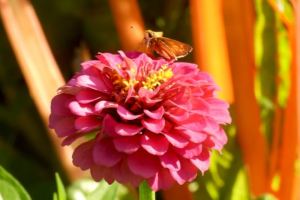
Sachem Butterfly on Zinnia bloom, our garden, July 11
Trying To Be One with the Land. Now, I may not be a skilled digger of holes, planter of seeds, plucker of weeds, spreader of mulch, waterer, watcher, and harvester, but I’ve become a pretty skilled admirer of the plants themselves and of the busy creatures who pollinate them. But getting to know our tiny, living plot of soil does help me respect the farmworkers who really know what they are doing, so that I never take any of what they do for granted.
Yes, Jean and I know what it feels like to be soaked with sweat, bitten by ants and mosquitos, and wilt after just one hour in the garden in the July sun. But can we imagine doing this work hour upon hour, day in and day out? We try, but know we really can’t.
It’s easier every day for us to marvel at the miracles that are plants and the miracles that are these real gardeners. And everyone who gardens knows that those people and those seeds and the soil, the rain, and the sun, are miraculous. And I can each and every day give thanks for these miracles.
And I can call out the injustice and cruelty of those–really all of us–who take the real gardeners for granted and even seek to punish them, banish them, and deny them citizenship.
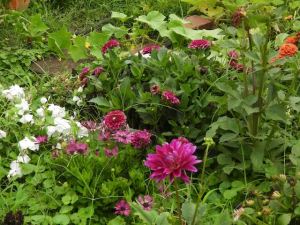
Dahlias, Vinca, Zinnias, and Cucumber vine, our garden, hot muggy July 2
******************************************************************************
Climate Log: Flash Flood Horror in Texas and “What Do You Call Iceland When All the Ice Is Gone?”
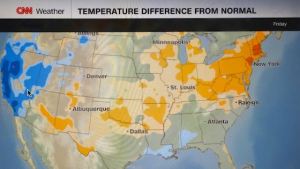
The next “heat dome” crossing the US and set to arrive in our region by July 25 (CNN Weather, July 22)
“Nature is changing faster than the language we use to describe it.” Andri Snaer Magnason, in the New York Times, July 19, 2025
Bed of the flood-ravaged Guadalupe River, Kerr County, Texas, July 6 (CNN video)
More and more continues to be written about the horrendous flash flooding in Texas Hill Country on July 4 that took 135 lives, with more persons still missing. Blame for the disaster has been spread among
- local officials for tardy responses to warnings,
- the gutted National Weather Service for staffing cuts,
- localities for feeble, under-funded warning systems,
- dangerous building locations by property owners and children’s summer camp owners (these camps were particularly hard hit), and of course,
- just plain old complacency by people who’d rather ignore warnings than do anything different.
In the last few days, another target has been named by a few conspiracy theorists: a chemical cloud-seeding operation in the bone-dry West to try to encourage more rainfall (LA Times, “How Cloud Seeding Sparked Texas Flood Theory,” Hayley Smith, June 21). If there is anything like positive news in this flooding horror, it might be that at long last at least a few climate-change deniers are willing to admit that these so-called “natural disasters” are anything but natural–even if their cloud-seeding notion is easily-debunked nonsense. That said, it’s highly unlikely in Texas–ground zero for climate-change denial–that the true human culprits, the fossil-fuel cartel, will receive any blame. So the flooding horrors will just continue and get worse.
“What Do We Call Iceland When All the Ice is Gone?” (New York Times, July 19).
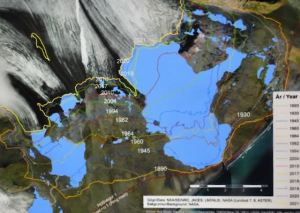
Some Icelandic glaciers have lost as much as 80% of their mass in the past century because of climate change, with projections that most of the country’s glaciers may be gone in the next 100 years (Horfandi Joklar photo, 2021)
I mention this article by Andri Snaer Magnason because it highlights how our language about climate change just can’t keep pace with the reality of what is happening. Iceland is a good case in point. There, so many place names feature glaciers–however, climate warming since 1900 has so depleted glaciers that the names no longer fit–yet people keep the names out of veneration for a happier past–and because the glaciers were for centuries so much of their national identify. Our continuing to use in the US the term “natural disasters” is another such example of how our use of language shows our failure to accept reality–and perhaps our longing for a past before Mother Nature was assaulted and violated day upon day by human forces.
***************************************************************
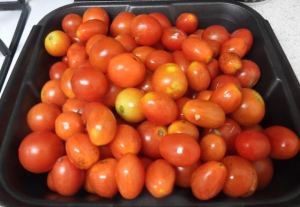
What to do with all these tomatoes? Four days of tomato harvest from our 4 Husky Cherry Red, Juliet, and Sweet Millions tomato plants, July 18
July Kitchen: Homemade Pies and Garden Produce Dishes
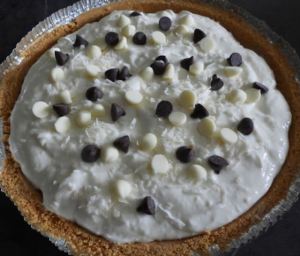
Jean’s Black and White Chocolate Cream Pie, July 19
Jean:
During my days of cooking for our graduate student friends as a young wife in the 1970s, I took pride in “sophisticated” desserts containing liquor or liqueur like black-bottom rum pie and grasshopper pie. This month, those cool, creamy tastes sounded enticing in the heat, so I went looking for recipes, old or new. Of course I found some online, but I also decided to alter them somewhat.
My black-bottom rum pie became a black and white chocolate cream pie, decorated with dark chocolate and white chocolate chips. Okay, it’s summer and I was hot and busy, so I used instant chocolate and white chocolate puddings rather than separating and cooking egg yolks in milk and all that, like I once did. But you do you. I did put rum into the puddings, but we couldn’t really taste it. The cream and chocolate overpowered the alcohol taste. Somebody in my house really enjoyed it despite all the disappointments!
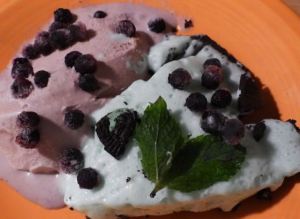
Slice of Jean’s Mint Oreo Pie with Black Raspberry ice cream and Wild Blueberries, July 25
Next I tackled grasshopper pie but did not want to buy an entire bottle of creme de cacao. (I already had a bottle of creme de menthe I had purchased for something I no longer remember, but this helped inspire the pie.) You could also use a Torani mint syrup, if you have or find that. See https://www.thepioneerwoman.com/food-cooking/recipes/a12009/grasshopper-pie/ You can change it up slightly to a mint chocolate chip pie, sprinkling mini chocolate chips on top in place of more Oreos. We added broken mint Oreos in the version you see here.
I must confess that the presence of these types of alcohol in my kitchen also inspired another treat for hot days–the boozy milkshake, like some of the upscale burger places serve. Just take your favorite flavors of ice cream and blend them with milk and a bit of complementary liquor. Everyone has mint chocolate chip ice cream on hand, right? Throw in some of that excess, nearly unusable creme de menthe if you bought it. The “grasshopper” actually used to be a drink, as shown here: https://food52.com/recipes/creme-de-cacao. And of course, another use for creme de cacao is a Brandy Alexander, which could be approximated as a milkshake using Irish creme ice cream and chocolate Irish creme liqueur, if you can find them. Just use your imagination to come up with combinations, and stay cool with a luscious cold liquid dessert. Have the drink with your slice of pie if you can afford the calories.
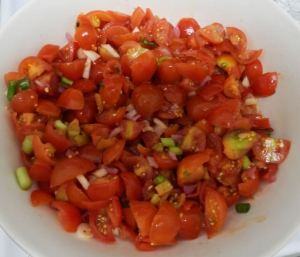
Chris’s Tomato, Onion, Hot Pepper Salsa
Chris:
What to do with all these tomatoes? We can use a lot, and friends will take some, too, but our local food banks are already resplendent in fresh donations from local supermarkets, so freezing for the fall and winter months is our best bet, as we used to do with our extra produce in California.
The fresh salsa shown above is super easy to make, as no cooking is required. And it disappears quickly, either as a dip/snack with chips, a side dish, or a topping for the veggie stir fry shown below.
Once you’ve done the tedious part–chopping all those little gems into 3-4 pieces each (I used 40 for my most recent batch), just sprinkle in salt and black pepper to your taste, plus some garlic powder, onion powder, and dried thyme or other herbs of your choice. The spice comes from the onion and from any hot pepper flakes or sauce you want to use (I used Cholula red, but I’ve also used sriracha). Fold it all up and taste. Stick it in the fridge until you want to use it. It keeps well for up to ten days.
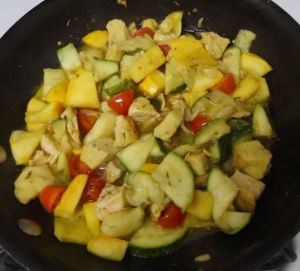
Chris’s spicy chicken, zucchini, yellow squash, tomato stir fry, July 19
For elementary cooks like me, the stir fry is perfect. With a light coating of oil in the skillet, and at medium temp and with a decent spatula, you can throw in any (well, almost any) chopped leftovers you have, add in salt, pepper, and spices of your choice, and just keep flipping and stirring until the mix softens to your desired firmness. (Just don’t leave it alone in the heat, because it will stick.) Except for the cooked chicken, which Jean provided, all the ingredients came from our garden patch. There are more of these veggies waiting in the fridge, so more stir frying will be coming up.
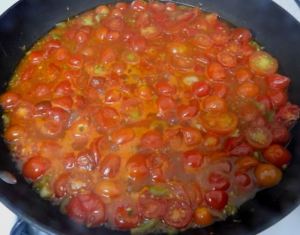
Chris’s Tomato Arrabbiata Sauce, cooking down, July 14
With as many Cherry and Grape Tomatoes as our patch has been producing since early July (50 or so ripe ones every two days), cooking sauce has been a great way to preserve those we can’t give away or eat as snacks or salsa. The large skillet of sauce just above has over 100 chopped in thirds or quarters.
Since there are a million tomato sauce recipes just a Google away, you can use the one you like. Just keep in mind that I’m using little tomatoes, so I can’t get the skins off. So as I cook the mixture of tomatoes, spices, red wine, olives, and herbs down on low heat, I’ll need extra time–say 90 minutes in all–to get the skins as soft as possible. I like to set up my laptop in the kitchen, so I can work and keep an eye on the stove during that slow cooking time. And the kitchen just smells so good!
The best part is that I can keep the finished sauce in jars in the fridge, where they’ll keep for a week or two, or I can freeze them. Right now, I have 2 jars in the fridge and just one in the freezer. We’ve already used 2 jars with pasta and stir fries! A load Like the one you see cooking will fill two 18 ounce jars.
*********************************************************
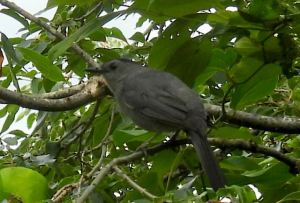
Grey Catbird in Persimmon tree right beside me on the west bank path, July 12
The July 2025 Photo/Video Gallery: Lake and Garden Highlights and One Local Outing
July’s gallery features shots of four gardens, the most intriguing of which may be the one that largely takes care of itself in the several acres within our semi-urban community. Or should I say that we humans care for this “garden” refuge by mostly leaving it and its citizens and visitors alone? Whatever hand we may or may not have in its care, it sure presents a marvelous array of species, shapes, and colors. And so do the other gardens pictured here! Enjoy.

Washington National Cathedral–a favorite spot from our earlier lives in this region, but our first visit in 25 years, July 1. Here is a view of this magnificent Gothic style cathedral from the 7th floor observation deck. Notice the “flying buttresses” that support the windowed walls, a classic feature of the Gothic style

The West Side of the Cathedral and the Rose Garden, July 1
In our garden patch, Monarch feeds on a Garden Cosmos flower, hot morning, July 21
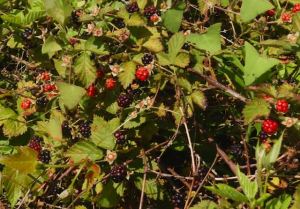
Ripe and ripening Allegheny Blackberries along the north end path of our lake, July 4. These berries grow wild in profusion around the lake. Plenty for us and for the birds
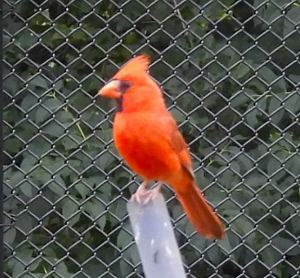
Beside our garden patch, this Male Cardinal calls from atop a neighbor’s stakes, July 21
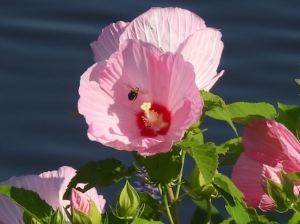
At nearby Lake Newport, Bumblebee feeds in Swamp Rose Mallow along southeast lake shore, July 11

This rarely seen Trumpet Vine flower adorns the southeast cove of our lake, July 12
Red-winged Blackbird chirps atop Red Cedar at the northwest corner of our lake, very hot noon, July 4
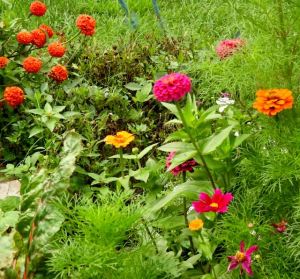
In our garden patch, Zinnias and Cosmos blooms and feathery stems, grown from seed, July 21
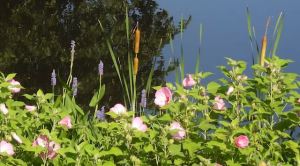
At Lake Newport, Cattails, Pickerel Weed, and Swamp Rose Mallow hug the shoreline, July 11
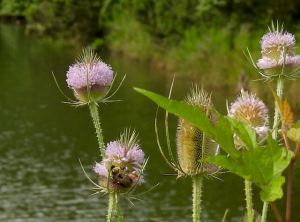
Bumblebee hugs blooming Purple Teazel on northwest shore of our lake, hot July 12
Snapping Turtle lurks at the surface, mid-lake, hot noon, July 4
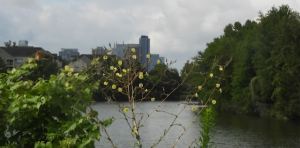
Panorama of our lake toward downtown, with yellow Prickly Lettuce flowers in bloom foreground, cloudy morning, July 12
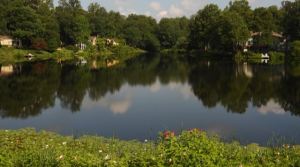
Panorama of Lake Newport with Lilypads and Swamp Rose Mallow, early morning, July 11

Swamp Milkweed with Bumblebee, east bank of our lake, noon, July 4
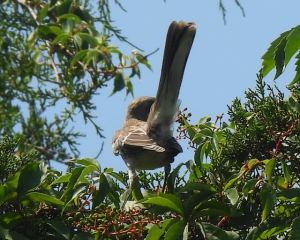
Mockingbird in Red Cedar, northwest corner by the path, with Porcelainberry, July 4

Two Red-bellied Cooters on log, west shore of our lake, hot noon, July 4
In our garden patch, Bumblebee feeds on pink Coneflower. So many pollinators! Hot morning, July 21
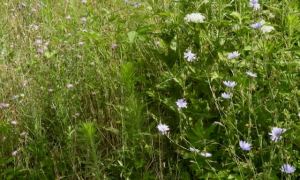
More lake summer wildflowers: Pink Spotted Knapweed and Blue Chicory, north end path by our lake, morning, July 12

Lake Newport: Red-winged Blackbird in flight, July 11
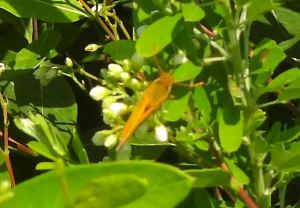
Orange Sulphur butterfly on Indian Hemp, north end path by our lake, noon, July 4
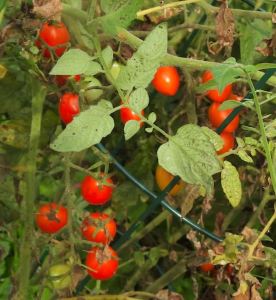
In our garden patch, Juliet and Sweet Millions ripe clusters, morning, July 21
Short clip: Mockingbird scans, then flies atop Red Cedar beside our lake, July 4
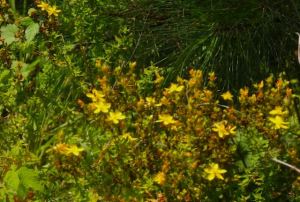
Another lake wildflower: St. John’s Wort along the north shore, July 4
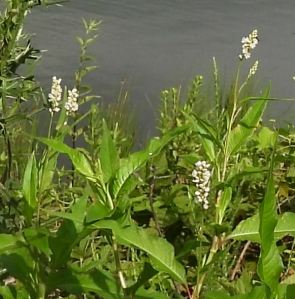
Yet one more lake wildflower–such bounty: Pennsylvania Smartweed along the north shore, hot July 12
And on to August! What do all our gardens have in store for us?
 From Sacramento to Potomac: Tales of Two Valleys