Bald Eagle–a rare sighting here!–scans our community from atop the power tower west of the lake, bright morning, November 3
Two Rock Doves, the usual inhabitants of the top of the power tower, claim their space–and keep their distance–from the visiting Bald Eagle, crisp morning, November 3
In this month’s blog:
“Call to Earth Day”–Saying Thanks to Wildlife by “Guarding Our Green Space”
Climate Log: Just the Most Recent Outrages from Washington
Climate Log 2: California Act Saves Water, Wildlife, and the Eastern Sierra
Garden Update: Winter Is Coming, but Growth Continues
Our November Kitchen: Thanksgiving, with a Difference
The November 2025 Photo/Video Gallery: Surprises
****************************************************

Children in the Czech Republic turn trash into art (CNN Photo, Nov. 6)
Call to Earth Day 2026: Preserving and Increasing Our Precious Green Space
Chris: While more anti-environment outrages occur in the secret halls of US power, we focus this month on celebrating the fifth annual Call to Earth Day (http:// cnn.com/calltoearthday) sponsored by CNN, program donors, and life-affirming thinkers and doers from around the world. “Yes, we can!” say these dedicated children and adults, whose ideas and hard work help inspire nations to protect and save all of us, our fellow creatures, and our land, air, and water.
From Kenya, to Nigeria, to Hong Kong, to England, to the Czech Republic, and, yes, to places around the US, CNN reported on life-building and nature-saving projects that give us hope for a greener, less poisonous world. In so many of these places, children–assisted by dedicated adults–are leading the way.
In California this fall, one such event, the 2nd annual Green New Leaders Summit, was held in San Bernardino: https://socalren.org/futuregreenleaders , with workshops for hundreds of middle school students on energy systems, wildlife, career pathways, and other topics in green technologies and environmental protection.

Three attendees at the Green New Leaders Summit in San Bernardino in November try out some of the energy apparatus.
Here in Virginia, the best recent news for “guarding our green space” is the election, by an emphatic margin, of Democrats Abigail Spanberger (Governor), Ghazala Hashmi (Lieutenant Governor), Jay Jones (Attorney General), and 13 new House of Delegates members on November 4. Although it remains to be seen what the new state administration can and will do to advance such green issues as energy efficiency and pollution reduction, part of Spanberger’s mandate is to reduce the cost of power for Virginia citizens, which certainly can be accomplished through more solar and wind. When we moved here from California 3 years ago, we were dismayed to see how few homes had solar panels, when we knew from our own experience how much we saved through our panels (for example, we paid 0 dollars for power every summer after installation in 2017 in comparison to $300 per month in the brutal summers before we went solar).
At the very least, Spanberger will be another thorn in the side against the Trump administration’s ongoing rollbacks of endangered species protections and its rollbacks of clean air and water protections (see the next section). Her promises to improve public education will no doubt include greater emphasis on science, including environmental science, which the Trump administration has deliberately weakened and defunded out of his deference to the fossil fuel cartel’s campaign for public ignorance.
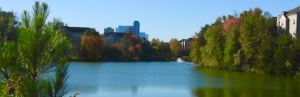
Looking toward downtown across our lake, October 17. Our tiny, precious refuge in a bustling city
Meanwhile, we anticipate that our pro-green political leaders here in our community in Northern Virginia will continue to fund our parks, trails, and public gardens for the benefit of our splendidly diverse population, and encourage both public transportation and our driving of EVs and hybrids. We also hope they’d join the state government in advocating for more rooftop solar.
The AI Monster. Still, by far the largest environmental issue facing our state and region is the explosion in the past 3 years of data centers for generative artificial intelligence. Indeed, our region of the state has the largest concentration of these data centers in the entire world!
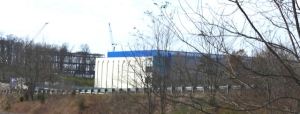
Two new data centers for AI processing, out of already over 200 such centers in Northern Virginia, November 6
The number one question for our leaders in the coming years is how the state and region, already in drought conditions, will handle the prodigious use of water to cool the machinery, as well as the burden on the electrical grid and on land use. Just before we took this photo, we had to drive on a makeshift gravel road almost impassable because of new ditches for the thick cables leading from the centers.
******************************************************************
Climate Log: Just the Most Recent Climate Disasters Coming out of Washington

US map of how home insurance rates have skyrocketed in various states, November 20
- Home insurance skyrockets in tandem with climate-change denial
The map above (National Bureau of Economic Research, 2025)) shows that those states who have suffered the most from the extreme heat and intense storms as a result of human-caused climate change now also suffer from extreme rises in home insurance rates. Florida and Louisiana have the nation’s highest rates by far, but those Plains states hardest hit by record hail storms suffer almost as much. These are also states whose leaders most emphatically deny climate science.
2. “This law helped save the bald eagle. Trump officials want to weaken it.”
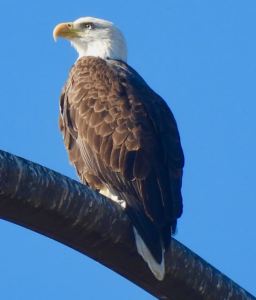
Our visiting Bald Eagle, threatened by new Trump order, scans our lake from perch on the power tower, November 3
“Trump Plan to Rollback Protections of Endangered Species, including the Bald Eagle” (Dino Grandoni, Washington Post, Nov. 20)
As the article describes, rolling back protections of endangered species follows the Trump administration’s mission of opening millions more acres in the US to drilling, mining, and commercial “development” (AKA environmental destruction), a topic also covered in last month’s blog in relation to the Arctic National Refuge.
3. Trump administration opens 85% of all US wetlands to “developers”
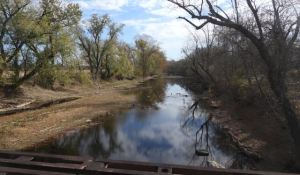
An intermittently-filled side channel of the Potomac River along the Potomac National Trail in Ashburn, Virginia, Nov. 17
Maxine Joselow of the New York Times (“E.P.A. Rule Would Drastically Curb Protections for Wetlands,” Nov. 17) describes the ruling this week that would put into jeopardy 85% of all US wetlands–prime sources of drinking water for millions of voters and their families, as well as habitat for countless species that depend on these waters. The new rule will allow “developers” and landowners to use as they wish 55 million acres of “intermittent” streams, ponds, and marshlands that had been protected– until a disastrous Supreme Court ruling in 2023 that was based on ignorance of how water and land interact on an annual basis. As this blog described in April, “To Save All Life, Don’t ‘Drain the Swamp,'” the wetlands, ponds, mires, bogs, swamps, and marshes of the world are responsible for creating much of the world’s fresh water and for nurturing all species. But ignorant, willful, greedy humans just see wetlands as “wasted,” “messy” land that they would damage by draining and disruption for other purposes.
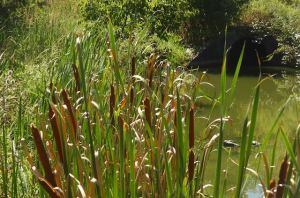
The marshy outlet pool of our lake, below the north end dam, with a Cattail festival, August 27
******************************************************************
Climate Log 2: California Act Saves Water, Wildlife, and the Eastern Sierra
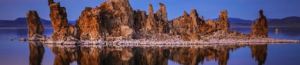
Mono Lake, east of the Sierra Nevada Mountains, long depleted by its use as a source of drinking water for Los Angeles (California Parks photo, Nov. 22)
In a massive victory for environmentalists and for the environment of California east of the Sierra, the city and county of Los Angeles is constructing a water recycling facility in Van Nuys that will meet the water needs of 500,000 residents. Even more important, using the recycled water for drinking will at long last enable Los Angeles to stop drawing water from Mono Lake and the Sierra streams feeding it–some 250 miles from LA. For well over a century, LA’s use of this imported water has sparked enmity, sometimes violent, with inland California residents. Even worse, it has made Mono Lake almost dry and destroyed habitat for many species.

Drinking water will come from this recycling facility being built in Van Nuys, CA (photo Eric Thayer, LA Times, Oct. 31
Ian James’s article in the LA Times (“Los Angeles Will Nearly Double Recycled Water for 500,000 Residents,” October 31) recounts the troubled history. But his main emphasis is on what this move means for the even larger possible use of recycled water for drinking. For 20 years, the safety of recycled water for drinking has been debated, and this move is the first in the West to follow through in a massive way on the water science that guarantees this safety. As the Western US becomes ever hotter and drier through climate change, successful recycling will help mitigate at least one of the fears that the ongoing drought and over-pumping of well water have intensified throughout the region.
Still, unless governments can agree to shift to renewable forms of energy and away from the burning of fossil fuels, even recycling plans as large as this one will be just a drop in the bucket.
**********************************************************************
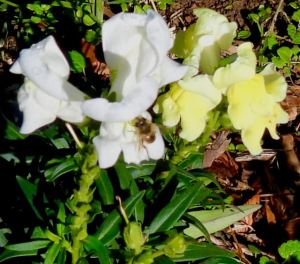
Honeybee on the White and Yellow Snapdragons in our garden plot, November 8
Garden Update: Winter Is Coming, But Growth Goes On
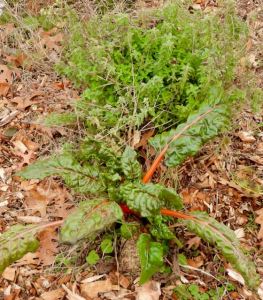
Swiss Chard and Oregano stay green and lush despite a few freezing nights, November 20
High temps now are mostly in the forties to low fifties, and we’ve had four freezing nights as low as 27. But the two veggies we’ve planted–6 Broccoli and 6 Cauliflower–plus the Snapgragons, Mums, and Asters we put in last month are hearty and green, with the Snappies still blooming. The surprises among the summer holdovers are 4 of our Swiss Chards and the Oregano, while we knew that the Rosemary would stay lush. Our most beautiful October performer, the Wild Blue Aster, has now lost its blooms, but is still thriving.
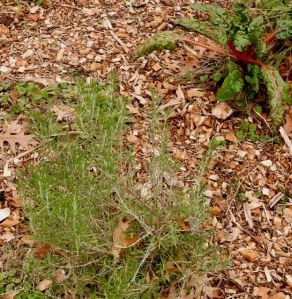
Rosemary and Swiss Chard, November 20
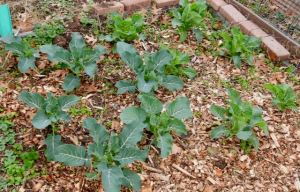
Our 6 Broccoli and 6 Cauliflower have handled the freezing nights well and continue swelling and developing toward producing heads, November 20
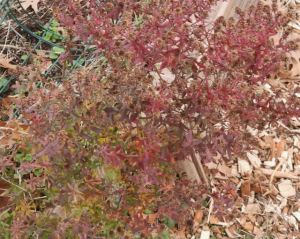
Our Wild Blue Aster may no longer be in spectacular blue bloom, but it has turned on its deep red leaves for winter, November 25
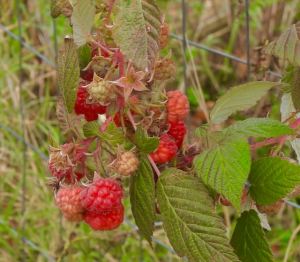
And here is a cluster of ripe red raspberries on the bush in our former neighbor’s now untended plot. We’ve been invited to pluck these and we can’t resist, November 25
What will come? Forecasters are predicting a freeze (25-29 degrees) for Thanksgiving weekend because of a strong polar vortex, but no snow in the forecast as yet. Will the plants keep thriving? We have had about an inch of rain in the past 2 weeks, so that’s a good sign. We’ll keep checking our garden plot in the community gardens every few days, because we just can’t stay away.
******************************************************************************
Our November Kitchen: Thanksgiving, of course, with a Difference

Jean’s Spicy Veggie Curry on the stove
Jean: This Thanksgiving season, we’re thankful to have a number of occasions to get together with family and friends. The traditional turkey, stuffing, and potatoes will be part of one of these meals, but our community of many cultures also gives us opportunities to indulge our varied palates and cooking styles.
Have I mentioned that curry is probably my favorite flavor and dish? At least on the savory side. Tiramisu is my favorite sweet, but that’s for another day.

PS. Curry is obviously nutritious as well as delicious, given the number of vegetables and legumes you can include. Once you get your family hooked on the flavors, you may be able to slide in vegetables they wouldn’t eat otherwise. The “C” spices mentioned above have various health benefits. Turmeric, another of my favorites, adds yellow color and anti-inflammatory properties.
Eat more curry!

A serving of Jean’s Spicy Veggie Curry

Jean’s Jumbo Pumpkin Oatmeal Cookies, with Pumpkin Butter Icing
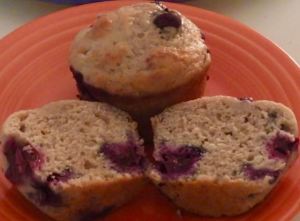
Jean’s Blueberry Muffins, with Jumbo Blueberries
***************************************************************************************
One of our ubiquitous House Sparrows chatters with us and friends along the north shore, November 21
The November 2025 Photo-Video Gallery: Communing with Our Neighbors in Our Green Space
Chris: Surprises always happen as we walk around our little lake, but several were especially memorable this month. The Bald Eagle I saw on the power tower west of the lake on Nov. 6 was a first for me here, as was the Yellow-Bellied Sapsucker pictured just below. On the 20th, I got one of my biggest surprises in the 3 years we’ve lived here, when I turned from watching the lake’s northeast shore and was startled by a young White-Tail Deer watching me–from no more than 10 feet away! Remarkably patient and inquisitive, this new friend moved slowly away, but kept eyes on me while munching on leaves and “hiding” visibly in the saplings and reeds. Three videos captured the conversation, two of which I show here. Though deer are always present in the nearby woods, I only see one every few months or so, and never before so close. How thankful I am for these moments when I can mutually treasure our green space with one or more of these neighbors.
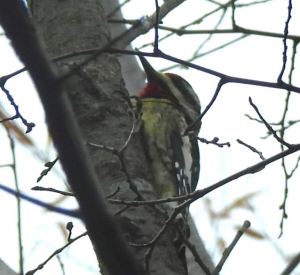
Yellow-Bellied Sapsucker–a rare visitor here on Nov. 21–perches on Willow Oak, southeast shore of the lake. A new study in Experimental Biology (Nov. 2025) shows how these woodpecking birds put full-body power into every strike, about 13 per second.
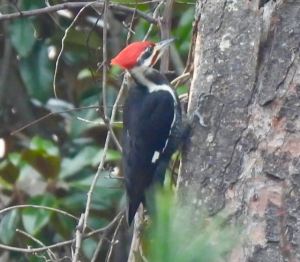
Talk about woodpeckers: here’s a large pileated one in the woods next to our garden plot, cloudy November 25
From ten feet away, White-Tail Deer watches me, then walks into cover, as a siren wails from the highway, cloudy morning, November 21
From 20 feet away, the deer continues to watch me, and feeds a bit, then watches some more, as I zoom in for a closer view. A siren blares from the highway, machinery grates in the community, and geese honk from the lake. Typical sounds. Cloudy November 21
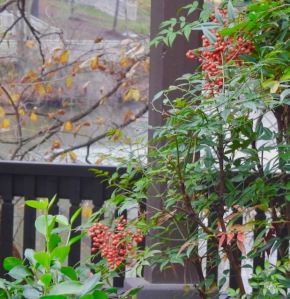
Heavenly Bamboo were prominent at our home in Northern California, and we’re happy to see them here, too, by the gazebo on the west shore of the lake, Nov. 20
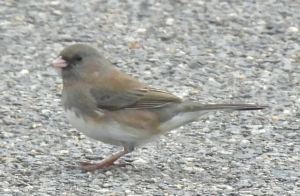
An uncommon Slate-Colored Junco stops for a moment on the path at the Northwest corner of the lake, November 21
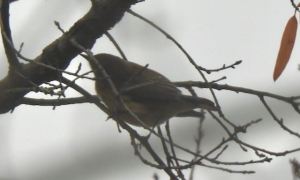
Tiny Ruby-Crowned Kinglet rests in shadows on the Willow Oak, Southeast shore, November 20
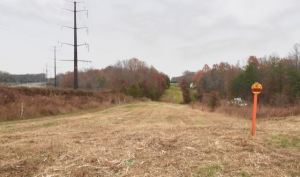
All summer the hillside down to the outlet stream below the dam was left unmowed, and the wildflowers and faunal inhabitants exulted. Now it has been mowed, revealing the signs for the petro line that runs below the surface, and the solar-powered gas substation near the outlet stream. Our Green Space shares its home. Note also the busy highway to the left, from which come the car and truck sounds and the sirens that are a steady chorus in our refuge. November 20
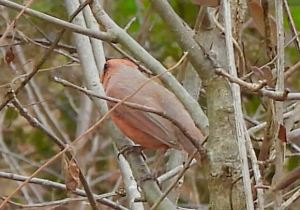
Cardinal male stops to rest in the North end woods, November 21
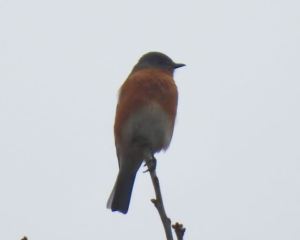
Eastern Bluebird scans atop Maple in the North end woods, cloudy November 21
Song Sparrow feeds along the gravel path on the hillside below the dam, as cars sound from the highway, November 21
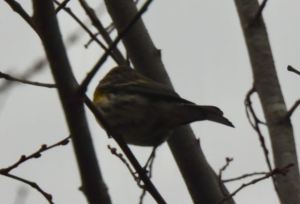
Yellow-Rumped Warbler in shadows amid branches along the Southeast bank, November 20
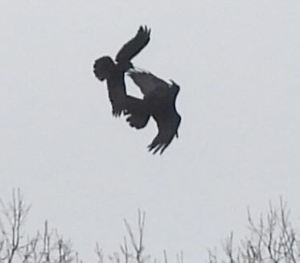
I capture a Common Raven in battle with American Crow above the treetops in the North woods, November 21

Burning Bush along the West shore, cloudy November 20
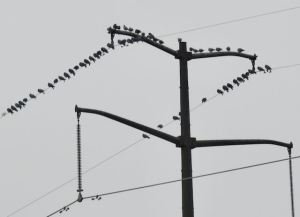
60 Rock Doves in their accustomed perch atop the power tower, November 21. No Bald Eagles around!
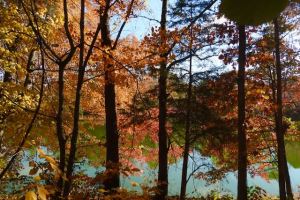
Sun through leaves on the West shore, sunny morning, November 3
Mockingbird scans from Catalpa along the East shore, November 3
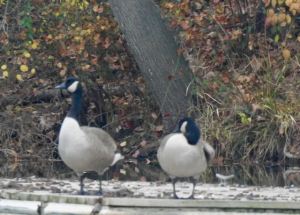
Canada Goose pair on the dock along the West shore, November 20
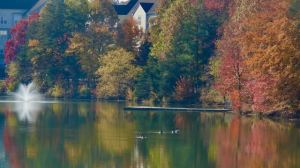
Late fall colors: Looking southwest on the lake with Geese and fountain, morning, November 3
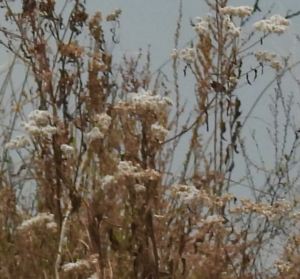
Salt Marsh Goldenrod, Northwest corner of the lake, cloudy November 21

Grey Squirrel amid leaves, southeast path, sunny November 23
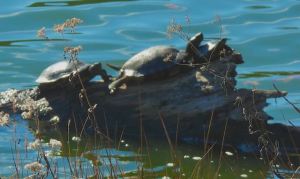
Too cold for turtles? Not for these 3 Red-Bellied Cooters on a log at the North shore, sunny November 23
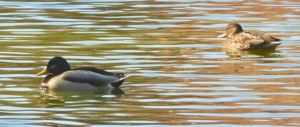
Here they are! The first Mallard pair of the new breeding season, Southeast cove, sunny November 23
Happy Thanksgiving! Hopes for the last week in November and a celebratory December…
 From Sacramento to Potomac: Tales of Two Valleys