If you’re new to this blog, start with the About page, then come to Home. Otherwise, you may feel a bit lost.
Rarely seen Monarch Butterfly feeds and flits among Swamp Milkweed along the east shore of our lake, on warm and breezy August 15
In this month’s blog:
Passing the Torch–Are We Ready for the Future?
Of Trees and Battlefields: More Potomac Valley Exploration
August 2024 Photo/Video Gallery: Serendipity
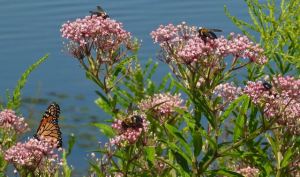
The same Monarch and 4 Bumblebees on Swamp Milkweed, same afternoon, Aug. 15
***********************************
Passing the Torch: Ready for the Future?
The Paris Olympics ended on August 11, with Los Angeles mayor Karen Bass accepting the Olympic flag and with ageless celebrity Tom Cruise taking the Olympic flame, zipping on a motorbike through the streets of Paris, and then “magically” landing by parachute at the Hollywood sign–signalling the 4-year buildup to the 2028 LA Olympics. The Paris Olympics, showcased for the world’s viewers against the classic backdrops of the Eiffel Tower, Sacre Coeur, Versailles, and the Seine, were a marvelous tribute to the work of the 45,000 people of a countless range of skills who made it an athletic and artistic success.
Now that the torch has literally been passed to Los Angeles, iconic in the world for its own, very different, works of imagination, the world will be watching as LA tries to equal the success of the Paris extravaganza. LA leaders swear that they are ready for the challenge. We will be paying attention.

Logo for the LA Olympics 2028 Plan
Meanwhile, the world witnessed in late July another dramatic passing of the torch, this time symbolic, but even more powerful. U.S. President Joseph Biden, reluctantly accepting that his age-related decline in powers was making him a liability to his Party’s chances of winning the Presidential election, withdrew from the race. He endorsed his Vice-President, Kamala Harris, 22 years his junior, as his successor in the competition. With truly remarkable speed, almost as if the many, highly-diverse millions of their fellow Party members had been psychologically practicing for this moment, delegates from every state–every one–rallied around Harris. Campaign contributions sky-rocketed (for once this overworked metaphor really exploded!), and volunteers in the many thousands shouted their desire to help. Harris herself, Constitutionally-muted for 3-plus years in the always silent role of VP, bloomed overnight, it seemed, into the charismatic, photogenic, bold, compassionate standard-bearer that the Party had been hoping for.

Kamala Harris at Democratic National Convention (Photo: Chip Somodevilla, Getty Images, Aug. 22)
This week, the torch flamed especially bright, as the Party nominating convention shook the walls of the Chicago convention center with an oratorical, rainbow-colored, music-filled, and choreographic love-fest different from any political convention seen before in the U.S. This Party really knows how to throw one!
Ready for the future? Now, this remains to be seen. The election happens on Nov. 5, and lots can happen between now and then. As with LA’s plans for the next Olympics, we’ll be watching, even more intently.
A third passing of the torch? It wouldn’t be this blog if it didn’t turn to a third torch, a much more emphatic and aggressive one, that is spreading its flames across the Western U.S. With extreme heat still smothering the West, the Plains States, and the South (especially Texas), it’s no wonder that, according to the New York Times Daily Fire Tracker, there are at least 39 major wildfires in the U.S. as of August 22. Though the largest of these, the 430,000-acre Park Fire, is in a state the media always cover, California, the state with the greatest number of large fires is Idaho, about which the news media are always silent.
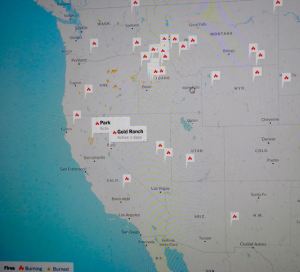
New York Times Wildfire Map, August 22
Will we be watching how the fire map changes as the heat lingers and the Western drought intensifies? So far I’d say no. As remarkable as is the cross-party vitriol that spews forth daily in the 2024 election campaigns, almost no one in the Republican and Democratic camps is even mentioning climate change and the ever-growing damage it sparks.
As this blog explored most recently last month, there are touchy reasons for this taboo. Put most bluntly, even though everyone knows what needs to be done to reverse climate change, the economic web woven by the fossil fuel cartel so controls everyday life in most of the world that few politicians have the courage to suggest changing policy. And no matter how people are suffering from the effects of a changing climate, even many great sufferers would prefer to pay the ever-rising costs of inaction rather than change how daily life plods on.
I guess we could say that this torch is just too hot to handle.
*********************************************************
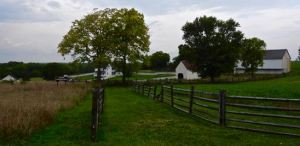
The restored Poffenberger Farm, at the north edge of the battlefield at Antietam National Military Park, Aug. 17
Of Trees and Battlefields: More Potomac Valley Explorations
Exploration I. We return to Antietam
Before last weekend, we last visited the Antietam National Battlefield Park in December 2022. Despite, but also perhaps because this bucolic setting witnessed the most costly, gruesome day in U.S. history, we keep being drawn back to traverse the fields on which so many–23,000–soldiers were killed or wounded on that September 17, 1862. We come to grieve for the loss of so many young lives, for families ripped apart; but also to honor the sacrifices made by these men in the name of clashing causes that led over three centuries to inevitable civil war. And also to wonder at the dire, seemingly intractable, enmities of our own time, that lead year upon year to the deaths of thousands, even millions, of soldiers and civilians, men, women, and children; enmities that we humans seem unable to resolve peaceably, generously.
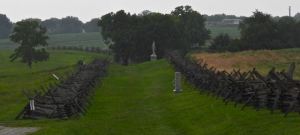
The Sunken Road, or “Bloody Lane,” Antietam Battlefield (photo August 17)
We came this past weekend, specifically, because the Park Rangers were honoring an incredible technological development that changed forever how people far from a battlefield could understand the horrors that happened there: photography.
In fact, through the chemical genius of 18th century and early 19th century experimenters with the capture of images on metal and glass, the art and science had so developed that by 1861, when the Civil War began, two photographers in the U.S., Mathew Brady and Alexander Gardner, were called on by the U.S. Army to make a photographic record of the war, mainly pictures of generals and other important figures. But Brady and Gardner wanted to photograph the war itself. They built a mobile studio–a fully-outfitted horse-drawn wagon with the great amount of equipment and chemicals needed to re-create studio conditions on a battlefield. The first battle so recorded in all its grim horror? Antietam.
Two historians were at the Visitors Center giving us insight into the evolution of the photographic process and allowing us to see through cameras like those Gardner used. We gained a much better appreciation of the intense, complex effort it would have required to bring the 1862 studio, as it were, to the battlefield. 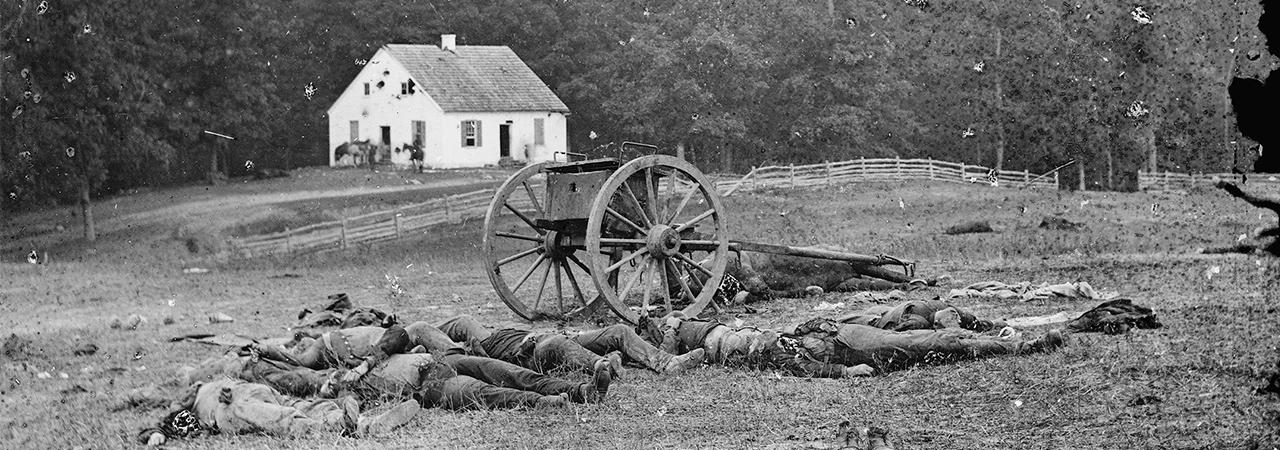
Corpse-strewn Field by Dunker Church, Antietam, taken by Alexander Gardner, September 19, 1862
A mere two days after the battle, as surviving Union soldiers began carrying out the somber work of burying corpses of their fallen comrades in shallow graves on the battlefield, Gardner’s team was at its own grim task of recording the carnage. Before Gardner’s team brought stark images like this one (above) to newspaper readers and museum visitors in Washington and New York, the only images of war that those far from battlefields had seen were drawings by artists: reconstructions, often fanciful, well after the fact. Moreover, the quality of these grim photographs was so clear that sometimes the families of those slain or missing in battle would do the bitter work of trying to identify their fallen loved ones from the photos. Any illusions about the glory of war, or even just its impersonal statistics, were quickly dispelled by the photographic record.
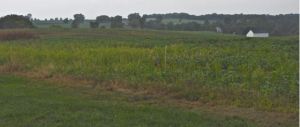
Panorama of Antietam battlefield from the woods and cornfield at top to the sunken road, foreground. As many as 18,000 soldiers fell on this ground from morning to early afternoon, Sept 17, 1862 (photo taken Aug. 17, 2024)
Today, as we walk and scan the quiet Maryland countryside, the Gardner photos remain in our consciousness. We realize that we are walking on haunted ground. Corn is still planted every year on what was then Miller’s cornfield, where thousands of Union marchers, unable even to see their attackers, fell in a hail of iron balls. Each day, tourists like us stroll the peaceful “Bloody Lane,” where so many Confederate soldiers were mowed down in an hour that bodies were stacked five deep.
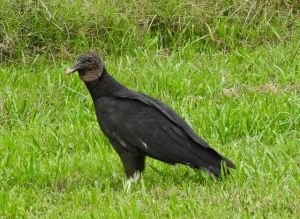
Having just munched on a grey squirrel, this Black Vulture stands beside our car, as we read a plaque at Miller’s Cornfield. Vultures are at home here, Aug. 17.
We give thanks to all those who have preserved this place as a park: as a kind of sanctuary for over 150 years, and to scientists like Gardner and his predecessors, so that we can have this double consciousness and explore its contradictions of peace and war.
Exploration II. Remembering John Brown

The Gibson-Todd House, Charles Town, West Virginia, Aug. 18
The day after our pensive visit to Antietam, we returned to a spot that we had visited many years before in nearby Charles Town, West Virginia, across the Potomac from Maryland. Here, on the grounds of what is now the Victorian-era Gibson-Todd House, was the scaffold on which the great abolitionist hero John Brown was hanged in December 1859. Again, it is hard to reconcile the quiet, beautiful, tree-lined neighborhood of stately homes in which we now walked with the rabid furor and fear that gripped the town, indeed the entire South, at the time of this violent event.
Drawing of the hanging of John Brown, Dec. 2, 1859
But Brown’s attempted raid on the arsenal at Harper’s Ferry, just up the road from Charles Town, had reignited in the slave-holding states their latent fear of a widespread rebellion by enslaved people. It is hard for us today to understand that slavery was still permitted in the U.S. before the Emancipation Proclamation of 1863, and so when Brown and his fellow insurrectionists were captured in 1859, they were tried for treason against the U.S. Only two years later, the Southern States seceded from the U.S. and so the Civil War, which had been threatened for many years, began.
While Brown had been feared for years in the South as a result of the attacks he led against slave holders in the Kansas Territory in 1856, so his capture after Harper’s Ferry was cheered across the South. In contrast, his capture and subsequent hanging made him a martyr to the cause of abolition in the North, and helped stoke the flames that led to war.
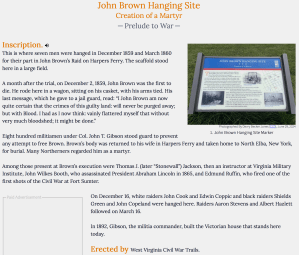
Text and image of the Civil War Trails historical marker at the hanging site of John Brown in Charles Town, West Virginia
Exploration III: Remarkable Trees in the Shenandoah Valley
As part of the weekend trip we took to the drought-stricken Shenandoah Valley just at the start of August, we were able to find two more of the “remarkable trees” from the book of that name, which we have been seeking out across the state for the past seven months. On this sojourn, the two we added to our list were the massive Chinquapin Oak, the largest of its kind in the state, in downtown Luray:
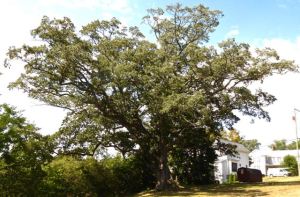
Virginia Champion Chinquapin Oak in downtown Luray, August 2
with its impressively gnarled trunk:
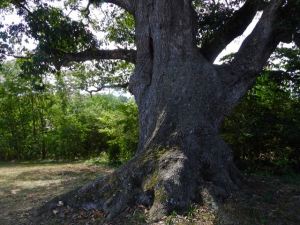
Trunk of the Champion Chinquapin Oak in Luray, VA, 15 feet in diameter, Aug. 2
…and the wide-spreading (132 feet in diameter) Bur Oak thirty miles south in downtown Elkton, the largest of four Bur Oaks that surround the historic Jennings House:
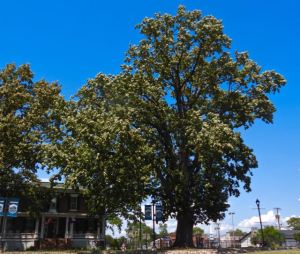
The historic Jennings House in Elkton, VA, is surrounded by four massive Bur Oaks, of which this is the largest, Aug. 2
In coming months we plan to seek out more of these remarkable Virginia trees in the Tidewater part of the state southeast of our home in Northern Virginia.
**********************************************

Five Canada Geese in flight across our lake on a muggy afternoon, Aug. 25
The August 2024 Photo/Video Gallery:
Birds, butterflies, bees, wildflowers, and other surprises from around our little lake community.
These sightings are never planned, but serendipitous. I go out to walk, camera at the ready, and then there they are–and then gone. Oh, yes, of course, there are patterns one can grow to expect, and even hope for. But even when I know that we have goldfinches in August, I never know when I’ll see one, and I’m just lucky this one time to witness one munching on a bunch of teazle seed puffs! As the weather and seasons change, new wildflowers keep appearing, too, making the landscape ever surprising. I grow to expect surprise and am rarely disappointed. I just try to be ready to capture it, but if I don’t, I’m confident there will always be more opportunities–as long as our little refuge stays a refuge within our bustling, motorized, semi-urban region.
Tiny Red Bellied Cooter and Thistle puff on the log in the southeast cove, Aug. 22, as Cicadas call

August wildflower: Grandfather’s Whiskers, along the north shore of the lake, Aug. 22

Bumblebee in Evening Primrose and Pokeberry bush, on the north shore, Aug. 22
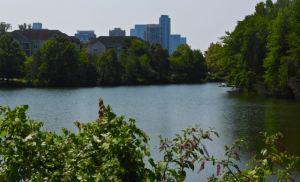
Panorama toward downtown with Pokeberry and Porcelain Berry, warm afternoon, Aug. 15
Goldfinch feeds on flying Teazle seed puffs on a muggy north shore afternoon, as children play across the lake, Aug. 25
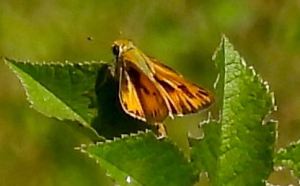
Orange Sachem Butterfly on Multiflora Rose leaves, north end path, warm afternoon, Aug. 15

Chinese Clematis blooming along the south shore, Aug. 20

Orange Cattails along the outlet stream below the dam, Aug. 20
Honeybees swarm over Porcelain Berry vines on the northeast shore, warm afternoon, Aug. 12
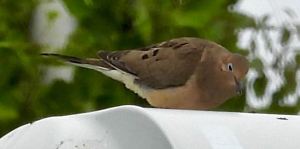
Mourning Dove perches on a light pole along the highway west of the lake, Aug. 20
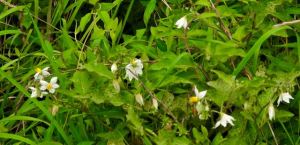
Carolina Horsenettle in the unmowed field below the dam, Aug. 20

One of our Double-crested Cormorants perches on a log in the lake on a cool morning, Aug. 20

Three young fisherfolk angle on the west shore dock on a cool morning, Aug. 20
Rare visitor: Osprey lands high in Virginia Pine along the west shore, scans, then takes off, morning of Aug. 22. Such sightings are always serendipitous, then fleeting

Crape Myrtle blooms in all its pinkness east of the lake, cool morning, Aug. 20

Snapping Turtle, first sighting of summer, glides in mid lake, muggy afternoon, Aug. 12
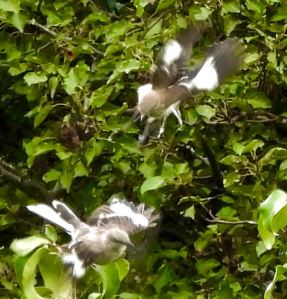
The Mockingbirds seem to be everywhere this month. Here two scuffle in their favorite Bradford Pear by the northeast corner path, Aug. 20
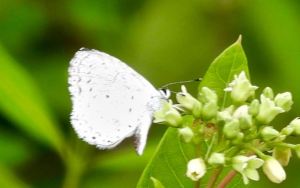
Summer Azure Butterfly feeds on new blooming Indian Hemp by the east side path, muggy morning, Aug. 7
I spy a Cottontail along the north end path. Then, lo and behold, there are 2!
Aug. 8
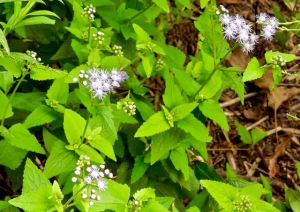
First tiny Blue Mistflowers appear along the southwest path, Aug. 20
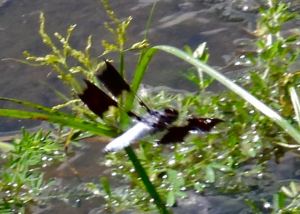
Purple Skipper Dragonfly amid Bushclover on the east shore, muggy afternoon, Aug. 12
On my morning walk, Aug. 22., the Canada Goose flock flies in, covers the southeast cove, and puts on its show of honking and wing flapping. Yes, we know you are here.
Let us march on, passing torches when we can, continue to explore, and expect serendipity. On into September!
 From Sacramento to Potomac: Tales of Two Valleys