
What terrors lurk within this placid scene?
Chris:
In science, X is the unknown. It’s what the explorer tries to find. X is mysterious, maybe dangerous. The X factor–its mystery draws us to it–perhaps to our doom.
Sometimes we are warned away from X. Think X-rated. Sometimes X is meant to be secret. Think X-files. Those prohibitions draw our curiosity even more.
The X is everywhere in the garden. If people only look at gardens in bloom, they will not know this. The pretty perfection seems so safe, so colorfully picturesque. So easy. As if its beauty is effortless, meant-to-be in a comfortable universe. People become gardeners because they want to create their own comfortable universes, at least in one little slice of life.
A rude awakening awaits. Some would-be gardeners give up when their first seeds fail to sprout, or when they can’t face the eternal question:
“Am I watering too much or too little?”
The crazy truth is that people who love to garden love the X. Well, they come to love the X, usually after their dreams of the perfect easy garden inevitably fall through. Something about the challenge of nurturing plants to realize their potential intrigues gardeners enough to keep going, and intrigues them more and more as they see the surprising results. When they see the scrawny meyer lemon bush that suddenly explodes in growth and fruit in its fourth year, or the sage and lemon verbena and Greek oregano that just keep coming back in spring year upon year in the same pots and soil, or the Thai pepper that keeps putting out little red hots even when the temp falls into the 40s.
But there is another tantalizing X factor as well. Gardeners who keep going learn that no two plants behave in exactly the same way. Especially in a small garden like mine, where
- trees and house architecture overhang parts of the garden, and
- where soil composition and water amounts can vary from plant to plant, and
- where multiple species become neighbors in a highly diverse village.
These gardeners love the X so much that whenever they get comfortable with a certain plant in a certain spot at a certain time of the year, they try a different plant or a different spot, or try to, let’s say, grow tomatoes outdoors in Canada, in December. Or they take silly risks, such as

Just grab on with your bare hands… well, at least inadvertently.

Take a big bite, I dare ya…(yes, well, at least little bites)
For dabblers like me, the Xs way outnumber the sure things. That’s the fun of gardening for me.
Oh, sure, I also love the predictable beauties of our garden: the year upon year explosions of yellow roses and purple-gold irises in April, the bounty of the apricots in May, the gifts of cherry plums, strawberries, tomatoes, peppers, eggplant, cukes, basil, oregano, lettuce, onions, arugula, and on and on at their appointed times of the year.
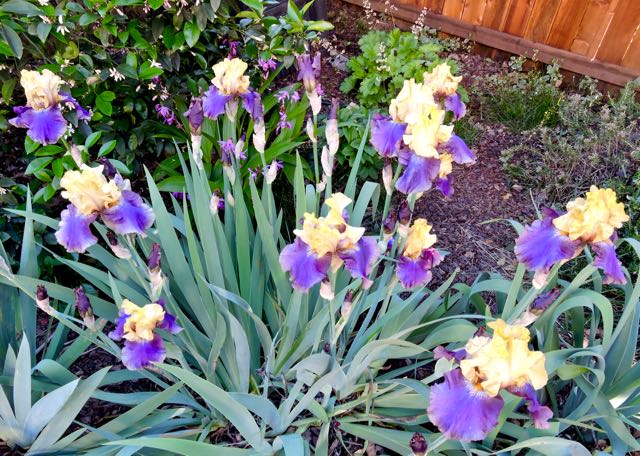
Ah, the irises!
The songs and dances of the birds, butterflies, and bees.
Something is always blooming, leafing, fruiting, singing, or darting past–and all it takes from the gardener is a bit of steady attention from week to week.
And have I mentioned the aromas? The orange blossoms throughout April. Then, three weeks ago, when I planted the spring and summer veggies, the orange blossom perfume was mixed with the pungency of compost and upturned soil, organic plant foods, redwood mulch. Every season has its smells, which attract me as they do the birds and bees. I just can’t get enough
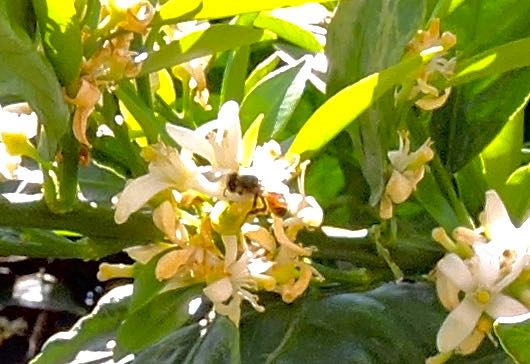
A honeybee dances in orange blossoms, April 2018
But the X is always there
The glories I have grown to expect in our garden are only made exquisite by the knowledge that none of them is inevitable. For every plant that outperforms my expectations, there are others that don’t thrive. Last summer I had my best-producing tomato ever. Another gave no fruit at all. The unpredictability is both the risk and the charm of gardening.
But some threats are greater and way more devastating than others. Just three years ago, the five-year drought (See “W Is for Water”) threatened every garden and farm in California. Without statewide voluntary rationing, many more acres would have been lost. Just last fall, wildfires devastated parts of Napa and Sonoma counties; winter wildfires devastated parts of Ventura and Santa Barbara counties. Wildfires happen every year, and though the state does all it can to prepare, we never really can predict where the devastation will be greatest.
Some threats we can see coming, but the X is how soon. As agricultural water use grows in all parts of the world, farmers everywhere draw down aquifers–and one of our most profound Xs, the depth of aquifers, remains a mystery. We just don’t know how much–or how little–water is down there. All we know is that the wells keep getting deeper.


The Disappearing Pollinators
In “B Is for Bees, Birds, and Butterflies,” I noted one of our most fearsome Xs: the steady decline of pollinators. What is known is that the decline is happening. It is not a mystery. For honeybees, the dramatic fall-off has been called Colony Collapse Disorder. Science keeps looking for “the cause,” as if finding one cause would suggest a cure. But what science knows is that the causes are multiple:
- neonicotinoid pesticides and herbicides,
- the Verroa mite,
- habitat loss for native bees.
Butterflies and bird species are in even steeper decline. Non-organic farming, the constant depletion of wildspaces for urban/suburban development, the steadily-rising temps caused by greenhouse gases–all have their part to play. These causes we know–they are not Xs.
What is an X is when and even whether we humans will do the obvious things to turn the pattern around. Will we have the courage to halt business as usual? Can we ween ourselves off chemical pesticides and herbicides? Can we grow up to reject fossil fuels and the industries that pull them from deep below ground and then turn them into poison gases?
Those who persistently benefit from the status quo try to convince us that climate change is an X: “Well, the science is inconclusive,” they say. But the science is fully conclusive–and the rest of the world agrees that it is. Only the U.S., with by far the largest and richest vested interests in polluting the planet, will not admit these truths. By withdrawing the U.S. from the Paris Climate Accords in 2017, the current President confirmed to the rest of the planet that the U.S. will be the problem, not the solution.
So the X question is this: Will these vested interests continue to intimidate (and pay off) our elected officials and so doom the world, and will we voters continue to let them? Can the U.S., which used to be the world leader in championing new ideas, strive again to lead the world in supporting the technologies–such as solar power–and attitudes that can defeat the polluters? We know what needs to be done. The only unknown is if we will have the will and the courage to join the rest of the world in doing it.
In 2017, the monarch butterfly below was the only one of its kind to visit our garden. It fed on the native lupine tree. Monarchs, which used to spend the winter in the millions in California, have declined by 90% as their habitats and food sources have disappeared. Will the monarch return to our garden?


 From Sacramento to Potomac: Tales of Two Valleys
Pingback: February 2021: VacciNation Valentine | A Sacramento Valley Kitchen Garden