Chris:
The guilty verdicts in the George Floyd murder case came in from Minneapolis on April 20. There is now a ray of hope for a new day in American justice. Just as with the great increase in the numbers of the vaccinated against COVID–more than 54% of the U.S. adult population now has received at least one shot– these signs fit the beginning of a glorious spring. Nurturing the garden of these hopes will take all our collective effort.
In this month’s blog:
A Bountiful Spring in the Garden: Irises, New Plantings, and More
The April Kitchen: Storing the Garden, Plus Two New Dishes
The April 2021 Gallery
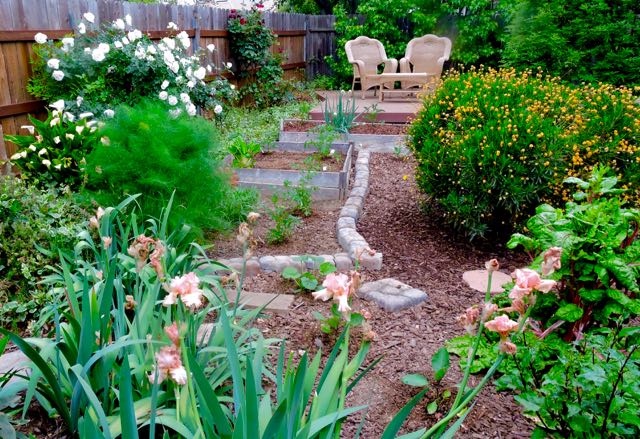
Back panorama to North: “line” of new veggie plantings from bottom to top in the center of the photo.
A Bountiful Spring in the Garden: Irises, New Plantings, and More
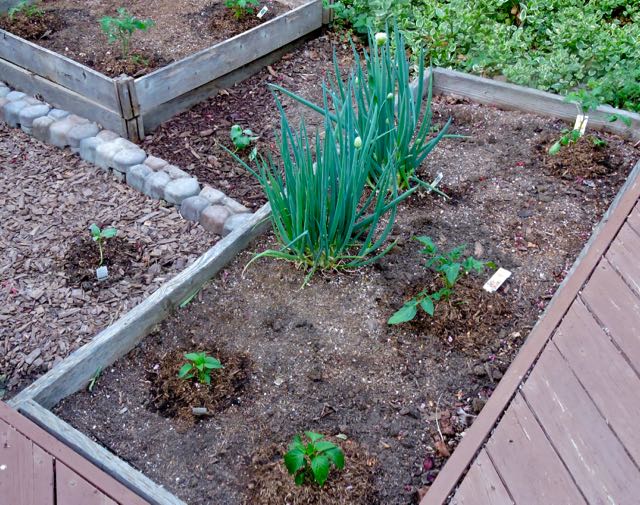
The “line” of new veggie plants in the photo above went in beginning April 10, about a week later than usual. The November plantings of beets, broccoli, Swiss chard, leaf lettuce, and green bunching onions had done so well through March that I didn’t want to take them out too early. I still have five chard plants and one Bulls Blood beet thriving, but just last weekend (April 25) I harvested the last of the green onion bunches, which were by far the most prolific onions I’ve ever had in the garden. (See the Kitchen section for more on the onions.)
New Plantings
Tomatoes. Seven (7) plants have gone in, in four varieties: two (2) Red Cherry plants, 2 Stupice mid-size, 2 Early Girl mid-size, and 1 Red-Orange Swirl cherry. All except the Red-Orange Swirl (April 25) went in April 10-11. The base for all is a mix of organic compost and organic garden soil. As of April 27, all the April 10 tomato plantings have doubled or tripled in height and breadth, and all 6 have a few yellow flowers.
Peppers. Five (5) plants have gone in between April 10 and 17: two (2) sweet green peppers, 1 sweet yellow (in pot), 1 sweet purple, and 1 Anaheim chili (in pot). I grew no spicy peppers last year, as we still have several hundred very hot Thai chilis in the freezer for cooking. The Anaheim I just planted is the first of that variety I’ve tried. The base for all 5 is organic compost and organic garden soil.
Eggplants. Two (2) Black Beauty eggplants went in April 10 and these have already tripled in size. Last year’s Rosa Biancas produced only a few fruit and perhaps did not get enough sun. Black Beauties have done very well in this garden and are in very full sun.
Cucumbers. Three (3) Burpless full-size planted April 10-17. As of April 27, these have at least doubled in size. Last year’s lemon cucumbers were plentiful, but seedy and not great for pickling. Burpless have done well in the past in this garden. Base a mixture of organic compost and organic garden soil.
Zucchini. One (1) planted April 10. Already quadrupled in size. Base a mix of organic compost and organic garden soil.
Basil. Two (2) planted in pots April 10: one (1) Genovese green basil and 1 purple basil. Already at least doubled in size by April 27.
Thyme. One (1) sweet English thyme planted April 11 in pot on veranda (part shade). Now doubled in size.
Strawberries. Six (6) planted by April 11, all in pots: four (4) in three large pots at edge of veranda (less than full sun). Base a mix of organic compost and organic garden soil, plus weekly acidic watering. Already doubled in size. This base mix and weekly acidic watering succeeded with one large strawberry plant last year.

Irises. As every year, this is their month. But this year, for some reason, our deep purple irises have not yet bloomed. Still, the orange and purple-yellows have been gorgeous.
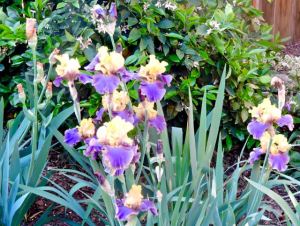
Purple yellow iris explosion, mid April
Oranges and Meyer Lemons. April is their month to move from the last ripe fruits of the season to the new buds, then to the blooming flowers luring bees with their wonderful fragrance, and finally to tiny green fruit.
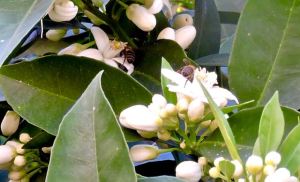
Bees in the orange blossoms, early April
Peaches. In 2019, we had a large crop of peaches (more than 60). But in 2020, strong March winds knocked down the blossoms and we had only one peach the whole season. Thankfully, this March, the blossoms held and turned gradually into tiny fruit covering the tree. We have promise of a bountiful harvest.

Tiny peaches in late April
Blackberries. I planted our first blackberry vine in a wine barrel last August, and it has flourished and now bloomed and produced small green blackberries in April.
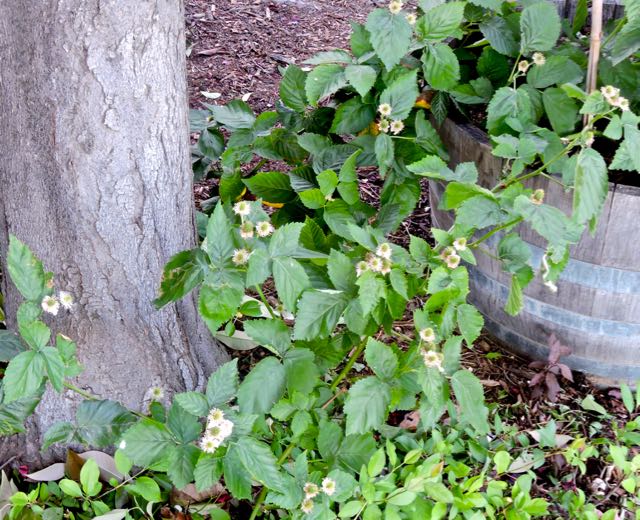
Our first blackberry vines, side garden
Cherry Plums. Although this year’s winds in early February knocked down the new blossoms on the apricot tree, so that we won’t have our usual crop of little orange gems, the blossoms on the cherry plum this year were full and plentiful. In late April, the little plums are growing apace toward June harvest.

Tiny cherry plums growing toward June harvest
The April Kitchen: Storing the Garden, Plus Two New Dishes

Beet and veggie borscht with green onions and parsley from the garden, and sour cream
Jean:
Frozen Storage. When our garden produce exceeds our ability either to consume it ourselves or give it away, we are challenged to store it or merely to toss the excess into the compost bin. We have found that freezing the excess is a great way to keep some of our veggies from degrading–and we can use the frozen goodies over several years. A good example is the super hot Thai chili peppers that have grown so prolifically, but that we can’t possibly use more than a fraction of in any given year. Indeed, we’ve not grown these peppers for the past two years, because our frozen store is way more than sufficient to fire up various dishes.
This year, our bumper crop of winter veggies: Bulls Blood beets, Swiss chard, Green Magic broccoli, and bunching green onions, has made frozen storage a particularly good option. As we have with the chilis, we’ve
- washed the veggies and cut them into small sizes perfect for cooking and eating
- placed them into plastic produce bags
- labelled the bags with date and type, and
- placed them into the freezer.
Now we can pull out the bags and use portions of the cut produce as needed. Depending on how much we use over the spring, summer, and fall months, we can decide how much we’ll need to grow next year.

Freezer bags of 2021 cut green onions, broccoli, chard, and beet leaves
The bunching green onions were particularly prolific, and letting them mature over 4-5 months (November-April) made them more and more succulent and spicy. When you dice the mature onions into roughly half-inch pieces, you can use the entire onion, if you wish, from the intense white end at ground level to the green and slightly spicy stalk.


We also let the Bulls Blood beets mature from November to early April, and the resulting beet root in the largest of these was more than 6 inches in diameter. Though the thick root appeared woody when taken from the ground, trimming the outside revealed a colorful core that was easy to slice into bite-size pieces. Cooking the slices in boiling water for a half hour gave us tender, mildly sweet pieces perfect for stews, soups, or a colorful side dish.
The deep dark red borscht shown above came mainly from these tender slices pureed in the blender with our beet leaves, chard, and onions, with a bit of beef broth.


Springtime Dessert: Rhubarb Cobbler
One of our daughters loves strawberry-rhubarb pie, as did my mother, so I have made it for years. But rhubarb is so seldom available that I have to remember to look for it in the spring. I went out of my way to find some last week but wasn’t sure how much to buy, so I only got a couple of stalks. I should have gotten more, but it turned out to be the right amount for a dish for two people.
This is so simple that it’s really a no-recipe recipe. The truth is I took some ideas from recipes online and added my own ingredients and techniques, as usual.
First, chop up the rhubarb and see how much you have. The recipe I started with called for 7 cups, but I found the two stalks made only about 2 cups chopped, so that is what I worked with. The first step is to macerate the chopped rhubarb with sugar. I used about ¼ cup, part white sugar and part Truvia. Then I thought, hey, macerating is also done with liqueur, and I had some cherry brandy and some triple sec, so I threw in about a tablespoon or two of each, plus a little orange zest (since Chris was squeezing the last of our oranges from the garden).
I wanted to add a fruit but didn’t have any strawberries except some frozen ones. I threw in a few of those and also some raspberry jam and some spiced cherry compote left over from topping for the Easter ham. Without that, I would have added my own ginger, cinnamon and cardamom, which are nice flavor features of the cherry compote I bought from the American Spoon company. That made the filling flavorful without being overly sweet.
After macerating for at least half an hour, bake the filling in a pie pan at 400 degrees for about 30 minutes to cook down and thicken. I debated using a little tapioca to thicken it, but it really wasn’t necessary.
While waiting for the fruit to macerate and bake, you need to make a sweet biscuit for the topping. Again, I cut down the recipe I was using and made changes to it. Truthfully, I have been changed forever by Joanna Gaines’ biscuit recipe, which is lighter and fluffier than any others I have made. Thus, I used self-rising flour plus extra leavening, a good amount of butter, and some pasteurized egg along with the cream. Here were the proportions for four small biscuits to top the fruit:
1/2 cup self-rising flour
1 T. sugar
1 tsp. baking powder
Pinch of Kosher salt
2 T. butter
2 T. cream and 1 T. pasteurized egg OR 3 T. cream
You know how to make biscuits, right? Whisk the dry ingredients together, cut in the cold butter and add the liquid last, stirring just until you can make a ball. Cover that well and chill for an hour or so.
Of course, cobblers are generally made by putting the raw dough on the fruit and cooking them together, but I don’t like the inevitable gooey interface, so I baked the biscuits on a separate sheet, rewarming the fruit in its own pan at the same time. (First I brushed the biscuits with a little cream and pasteurized egg and dusted them with large-grain sugar for good color and crunch.) Keeping the biscuit on top of the filling brings out the buttery crunch.
Plop the warm biscuit on a scoop of the warm fruit and top with a little ice cream or whipped cream. Heaven!


The April 2021 Garden Gallery

Season’s first display of red roses on back fence
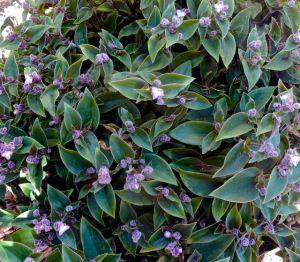
Tradescantia blooming in the front garden

Front garden: breath of heaven, blackberry vines, yellow rose explosion, red-orange roses, creeping juniper
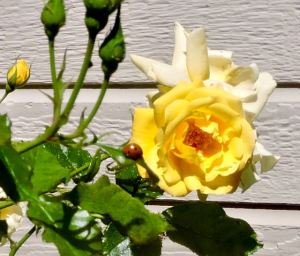
Ladybeetle on yellow rose, front garden
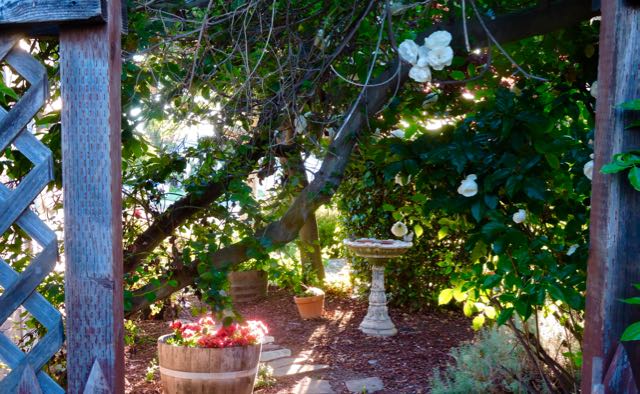
Through gate and trellis, to alstroemeria, birdbath, fuchsia, and white roses, side garden

Multi-color rose thicket, back garden

Blooming aloe flower stalk, back garden
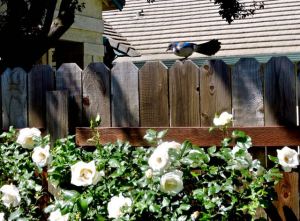
Neighborly scrub jay on back fence above white roses
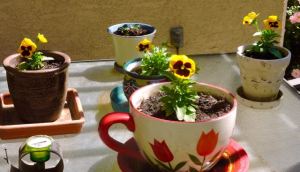
Pansies in pots on veranda
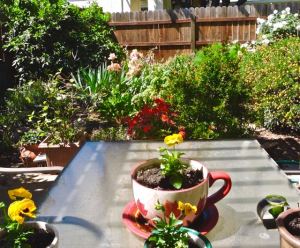
Back garden display from pansies to back fence
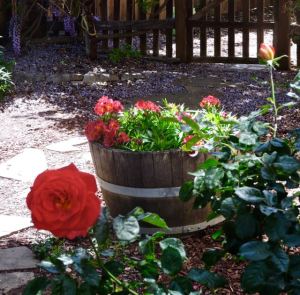
Side garden: red-yellow roses, alstroemeria, wisteria and ceanothus petals
The bees that came to the ceanothus and wisteria early in April were followed by swarms on the orange blossoms and the meyer lemon blossoms in the middle of the month–then on to the several rose varieties later in April.
And on to May!
 From Sacramento to Potomac: Tales of Two Valleys
Lovely garden! It’s all possibilities right now!
LikeLike
Thanks! You are so right!
LikeLike