February 2020–Heading for the Driest on Record!

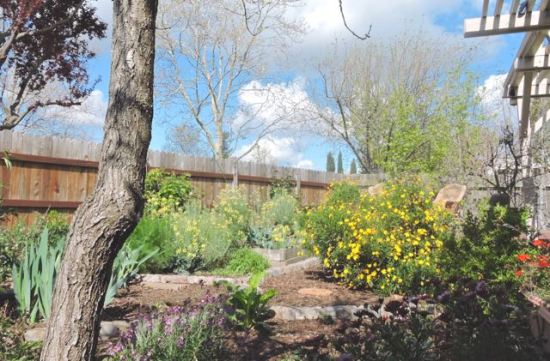
garden sunset over back fence feb 20 - 1

In this month’s blog:

1. Heading for the Driest on Record

2. The First Month of Spring

3. More February Bloomers

4. February in the Kitchen

Chris:

1. Heading for the Driest on Record

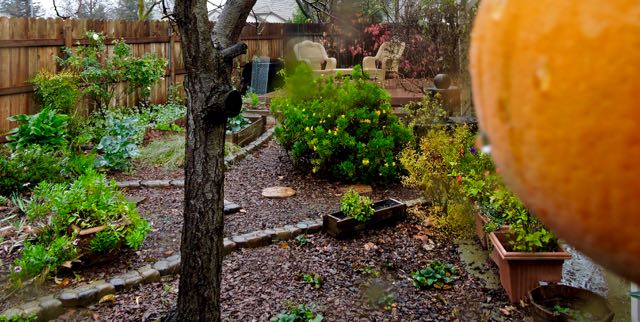
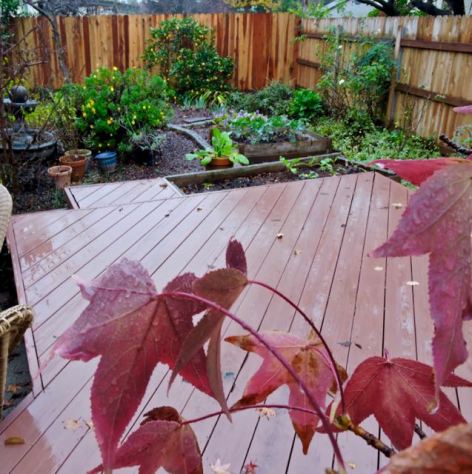
Don’t be alarmed. This isn’t a photo (above) of an approaching wildfire. It’s just a beautiful February sunset seen from our back garden. But you’ll have to excuse me for thinking of fires when, yet again, in what is usually one of our wettest months, the weather news is depressingly the same from day to day: sunny and dry, with temps from the 40s to the 60s, and even into the 70s, warmer than average. (Today’s predicted high of 77 by the National Weather Service would be a record for this date.)

Please understand: I’m trying not to take for granted the magnificent weather in California, but the gardener in me always wants there to be that magnificent natural balance between sun and rain. Between late October and mid May, the climate usually blesses us with enough rain (and mountain snow) to tide us over during the intensely blue skies and high temps of June through mid-October. See, balance.

So you’ll forgive me if I share the alarm of many fellow Golden Staters when it looks as if Northern CA will have for the first time in recorded history no rain in February–not even a trace or a smidgen or a drop.

Meteorologists blame the infamous “high pressure ridge” over the Pacific, the same condition that gave us the 5-year drought that ended in 2016, before the way-above-average rain seasons of 2016-17 and 2018-19. So Californians are used to these climatic waves, and as I wrote in “W Is for Water,” we have done many things to prepare for them and to see them through.

So I’m not horribly anxious about this go-round. Yet it does come as a bit of a shock to my sense of well-being when I must reactivate the irrigation system and unwind the hose three months early. Not to mention a shock to our finances because of the rising cost of water.

Oh well, the snowpack in the Sierra still has 50% of normal, and the reservoirs around the region are still mighty deep, so we’ll forge ahead.

2. The First Month of Spring

Meanwhile, it’s February! Which means in our part of the world the first month of spring, the time of first blooms and return of the warm weather birds.

And so…

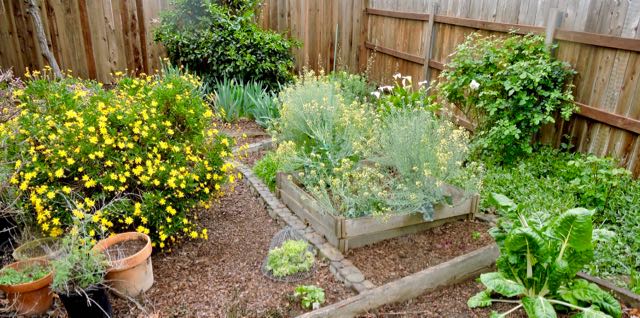
garden back panorama w warbler on fence 2 22 20 - 1

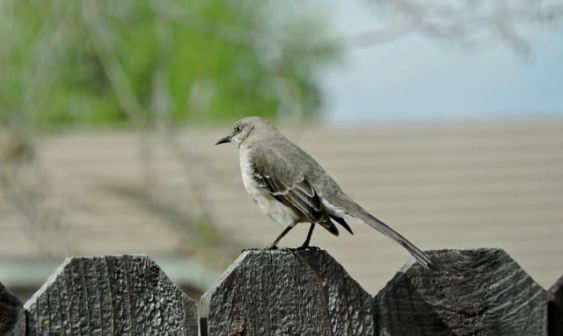
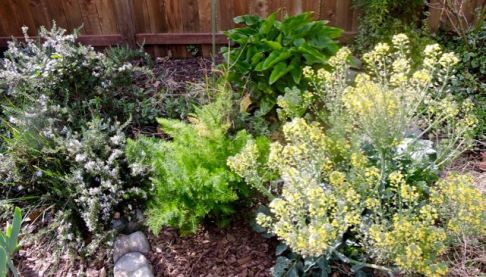
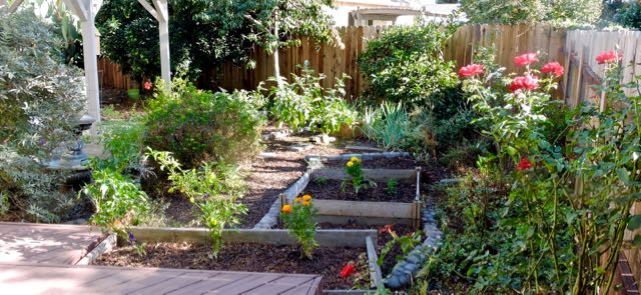
Panorama of the SW corner of the late February back garden, with a warbler on the fence


There are new blooms all across the garden, and rarely does a day go by in late February when one or more of our plants isn’t beginning to flower–or even bursting into full bloom. Here is this month’s gallery, with a few comments:

Apricots

Ten days ago, I took the video (above) of the bees hard at work in the just opened blooms of this harbinger of our fruit trees. Now, most of the blooms have fallen to carpet the ground and the tree is beginning to bud it first leaves:

garden apricot new leaves 2 20 - 1

Arugula

With last year’s stems dried out early this month, here come this year’s peppery new stems and leaves from the ground:

garden new arugula arising amid the old 2 20 20 - 1

Broccoli

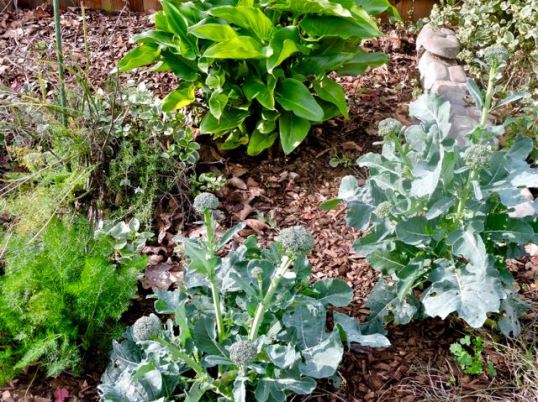
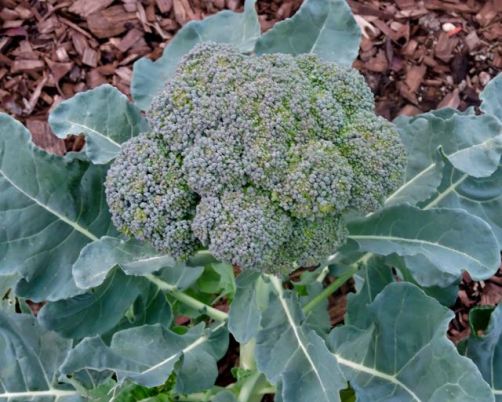
This season’s amazing crop just keeps proliferating (see below). The five plants have moved headlong into the blooming phase, and the bees couldn’t be happier. Every time I clip off a bunch for either cooking or decoration (imagine–broccoli as decorative flower!) another green shoot emerges. For cooking, the flowery shoots remain tasty, even with the yellow blooms, because the stems within each floret are thin and tender.

See the following site for more on the joys of cooking and eating broccoli flowers:

https://www.gardenguides.com/90097-flowers-broccoli-sprouts.html

garden two bees in the blooming broccoli 2 20 20 - 1

Bees on largest blooming broccoli head

garden rosemary fennel calla lily broccoli in bloom 2 20 20 - 1

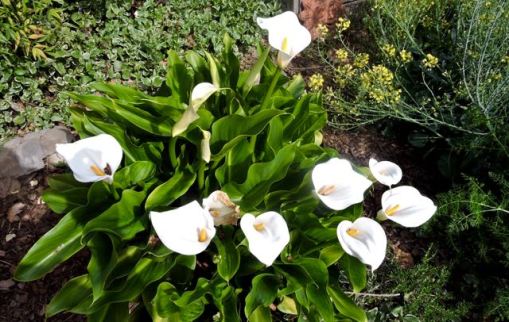
Broccoli plants with fennel, rosemary, and calla lily

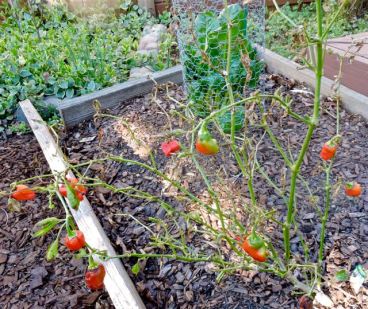
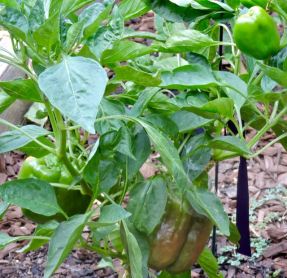
Cajun Red Pepper

Now in its 11th month, this wonder just keeps producing ripe, spicy fruit. I’ll grab its space for new plants in April (or will I?)

garden cajun red pppers and chard 2 20 - 1

Cajun red pepper, still thriving, with Swiss chard and periwinkle in background

Cherry Plum

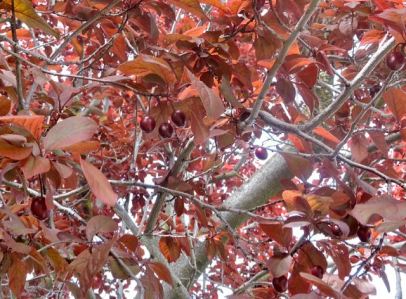
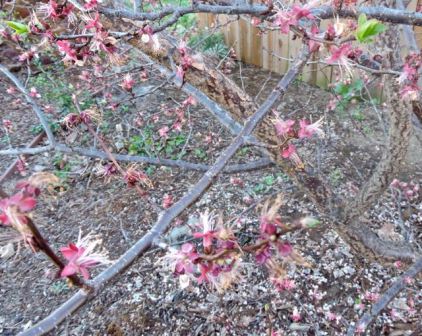
The white and deep burgundy blossoms of the cherry plum (below) come just after those of the apricot. Last year’s tiny plums were the most prolific ever, over a thousand; what will happen this year?

Lemons and Oranges

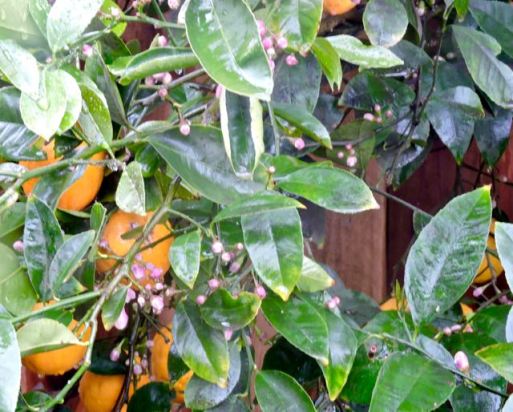
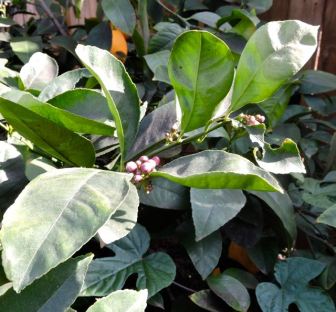
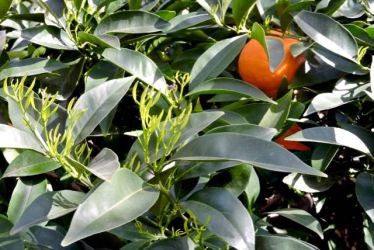
While ripe fruit still awaits us on the orange tree and the meyer lemon bush, new shoots and even a few buds proclaim that the next crop is coming…

garden meyer lemon buds with lemons still on the bush 2 20 20 - 1

New buds on the lemon, while ripe fruit hide.

garden new shoots on orange tree with fruit still on tree 2 20 20 - 1

New shoots share space with the ripe oranges.


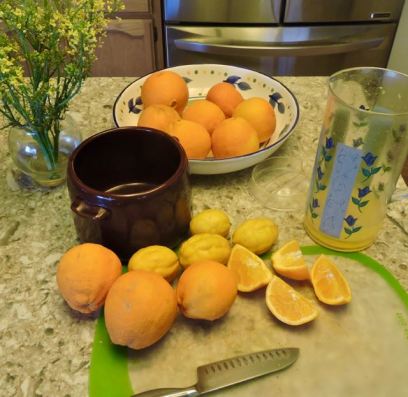
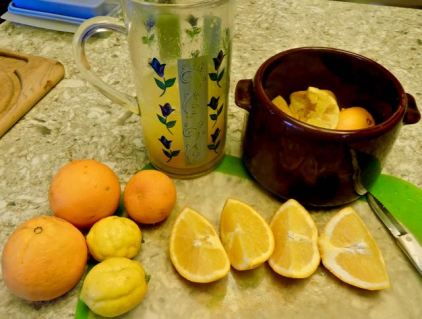
…and I just keep making juice:

kitchen oranges and lemons for juicemaking 2 20 - 1


3. More February Bloomers

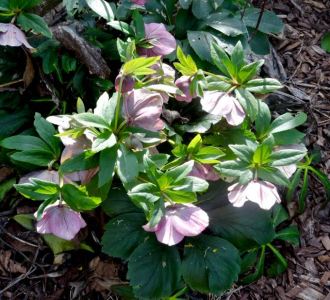
garden lenten rose 2 20 20 - 1

Lenten Rose

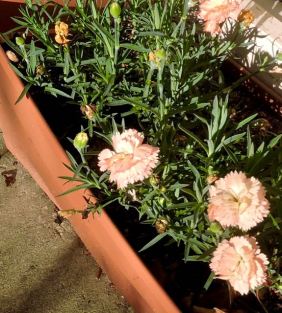
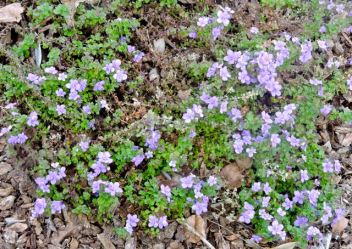
garden front dianthus in bloom 2 20 - 1

Dianthus


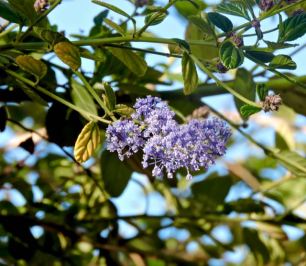
garden first bloom of the ceonothus 2 20 - 1

First blooms on the Ceanothus (Western Lilac)


garden front bacopa in bloom 2 20 20 - 1

Bacopa

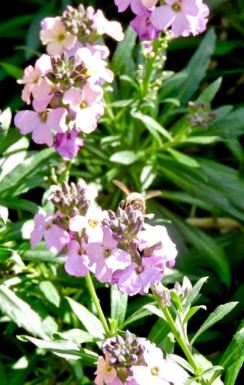
garden bee on the blooming erisymum 2 20 20 - 1

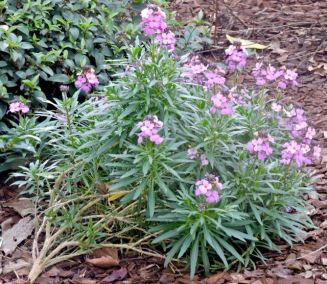
Erysimum

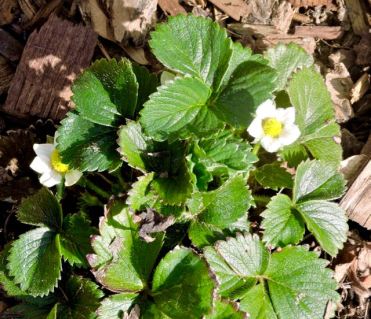
garden strawberry flowers 2 20 20 - 1

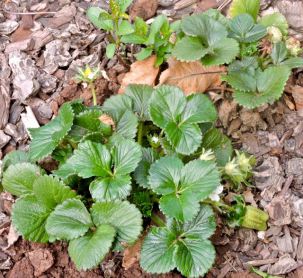
Strawberries

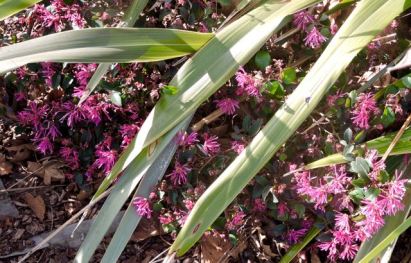
garden loro petulam in bloom beneath new zealand flax 2 20 20 - 1

Loro Petulam beneath New Zealand flax fronds

garden periwinkle in bloom 2 20 20 - 1

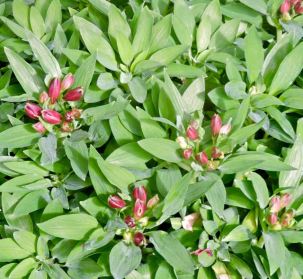
Periwinkle (Vinca)


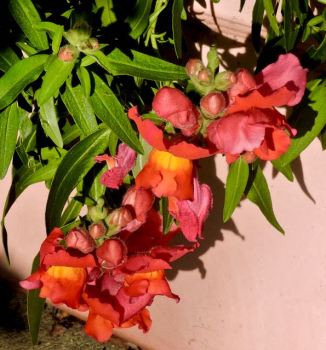
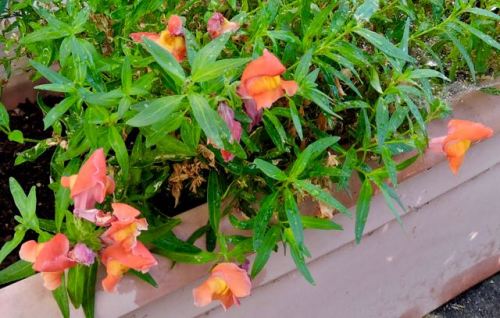
garden front snapdragons in bloom 2 20 - 1

Snapdragon

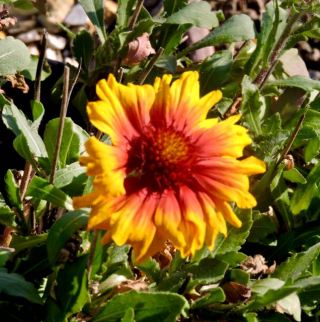
garden front gaillardia flower 2 20 - 1

Gaillardia


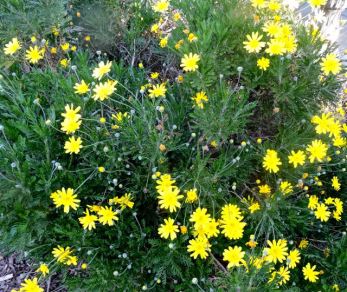
garden coreopsis euryops in bloom 2 20 - 1

Coreopsis (Euryops)

And getting ready to bloom in March…

…are the roses, all trimmed back in January and now rich in new shoots and leaves:

While all this goes on outside, inside it’s also cookin’…

4. February in the Kitchen

Jean:

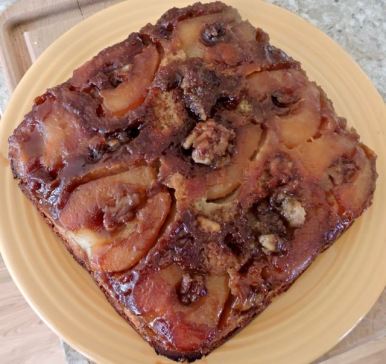
Ginger Pear Apricot Upside Down Cake

kitchen ginger apricot pear spice cake 2 20 - 1

Jean’s ginger pear apricot upside down cake

This is an upside down fruit cake, which is always popular.  To make the cake itself, you can use your favorite gingerbread recipe or cake mix.  I used a simple homemade spice cake recipe, below.

1. First, prepare the topping in the bottom of your cake pan.  Using a 9-inch square pan, combine 2 tablespoons hot melted butter with 1/4 c. brown sugar and 1/4 c. dark corn syrup or molasses.  Make sure those are well blended and spread over the bottom of the pan.

I also put down a layer of our homemade apricot jam (from last year’s crop), for an additional layer of flavor.

2. Then arrange 9 showy half-nuts like walnuts or pecans equidistant apart and place 9 canned pear halves, cavities down, on top of the nuts.  You can add more nuts, maybe broken ones, and/or candied ginger, in between the pears.  Set aside while you prepare the cake and preheat the oven to 350 degrees.

3. For the cake itself, sift together 2 cups flour, 3-1/2 tsp. baking powder, 1-1/4 c. sugar, 1 teaspoon salt, and 2 tsp. spices.  You can either use a gingerbread spice mix, or 1 tsp. cinnamon, 1/2 tsp. nutmeg, and 1/2 tsp. ginger.  Throw in a little allspice and cloves if you have them.  It’s all good.

4. Next, beat in 1 cup milk, 1/2 cup shortening, and 1 tsp. vanilla.  (I used coconut milk for half of the milk and shortening because I had some left over, but that’s up to you.)

5. Beat for a couple of minutes, then add 2 large eggs and beat another couple of minutes.  Pour into the prepared cake pan until 3/4 full.  If you have too much batter, as you probably will, bake the rest as cupcakes.  (I tried using half a recipe of the cake batter, but it didn’t sufficiently fill the pan.)

6. Bake the cake for 40 minutes and cupcakes for 20 minutes.  Let the cake stand just a minute before inverting onto a cake plate.  You don’t want the sugary topping to seize up before you try to release it from the pan, but try not to break the cake.  You might need to go around the edges with a knife first, to make sure the cake can come free in one piece.

7. We served this upside down cake to guests, and they loved it!

Lemon Almond Tart

Our meyer lemons are so abundant and so juicy that I wanted to use them in a special way. We also had on hand a lot of delicious sliced almonds, another Sacramento Valley staple, so this is what I came up with to use them together.

kitchen lemon curd almond crunch cakefeb 20 - 1

Jean’s Lemon Almond Tart (A quarter already disappeared before Chris could even get the photo!)

FOR THE CRUST:

  • 1 ½ cups/192 grams all-purpose flour OR substitute some of the flour with almond meal
  • ⅔ cup/82 grams confectioners’ sugar
  • 1 ½ teaspoons kosher salt
  • ¾ cup/170 grams (1 ½ sticks) unsalted butter, melted

FOR THE FILLING:

  • 1 cup/240 milliliters fresh lemon juice
  • 1 ¼ cup/250 grams granulated sugar
  • 3 large eggs
  • ¼ cup/32 grams all-purpose flour
  • 1 tablespoon freshly grated ginger
  • ½ teaspoon ground turmeric
  • ¼ teaspoon kosher salt
  • ½ lemon, thinly sliced, seeds removed (optional)
  • sliced almonds
  1. Make the crust: Heat the oven to 350 degrees.
  2. Whisk together flour, sugar, and salt in a medium bowl. Drizzle in melted butter and, using a spatula, mix until well combined. Press this into the bottom and up the sides of a 9-inch tart pan or square pan, using the flat bottom of a glass or cup to even it.
  3. Bake the tart shell until it’s a pale golden brown on the edges and baked through on the bottom, 15 to 20 minutes.
  4. In a medium bowl, whisk together lemon juice, sugar, eggs, flour, ginger, turmeric and salt. Make sure no lumps remain, but don’t overmix. Pass the mixture through a fine mesh strainer to make sure no bits of flour or egg are left behind. (I actually cooked this on a double boiler and then strained it, to get out lumps of white.)
  5. Transfer filling to the crust (depending on the depth of your pan, you may have a little yummy lemon curd left over). Lay reserved lemon slices and/or sliced almonds across the top. Bake until the edges are set, 15 minutes. Let cool completely before slicing.


And on to March!


January Surprises, 2020

garden oranges w hibiscus geranium coreopsis in back jan 20 - 1

Oranges in foreground shade, with hibiscus, spicy oregano, geraniums, pomegranate, and coreopsis sunlit

In this entry:

  • January Surprises
  • Fruits and Veggies
  • January Garden Friends
  • The January Kitchen: Party Time!

Chris:

The opening month of the new decade–the 2020s!–brought us our typical chilly grey mornings of dew and fog, followed by afternoons of wintry sun, deep blue skies with puffy clouds, and temps in the 50s. Days of rain? Some, but fewer than usual, and as the month draws toward a close we’ve received less than 2 inches, more than 2″ below average.  But our rainy December–almost 9 inches–gave us a surplus gift for the new year, so the soil is dark and moist, perfect for a bit of transplanting and perfect for growth of the hearty winter veggies, fruits, and flowering plants.

By now, I should have grown to expect color in the January garden, but my deeply ingrained expectations for bleak Januaries from all my years in the East always make our Northern California Januaries an exquisite surprise.

garden garlic agapanthus new zealand flax gaillardia penstemon front - 1

Front garden: Agapanthus in front, with (l-r) flowering garlic, New Zealand flax, breath of heaven, yellow gaillardia, and penstemon in background

For example, the palette of the photo just above isn’t as intense as it will be come March, but it’s still rich and varied.

And we love the January brilliance of some of our perennials in the back garden…

garden blooming erysimum jan 20 - 1

Erysimum

garden back african daisies jan 2020 - 1

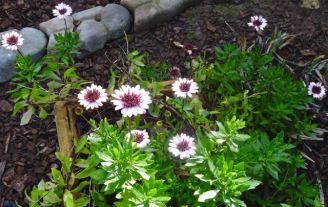
African daisies


garden blooming rosemary jan 2020 - 1

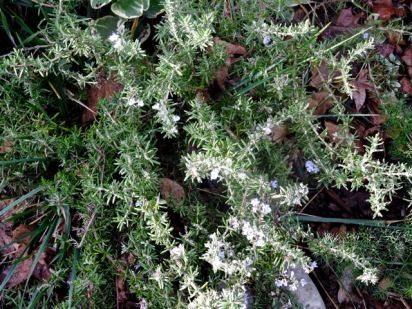
Blooming rosemary

garden geranium blooms jan 20 - 1

Geranium

garden coreopsis blooms and friend jan 20 - 1

Coreopsis


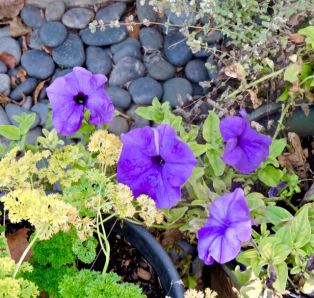
…not to mention the hearty annual petunias that keep going this January after having bloomed all spring, summer, and fall…

garden purple petunia bloom jan 20 - 1

garden petunias parsley marjoram jan 2020 - 1

Purple petunias with parsley (left) and marjoram (upper right)


Fruits and Veggies

Oranges and Lemons

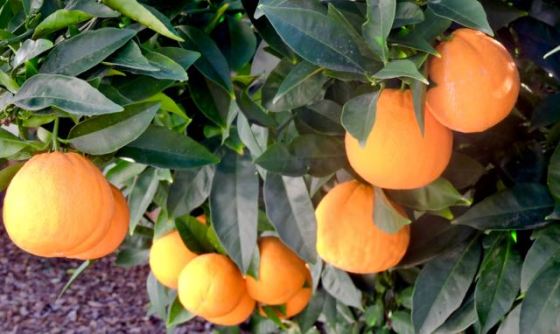
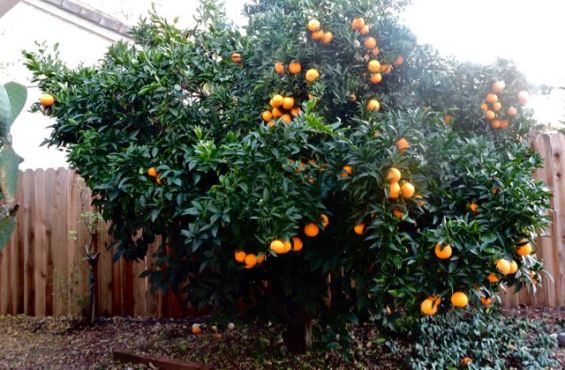
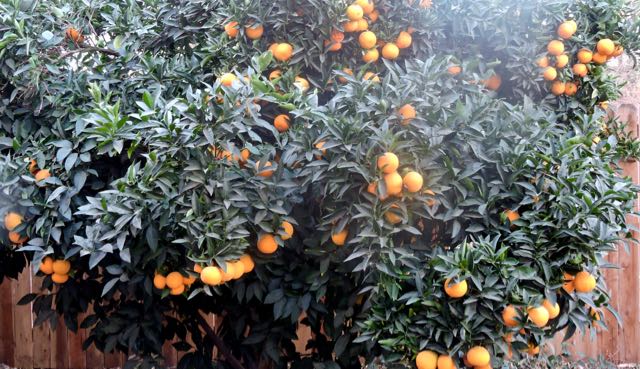
Oranges. No surprises here. Just the colorful, supple, and juicy fruit. We’ve had a steady supply of sweet and tangy juice from the navel oranges, of which we’ve consumed or given away about 65 so far this month, about 155 total used so far this season. I’d estimate about 100 still on the tree, all in all somewhat less than last year’s more than 300 total for the season.

The birds love them, too, especially those fruit higher up in the tree, where the birds feel safer. But there are plenty for us humans.

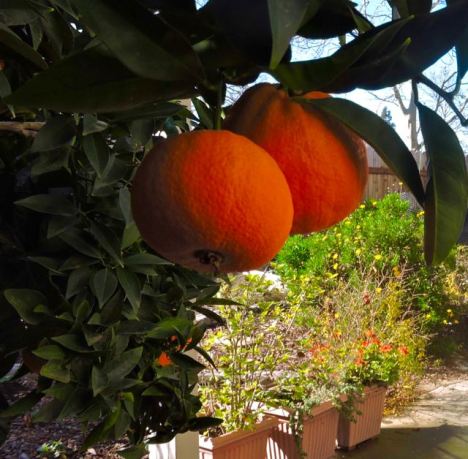
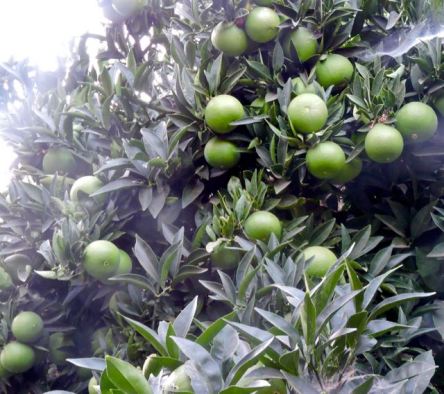
Mostly, the oranges are much larger than what you’d find in the grocery store; ours are typically 4 to 6 inches in diameter. Those in the clusters below are in this size range, as are the two in the photo at the top of this post.

garden orange clusters jan 20 - 1

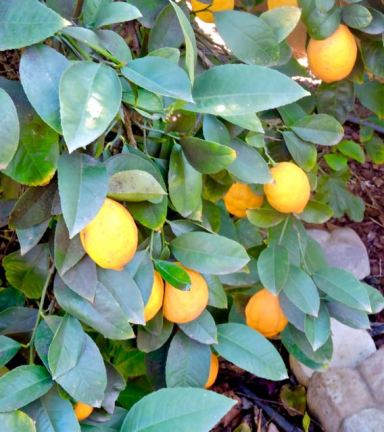
Meyer lemons. When I make juice, I like to blend about 3 oranges for each lemon–so about 15 oranges to 5 lemons for a full pitcher, which lasts us around a week. The fruit is so intense that we like to dilute the juice with water–and I’ll also add a small packet or two of stevia natural sweetener and a bit of baker’s sugar to balance the tang of the lemons.

The lemons this season are above average in size and in clarity of the skins: in size about 2-3 inches in diameter, or smaller than the more common Eureka lemons. In all, we’ll have about 125 meyer lemons this season, about average for the mature bush.

While the orange tree was here when we moved in 13 years ago (though much smaller than the present tree, which we need to cut back every other year or so), I planted the meyer lemon 11 years ago (about a foot high then). It stayed tiny and unproductive for three years, but in 2011 it started to take off; it grew steadily and produced more each year for the next five years (by 2016), when it reached almost its current size and productivity.

Unlike the sweet oranges, which draw the hungry birds, the sour lemons are almost untouched by our garden friends. But wait for the spring buds and blooms, which the bees love.

garden meyer lemon clusters jan 20 - 1

Swiss Chard

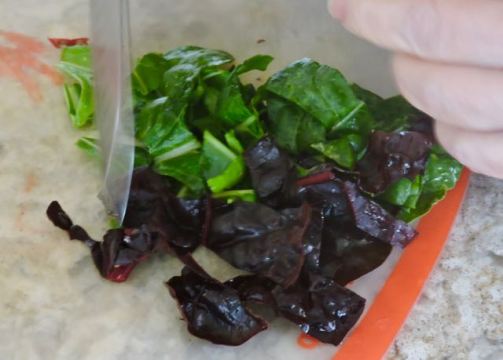
kitchen chopping fresh chard jan 20 - 1

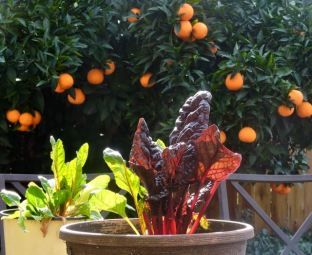
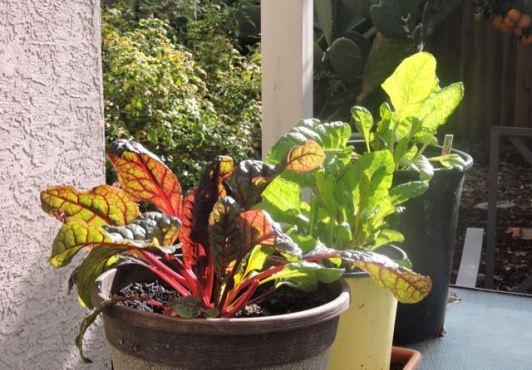
Jean seems to be using our chard even more often this year in her cooking than in the three previous years in which we’ve grown it (see January in the Kitchen: Party Time!, below in this post). Perhaps because when I planted the six seedlings in October, the garden critters quickly devoured two plants and damaged the others–until I moved the remaining four into pots and moved them close to the house on the veranda. So we appreciate their preciousness–as well as the deliciousness of the gorgeous leaves.

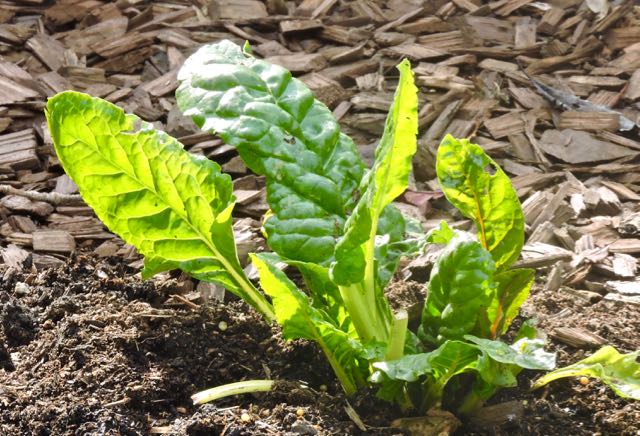
In November, I transplanted one of the four into the large raised bed and surrounded it by chicken wire. It has grown and thrived since, even in the cold weather. Then, a week ago, I transplanted another into ground near the strawberries, and did not protect it in any way. So far, so good. I’ll see what happens.

In previous years, such as last spring, 2019, the chard has never needed protection, even as the weather warms significantly, and it has grown prodigiously. So I have my fingers crossed for this new transplant. I have often found that fall and winter veggies that were eaten by insects in October thrive once the coolness of November and the cold of December come along. That’s true of the chard this year.

garden potted chard before ripe oranges jan 20 - 1

Two chard plants in pots near house, January

garden newly transplanted chard from pot jan 20 - 1

Chard transplanted from pot, January


The Champion Cajun Red Pepper

garden cajun red pepper plants jan 20 - 1

We keep getting ripe spicy red peppers  from this sturdy plant.

This hearty plant continues to be fruitful even in January. Planted in April and bountiful each month since May, this Cajun Red is the champion pepper in the history of this garden. I keep wanting to replace it in the raised bed with something new, but I’ll continue to give it space until it gives up the ghost.


Broccoli

In this third year of growing broccoli in the garden, these five 2019-2020 plants are the best so far. All five have flourished this month, and we have used florets in a range of dishes thus far, with no real diminution of the stock. We may soon be cutting off florets to freeze for the coming months, as the heads are just beginning to show their tiny yellow flowers. See last month’s blog entry, December 2019, for a description of the two ways I’ve tended to these five plants, as reflected in the photos below.

garden two broccoli heads and periwinkle jan 20 - 1

Two lush broccoli heads with many florets, late January

garden large broccoli head jan 20 - 1

The plant with the largest head. Note the few yellow flowers starting to appear, late January.

garden fennel broccolini 2 and callalily jan 20 - 1

Bordered by fennel and calla lily, these two thriving broccolis feature the broccolini shoots that rise up once the central shoot is cut off.

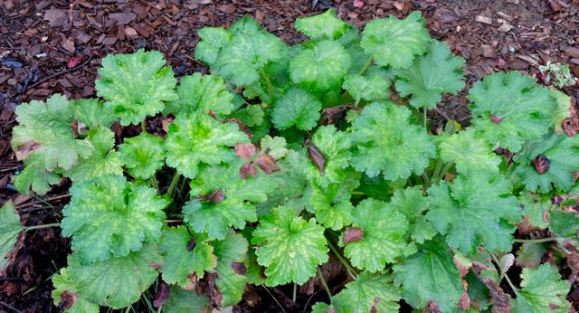
Alum Root

I’ve never written in this blog about this hearty perennial that loves the fall, winter, and spring (when it flowers), and survives despite deep stress in the summer heat. I tend to ignore photographing it because it doesn’t produce edible fruit and it doesn’t have showy flowers–and in summer it browns out in the intense sunlight, unless I give it extra water, which I do. But it deserves better appreciation than I’ve given it. It’s now lasted a dozen years and has tripled in size since its early years. In many parts of the world, alum root is appreciated for its medicinal properties and has been used for many centuries by people much more considerate and savvy than I. See, for example, https://www.medicinalherbs-4u.com/alum-root.html

garden back alum root jan 2020 - 1

The venerable alum root, back garden

Even strawberries?

garden strawberry plant and fruit jan 20 - 1

See the strawberry at the lower right edge? January surprise.

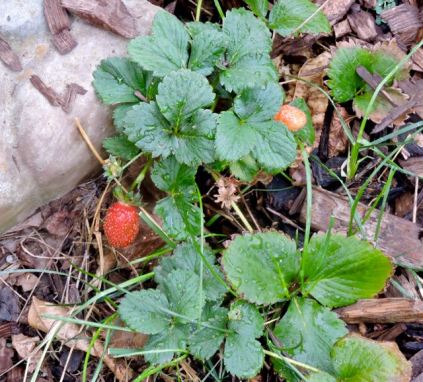
I always expect that my eleven modest strawberry plants in the back garden are happily keeping their roots warm underground in the cold weather, just waiting for spring to blossom and fruit. But two of the plants have put out a few fruit this January. A very pleasant surprise! We’ll see what this bodes for spring 2020.


January Garden Friends

We share the garden with the Western scrub jays (AKA rock jays), who don’t mind me too much, and who like to cavort around productively in my presence. They are as territorial as I am, but have come to realize that I am not a threat. Not so for other birds who visit, whom the jays can’t abide (especially the mockingbirds!–oh how they squabble!). So other visitors flit around, hope for a bit of food here and there, and rarely perch for more than a few seconds before flitting to another branch or tree or to someone else’s yard.

So getting good photos is not easy (except for the jays!). Here are a few recent ones…

garden rock jay in peach tree jan 2020 - 1

Scrub jay in the peach tree, a favorite perch

garden rock jay beside broccoli jan 2020 - 1

Scrub jay by the broccoli, late January

garden rock jay in peach tree jan 20 - 1

Scrub jay in the peach tree again, looking for intruders.

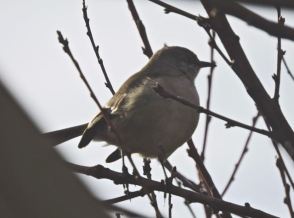
garden ruby crowned kinglet in peach tree 2 jan 2020 - 1

Warbler in the peach tree, when the jays are elsewhere

garden ruby crowned kinglet in peach tree jan 2020 - 1

Ruby-crowned kinglet (I think) in the peach tree, just for a few seconds

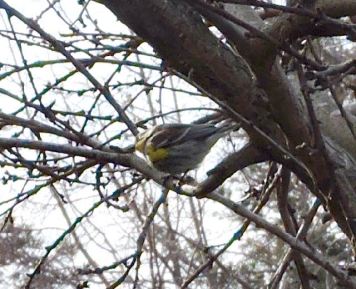
garden yellow rumped warbler in sycamore jan 20 - 1

Yellow-rumped warbler in the neighbor’s sycamore. Very lucky to get this shot!

garden white crowned sparrow by coreopsis jan 2020 - 1

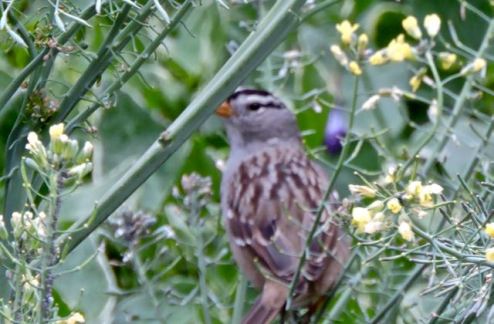
White-crowned sparrow by the coreopsis (euryops)

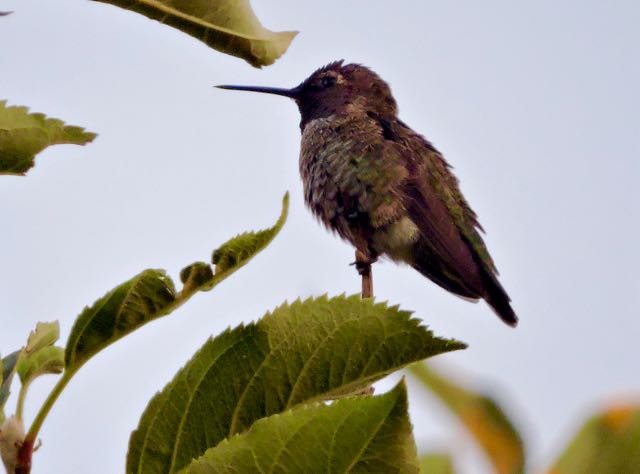
Oh, and if you are wondering where the Anna’s hummingbirds are, they are around. I heard one whirring close by my head last week, but it disappeared before I could get a look. They are not happy that I’ve cut back the now-dormant Mexican bush sage to await new growth, but the hummers will be showing their iridescence once again, when spring flowers begin to surge.

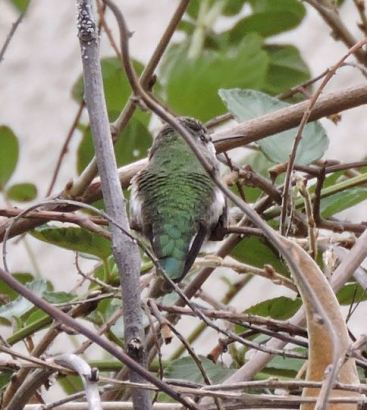
Ooh, wait a minute! After writing the above, I was out in the garden a few minutes ago and heard the distinctive chirp. I was lucky to get this pic…

garden annas hummingbird still jan 20 - 1

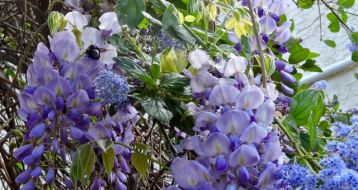
Anna’s hummingbird amid the wisteria branches

Bees

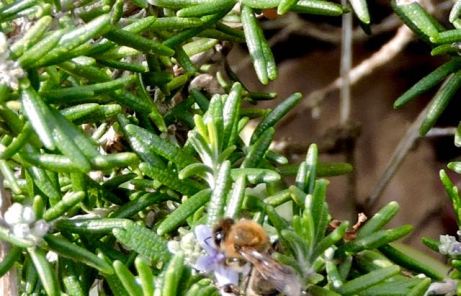
It’s never cold enough around here to chase away the bees, though they lie low on chilly mornings. Thankfully, no matter how foggy and wet a morning might be, the bees reappear as soon as the sun comes out. See this blurry honeybee I snapped three  afternoons ago on the blooming rosemary…

garden honeybee in rosemary blossom jan 20 - 1


The January Kitchen: Party Time!

Jean:

Chris and I have special fondness for the winter months, as they contain our anniversary,  our birthdays, and so many holidays, from Thanksgiving through Christmas, Hanukkah, and New Year’s, and on to Martin Luther King Day, the Super Bowl, Washington-Lincoln Day, the Asian Lunar New Year, Valentine’s Day, Mardi Gras, St. Patrick’s Day…. You get the picture.
And special foods seem to be part of them all, so what better time to exercise your cooking muscles and try different dishes?

This month we co-hosted a multi-occasion, food-focused party for friends. The party aimed to celebrate a bunch of these holidays in one big event. We’re calling it the Super Party! Why not? I cooked several dishes, and each couple also contributed a dish of their choice.

The rest of this entry will be a photo parade of some of the dishes at the party, with a comment about each.  Here goes:

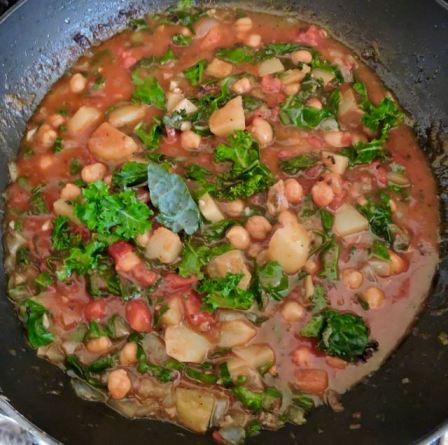
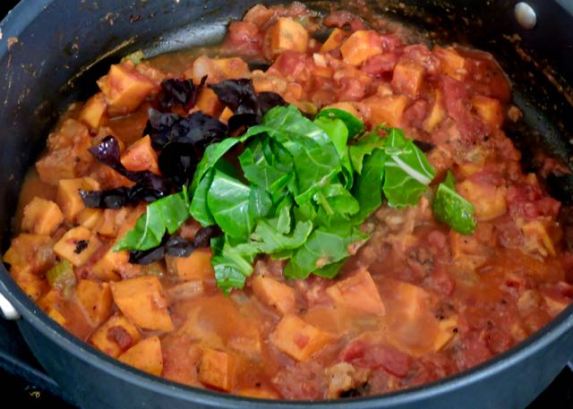
kitchen adding chard for the West African stew jan 20 - 1

Chard about to be mixed into Jean’s West African veggie stew


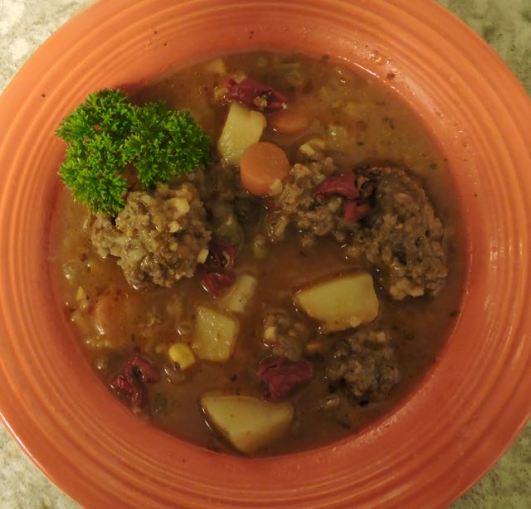
kitchen albondigas soup jan 20 - 1

Albondigas soup garnished with parsley and red pepper

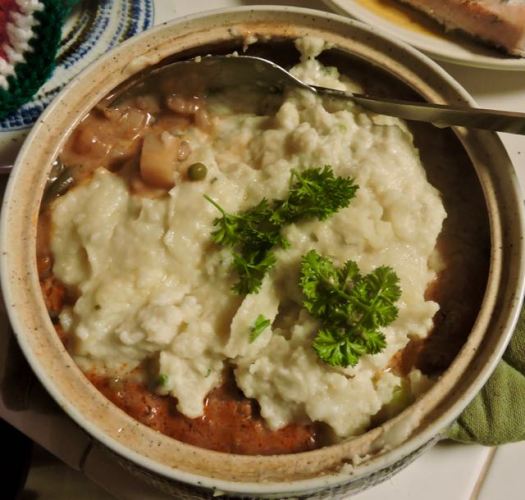
kitchen vegetarian shepherd's pie 1 jan 20 - 1

Jean’s Vegetarian shepherd’s pie before potato topping

kitchen vegetarian shepherds pie jan 20 - 1

…and with the topping!

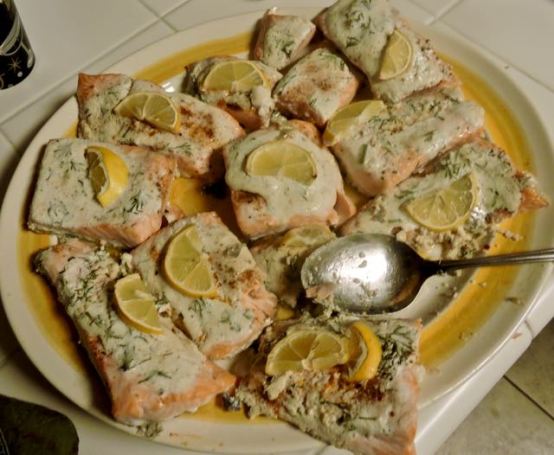
kitchen aparnas salmon in dill cream sauce jan 20 - 1

Aparna’s Salmon with dill cream sauce

kitchen brendas broccoli radish peapods salad jan 20 - 1

Brenda’s Broccoli, radish, and peapod salad

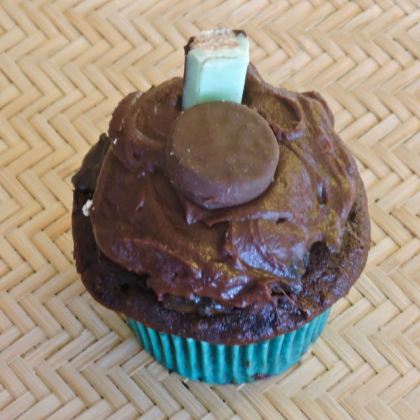
kitchen mardi gras cupcakes jan 20 - 1

Mardi Gras cupcakes

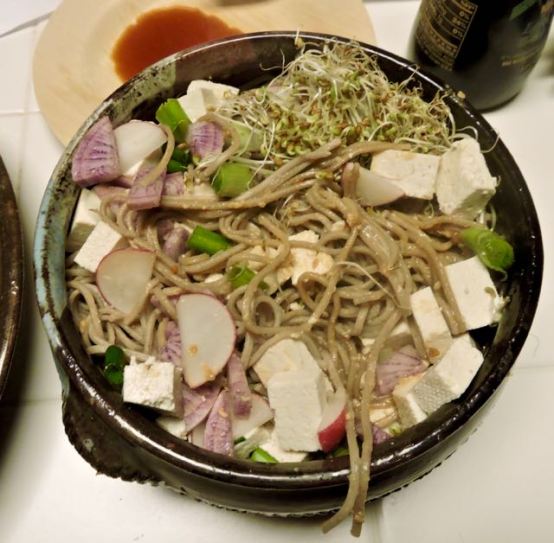
kitchen soba noodle tofu radish medley jan 20 - 1

Soba noodle, tofu, radish, sprouts, green onion medley

May all your holiday celebrations be as joyful as ours!

On to February…


December 2019: When Rain Arrives, the Garden Thrives

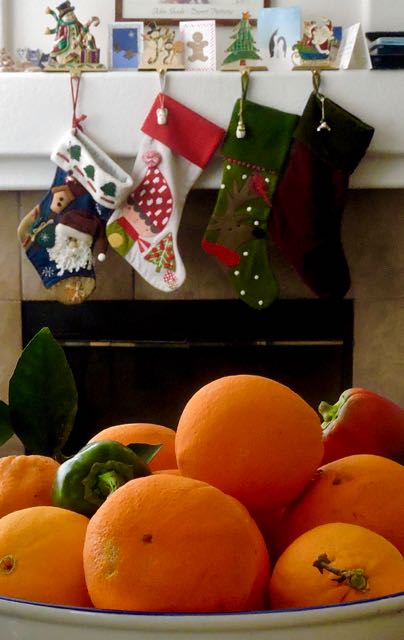
kitchen oranges peppers stockings dec 19 - 1

Chris:

A year ago, December 2018, our blog entry reported on the devastating Camp Fire in Butte County that destroyed the town of Paradise and cost 86 lives and thousands of homes. The mood this December feels very different, even though the threat of wildfires is never far from our minds.

As I described last month, this year’s fire season was far less severe, and now with the plentiful rains thus far in December our region is breathing a collective sigh of relief. The holiday season is upon us, and we are preparing in comparatively high spirits.

Indeed, we are hosting family for Christmas week (see the stockings in the photo above?). And the garden is doing its part (see the oranges and peppers?) to enrich our joy.

In this post, we begin with Jean’s description of her dishes for our holiday guests. Then we’ll move on to my garden comments–and compare this year’s December garden with that of 2018.

Finally, we’ll close with our gallery for the month.

Our (International) Holiday Kitchen in December

Jean:

(December 28)

In keeping with our theme of an international Christmas, I made the three dishes I describe here, as well as others.

Pozole verde soup: First, on Christmas Eve, and the day before that (when our guests arrived), I wanted a Mexican theme.  We had tamales, chili, and this pozole verde soup, which was a particular hit.  I boiled a couple of bone-in chicken breasts with onions and garlic to make a good broth, then cooled them and pulled the cooked meat off the bones.  Finally, I reheated it with hominy, some chard from the garden, and a green tomatillo sauce before adding back the chicken.  You can top it with sour cream and/or cilantro.

For some history on pozole, I suggest the following: https://en.wikipedia.org/wiki/Pozole

kitchen hominy chard red pepper posole dec 19 - 1

My pozole with chard, hominy, chicken, and a dollop of sour cream


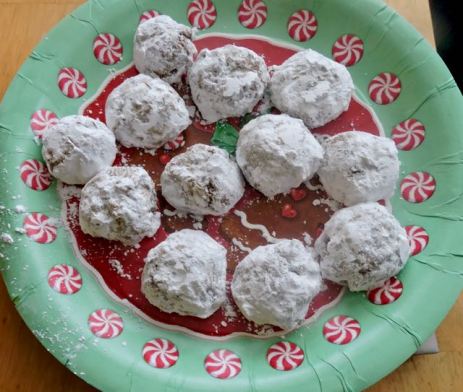
Pfeffernusse: I love making Christmas cookies.  There are so many different types.  I tried some new ones this year, including red velvet crinkle cookies, matcha shortbread, and pfeffernusse.   I can see from this Wikipedia article that pfeffernusse should be smaller and not rolled in powdered sugar, but we’re partial to anything rolled in powdered sugar.  Because I didn’t get around to making Mexican wedding cookies (AKA Russian teacakes or snowball cookies) this year, so the pfeffernusse got the powdered sugar that these other types would usually get from me. And we and our guests enjoyed them.

I had to ask what the name pfeffernusse means; I could guess the pepper part, but the “nusse” or nuts may refer to the cloves, or the nutmeg.  Anyway, I love anything that uses most of my spice rack.

https://en.wikipedia.org/wiki/Pfeffern%c3%bcsse


kitchen pfeffernusse jean dec 19 - 1

My pfeffernusse rolled in powdered sugar


Shakshouka: I wanted something warm and hearty plus colorful for Christmas breakfast, although we also had sweet breads available like stollen and my pumpkin bread.  This shakshouka met all of those wishes.  It contains many of Chris’s favorite flavors.  (He wanted to add the manzanilla olives, but basically it is just a tomato, sweet pepper, and spice dish.) I also added in a chopped-up Cajun red pepper from the garden for an extra kick.  While shakshouka is red and green, it is not per se a Christmas dish–it is a Middle Eastern dish loved by Israelis and Arabs alike.  Italians, however, know it as “eggs in purgatory.”  You poach eggs in the sauce, but you can’t see those well, so I added hard-boiled eggs on top for visual effect and to give choices of egg styles.

https://en.wikipedia.org/wiki/Shakshouka

kitchen shakshuka for christmas dec 19 - 1

My shakshouka with hard-boiled eggs and artichoke hearts added


Comparing the Gardens, 2018 and 2019

garden panorama from orange to flame trees dec 19 - 1

garden flame leaves deck fountain veggies etc in rain dec 18 - 1

2019 top, 2018 bottom

Chris:

The main reason I started one year ago doing blog entries named month to month was so I could compare one year with the next. These two December photos are taken from opposite vantage points:

  • the 2019 photo is taken from behind the orange tree and toward the deck to the north;
  • the 2018 photo was taken from behind the sweetgum (liquidambar) trees and south toward the meyer lemon bush.

Both photos are taken in the rain, and you’d have to say the garden looks pretty much the same in both–in its deep greenness, its carpet of brown mulch, and its decorative stone borders. But the photos do highlight different features of the back garden:

  • the 2018 shot shows the French breakfast radishes in the nearest raised bed, the broccoli plants in the square raised bed, and the chard in the pot between the beds, as well as the ripe meyer lemons in the background;
  • the 2019 shot shows the strawberry plants in the near foreground, the African daisy in the pot to the near left, and the potted hibiscus, Greek oregano, and geranium in the near right, as well as the dwarf pomegranate bush beside them. It also shows the fennel just beyond the African daisy, the broccoli plants in the ground beside the fennel, and the feathery arugula to the right of the broccoli. In the background is the wire-protected chard in front of our black compost bin.

Both photos feature the fountain, the striking Euryops with its yellow blooms, the white rose bush, and the rosemary and calla lily beside the white rose.

What else stands out for you in the photos?

More comparisons

Oranges: The production of the orange tree in December 2018 and in December 2019 is about the same for each year. In 2018, the tree produced roughly 350 oranges. The tree this year looks as if production will be similar (about 90 oranges have been used for juice or for giving away to the local food bank thus far:

kitchen making orange lemon juice dec 19 - 1

About 15 navel oranges and 5 meyer lemons, plus water to limit the intensity, make a full pitcher of orange-lemonade. We like ours with some pulp.

For years, our orange production varied between a huge crop (300 or more) one year and a small crop (under 100) the next (keep in mind that an orange will grow in the same spot on the tree only every other year). That the last two crops have been about even shows that the tree is now pretty balanced in where the fruit grows from year to year. We’ll see if that keeps up!

garden orange tree christmas dec 19 - 1

Orange tree December 2019, about 90 already picked

 Meyer Lemons: We’ve used about 20 of the lemons already this season for our juice (see photo below), so this year’s total production is about the same as last year’s (about 125). But this year’s crop ripened just a bit earlier and is freer of the blemishes that marked the 2018 crop.

garden meyer lemon bush christmas dec 19 - 1

Meyer lemon bush December 2019, about 20 lemons picked so far

Broccoli: In this third consecutive year of growing broccoli in the winter garden, I’m mixing the techniques I used in the previous two years. In 2017, I allowed each plant to produce one large head (multiple florets) in the center. In 2018, I trimmed off the central head in each plant when the head reached about 1.5 inches across, so that multiple much smaller heads (broccolini) would spring up outside the center. So what I lost in the volume of the central head was compensated for by the number of heads. (See the post “February 2019: Cold, Rainy,  but Warm in the Kitchen” for a photo of the proliferating heads last winter.)

This year, I have five thriving plants:

  • two of these I’m treating like the 2018 plants, with the central heads cut off and the smaller heads growing around the centers (see below)
garden broccolini shoots christmas dec 19 - 1

Notice the four small heads growing around the lopped off central shoot in this 2019 plant.

  • the other three I’m treating like the 2017 plants, with the central head of each becoming lush and with multiple florets:
garden broccoli head christmas dec 19 - 1

Notice the multiple florets in the rich central shoot of this 2019 plant.

The advantage of the 2017 technique is the lushness of the central shoots, which most broccoli eaters will recognize. The advantage of the 2018 method is that as the smaller side shoots are cut off for eating, other small shoots will continue to grow. However, none of these will have the volume and lushness of the central heads.

In all three years, the broccoli plants have thrived, especially in the cold weather of late November through January and even into February.

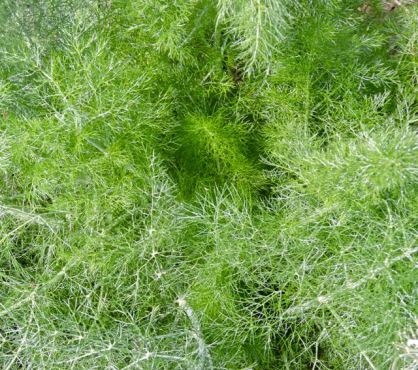
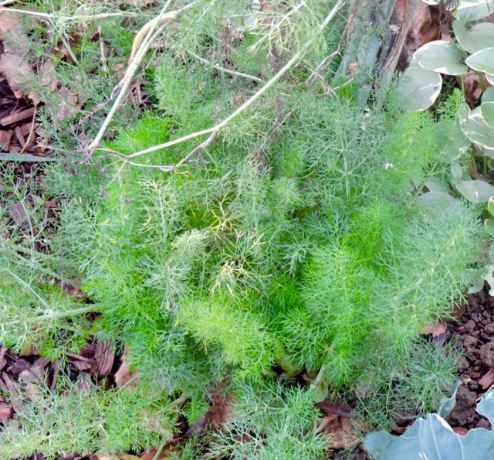
Fennel: I can’t compare the 2019 fennel with that from 2018, because this is the first year I planted fennel in the garden. I should have done so years ago, because fennel is a perennial that has thrived in the garden since the spring–and is particularly lush and green now. I started the fennel off in a pot in April, and it took off. I transplanted it into the ground in the summer and it just kept growing taller. I tied it to a stake in August, so it would continue to rise and not fall over. In October, I trimmed off the tallest branches, which appeared worn out. Now in December it is proliferating deep green feathery shoots that are oh so fragrant and beautiful.

garden fennel plant christmas dec 19 - 1

These feathery fronds of fennel have appeared in the last couple of weeks of this December.

A Small December Gallery

garden one african daisy dec 19 - 1

African daisy, back garden

garden cajun red pepper dec 19 - 1

The amazing Cajun red pepper plant, still producing ripening hot peppers in the occasionally frosty December mornings. A champion.

garden white rose christmas dec 19 - 1

A white rose, back garden–never a month without new roses in this garden

garden salmon roses dec 19 - 1

Salmon roses–of course

garden callalily fennel broccoli euryops dec 19 - 1

The calla lily front left is the star in this shot, but just look at the broccoli, the feathery arugula, the blooming rosemary, and the feathery fennel!

garden back erysimum poem lilac dec 19 - 1

Erysimum, green in summer and fall, blooming now in winter.

garden fountain petunias kolancho aloe dec 19 - 1

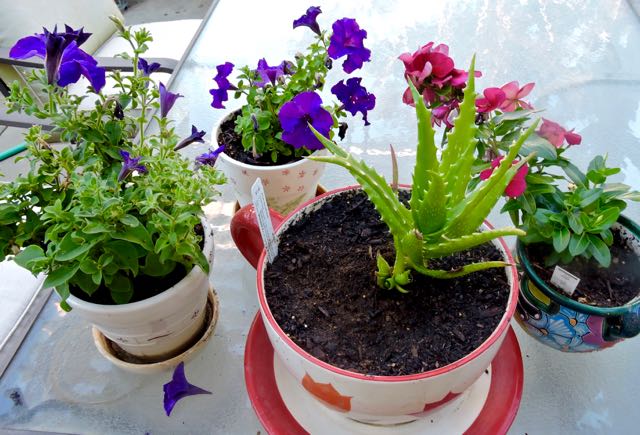
Just as in December 2018, a few of our petunias still bloom even as frost appears some mornings–and look at the hearty aloe and kalanchoe (white blooms) in the foreground of this photo.

On to the New Year!


November 2019: Let the Rains Begin

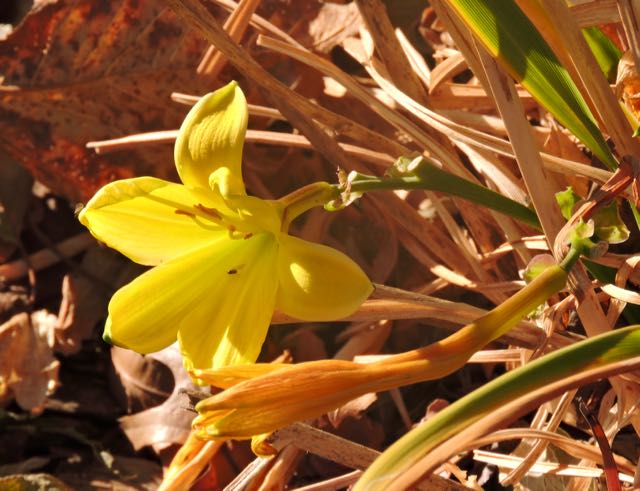
garden front yellow day lily late nov 19 - 1

Chris:

At last, the first raindrops of the season are falling. Just yesterday, the day lily above posed for my camera in the bright morning sunshine. This afternoon, we have the steady patter of drops on the dusty deck in the back garden (below).

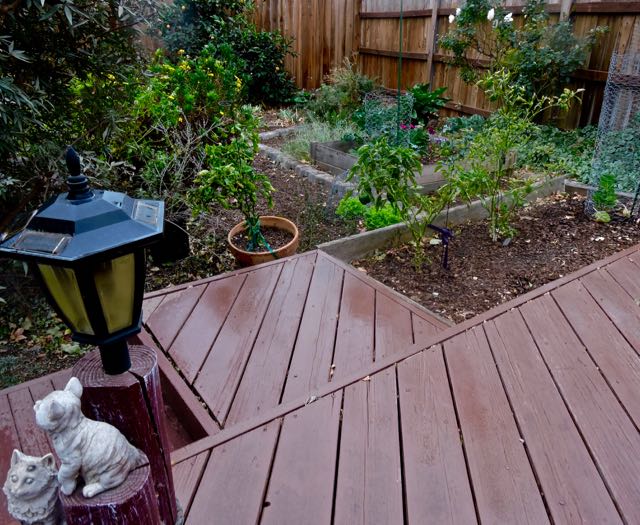
garden back panorama in rain late nov 19 - 1

The forecast is for a good soaking here in the Valley, which means maybe an inch. Hey, that would be a great start.  Meanwhile, the Sierra foothills might get a foot or more of snow over the next two days, and–if the weather service is right–as much as five feet in the highest passes above 7000′. Thanksgiving is just ahead, and mountain travelers, among whom we were supposed to be, are scrambling to make alternative plans–or at least get an earlier driving start.

Here in the garden, this November has been pretty much like last year’s. Which means that we’re waiting for the rainy season to begin, so that…

  • then I can stop the irrigation system, and, more important,
  • then all of us in the region can stop worrying when the next big wildfire will explode upon us. As I’ve explored in this blog, October ’17 and November ’18 were horrible fire months, with record death tolls, number of structures destroyed, and burned square miles. In ’17, the fires ravaged Sonoma and Ventura counties; in ’18, the Carr Fire did the same to the area near Redding, then the Camp Fire truly devastated Butte County. (See “December 2018: Rains Come, After the Fires,” and “W Is for Water.”)

This late October and early November, the Kincade Fire swept through northern Sonoma, while three much smaller fires fueled by the annual Santa Ana winds threatened Southern California. But the overall devastation was incredibly less than in the previous two years–about 85% less–in part because the beleaguered Pacific Gas & Electric corporation took the extraordinary preemptive step of shutting off power to a million or more households across the state in the most fire-prone areas.  This step reduced the chances of sparks from power lines igniting dry brush, which had been the immediate cause of the Camp Fire, the Sonoma fires of ’17, and other recent blazes.

The effectiveness and justification for the PG&E decisions remain controversial. But at least the PG&E action was one sign of the overall desire of Californians to be proactive in reducing the threat of such devastation as occurred in ’17 and ’18. It is the rare Californian who fails to recognize the fact of gradually rising yearly temperatures and an extended fire season–and therefore the need for collaborative planning toward identifying the most threatened areas and establishing the most effective laws and procedures.

It would be great if the current federal administration were interested in cooperating with the state toward real solutions. But since the 2016 elections the feds won’t even take the first baby step of acknowledging the environmental warming trend, not to mention acknowledging the human and corporate causes of climate change so that real progress might be made toward reducing those causes. Note that 57% of the forested land in California is federal, so the inaction at the federal level truly harms Californians. The Camp Fire and the Carr Fire were among recent catastrophes that began on federal lands.

The Plants of This November

garden cajun red pepper nov 19 - 1

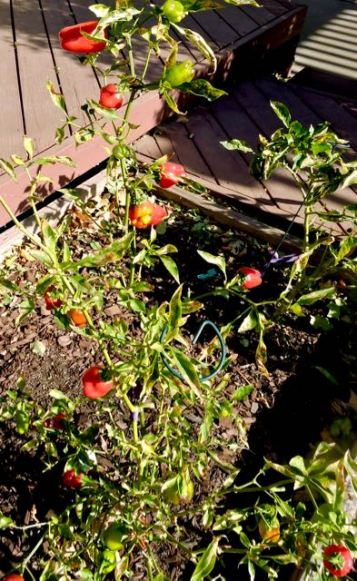
I must begin with the amazing Cajun red pepper (at right), which even now is still putting out new fruit, and whose spicy brilliants keep making our soups and chilis burst with flavor. Last month’s blog was already marveling at the longevity of this plant. Now that it’s threatening to last into December, I’m beginning to wonder if it might become a two-year wonder.  Well, time will tell. Let’s see if it can withstand the freezing temps of winter. Through most of November, the daily highs have been from the low 70s into the 60s, but now the beginning of the rainy season will bring the daily range down to the 30s to the high 50s. How much longer can this hearty specimen survive?

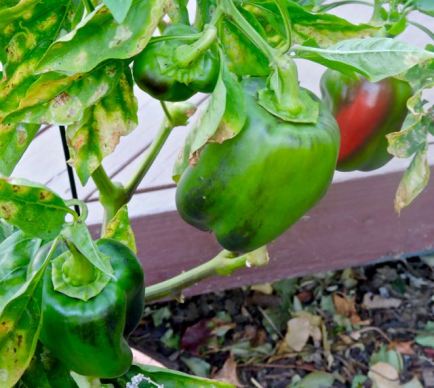
Meanwhile, the Cajun red’s two pepper buddies, both mild, keep going, too, but less spectacularly (see one of them, below). I’d like to replace all three in the raised bed with something exotic, like the French radishes I grew last winter, but right now I’m so intrigued by the pepper oldsters that I’m willing to keep honoring their seniority. I guess that we old folks need to stick together.

garden still ripening mild peppers late nov 19 - 1

Lettuce, Chard, Arugula

Our three very different salad greens have different stories. The arugula this year was a spring planting. In fact, it began with seeds that I planted in a pot in the shady front garden, and which I transplanted to the much sunnier back in July when it didn’t thrive in the front. In the ground in back, it flourished with moderate watering and no fertilizer into the early fall. Now it is heartier than ever and will keep going into next spring, as arugula does. Arugula has always been a strong performer in this garden, and the tiny yellow flowers of this variety are a bee magnet (October video, below).

The leaf lettuce and the Swiss chard this fall are October plantings, and both of these plant groupings had a rough start. The October temps stayed above normal, so the summer insects attacked the new plants, and, believe it or not, a free-range cat who loved our garden also liked to snack on the new veggies. Two chard plants and two lettuces, all of which I’d planted in the ground, pretty quickly disappeared.

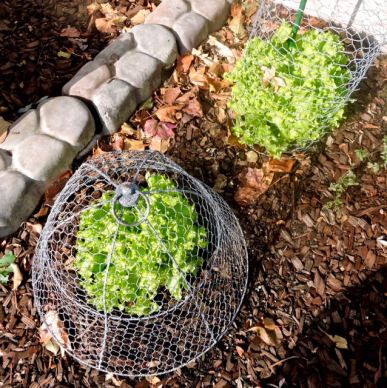
However, the four chards and four lettuces that I’d had the good luck to plant in pots survived–especially when I moved them close to the house.  Once they were better established, I transplanted one of the chards and two of the lettuces into the ground–but covered them with chicken wire.  All of these plants are now doing well, and should thrive in the cooler temps and in the rainy season.

garden back leaf lettuce late nov 19 - 1

Two leaf lettuce plants, late November

garden back three chards late nov 19 - 1

Three Swiss chard plants in pots near the house

Broccoli

Once again, broccoli grows in the winter garden (see below), and in November these October plantings really took off–especially once the weather began to cool off in the past two weeks. In October, one of the plants was devoured by the cabbage leaf butterflies and the remaining five suffered partial damage. But now in the cooler temps, these plants are thriving. The center heads are beginning to appear, and I’ll need to decide if I want to let the center heads grow to their full (and delicious) size (as I did in 2017), or if I want to cut off the center heads so that the small broccolini heads will proliferate around the centers (as I did last year). I may choose to do some in each style.

garden petunias broccoli arugula late nov 19 - 1

Three broccoli plants, plus petunias, in late November

Petunias

garden red white petunias in box nov 19 - 1

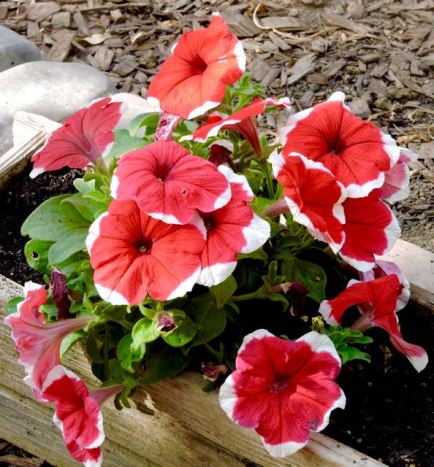
Petunias in wooden planter in back garden, late November

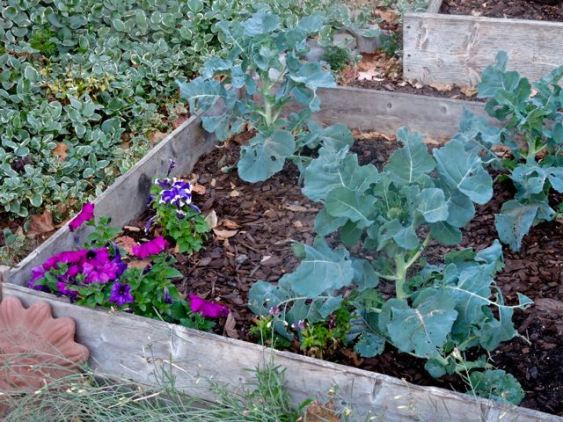
Last year’s petunias lasted from Spring through December and into 2019. This spring’s have now lasted almost as long, and are as beautiful as ever. Indeed, this year, I transplanted several of the plants from the front garden, when the sidewalk pots had been overtaken by the prolific vincas. The transplanted petunias have thrived now in the raised bed with the broccoli and in another planter in the back garden (see above).

In fact, a few of the plants have been transplanted more than once, moving from small pots and into the ground, or from small pots into larger ones. As always with pots, I can move them depending on shade and sun, and most of the moved plants do just fine. And as with our other annual plants, the long growing season means that some annuals can last into the next year with no problem.

Oranges and Lemons

When I have written that our navel oranges and our meyer lemons are ready for harvest in December, I don’t mean that that’s when they look ready. If we went by looks alone, then harvest should be in November (see below).

garden meyer lemons late nov 19 - 1

These meyer lemons at right look ripe, a nice deep yellow. And some might be ready for picking. But too often when I pick these November beauties, they are green on the side facing away from the sun, and they are not yet at their peak of juiciness. Just give them a few weeks more, and they’ll have that tiny bit of sweetness they need to keep the sour from overwhelming our taste buds.

Pretty much the same goes with the oranges.

garden orange tree late nov 19 - 1

The late November tree (above) looks laden with ripe sweetness. And if you pick one orange ball and cut into it, you’ll get plenty of juice–but your mouth will pucker from the sour bite and you’ll even shiver.  Not yet ready!

Try them again later in December and the sweetness will have improved a lot. Try them again in January, then February, then March–and each month the sweetness grows greater until the March guys are memorably sweet, but still with enough tang to be oranges.

I’ve written so much about the orange tree in this blog over the years, but I never get tired of the sweet, juicy, fragrant, huge miracle that it is. Every new season dazzles me still. May we never, ever, take this miracle for granted.

A Late November Gallery

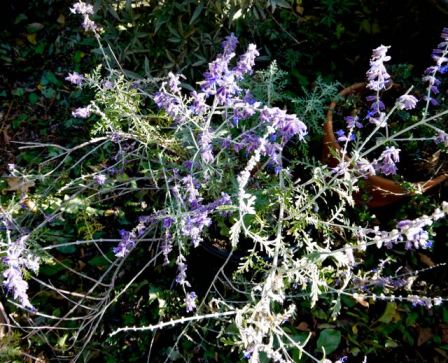
garden culinary russian sage nov 19 - 1

Culinary Russian Sage, back garden

garden back lantana nov 19 - 1

Lantana, back garden

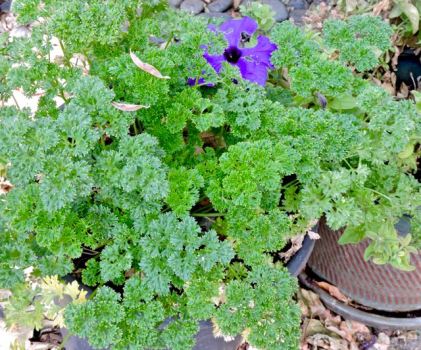
garden back curly parsley and lone petunia nov 19 - 1

Curly Parsley

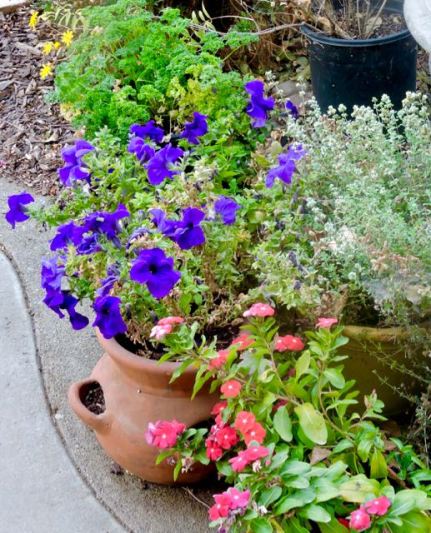
garden euryops parsley petunias vinca marjoram late nov 19 - 1

From top: Euryops, parsley, petunias, marjoram, vinca, back garden

garden front cut back bush sage late nov 19 - 1

Mexican bush sage, cut back for winter

garden front dianthus vinca late nov 19 - 1

Dianthus and vinca, front garden

garden through one meyer lemon late nov 19 - 1

Through the meyer lemon bush toward the back garden

garden through oranges w geranium pomegranate euryops etc late nov 19 - 1

Through the orange tree toward the hibiscus, spicy oregano, geranium, dwarf pomegranate, Euryops, back garden

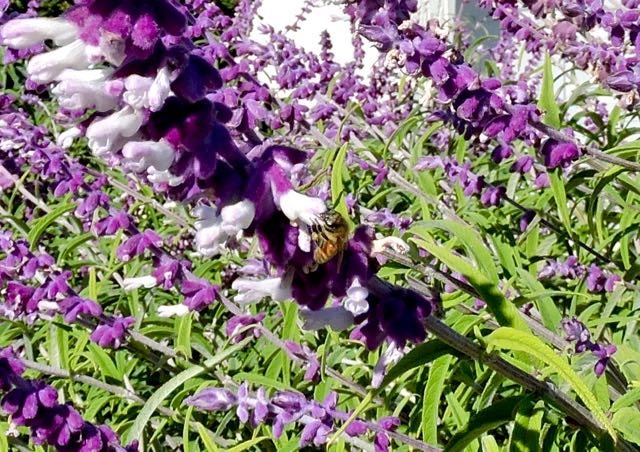
Late November coda, just before the rains…bees in the Mexican sage…

..and on to December…with hopes for more rain to forestall more fires this season.

October 2019: A Fan Palm and SummerFall

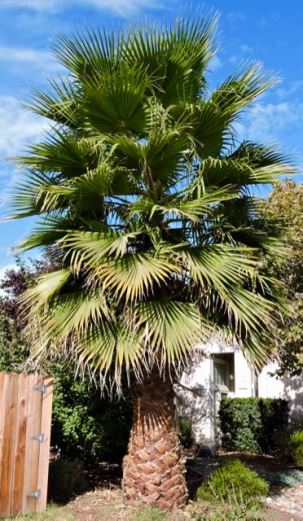
garden california fan palm canopy oct 19 - 1

Chris:

In April 2013, I added several new plantings to our front garden, including the two-feet high fan palm in the foreground of the photo below. The fan palm had been for the previous two years (2011-12) in a large pot on the back veranda.  The photo above is of that fan palm today, taken as I look up through the canopy of fans along the thick red-brown trunk covered in the sharp-toothed stems of the many fans I’ve trimmed off regularly over the last three years.

garden new palm planting apr 13

New plantings, April 2013

The photo below is also of that fan palm today, now well over twenty feet tall and growing upward about three feet per year.

garden front california fan palm oct 19 - 1

Hazards of Untrimmed Fan Palms

Notice how the fans toward the top are lush, firm, and deep green, while the lower fans are just beginning to dry out. If left untrimmed once these fans turn grey and hug the trunk, these dried fans will dry further–and will eventually fall to the ground, posing a hazard to any creature unlucky enough to be standing beneath. Communities across California, but mainly in Southern California, where the weather is most conducive to these trees, must keep their many palms trimmed to eliminate this danger.

But in Northern California, where palm trees are common but much less frequent, the same hazard exists, but we’ve noticed so often that property owners neglect the care of the trees–which often grow to 50 feet or more in height— and years of dried out fans hug the trunks and pose this silent threat.

An even greater threat from untrimmed, dried-out palm fans is that of fire. See this graphic 2008 brochure (and attached video) from the Escondido Fire Department in Southern California that describes the hazards–and offers advice that can help gardeners keep their palms healthy, safe, and looking beautiful.

SummerFall, 2019

In 2018, I drew a clear distinction between summer and fall in our post “Between the Seasons: September 20, 2018.” By October of last year, I had removed the summer veggies and was waiting to plant the fall veg. This October, the distinction is less clear: hence the term “SummerFall.” The back garden panorama just below shows what I mean:

garden back panorama 2 oct 19 - 1

(Click on the garden infographic oct 19  to see the plants labelled.)

Still thriving from the summer are the three pepper plants in the foreground and the arugula just beyond the petunias in the small raised bed. Brand new for October are

  • the three leaf lettuce plants hugging the ground and protected by screens
  • six stir fry broccoli plants in the small raised bed and just beyond (next to the arugula)
  • and four Swiss chard plants in pots (beyond the arugula)

As long as the daytime temps stay in the mid 70s to mid 80s, all these plants should continue to do well. Once the daytime temps fall below 70, the peppers will be done, but all the rest of the veggies will thrive through the winter. In the next few months, I hope to add several more winter veggies that I’ve had success with, such as radishes and onions.

Here are a couple of closer looks at the amazing pepper plants and a video of the thriving arugula with its bright yellow flowers and their attendant bees:

Notice the petunias and the newly planted stir fry broccoli plants beside the arugula.

Bees and Birds in the October Garden

Not only is the arugula attracting a small swarm of bees, but so are the Mexican sage and the blooming rosemary (below).

garden bee in rosemary oct 19 - 1

bees on rosemary

garden front fall blooming mexican sage w bee oct 1 2019 2 - 1

bees on Mexican sage

Among the birds that make music in our October garden are these two that I photographed this week:

garden warbler on peach tree oct 19 - 1

Warbler on peach tree

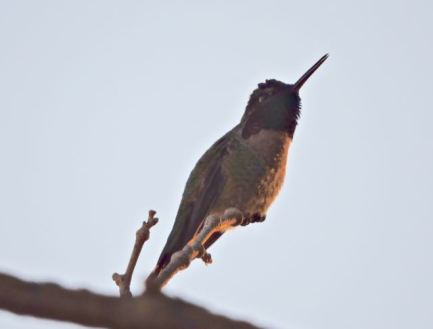
garden annas hummingbird on sycamore oct 19 - 1

Anna’s hummingbird on the sycamore

The Last of the Eggplants

Finally, the stalwart eggplants stopped producing in early October, but left behind some beautiful Black Beauty fruit that Jean continues to turn into luscious dishes, such as the crispy, rich tomato eggplant and cheese tart below:

kitchen eggplant tomato cheese basil tart oct 19 - 1

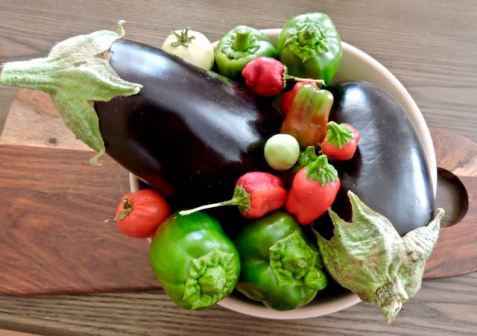
Here is my still life to honor these beauties, surrounded by some of the Cajun red  and mild red peppers and a pot of newly-planted leaf lettuce:

garden bowl display eggplants and peppers oct 19 - 1

The eggplants will keep fresh for still a couple of weeks more, so we’ll be enjoying home-grown summer eggplant into November.

Some More October Garden Views

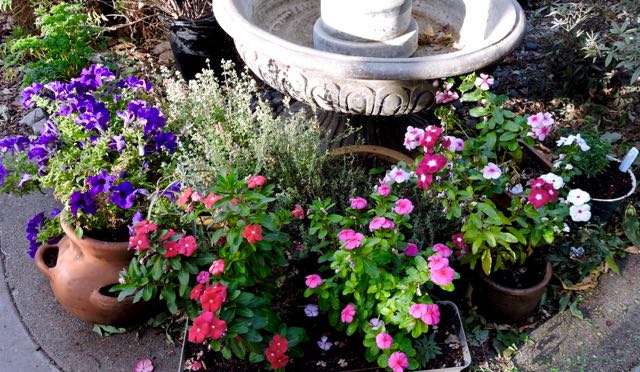
garden parsley petunias marjoram vinca thyme mint savory oct 19 - 1

L-R: Parsley, Petunias, Vinca, Marjoram, Thyme, Savory


garden back salmon roses oct 19 - 1

Salmon roses

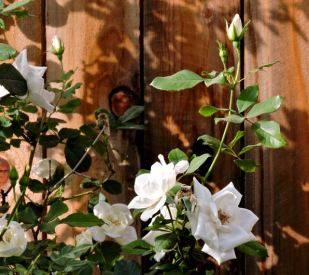
garden back white roses buds fence oct 19 - 1

White roses on back fence

garden side orange fuchsia oct 19 - 1

Orange fuchsia

garden side provence lavender oct 19 - 1

Provence lavender

garden lavender rose amid periwinkle oct 19 - 1

Lavender rose amid periwinkle, back garden

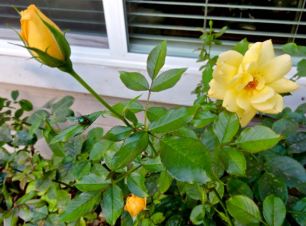
garden yellow rose and buds oct 19 - 1

Yellow roses


garden cabbage leaf butterfly on broccoli leaf oct 19 - 1

A pesky, but pretty cabbage leaf butterfly on a fresh, tasty broccoli leaf…

…which it loves as much as I do, and for the same reasons.

On to November, and with hopes for rain to forestall another terrible fire season.

September 2019: Finally the Eggplants!

kitchen eggplant pepper parmesan lasagna sept 19 - 1

Jean’s Eggplant Peppers Parmesan Lasagna

Jean:

Our oldest grandson had requested eggplant parmesan for his recent visit, so before our eggplants ripened, I bought one at a farmers’ market and started practicing the whole regimen of dipping the slices of eggplant in seasoned flour, beaten egg, and then bread crumbs and/or panko and frying them before covering them with tomato sauce and cheeses for the final bake.  The result was somewhat underwhelming.  I wasn’t sure if the defect lay in the eggplant itself or the method of preparation, but I knew that method was very time-consuming and messy.

When the eggplants from our garden were ready for harvest in September, I took one and decided to try an alternate approach.  I coated each side of each slice with about a tablespoon of olive oil and roasted them at 400 degrees for about 15 minutes, turning them over halfway.  I expected it to take longer, but I took them out when the outsides looked slightly golden brown and the insides were soft.  It was so easy and delicious that I decided to forget about the whole breading process, except that I saw a suggestion online to put some bread crumbs mixed with parmesan cheese on top of the whole pan after assembling the eggplant and sauce.  It also sounded easy and delicious.

However, since I always want to use up what I have in the pantry, and I had lasagna noodles, I ended up making a vegetarian lasagna, adding roasted peppers from the garden as well as eggplant in between the layers of noodles.  I still owe my grandson an eggplant parmesan, I think. But he loved the result!

My tip for lasagna noodles?  If you fully cook them before assembling them with the sauce and cheeses, they may be too soft to handle and tear easily.  I don’t like the supposedly pre-cooked noodles you can buy; they are still too hard on the edges, I find.  So I parboil the noodles myself.  When they look about half-cooked, I drain, rinse and oil them so they can cool off without sticking together while I assemble the other elements of the dish.  They finish cooking nicely as you bake the final assembled dish.  Just put the cheese on top toward the end of baking unless you like it more brown.

Chris:

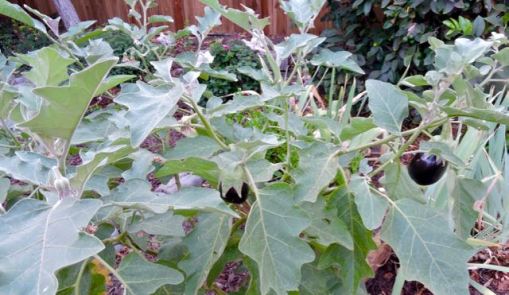
September ended just yesterday, and I will call it the month of the eggplants. Last year at this time (“Between the Seasons: September 20, 2018”) I sentimentalized about the end of summer. I had pulled out all the summer veggies except for two pepper plants that were barely hanging on–but as I looked beneath one of the eggplant bushes (little fingers variety) I actually discovered eight smaller fruit that I had missed! But it was too late for any more eggplants that still might have had a mind to grow. I had already pulled out the bushes.

This year, as I remarked in last month’s entry (“August 2019: July and Thensome”), had been a summer eggplant wasteland. Out of three black beauty plants, we didn’t get even one fruit until late July, despite many lavender flowers. I hoped that August would provide a “bumper crop,” but that was just wishful thinking. Only in the last week of August did a few buds start turning into tiny fruit.

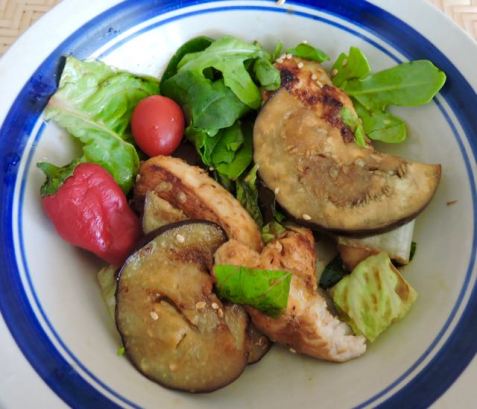
Well, September brought the windfall–close to a dozen huge beauties from the three plants, with half of them still on the bushes as the month ended. Jean’s eggplant peppers parmesan lasagna (described above) is just one of several dishes that have sparked her creativity in the kitchen. Here’s another of her creations: her chicken eggplant red pepper salad, a great blend of hot and cold:

kitchen eggplant chicken pepper salad sept 2019 - 1

How long will the eggplant last? I won’t make the mistake this year of pulling out the eggplants too early. I just saw another tiny fruit growing and there are many lavender flowers blooming. As long as the temps in the 70s hold, who knows how many more may appear?

garden 3 eggplants sept 19 - 1

You can see two fruit here, but more lurk below. And note the fat bud at left. That will be another fruit.

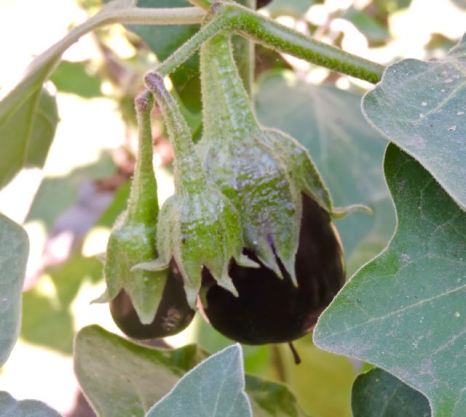
garden new eggplant cluster sept 19 - 1

This cluster of three is now weighing down their bush.

kitchen bowl of eggplant peppers tomatoes sept 19 - 1

These two monsters, plus the green and spicy red peppers in this bowl, have since been cooked into succulent dishes.

Peppers

Three plants–the mild red, the mild green, and the spicy cajun red–still thrive in the late September, early October garden.  Jean just put some into her beef chili, and they’ll be great in more eggplant parm and in the veggie hashes and salads like those we described above and last month in the blog. The cajun red is the champ of the group. You can see (below) all the green fruit still ripening toward red on the bushes today.

Unlike last year, when the last two pepper plants were just holding on in late September, these plants look good and fruitful for at least a few weeks, as long as the temps hold.

Late September Garden Views

garden panorama veggies flowers sept 19 - 1

With the tomatoes and cukes gone and the marigolds added, a different panorama of the back garden.

garden woodpecker on cherry plum sept 19 - 1

A rare visitor to the cherry plum tree: a Ladder-backed or Nuttall’s Woodpecker

garden aloe and flowers sept 19 - 1

Aloe, hibiscus, petunias

garden red rose cluster sept 19 - 1

The everblooming red roses on the back fence

garden baseball size oranges sept 19 - 1

Slowly and silently the orange tree grows toward December harvest.

garden petunias vinca parsley marjoram thyme oct 1 2019 - 1

Parsley, petunias, marjoram, thyme, vinca, basil

garden peace roses sept 19 - 1

Peace…and strawberries


garden strawberries sept 19 - 1

garden front fall blooming snapdragon oct 1 2019 - 1

Fall blooming snapdragons

garden front fall blooming mexican sage w bee oct 1 2019 2 - 1

Fall blooming mexican sage with honeybee


August 2019: July and Thensome

garden back petunias aloe vinca in pots late aug 19 - 1

Chris:

August used to be the summer month when people who couldn’t go on vacation in July went on vacation.  But now it’s what September used to be when our children were children: the month when the kids go back to school. We still find our semi-retired selves cheerily asking how the grandkids are enjoying their summer vacation, only to be told by whichever one we are talking with that “we are back in school,” said with a resigned tone that conveys their sense of the unfairness of it all.

I get the same resigned, nostalgic attitude from the citizens of the garden–at least some of them. They are not happy about August. It’s like an even hotter July, and really dull. At best, their growth keeps going at a good pace–such as the tomatoes and the cucumbers and the peppers, which fill our fruit and veggie bowl each week pretty much as they did in July:

kitchen pepper tomato one-week harvest late aug 19 - 1

But even these hearty souls are getting weary. The number of dried out, exhausted shoots and leaves is building, and when I look at the plants it’s as if I’m looking in the mirror: “Come on, old fella,” I think, “I know you’ve got some life left in ya, but not a whole lot.”

It doesn’t help that the heat is just as relentless as ever. The temps have been routinely in the 90s to just over 100, pretty typical for August, but creeping slowly higher with each passing year.  In our blissful little patch, it didn’t help that our neighbor decided in July to have his cherry-plum tree, which always gave some shade to our back garden, drastically cut back so that the hours of blistering sun increased by 50%. Believe me, it is no fun to stroll through the back garden on August afternoons this year. And I can go back inside. The plants in the ground can’t.

This old fella (yours truly) is stubbornly resisting watering more frequently or longer, despite the increase in heat.  I’m willing, curmudgeon that I am, to see how the garden reacts.  On the one hand, I must say that the tomatoes have handled the greater sun like troopers. But on the other, I won’t be having any of my tomatoes thriving greenly into mid September like my champion red grape tomato of 2018, which got plenty of shade on those blistering August afternoons. (See “Between the Seasons, Sept. 20, 2018”).

Of the 2019 group, the husky cherry red has held out longest:

garden husky cherry red tomatoes late aug 19 - 1

…and will probably be fruitful for about another week, to month’s end. But then, bye-bye.

The two Ace tomato plants (mid-size fruit) are still chugging along, too, with about ten more small green fruit having appeared in the past two weeks. But at this point, it’s a race between the plant’s urge to propagate and the strength it still has to take the fruit to full term. I’m thinking there’ll be some green fruit still on the withered vines when I pull them out.

Tomato Pests/Guests

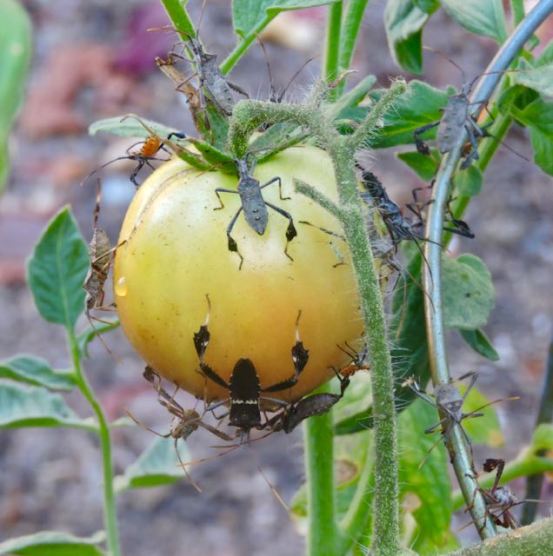
Another problem for the tomatoes is one that I’ve not seen before this August: an assortment of oddly-shaped and multicolored munchy bugs that just love the ripening tomatoes as much as we do. Study the photo below, if you have the nerve:

garden tomato bug medley late aug 19 - 1

See http://ipm.ucanr.edu/PMG/GARDEN/VEGES/tomato.html for descriptions and pictures of some of these and similar visitors.

Besides the groups already on the mid-size tomato, notice the lines approaching the buffet. Everybody gets a turn. Too bad for them, though, the buffet closes as soon as I flick the tomato a few times or throw an ounce or two of water on the fruit to wash the visitors off. Then I pluck the tomato for the fruit bowl, where it will ripen just fine, with little or no damage to the tomato–if I catch the bugs within a day of their attacking the fruit.

As I said, the problem never appeared before this year: that’s ten years of tomatoes with no pests. I will still not spray them with chemicals, as I never have. Besides, because my garden is small enough and the pace of tomato production slow enough, I can keep track tomato by tomato. But I’ll be on the lookout next spring and summer, so I can balance what we eat against what we leave for our “guests.”

What Loves August

Plenty of the plants in our garden love August, despite what I said earlier.  As long as they receive regular water, they can thrive in the heat. Here are a few, some in full sun, some in part shade:

garden back african daisies late aug 19 - 1

African daisies, back garden, full sun

garden baseball size tomatoes late aug 19 - 1

Baseball-size oranges, growing toward December, full sun

garden cajun red peppers late aug 19 - 1

Cajun red peppers, full sun

garden back petunias aloe vinca in pots late aug 19 - 1

Petunias, aloe, vinca in pots in shade, back garden

garden back egg-size meyer lemons late aug 19 - 1

Egg-size meyer lemons, growing toward December, full sun

garden fountain tomato herbs flowers medley late aug 19 - 1

Pots in part shade (L-R): cherry tomato, petunias (2), marjoram, thyme. vinca, back garden

garden back arugula late aug 19 - 1

Arugula, back garden, full sun

garden back baby lantana late aug 19 - 1

Lantana, back garden, part shade

garden front penstemon mesa gold gaillardia purple cockscomb late aug 19 - 1

L-R: Penstemon, Mesa Gold Gaillardia, Purple Cockscomb, front garden, part shade

What Did I Say about Eggplant in July?

Last month, I was bemoaning the slow development of our three eggplants, which usually provide a few fruit in late July and more into August and early September.  This year’s rains in May slowed the growth even more, and by the end of July, only one eggplant fruit had grown to harvest on the three bushes. I predicted (hoped?) then that we might have a “bumper crop” in August.

Well, that did not happen. Lavender flowers kept appearing and maturing, but none turned into nascent fruit.  Until, that is, the final week of the month. I’m happy to report that now we have several tiny, tiny fruit beginning to take shape across the three plants. Here is the largest of these–about 1.5 inches in diameter at this point. I’ll be monitoring them in September, and I hope will have good things to report in the next blog entry.

garden new black beauty eggplant late aug 19 - 1

Black Beauty eggplant beginning to grow, last week in August

Kitchen Treats

The steady stream of tomatoes, peppers, and cucumbers in August meant a bit more experimentation in our “test kitchen.” The July peaches had been pretty much all used up (see the July blog entry) or the cooked peaches frozen for later, so the August creations were variations on the veggies-plus-herbs theme. The two we describe here–

  • hot summer veggie hash, and
  • grape tomato salsa

use pretty much the same ingredients, but differ in cooking, texture, and uses.

Hot Summer Veggie Hash

kitchen late summer hot veggie hash late aug 19 - 1

Really a stir fry, this colorful “hash” features chopped-up red and green mild peppers, red onion, chopped cucumbers, and whole (not sliced!) cherry and grape tomatoes. Keeping the tiny tomatoes whole in the sizzling oil-prepped skillet or wok means the little fruits are ready to burst when you pop them in your mouth, and that hot burst of flavor makes the dish special.

The spicy “hot” in this summer veggie hash comes mainly from the red cajun peppers chopped into the mix. If you want it mild-to-medium spicy, be sure to cut away the seeds in the chopping process. As with all hot peppers, leaving in the seeds ramps the Scovil score way up, and you may not want that. But live dangerously, if that’s what you want.

What we recommend: when chopping the hot peppers, taste the flesh without the seeds to see how much of a burn you get. Then pop into your mouth a seed or two or three and see what happens. Consider how much heat you and your guests can stand and enjoy.  Just be sure not to touch your eyes with any fingers that were involved with manipulating those peppers.  The burn can be transferred even hours later.

Serving suggestions: Serve as either a side dish with meat and starches, or merely as a colorful, spicy garnish. It also goes well blended with roasted or hash brown potatoes.

Grape Tomato Salsa

kitchen tomato pepper cuke onion salsa late aug 19 - 1

As noted last month, if you make sauce from grape or cherry tomatoes, you have to contend with the hundred or more skins that peel off into the mixture as it cooks. If you don’t like the texture of the skins, you have to find a way–always tedious–to remove them during or after cooking.

Well, our salsa avoids that problem. After you’ve chopped up your tomatoes, mild and hot peppers, cucumbers, eggplant, onion, herbs, garlic, etc.–everything you want to throw in to make your special flavors–gradually spoon your mix of ingredients from your bowl into your blender. Don’t try to blend all of it at once. Experiment with small batches until, batch by batch, you get it all finely chopped.  How much blending you do depends on how chunky or smooth you want the salsa.

Once it’s all blended, you’ll have a beautifully wet, chunky, colorful, oh-so-fragrant mess that you can’t wait to pour into your saucepan and cook down.

The great thing about the chunky mess is that the skins of the tiny tomatoes will be tiny-tiny fragments that are just part of the blend.

(By the way, if you don’t want to cook it down, you’ll have a beautiful blend for a summer gazpacho! See “T Is for Tomatoes” and “S Is for Soups and Stews.”)

Your cooked salsa (ours cooked down on simmer in less than an hour) will be perfect for

  • chip dipping
  • pouring over meatballs
  • pouring over pasta
  • mixing into a chunky Bloody Mary

or any dish that can be enhanced with rich tomato, herb, and garden veggie flavors.

The Last Word?

garden salmon rose bud late aug 19 - 1

Yes, August does have its roses, too. See you in September!

July 2019: Hot, Dry–So What’s New?

kitchen july harvest display late jul19 - 1

Chris:

Summer is here with a vengeance, finally.

As recorded the past two months, the rains of May set back our harvest schedule by  almost a month, but this typically hot (90s to over 100), dry-as-a-bone July has us making up for lost time. The cherry tomatoes continue to ripen at a great daily rate (see the photos above and below), a dozen or two dozen a day,

while the two cucumber plants keep producing steadily.

garden cuke ripe jul19 - 1

Meanwhile, the three pepper plants–especially the cajun red–are producing fruit at a record rate for our little garden.

garden mild red pepper late jul19 - 1

Mild Red pepper

garden cajun red pepper late jul19 - 1

Cajun Red pepper

Even the Black Beauty eggplants are beginning to sprout fruit, a good month later than usual…

garden first eggplant late jul19 - 1

First eggplant of the year

…and I have hope for a bumper crop from the three plants in August.

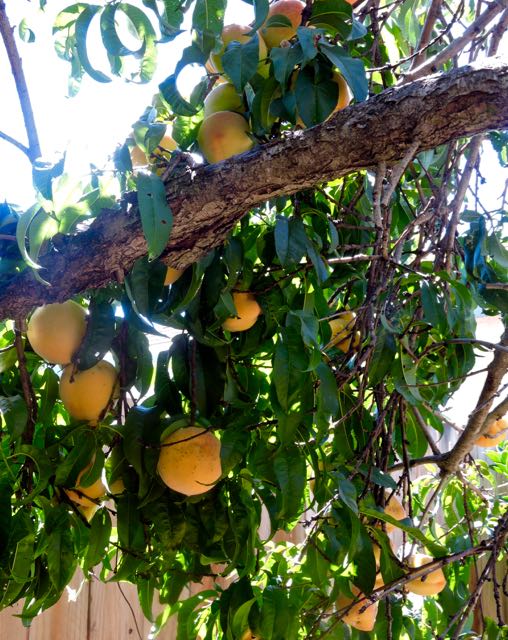
Peaches, anyone? But the big story for the end of July is the arrival of the ripe freestone peaches, a good month later than usual for the past several years. Now, of course, we are inundated, since peaches all ripen–unlike tomatoes–in a big bunch over ten days or so. If we don’t pick them and process them in one or more ways, they just wind up falling to the ground or being devoured by the birds (which we don’t mind at all).

So we chop as many as we can for freezing…

…eat them steadily as dessert or snacks,

…give them away to friends, and/or

…slice them into cereal, yogurt, or ice cream.

Some make their way into Jean’s pies and her blueberry peach muffins (see below).

What we try to avoid as much as we can is just chucking them into the compost bin (not a bad alternative, really), or, worse, watching them soften and rot on the counter or in the fruit bowl.

garden back peaches ripe on tree late jul19 - 1

Ripe peaches on our tree, late July

Jean:

Three Kitchen Treats

        Cucumber-Radish-Mint Salad

Thanks to Molly Yeh and the folks at the Food Network,

https://www.foodnetwork.com/recipes/smashed-cucumber-salad-with-mint-5543565

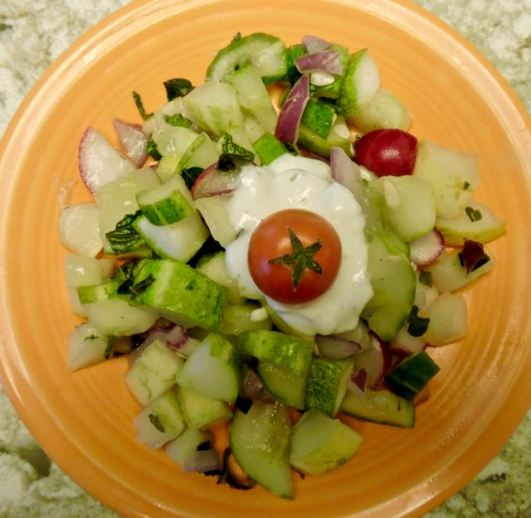
here is a tasty salad idea that highlights the cucumbers and mint from our garden. We chop the cukes (into half-inch wedges) rather than “smash” them, and we used the spices we have on hand rather than buy the more exotic elements (like za’atar) that Yeh recommends. Still, the blend of cukes with salt, black pepper, spicy radishes and red onion, plus the tang of the lemon juice (you can also use vinegar) with the bold freshness of the mint, makes this an ideal July treat to serve alongside any meat dish–or eat as the main dish itself.

We put all the veggie ingredients in a bowl, toss thoroughly,

…add the mint, toss again

…then add the lemon juice, the salt, the black pepper, and spices, and toss thoroughly again. Feel free to add more salt, pepper, and spices until you achieve the desired taste.

We added plain yogurt as a topping and cherry tomatoes as a garnish both for color and sweetness.

kitchen cuke radish mint herbs salad late jul19 - 1

Tomato,Veggie, Herb Sauce for Pasta

This one is about as simple as you can imagine. What you mainly need is patience as the mixture cooks down on low heat, with you stirring occasionally to keep it from sticking.

It’s a tasty way to use all those accumulated cherry or grape tomatoes. Wash them and be sure to pull out the tiny stems before you plop them into the water (a couple cups) in a large saucepan.  Bring to boil, then reduce to simmer or low.

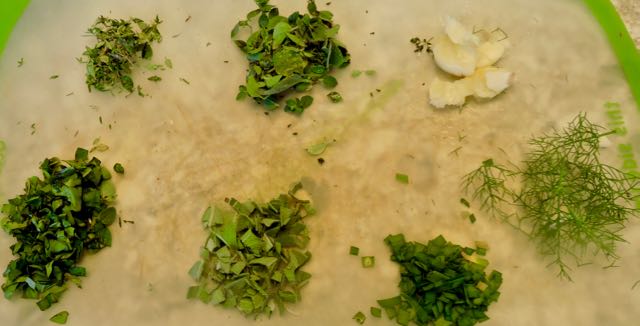
While the water is heating and the tomatoes begin to soften, chop up your garden herbs, plus a yellow onion and a couple cloves of garlic. We used Italian basil, Greek oregano, fennel, thyme, chives, and marjoram, as you see below…

kitchen chopped herbs garlic for sauce jul19 - 1

…but feel free to throw in other savory herbs you have in your garden or pantry.

Add the herbs to the cooking tomatoes, plus salt, black pepper, baking sugar (just a bit, for balance with the savory flavors), and other spices you desire.

Saute the onion and garlic, plus any other veggies you choose, like green pepper, cucumber, or zucchini, in a kind of skillet stir fry…. Cook until the onions are translucent.
kitchen onion garlic veggie stir fry late jul19 - 1

Then join all the ingredients in the saucepan; continue cooking on low. As the tomatoes cook, you may want to add more salt, pepper, and spices to taste. If you’d like to throw in some red wine, go ahead. It’s all up to you.

The key is to keep cooking until all the tomatoes have separated from the skins. This will take an hour or more, so be patient. Stir occasionally. Taste as desired. (If you’re like us, you’ll taste pretty often, because the aroma is so tantalizing.)

Once the skins have separated, you can pull them out with metal tongs. We always get a lot of them out, but some stay in and that doesn’t bother us in the slightest.

We used this batch with spaghetti, with polenta, with rice, and even with scrambled eggs. Again, whatever your taste thinks will work together.

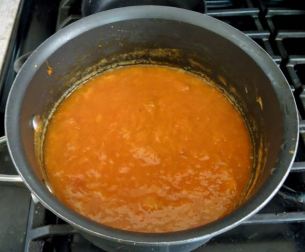
kitchen cooking tomato herbs sauce jul19 - 1

Blueberry Peach Muffins

With visits from kids and grandkids coming up this summer (including one visit later this week), we wanted these on hand. They’re great either just from the oven, or out on a plate for snacking–or thawed out from the freezer later on.  Here’s the article we used as a guide:

https://www.allrecipes.com/recipe/35815/blueberry-peach-muffins/

but, as you know, we always feel free to make adjustments, depending on what we have on hand.  Instead of all AP white flour, we substituted half a cup of white whole wheat flour and half a cup of instant oatmeal for a cup of the AP flour.  we had some slightly soured milk to use instead of fresh milk, so we added a little (1/2 tsp?) baking soda to sweeten the milk.  For further sweetening and moistening, we threw in 1/2 cup chopped banana with the other fruits, and finally sprinkled some chopped pecans on top.  Oh, and some cinnamon sugar.  Very nice.


kitchen blueberry peach muffin late jul19 - 1

A Few More July Bright Spots in the Garden

garden back ace tomatoes ripe late jul19 - 1

Ripe Ace Tomatoes

garden lavender rose late jul19 - 1

Lavender Rose


garden side fuchsia and lavender late jul19 - 1

Fuchsia and Lavender

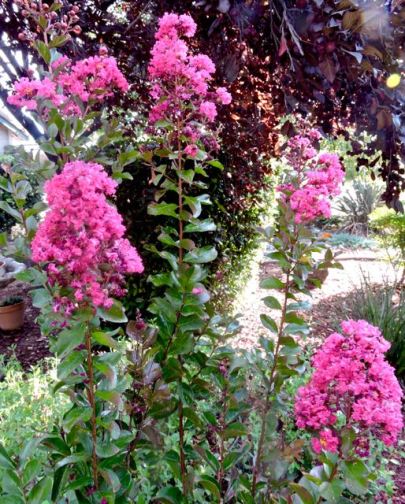
garden crape myrtle late jul19 - 1

Crape Myrtle

garden back young lantana late jul19 - 1

Transplanted Lantana

…And a Busy Friend Poses on a Nearby Tree

garden annas hummingbird late jul19 2 - 1

Anna’s Hummingbird

On to August!


June 2019: First Heat, Late First Harvests

garden bluegray gnatcatcher art jun 19 - 1

Chris:

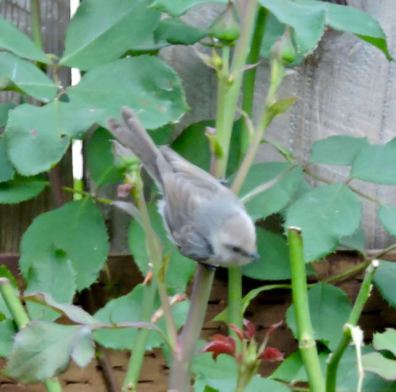
One early June morning, I was studying the tomato plants for new fruit and the health of the leaves, when I was suddenly surrounded by a chattering flock of tiny blue gray gnatcatchers. They flew-hopped from plant to plant, especially on the red and white rosebushes, looking for food. I barely had more than thirty seconds to converse with them in my poor imitation of their call before they told me that I didn’t have what they were looking for, and whoosh! they were gone again, taking their chatter elsewhere in the neighborhood and then, presumably, far away, to their preferred summer climate in the mountains (according to National Geographic’s Birds of North America).

Jean and I had seen them the day before from our vantage point in the kitchen, and they had stayed long enough for me to get a few snaps through the sliding glass doors. Ah, serendipity! They have not returned and I don’t know when they will, since they don’t stay long in our hot Valley climate.

garden bluegray gnatcatcher jun 19 1 - 1

The gnatcatchers’ quick visit has been just one of several unexpected events this June, which followed on the very unexpected cool raininess of May (see the May 2019 post). Yes, finally summer appeared in the form of several 100+ days this month, and a solid two weeks above 90, but the growth delay in May has kept some of the plants still well behind schedule.

Some of the most notable laggards are the apricots, the cherry plums, and the peaches.

kitchen apricot jam cooked down jun 19 - 1

kitchen apricots cut up for cooking jun 19 - 1

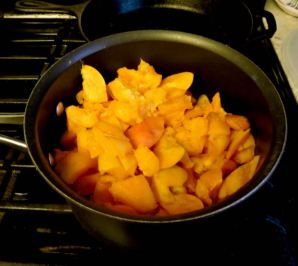
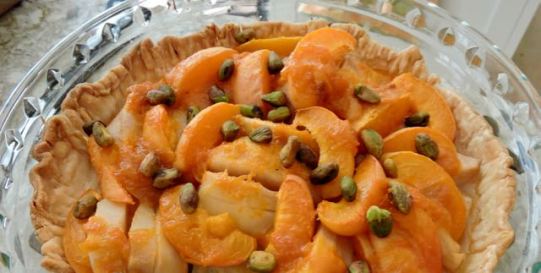
The apricots finally came in during the first week in June–2-3 weeks behind schedule. As noted in last month’s blog, there were many fewer than in 2018, about fifty in total. But they were no less sweet and firm when harvested, and made five 10-ounce jars of our jam (see photos of the cooking above), plus more than enough for apricot muffins and Jean’s apricot-pistachio tart (below):

kitchen apricot pistachio tart jun 19 - 1

The cherry plums in the most recent five years have been ripe and ready for picking by early June. But this year the abundant fruit finally was ripe in the final week of June and I picked them on the 26th–with some of those harvested just barely soft enough to pluck off the two trees, the one in our side garden and the other leaning well over our back fence from the neighbors’ yard.

In stark contrast with the low apricot volume, this year’s abundance of cherry plums was overwhelmingly greater–in the thousands–than in any year since we’ve been here. For the first time in our dozen years, I was able to harvest all the fruit we would need for our annual jam making–about 400–by just standing on the ground and plucking the literally low-hanging fruit. No step ladder needed.

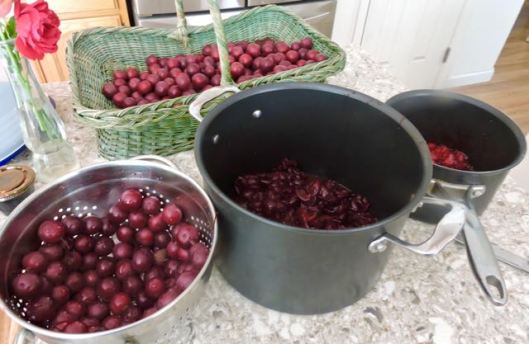
As in all previous years, pitting and then cooking down the plums is a several-hours job. Here is my setup for that operation:

kitchen 400 plums w colander and boiling pots jun 19 - 1

As I write this post in the middle evening, the cherry plums–with sugar, water, some apple juice, and fruit pectin all added to desired taste and texture–is still simmering away on the stove. The fruity fragrance fills the house…

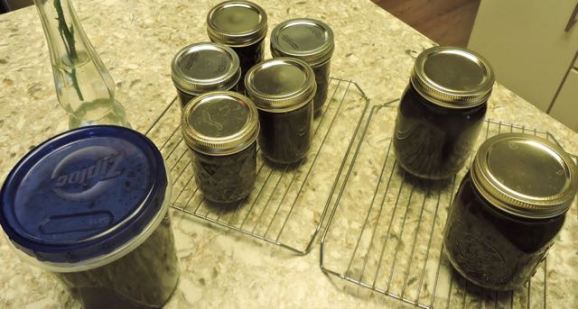
…Now, here’s the finished product the next morning, after we’ve sterilized the jars and lids:

kitchen finished cherry plum jam containers jun 19 - 1

Peaches: Slow Growing and Being Cooked

The peaches are nowhere near ready for harvest, and were the most delayed by the cool May. Last month’s golfball-size fruit are now closer to tennis balls, but they are also still tennis-ball green and as hard as baseballs. At this rate, I’d give a ballpark estimate of the end of July for harvest–a good month later than the 2018 crop.

But speaking of peaches, Jean dug out our frozen peaches from last summer’s bounty and just made her delectable peach “dump” cake–as well as other goodies she describes below…

Jean:

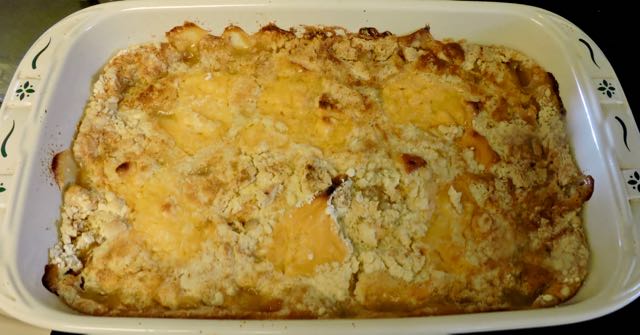
kitchen peach dump cake jun 19 - 1

Peach “Dump” Cake: Don’t be fooled by the name!

Knowing that our peaches were still far from ripe, but wanting to make some summer peachy dishes, I found a large container of last year’s peaches that were still in the freezer.  I used them to make peach smoothies and peach yogurt muffins for breakfast, throwing a few blueberries into each of those.

I found this lovely peach yogurt recipe:

http://www.maysquared.com/blog/peach-and-blueberry-greek-yogurt-muffins/

As the author allows, and as I often recommend in this blog, I swapped some things out.  I used whole wheat flour, almond flour, and oat bran in place of some of the white flour.  I had peach yogurt and used some of that in place of some of the Greek yogurt, and I used apple juice in place of orange because that’s what I had.

I found these substitutions didn’t make much difference in the texture, but maybe that was because I had both more moisture from the regular yogurt and more binding from the heartier dry ingredients.  Anyway, we got both a moist crumb and a slightly crunchy top—perfect!

Peach Dump Cake (Hate the name, love the cake)

After the muffins and smoothies, I still had left over from the frozen peaches the equivalent of a large can of peaches in syrup, so I made my own version of Ree Drummond’s “dump cake”:   https://www.foodnetwork.com/recipes/ree-drummond/dump-cakes-2576003

I wonder why it has such an unattractive name, but I figure it is because you simply dump all the elements into the baking dish and you’re good to go.  None of the usual mess of baking a cake, leaving sticky measuring cups, spoons, beaters, and bowls around the kitchen (to Chris’s chagrin).

So after retrieving my favorite 13×9 inch dish, preheating the oven to 350 (using the convection option), and dumping in the remaining sliced defrosted peaches, I sprinkled the contents of a pineapple-flavored cake mix I happened to have (plain yellow cake is also very good), and then put bits of butter everywhere, as the recipe calls for. I baked it for about an hour.

Here’s the thing.  The dry cake mix may not all be absorbed in the liquid; you may have some dry bits, which would horrify me if it were just flour, but have you tasted dry cake mix?  It’s delicious.  I also worried about so much butter, so I used mostly unsalted butter (the one stick, with a half stick salted) for fear of salty cake, but somehow all the butter and the bits of dry cake mix leave the impression of streusel, so the overall effect is more like a crumble than a cake.  Very peach-forward.  Yum.

Chris:

Tomatoes, Peppers, and Cukes

All three of these annual stalwarts have been in-ground since April 10 or so. They were delayed somewhat by the cool May, but not like the stone fruit. Indeed, once we hit the mid to high 90s this month, they took off and have been steadily producing.

garden 1st ripe sun golds of season jun 19 - 1


garden first ready cherry tomatoes jun 19 - 1


The tomato stars, as usual, have been the cherry tomato varieties, the one husky cherry red (above right) and the two sun gold (above left). Of the several hundred fruit growing at any one time, I can count on a dozen to be ripe each day for snacking, sandwiches, or stews and chilis. As the heat intensifies, so does each day’s production. Though each plant is caged, the shoots go up and out and everywhere (below).

garden 3 cherry tomato plants jun 19 - 1

The great success of the cherry tomatoes has created a dilemma for me. Much less early and prolific in our garden are the mid- and large-size tomatoes, with this year’s candidates being Ace and T-67. This comparative lack of performance has been an every-year pattern, and so I’m thinking of sticking only with–and expanding the number of–the cherry varieties next year. (Stay tuned.)

Peppers. This year’s three plants–a mild green, a mild red, and a Cajun red–also sprang to life when the heat hit, and all three have made up for lost time in May. The potted mild green has been especially sprightly (below left)…

kitchen large green peppers jun 19 - 1kitchen cajun peppers jun 19 - 1

but the Cajun red (right), which of course begins as green, may soon surpass its neighbor in putting out new fruit.

Cucumbers. Last season’s Burpless cukes were so successful and tasty that they’ve now become a staple.  (I might go back to zucchini next year, too–see “Z Is for Zucchini”–if I want to engage with that adventure in mass productivity again, but for now the cukes are plenty prolific for us.) I love how the cukes grow quickly and steadily, and how I need to peek under the canopy of leaves to see the dark green fruit in the shade. Both of the two plants have been productive.

Pickling. As last year, we pickle most of the cukes, and they disappear during the ensuing months. I never realized how easy pickling is, and this year both of us have been varying the pickling mixtures. Jean has used a Japanese-inspired light covering of white vinegar and salt, while I’ve experimented with a spicy blend of oil, vinegar, salt, Thai chili pepper, and a touch of sugar.

The photo series below shows the simple stages of the prep for the latest cuke, from the garden to the pickle jar.

Another cucumber delight. Slightly more ambitious for the cukes is homemade tzatziki sauce, a staple of Greek cuisine and one of my favorites. There are many slight variations online, but they share many of the same ingredients. For mine, I used chopped up cukes from the garden, folded into Greek yogurt, thinned with a bit of milk, and into which I squeezed lemon juice. Then I sprinkled in salt, black pepper, and garlic powder.

Play with the ingredients until you get the taste you like. If you want to blend in some herbs, like basil, oregano, thyme, etc., go right ahead. It’s all about desired taste and whatever you have on hand or just outside in the garden:

kitchen homemade tzatziki sauce jun 19 - 1

Use it as a salad dressing or as a topping for meats or cooked veggies.

Eggplant. Always the latest fruiting of the summer veggies in our garden, the Black Beauty eggplants (3 of them) have spent June leafing out splendidly and producing lavender flowers in the past two weeks. None of these flowers has as yet become a dark purple fruit, but that’s typical. It’s usually late July before we get our first Black Beauty (or one of the other varieties I often plant). The fruit like to hide beneath the broad leaves that give cool shade to the fruit, so leafing is the job of the plant in June (below).

A Few Other June Treats

garden back panorama jun 19 - 1

As the old song says, “June is bustin’ out all over,” and it’s not just veggies that take off in the heat. Here are a few of the other garden highlights that shine beginning in June:

garden back season's first lavender roses jun 19 - 1

Lavender roses, back garden

garden front season's first red day lily jun 19 - 1

Magenta day lily, front garden


garden side blue nile lily 2 jun 19 - 1

Blue Nile lily, side garden

garden back peace rose w wisteria jun 19 - 1

Peace rose and very late blooming wisteria in background, back garden

garden late june new blooms on meyer lemon jun 19 - 1

Very late blooming meyer lemon and grateful visitor, back garden

garden side crape mytle and provence lavender jun 19 - 1

Crape myrtle and Provence lavender, side garden

garden front yellow roses after April cutback jun 19 - 1

Season’s second explosion of blooms on yellow roses, front garden

garden carpenter bee on lupine jun 19 - 1

June-blooming lupine bush and carpenter bee, back garden

garden orange dragonfly on tomato cage jun 19 - 1

Dragonfly on tomato cage, a favorite perch in the hot June sun, back garden

And on to July…


May 2019: A Rainy Surprise and Cooler Temps

garden back rain panorama may 19 - 1

We had a small rain the first week in April and nothing since. Everyone figured that the rain year was over. Fine. We’d had a good rainy season, over 24 inches, 8 more than 2017-18 and about 6 above average. April was a booming, blooming month (see last month’s post, April 2019) and we were all set for a sunny May with temps in the 80s. Perfect for the April-planted veggies and the baby fruit.  I’d brought out the cushions for the outdoor furniture and turned on the automatic twice-a-week drip irrigation.

Then came the middle of the month. Over four days, 2 inches of rain. In the past week, another 1 inch plus: overall, a record in the Sacramento region for May. Plus temps struggling to reach 70.  While in the Sierra, new snow fell, up to twenty more inches in the highest passes. Predictions were made of the ski season lasting into July!

In our little garden, the drip system was again shut off, and the cushions went back into the garage. Meanwhile, in the San Joaquin Valley to the south, the cherry farmers, who’d been getting set for a mammoth harvest of rich red bings, saw tons of fruit fall to the ground and more rot on the trees.

In California, all weather news is a mixed message: rain in May means that perhaps the fire season will be delayed; but it also means that crops about to be harvested may fail and new crops won’t grow as they would in the hot sun.  The ski operators love it; the reservoir operators fear over-capacity and downstream flooding as all that Sierra snow melts.

Conversely, below normal rain threatens the water supply for everyone and everything, but it reduces the fuel supply in fire-prone forests. Californians, as I’ve learned, can adapt, if they are willing, to almost any extreme of the weather, but pretty much they (we) would prefer that things stay about average–with all the threats and joys that average entails.  We’ve built up stout defenses for the threats, so we can keep our brightest expectations.

In our little garden, the May surprise means that the forecast I made in April was wrong. “The apricots,” I announced, “will harvest in May.” Well, here are the apricots now:

garden side apricots not ready for harvest may 19 - 1

versus where 2018’s were exactly a year ago:

garden apricot bountry on tree may 27 18 - 1

In contrast, last year’s cherry plum harvest was about average in volume and timing (mid-June). This year, the volume of fruit far exceeds anything we’ve seen in the thirteen years we’ve been in California, with clusters weighing down the branches all over the tree:

garden side ripening cherry plum clusters may 19 - 1

Look closely to see how many plums are hidden among the leaves.

…but it remains to be seen if the hard little spheres will soften in time for the annual mid-June gathering we make for our cherry plum jam.

Also responding to this year’s copious rains are the peaches, which developed from the tiny green babies I photographed in late April to the plentiful fuzzy green golfballs on their way to harvest in early July:

garden back green peaches against cherry plum tree may 19 - 1

Last year’s harvest of 60 will be dwarfed by this year’s–unless extreme weather intervenes!  The number of growing fruit this year is greater than in any of the most recent three seasons. Branches broke under the weight of more than 200 peaches in 2016, but the record rains of spring 2017 destroyed the buds and the tree produced no fruit. (See “A Month in the Life” for July 2018.)

Oranges and Meyer Lemons. Unlike 2017, when the record rains caused the orange tree to lose most of its infant fruit in April, this year’s May rain caused fewer than a hundred of the babies to fall, leaving what appear to be hundreds more on the tree and growing to grape size at present:

garden back baby oranges in clusters may 19 - 1

garden back new meyer lemons may 19 - 1The meyer lemons, about a week behind the oranges, also came through the surprise rains of May mostly unscathed and are growing abundantly.

The New Veggies and Fruit (all planted early April)

Tomatoes. Four varieties this year (7 plants): Husky cherry  red, Sun Gold (grape), Ace, T-67. Five of the seven have tiny green tomatoes growing amid the yellow flowers, with the Husky Cherry Red leading the way:

garden back husky cherry red tomatoes on vine may 19 - 1

Peppers.  Three varieties, three plants: Cajun red (mild spice), red mild, green mild. All have white flowers, but only the mild green (in a pot) has small growing fruit. The low temps have kept it from growing more quickly.

Eggplant. Three plants of the Black Beauty variety. Each has grown steadily, about 2-3 time the size of the seedlings, but, again, the lack of higher temps has kept growth slower than usual. Eggplant are usually slow in producing ripe fruit, with later July the usual time in this garden.

Cucumbers. As in 2018, we have two plants of the Burpless variety planted 4 feet apart for cross-pollination.  Some slower growth due to lower temps, but each has numerous yellow flowers and tiny starter cukes, but only one plant has a larger cuke growing (about five inches).

Blueberries. As with the cucumbers, we have two plants about 3-4 feet apart for cross-pollination. Both are healthy, but growth above ground has been minimal so far. Fed weekly with Miracid.

The photo below shows the array of peppers, cukes, and tomato plants in late May:

garden back five tomato varieties and peppers cukes eggplant may 19 - 1

Foreground, from left: red pepper, Cajun red, T-67 tomato; row 2, from left: mild green pepper (in pot), cucumber, cucumber, leaf lettuce; in cages in background: Ace, T-67, Sun Gold, and Husky cherry red tomatoes.

Herbs in May

Of those shown below, fennel is a first-timer in our garden.

garden back russian sage lupine mint fennel oregano basil may 19 - 1

From left: Russian sage, mint, lupine, fennel, Greek oregano, sweet basil

Of those shown below, watercress is a first-timer in our garden.

garden back herbs in pots may 19 - 1

From left, in pots: parsley, marjoram, English thyme, leaf lettuce (front), watercress, Italian basil, chives

Flowers and Flowering Bushes

The most dramatic May event has been the swarming of Painted Lady butterflies on the Escallonia fradesii (Pink Princess) bush in our front garden. Enjoy the video!

The painted ladies are especially plentiful this spring, for the first time since we’ve been here. Too bad that no other butterflies, except the occasional yellow swallowtail, have visited the garden so far this season. It’s been several years since we’ve seen a monarch, which are now nearing extinction on the Pacific coast–thanks to neonicotinoid pesticides and habitat destruction. Gone are the days when the monarchs in migration literally covered the eucalyptus trees in Pacific Grove in February. We got to see that one time after we moved West, and it’s a treasured memory.

While this rainy, cool May has not provided the same display of colors that April did, our garden never fails to show off in some spots:

garden side garlic daylilies blue nile lily may 19 - 1

Garlic, Daylilies, and Blue Nile lilies in the side garden

garden back peace roses against wisteria may 19 - 1

Peace roses in the back garden

garden side heavenly bamboo flowers may 19 - 1

Heavenly bamboo in the side garden

garden side white thornless rose cluster may 19 - 1

White thornless roses in the side garden

garden front mexican bush sage abloom may 19 - 1

Mexican bush sage in the front garden

garden front wandering jew in wine barrel may 19 - 1

Wandering jew (Tradescantia pallid) in a wine barrel

garden front snapdragons and arugula may 19 - 1

Snapdragons in the front garden

garden front all my loving roses against cherry plum may 19 - 1

All My Loving roses against the cherry plums in the side garden

garden front new zealand flax blooms in yr 4 may 19 - 1

New Zealand flax blooms in the front garden

garden back jasmine in bloom beneath orange may 19 - 1

Jasmine in the back garden

Now, on to June!